Home Blog Page 4

Defending 5A champs face demanding road slate in 2026 football schedule

0

JT Keith

The 2026 football schedule is out for the defending Class 5A state champions, and the schedule gods did not do Artesia any favors. If the Bulldogs want to bring home state title No. 34, they are going to have to earn it the hard way — with long road trips, tough turnarounds, and only four home games on the regular-season slate.

A road-heavy path

Artesia opens the season Aug. 21 at home against Carlsbad in the Eddy County War, before hitting the road in back-to-back weeks against Hobbs and Centennial. The Bulldogs return home for consecutive games against Deming on Sept. 11 and Gadsden on Sept. 18, with the Gadsden matchup set to serve as homecoming.

That two-game homestand is about the only extended comfort the Bulldogs will see. After that, Artesia returns to the road for games at Alamogordo and Chaparral before an open date on Oct. 9.

District play closes with Roswell at home, followed by road trips to Goddard and Mayfield to finish the regular season.

That makes for a brutal travel itinerary. Artesia will be on the road for consecutive weeks three different times, starting with Hobbs on Aug. 28 and Centennial on Sept. 3. The Bulldogs hit another two-game road swing with Alamogordo on Sept. 25 and Chaparral on Oct. 2, then end the regular season away from home at Goddard and Mayfield.

For a defending champion, it is the kind of schedule that can harden a team early — but it also leaves very little room to coast.

JT Keith | Artesia Daily Press
The Bulldogs celebrate after the last play of the game.

Realignment impact

Bulldogs coach Jeremy Maupin said the latest football realignment did not drastically change Artesia’s path in southeastern New Mexico, even if it shuffled a couple of names on the schedule.

“We just plugged Alamogordo into Lovington’s spot,” Maupin said. “Also, Chaparral into Santa Teresa’s spot. The north gets a lot more competitive with Cibola, Los Lunas and Piedra Vista coming in.”

“Those are three teams that made the 6A playoffs,” he said. “I think it will make the northern district a lot more competitive when you add in Highlands and Los Alamos and those guys.”

What it means for Artesia

For Artesia, the focus will stay local and immediate. The Bulldogs know every week will bring a target on their back after winning the 5A title, and this schedule gives them plenty of chances to prove they can handle that pressure away from Bulldog Bowl. If they navigate the mileage and come out healthy, the road-tested version of Artesia could be even more dangerous by November.

JT Keith | Artesia Daily Press
Artesia fans cheer and throw confetti after the football team’s win against Roswell.

2026 Artesia Bulldogs football schedule:

Aug. 21 — Carlsbad, 7 p.m.

Aug. 28 — at Hobbs, 7 p.m.

Sept. 3 — at Centennial, 7 p.m.

Sept. 11 — Deming, 7 p.m.

Sept. 18 — Gadsden (homecoming), 7 p.m.

Sept. 25 — at Alamogordo, 7 p.m.

Oct. 2 — at Chaparral, 7 p.m.

Oct. 9 — Open

Oct. 16 — Roswell, 7 p.m.

Oct. 23 — at Goddard, 7 p.m.

Oct. 31 — at Mayfield, 1 p.m.

jtkeith can be reached at 575-420-0061, or on X@JTKEITH1.

Victor Davis Hanson: America is not caught in a ‘Thucydides Trap’!

0

The distinguished political scientist Graham Allison, author of the 2015 Atlantic article “The Thucydides Trap,” argued that often in history an established power will stage a preventive war against an ascendant adversary–for fear that otherwise it will soon lose its primacy.

His title derives from two passages in the first book of the ancient Greek historian Thucydides (460-400/395? BC), author of “The Peloponnesian War.”

Thucydides, on these two occasions, felt that the most likely cause of the Spartan-Athenian war (431-404) was Spartan fear of an increasingly powerful rival Athenian empire. That anxiety supposedly prompted a Spartan preventive invasion before, so Sparta believed it would be insidiously eclipsed by its more dynamic Athenian competitor.

Allison and others argue that this paradigm now applies to the United States. It is the supposed jittery established power–and a rising Communist China is the upstart contender. His theory implies that the U.S. might, like Sparta, take provocative steps to abort an inevitable Chinese-dominated world.

There are, however, a number of problems, ancient and modern, with Allison’s intriguing thesis.

First, Thucydides left his history unfinished and unrevised. And so often he offers analyses that are contradicted by his other observations elsewhere in history.

For example, in a variety of passages, the historian contrasts the antithetical Spartan and Athenian systems. He does this to explain why they often fell into disputes even before the Peloponnesian War–such as after their shared successful effort against the Persians (480-479) and during the prior fifteen-year conflict, the so-called “first” Peloponnesian War (460-445 BC).

Sparta was oligarchic, Dorian, and an infantry power. It was a parochial landlocked society, overseeing a vast population of enserfed helots. Athens, in contrast, was radically democratic, Ionian, and slave-owning, with a huge navy and maritime empire. It was as cosmopolitan a city as Sparta was a closed society.

So there were many long-standing, deeply rooted differences that sparked tensions and war, besides the Spartans’ fear of Athenian expansionism.

Moreover, the time-honored hegemon Sparta won the war, as do most such established superpowers.

The centuries-long dominance of the British Royal Navy explained why Britain was able to stop the upstart Hitler’s blitz and planned invasion of Britain. The economy and resources of the established U.S. took only four years to crush the aspiring new hegemon, imperial Japan.

The same was true in the Cold War, when the U.S. wore down a supposedly ascendant Soviet Union.

Often, it is not even the traditional superpower that instigates the wars that they win. It is just as common in world history for a would-be new power to initiate hostilities or launch a war against a traditionally dominant nation. Compare the foolhardy conflicts that they often lose, like the wars, either hot or cold, that would-be hegemons Germany, Japan, and the Soviet Union all started against the dominant U.S.

Moreover, great-power rivalries between a veteran powerhouse and a newcomer often never result in war. The U.S. gradually replaced the British Empire in the postwar era as the global policeman without a war. Britain and France peacefully accepted the “German miracle” of postwar West Germany’s ascendance as Europe’s dominant economic power.

A better prognosticator of the likelihood of war, ancient and modern, is whether the adversaries’ political, economic, and cultural systems are similar or antithetical. If they are different, the chances of war between such opposing systems mount. (Contrast Athens and Sparta, Nazi Germany and Britain, imperial Japan and the U.S., etc.)

Finally, how does the supposed “Thucydides Trap” apply to the U.S. and China?

Despite the recent summit hype, not at all.

America is the traditional global power but is also radically ascendant; China is the upcoming challenger but is currently stumbling.

In all the key indicators–oil and gas production, food self-sufficiency, fertility, innovation, weaponry, constitutional stability, personal freedom, university STEM programs, naval carrier groups, air power, nuclear arsenals, space exploration, GDP per capita, and alliances–America continues to widen its advantages.

Thus, the U.S., as the status quo superpower, has no need to launch a preventive war against a struggling China.

Why?

One, Beijing is not ascendant vis-a-vis America in the key areas that count.

Two, both countries are nuclear powers, and neither wishes Armageddon.

In sum, there is historically no universal “Thucydides Trap” phenomenon of asymmetrical rivalries leading inevitably to war.

The titular “trap” is not even a complete analysis of all the major causes of the Peloponnesian War, as outlined by Thucydides himself.

Moreover, ascendant powers start as many wars as do fearful, stronger, and established nations. And the upstarts more often than not lose their risky gambits against the established powers.

So, we are not caught in a “Thucydides Trap.” We can prevent any challenges from a weaker China from escalating to war through deterrence, alliances, maintaining a balance of power, occasional respectful negotiations–and our far greater power and resilience.

(Victor Davis Hanson is a distinguished fellow of the Center for American Greatness. He is a classicist and historian at the Hoover Institution, Stanford University, and the author of “The Second World Wars: How the First Global Conflict Was Fought and Won,” from Basic Books. You can reach him by e-mailing authorvdh@gmail.com.)

A Love Letter to the Bowl: Waiting for August

0


JT Keith

You just do not know who you are yet, or what you truly mean to the people of Artesia.
Right now, the Bulldog Bowl sits in a rare, heavy silence. The orange gates are locked, and the artificial turf—this place that Mack Chase helped to build, a ground soaked in championship tradition, is empty.

We miss you on Friday nights just as much as you miss us. This isn’t a ghost story, though the echoes are there if you listen. This is a love letter to a place that shouldn’t be able to love us back, yet somehow, it does. Every Friday night, the Bulldog Bowl opens its arms and reminds us of who we are.

In this town, Friday night isn’t just a date on a calendar; it’s a shared breath. It is the only event in town. If a robber were looking to commit a crime in Eddy County, Friday night would be the time to do it. The Sheriff is at the Bowl. The Artesia Police Department is at the Bowl. They’d probably just look at the crook and say, “We’ll catch you later, the Dogs are in the red zone.” Or perhaps the crooks love the Bulldogs too much to interrupt the game; they’d likely wait until the final whistle to do their deeds.


The outside of the stadium is beautiful in the moonlight, a quiet fortress waiting for its army. There is a specific “Artesia Orange” that seems to glow differently under the stadium lights than any other color in the world, casting a warm hue against the walls. Under the watchful eye, the players compete beneath the gaze of every state title team; their helmets are mounted on the wall, each marked with the year they brought the trophy home. It’s a reminder that 33 times before, the job was finished—and we are looking for No. 34.

We aren’t just waiting for a game; we are waiting for the community to come back together and greet each other as old friends do. We’re waiting for the players to walk up and down the Winner’s Ramp. We’re waiting to see that massive Capital A—the one that requires four people to steady it, with kids climbing onto shoulders just to hold it high enough for the players to jump up and touch. We want to watch them sprint toward those old-school paper signs the cheerleaders spent hours making—the sound of that paper tearing as the team breaks through and the season finally begins.

We cannot wait for that first Dog Pile of the year. We want to see the fans on both sides cheering as players slide through and jump high, fighting to be at the top of the pile. In that moment, we will finally know that football is back.


Pretty soon, on August 21, we will be here for you, and you will be here for us. We will welcome each other back home to the place where we have created—and will create—so many more memories.

Until then, thank you for waiting. We’ll see you under the lights.

jtkeith can be reached at 575-420-0061, or on X@JTKEITH1.

Catfish, sunfish, trout, bass highlight New Mexico’s fishing waters this week. Here is the latest fishing report

0

June is here and for many in New Mexico, summer vacation means heading to one of the state’s popular fishing spots.

In eastern and southeastern New Mexico, at Greene Acres Lake near Clovis, fishing for catfish was fair to good using hot dot dogs. Fishing for bass was fair to good using Tequila Sunrise Berkley Power Worms on jig heads.

Fishing for catfish was fair to good when using hot dogs.

In Lincoln County at Bonito Lake, fishing for green sunfish was good using PowerBait.

Along the Pecos River below Sumner Lake, fishing for largemouth bass was particularly good using swimbaits and topwater lures.

At Sumner Lake, walleye fishing was slow to fair when using neon diver lures.

In southwestern New Mexico, fly fishing for trout was good at Whitewater Creek. Bait fishing for trout was slow to fair using PowerBait at Glenwood Pond.

East of Silver City at Lake Roberts, fishing for crappie was fair to good using lures.

At Quemado Lake, trout fishing was exceptionally good using salmon eggs and PowerBait.

In northern New Mexico at Cochiti Lake, fishing for carp was fair to good using corn. Fishing for northern pike was slow to fair using crankbaits and cut bait.

Fishing for rainbow trout was incredibly good using worms, cowbells, and spinners at El Vado Lake.

Along the Rio Grande near Taos, fishing for trout and smallmouth bass was fair to good using PowerBait.

At Ute Lake, fishing for smallmouth bass was fair to good when using shad-colored Bass Pro Shops XPS Staredown jerkbaits.

At Seven Springs Kids Pond, fishing for trout was very good using corn and PowerBait.

This fishing report has been generated from the best information available at the time of publication.

Cal Thomas: Fraudsters run amok as little has been done to solve it

0

At first, it didn’t sound right. Someone must have miscalculated. How could there be so much fraud that has robbed taxpayers of billions of dollars without anyone seeming to notice? Worse, it appears they didn’t seem to care.

Vice President JD Vance convened a meeting on Tuesday of his Task Force to Eliminate Fraud. Fifteen Republican attorneys general showed up. Almost two dozen Democrat attorneys general didn’t come, citing short notice. Their invitations went out on Friday, so they probably had a good excuse. Vance urged all of them to help in rooting out more fraud than has so far been discovered. So many administrations have talked about fraud, but seemingly have done little about it, until now.

According to Vance, taxpayers across the country were defrauded of billions of dollars by unscrupulous scammers. Vance said the number will likely be higher as investigations continue. One optimistic note. Vance said $160 billion has been “clawed back,” which doesn’t always happen in such cases.

Vance said more than $22 billion has been recovered from small business loans and transferred to the Treasury Department. He said more than $1.3 billion in fraudulent Medicaid reimbursements has been recovered. As previously disclosed these included fake hospice care facilities, many of which were in Los Angeles and other California cities. Vance also said: “We’ve recovered taxpayer funds from the $135 billion stolen after the floodgates were opened in the immediate aftermath of COVID.”

Vance also announced $6.3 billion has been recovered from fraudulent government contracts which “were mostly rewarded during the (Biden) administration. And finally, he said the task force has blocked $60 million in student aid fraud.

Fraud is not a victimless crime, Vance said, because it robs people who should be getting help, including needed medical aid.

The first question that should come to mind from these revelations and accusations, is where were the inspectors general in these states and at the federal level? Why did no one appear to notice? Probably because it wasn’t their money being wasted. Look at the defensive posture of Minnesota Governor Tim Walz and his attorney general, Keith Ellison. Both made initial statements they knew nothing about fraud in their state. They sounded like piano players in a brothel who claimed not to know what was going on upstairs.

DOGE – the Department of Government Efficiency – began to unveil some of this fraud, but it takes a much larger effort than Elon Musk and his crew of volunteers were able to achieve.

One other point. The fraudsters revealed a complete lack of conscience as they stole money that was supposed to help people, especially those in physical need. Is this another consequence of our failure in too many cases to impose a moral and ethical standard, beginning in schools?

An ancient proverb says: “Where there is no revelation (or vision), people cast off restraint.” (Proverbs 29:18)

It also makes one wonder whatever became of shame?

Look for Cal Thomas’ latest book “A Watchman in the Night: What I’ve Seen Over 50 Years Reporting on America” (HumanixBooks).

Election Day is June 2. Here is a guide to get you prepared.

0

Eddy County voters will choose multiple local and statewide candidates for the General Election on Nov. 3 during the Tuesday, June 2 Primary Election.

Primary voters will choose party nominees for county commission seats, county sheriff and magistrate judge, along with governor, lieutenant governor and seats in the New Mexico Legislature.

New Mexico’s runs closed primary elections, meaning only those registered with a particular party are allowed to vote for that party’s nominees.

This year is the first where voters registered as Independent can choose a ballot for either of the major parties.

Polls close at 7 p.m., June 2 throughout the county.

Here’s what to know and who is on the ballot in Eddy County.

Where to vote on Election Day

Artesia

Faith Baptist Church

401 S. 20th St.

Eddy County Sub-Office

602 S. 1st St.

Central Valley Electric

1403 N. 13th St.

Trinity Temple Church

16th & Hermosa

Loving

Loving School Administration

603 W Cottonwood

Carlsbad

St. Peter Lutheran Church

1302 W. Pierce St.

Lakeview Christian Home

1300 N. Canal St.

VFW

1916 San Jose Blvd.

Hillcrest Baptist Church

605 N. 6th St.

JMA

500 W. Church St.

Clerk’s Office

325 S. Main St.

Eddy County Fire Service Center

1400 Commerce Dr.

Otis Community Center

2513 Bannister Rd.

Who’s on the ballot?Local contested Races

New Mexico Representative, District 66

Republicans

Trinidad Malone

Dan Lewis

County Commissioner, District 1

Republicans

Austin Washburn

Henry Casteneda

County Assessor

Democrats

Gemma Ferguson

Republicans

Rhonda Hatch (Incumbent)

Melissa Washburn

Statewide Races

U.S. Representative District 2

Democrats

Gabe Vasquez (Incumbent)

Republicans

Greg Cunningham

U.S. Representative District 3

Democrats

Teresa Leger Fernandez (Incumbent)

Republicans

Martin Zamora

U.S. Senate

Democrats

Ben Ray Lujan (Incumbent)

Matt Dodson

Republicans

Larry Marker (write-in)

Governor

Democrats

Deb Haaland

Sam Bregman

Republicans

Gregg Hull

Doug Turner

Duke Rodriguez

Lieutenant Governor

Democrats

Maggie Toulouse Oliver

Harold Pope

Republicans

David Gallegos

Manuel Lardizabal

Aubrey Blair Dunne

Vote for Artesia’s All-Time Top 100 Football Players

0

JT Keith

Artesia, football season is coming fast. The Bulldogs will face Carlsbad in just 86 days to start their highly anticipated 2026 season, as grueling two-a-days begin officially on July 6.

The hot summer air will soon carry the familiar sounds of sharp whistles, crashing shoulder pads, and the undeniable energy of a community completely united by a single gridiron goal.

As Artesia chases another blue trophy and adds to its unmatched state title count (33), the Artesia Daily Press is diving deep into comprehensive football coverage this summer.

 We are launching an ambitious project to celebrate the rich, unmatched history of this powerhouse program, and I want your direct help to build a definitive list of the top 100 Bulldogs football players of all time.

The goal here is simple: honor the gridiron icons who built Artesia football’s proud legacy and tell their incredible stories the right way.

This program has spent decades establishing a rigorous standard of excellence. You can see that history plain as day on the facility walls, where a football helmet hangs to honor every single state championship season, proudly displaying the year the Bulldogs brought the blue trophy home.

 We want to celebrate the elite athletes who earned those helmets and defined generation after generation of unforgettable hometown talent. From the fierce defensive stalwarts who completely shut down opponents on Friday nights to the explosive playmakers who lit up the scoreboard and left defenses grasping at air, every single era of Bulldogs football has its unique heroes.

We want to make sure absolutely no deserving player is left behind in this count, which is why this comprehensive list needs to be shaped directly by the diehard fans, families, and community members who witnessed this greatness firsthand from the stands.

Whether it is a star from the historic championship squads of the mid-20th century or a more recent standout who left everything on the field just a few seasons ago, we want to hear from you.

Please send your personal nominations, along with your favorite Friday night memories, key statistics, or brief stories about why these men belong on the ultimate all-time list, directly to my email address.

Let’s work together as a community to create a lasting, definitive tribute to the Bulldogs who defined what it truly means to wear the orange and black. Get your votes in early, let the fierce debate begin, and let’s honor the tradition that makes Artesia the greatest football town in New Mexico.

Let the feedback begin.

Wildlife Department reminds boaters to clean, drain and dry to keep harm out of New Mexico’s waters

0

Clean, drain and dry: these three words represent requirements for boating in New Mexico and preventing the spread of aquatic invasive species.

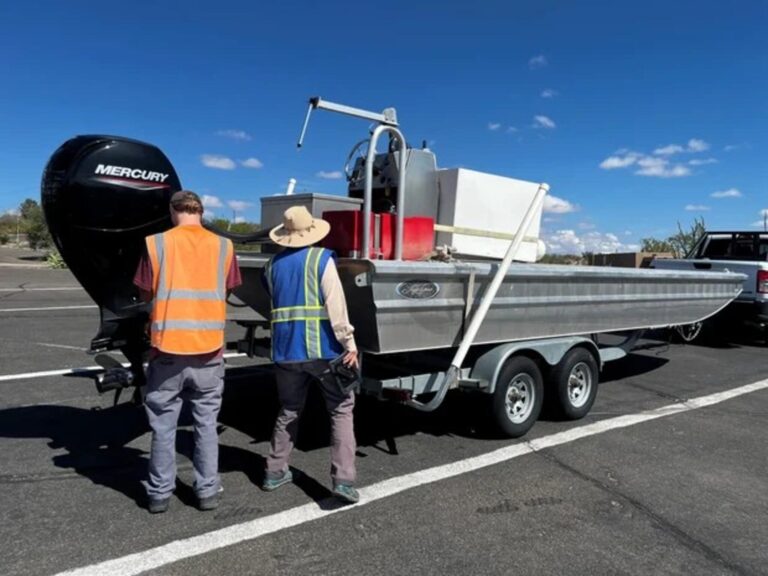
The New Mexico Department of Wildlife, along with New Mexico State Parks, the U.S. Fish and Wildlife Service, the U.S. Army Corps of Engineers, the U.S. Bureau of Reclamation and other stakeholders are asking boaters to stop the spread of harmful invasive mussels. Boaters should be prepared for mandatory inspections throughout the state designed to help ensure that New Mexico’s waters remain mussel-free, according to a Department of Wildlife news release.

An Aquatic Invasive Species (AIS) is any non-native plant, animal or pathogen that can harm our economy, environment and the health of humans, animals or plants. The New Mexico Department of Wildlife, along with state, federal and private partners, are working diligently to stop the spread of AIS.

“Trying to keep AIS species out of our waterbodies is a big task, but with the public’s help, it is much more achievable. Each boat owner we can converse with allows us to teach proper ‘Clean, Drain, Dry’ techniques and provide education information that can be passed on to others,” said James Dominiguez, aquatic invasive species coordinator for the New Mexico Department of Wildlife.

Of particular concern is the invasion of New Mexico’s lakes and water by zebra and quagga mussels. The spread of these mussels not only poses a risk to the state’s native aquatic wildlife, but also to all water-based recreation, including boating and fishing, as well as to all surface water delivery systems, including municipal water supplies, hydroelectric power generation and irrigation for farming and agriculture.

Currently, there is no known method for successfully eradicating these mussels, resulting in enormous management costs that could be passed along to New Mexicans. In a water-dry state like ours, mussel infestations can affect everyone. This is why it is unlawful in New Mexico to knowingly transport AIS into or within its borders.

All boats are required to stop for a free inspection when check stations are in operation. All out-of-state boats or any boats re-entering the state must obtain an inspection prior to being launched or exposed to any waterbody in the state. The Department is manning inspection stations at several

lakes this summer in partnership with other agencies, including Navajo, Elephant Butte, Ute and Conchas lakes.

Democratic Gov. candidate Haaland shares vision for New Mexico as primary nears

0

Deb Haaland, 65, of Laguna Pueblo, served as the 54th United States secretary of the Interior from 2021 to 2025 after being appointed by President Joe Biden in 2020 and confirmed by the U.S. Senate in March 2021. She became the first Native American to serve as a cabinet secretary and the second to serve in the cabinet. She also served as the U.S. representative for New Mexico’s First Congressional District from 2019 to 2021.

She attended law school at The University of New Mexico in 2006 and was working on completing her master’s degree in American Indian Studies at the University of California, Los Angeles, while serving as the interior secretary.

El Rito Media sat down with Deb Haaland to discuss her vision for New Mexico, should he be elected governor.

What are your plans for K-12 education?

“I’m glad the governor and legislature got early childhood learning across the finish line. I want children to read sooner because it’s a foundation of learning, so we want to launch reading coaches into classrooms and help teachers identify the students who need that one-on-one help. If kids can learn to read sooner, they can learn how to do math sooner, they can learn to read, they’ll have the confidence to move forward, so ultimate goal graduating more kids from our public schools and helping them to have more opportunities when they graduate from high school. We also want to bring trades back to the schools in a big way, have career path recognition in middle school and hands-on training for high school, for kids who want to be an electrician, go into carpentry and I want to implement outdoor learning.”

What are your spending priorities for New Mexico?

“I can’t speak to cutting or eliminating, right. You hope that you have enough money to make sure all the important things are happening, but I know that we have a nice education budget already, so maybe it’s just moving budget items around. But I really want the reading coaches in classrooms, I really want the outdoor learning piece to public education and working with the unions to have trades in the schools. And then of course, healthcare is a big issue. There’s a few folks who want to explore a public option for New Mexico, the Medicaid cuts the Trump administration has implementing across New Mexico is really putting a lot of fear and worry into the people across the state and couple that with all the SNAP benefit cuts and making people re-certify every six months for these programs they need and deserve will be very challenging and so we want to make sure people have the healthcare that they need.”

What is your tax policy for individuals and companies and are you in favor of reducing, changing or eliminating GRT?

“Everybody hates GRT, so I feel we need to have conversations about that. I know some municipalities rely on that tax that comes in, so we’ll have to have a lot of conversations, namely about GRT and medical services. Some people feel if we’re trying to recruit and retain doctors and medical professionals here in New Mexico, that we need to change the GRT on medical services. I’d also like to explore tax rebates or tax credits for doctors who work on their own, have their own family practices and things of that nature. Because those are the types of doctors that we want to be in rural communities, so we want to enhance the child tax credit and the working families tax credit, but certainly nobody likes GRT so I’m sure there’s some way we can have those conversations and come to some sort of understanding how to change that.”

What are your plans for reducing homelessness and drug abuse?

“More rehab centers, more behavioral health dollars sent to substance abuse, helping people to become sober. We visited a rehab center just this week, very successful. They need to expand and there’s already people doing that work. There’s already quality companies doing that work, so how can we expand locations, helping people to find opportunities. We need rehab centers in tribal communities as well. They’ve come to us and stated that to us many times. We need more behavioral health professionals in our public schools, too. We went to Las Cruces and visited Community of Hope, it’s so wonderful. We need 20 Communities of Hope around New Mexico. It’s wrap-around services and I think we have people who know how to get services for folks and I feel like thats a good way to go. And veterans integration center was a really good one. They bring veterans in who are unhoused and they give them what they need immediately and then they follow them and help them access the benefits they deserve, open bank accounts, get a job if that’s the case and then they follow them after they move out of the veterans integration center. They’re not alone for months and months, it’s a six-month program. So I feel like those are all programs that work.”

What can New Mexico do to be more attractive and competitive for new businesses?

“I mentioned the site readiness fund that would go for medical facilities, but also for small businesses. We need a one-stop shop for small businesses can go and do everything at one place instead of going to one department for this and another department for that. It sometimes gets confusing and it’s difficult. Training, there’s arts and crafts people all over our state’s pueblos and in our rural communities. How can we help them get online with the things they sell. We need to make sure that people have access to the Internet or they have opportunities to learn how to build a website and so forth. The opportunity scholarships are very much in favor of enhancing, if people want to change careers midway, so whatever we can do to help folks get the training they need and certifications they need.”

Do you approve of data centers?

“We need to be concerned about water, we’re in a high desert in the middle of a climate crisis. I’m not quite sure how the data centers are dealing with the water issue. You hear they’re only going to use a small amount, they’re going to have closed loop systems, but then you hear the closed loop systems need to be flushed every now and then and that water is not usable after that. I feel the public is not informed about, they’re not transparent on how they’re going to use our natural resources. In New Mexico, we have a goal of zero emissions by 2050. As a state, if we have zero emissions by 2050 we all have to assent to that goal. Data centers haven’t been transparent. We need to have guardrails, any industry that comes to New Mexico, they have to be sustainable, we don’t have water to burn here.”

How can environmental concerns be addressed?

“The Trump administration has no regard for our environment here, so they’re moving those things forward (uranium mining in the Carson National Forest). I think people need to keep speaking out. New Mexico has scars all over the state. I’m from Laguna Pueblo, the largest open pit uranium mine in the state for 30 years. Uranium blew around for 25 years before they came and cleaned it up. We have so much legacy pollution here that it’s still making people sick. I’m not in favor, we need to clean up the mess that we started and the federal government is responsible for so much of that and yet they are talking about reopening a wound that so many people are still suffering from and still have trauma over. I feel that here in New Mexico, people’s health comes first. A place like the Carson National Forest, you feel alive in a place like that and they want to have a uranium mine there. I’m against that. For any of these things, San Ildefonso pueblo is right there (near Los Alamos National Laboratory). They need to consult with other tribes in the area (regarding the plans for plutonium production at LANL). This is the ancestral homeland of the pueblo people. If I’m the next governor, I’m going to press them to make sure they are actively doing tribal consultation because that isn’t happening with the Trump administration. The tribes have a real say in what happens on these lands.”

“Our top four policy pillars are: education, healthcare, public safety and affordability, when I first launched my campaign, those were the four things people were talking about. Whatever we do, we have to ensure that New Mexicans can sustain themselves, that they have healthy food to eat, that we are meeting the moment because right now Donald Trump is making New Mexican sicker, hungrier and poorer. I feel that any government needs to care about it’s citizens and that’s one of the main reasons I’m running for governor.”

New Mexico in Depth report: Hidden donors fuel New Mexico primary ads through nonprofits. Here are more details.

0

This story originally appeared in New Mexico In Depth at nmindepth.com.

Two political groups spending heavily in New Mexico’s primary elections have found a way to keep their donors hidden. Whether the arrangements comply with state law is unclear.

The setup is an example of what political spending watchdogs call “gray money,” where a nonprofit gives money to a political committee, or PAC. Under state law, the PAC has to disclose the nonprofit as the source of money it’s using in its efforts to influence elections.

The term “gray money” refers to political spending that is only partly transparent — visible up to the nonprofit, but not beyond it to the original donors. The people who gave money to the nonprofit stay hidden from public view.

The twist here is that the two PACs and their nonprofit donors have reported enough information to raise questions about whether the PACs themselves formed the nonprofits in order to keep their donors hidden.

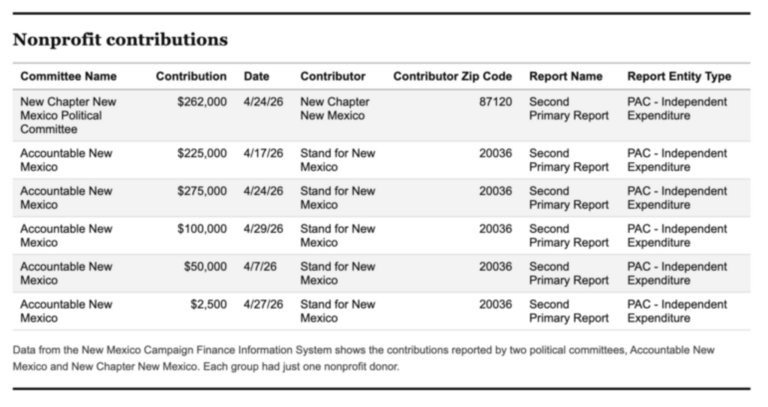
One PAC that was created on March 3, Accountable New Mexico, has reported receiving $650,000 from a nonprofit called Stand for New Mexico, which incorporated March 2. The nonprofit was the sole donor reported in its second primary disclosure. The political group and the nonprofit share a treasurer, Alyssa Brooks, and a Washington D.C. address.

Brooks did not return a phone call or respond to an email from New Mexico In Depth asking about the nonprofit’s donors.

Accountable New Mexico has spent heavily on negative television ads targeting former Interior Secretary Deb Haaland, who is running against Bernalillo County District Attorney Sam Bregman for the Democratic nomination for governor.

Bregman spokesperson Joanie Griffin said in an email that the campaign has “no idea” who funds the nonprofit.

“The campaign has no relationship nor communication with Accountable New Mexico,” she wrote.

Another political group, New Chapter New Mexico, is similarly relying on one nonprofit for its funds. Its entire $262,000 came from a nonprofit that shares its exact name, New Chapter New Mexico, and its mailing address.

New Chapter’s treasurer, Greg Gallegos, ran as a Republican against Democratic Rep. Marian Matthews in 2024, a race he lost. In 2026, the group’s disclosure reports note spending on advertising to support Matthews and seven other Democrats in legislative races, as well as a payment of almost $7,000 to Gallegos’s firm, KGH Strategies, for “compliance consulting.”

Gallegos did not respond to a phone call or email from New Mexico In Depth. He has also created another PAC called Back Forty New Mexico, listing himself as treasurer. Back Forty has not yet filed disclosure reports. Videos supporting seven of the eight candidates that New Chapter is supporting can be seen on youtube channels of Back Forty and New Chapter.

These arrangements have raised questions about whether the nonprofits were created by the PACs they are funding, given their shared officers, addresses and, in one case, the same name. State law prohibits making contributions “with an intent to conceal the names of persons who are the true source of funds used to make independent expenditures.”

Whether the nonprofits themselves are required to disclose their donors depends on how they are classified under state campaign finance law.

Nonprofits whose primary purpose is raising or spending money to influence elections can qualify as political committees, a designation that triggers stricter donor disclosure requirements.

But if political activity is not a nonprofit’s primary purpose, the organization is required to disclose only the donors who funded political advertising it paid for directly, rather than all donors to the organization. And if a nonprofit gives money to a PAC instead of paying for ads itself, as in these two cases, it is not required to file reports identifying its donors at all.

It’s unclear if these two nonprofit’s primary purpose is political activity. The groups’ IRS Form 990 tax filings may provide insight into that question because the filings show an organization’s overall revenue and spending, allowing the public to compare those figures with campaign finance reports and determine whether most of the groups’ money was spent on politics. But those records may not become public for more than a year — well after the June 2 primary election.