El Rito Media News Services
SANTA ROSA — If cattle could learn the limits of their grazing area with collars that would give warnings and shocks instead of requiring barbed-wire fences to stay in bounds, it might mean better cattle location and management, and less expense for ranchers.
That’s the idea behind “virtual fencing,” a concept that is being tested in Guadalupe County through the Guadalupe Soil and Water Conservation District (GSWCD) with a $99,992 grant from the New Mexico Department of Agriculture.
An audience of about 150 persons heard about this project and several others on Sept. 18 at the GSWCD’s annual meeting held at Santa Rosa’s Blue Hole Convention Center.
The district took no action at the Sept. 18 annual meeting. Cordova said the main purpose of the meeting was to inform district farmers and ranchers about progress on various projects.
There are 40 cows and 1,760 acres participating in the virtual fence program, GSWCD chair Vincent Cordova wrote in an email to The Communicator.
“Our goal is to have 1,000 cows and 30,000 acres in Guadalupe County under this program,” he added, and the state “has given the opportunity to the GSWCD (to) lead the state in the implementation of this technology.”
Rose Fernandez, district manager, on Sept. 23 invited more farmers and ranchers in the district to participate in the project.
Another grant-funded project for GSWCD involves a proposed aerial drone assault on invasive mesquite trees with an $81,125 Land of Enchantment Legacy Fund grant.
The purpose of the project is “to prove that drones and satellite technology can be effectively utilized to eradicate mesquite in small difficult access areas,” Cordova wrote. “We have already sprayed 1,300 acres and the results are incredibly positive.”
The drone effort is similar to a project aimed at eradicating water-robbing salt cedar and Russian olive growth in the district. This project is funded by a $250,000 Water Trust Board Grant, Cordova wrote, and is also designed to promote the growth of the Pecos sunflower.
Other projects discussed included:
Healthy Soils Seed Program – designed to improve soil conditions by providing cover crop seed to district farmers. Funded by a $100,000 state Department of Agriculture grant.
Capacity Building Grant – designed to improve organizational capabilities. Cordova said the district is hiring a field operations specialist for archaeological field work support, virtual fence program monitoring, drone operator capabilities and equipment operations. The grant is for $160,000.
Pintada Watershed Restoration Project – designed to restore the watershed of the Pintada Arroyo in Guadalupe County. The project’s total funding is less than $2.9 million, and sources include $219,010 from the state Department of Agriculture, $400,000 from the state Water Trust Board, $234,250 from the National Association of Conservation Districts, and $2 million from the federal Natural Resources Conservation Services.
New Agricultural Center – funding design of a new regional center which will house the GSWCD office, as well as the local federal offices of the Farm Service Agency and Natural Resources Conservation Services. It is funded by a $365,000 capital outlay appropriation though the New Mexico Legislature.
Cordova said the district has an operating budget of just over $4 million for the current year, compared to about $50,000 a decade ago. The district’s work, he said, was recently recognized at the annual meeting of the National Association of Conservation Districts in Salt Lake City.
Speakers at the district’s annual meeting included state Sen. Pete Campos, who delivered the keynote address, state Rep. Martin Zamora and state Rep. Rebecca Dow, who also serves as deputy executive director of the New Mexico Association of Conservation Districts.
All three “recognized the work of the Guadalupe Soil & Water Conservation District and pledged their continued support for the work that still needs to be done,” Cordova wrote. “All of these people have been key supporters of the agriculture in this community for the past several years.”
The district’s annual Rancher of the Year award was presented to the Carlos Armendariz family, Cordova wrote, “in recognition of their outstanding leadership, stewardship, and dedication to the land, livestock and legacy of ranching in New Mexico,” including their adoption of virtual fencing.
The family’s eldest son, Jovani Armendariz, served in Iraq, and later earned a degree in veterinary medicine from Texas Tech University. The younger son, Jim Armendariz, received an engineering degree from New Mexico State University and now works with the U.S. Department of Agriculture “helping shape the future of our district,” Cordova said.
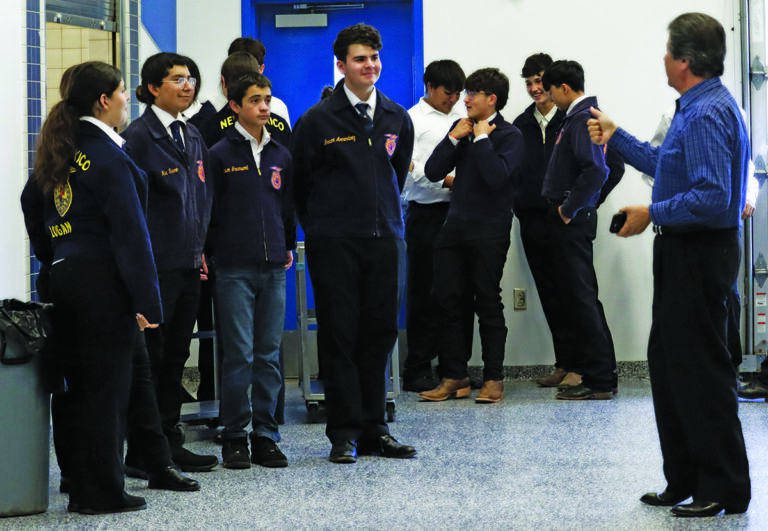
Fernandez added a “thank you” to the Santa Rosa High School FFA members who helped serve dinner for the annual meeting.