Adrian Hedden
Artesia Daily Press
achedden@currentargus.com
A contractor hired to oversee nuclear waste disposal near Carlsbad will continue running the facility for the next three years.
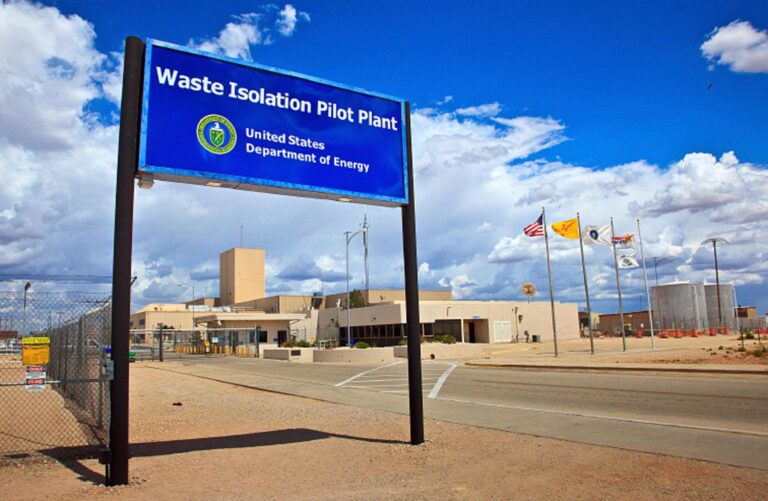
The U.S. Department of Energy announced Wednesday, Dec. 10, it extended its contract with Salado Isolation Mining Contractors, also known as SIMCO, which was hired in November 2022 as the primary operations contractor at the Waste Isolation Pilot Plant.
The initial contract was for four years and included six one-year extensions. Last week’s announcement used three of those potential extensions from, Oct. 1, 2026 to Sept. 30, 2029.
The other three extensions were still available.
With all six extensions enacted, the contract was valued at about $3 billion.
At WIPP, the Energy Department disposes of transuranic nuclear waste (TRU), which is clothing materials, equipment and other debris irradiated during nuclear activities.
The waste is buried at WIPP in a salt deposit about 2,000 feet underground. The salt gradually collapses on the waste, burying the refuse and blocking radiation from escaping.
The Energy Department said Salado has completed several infrastructure improvements since taking over operation of the facility.
“SIMCO has been an exceptional partner, safely emplacing waste from across the nation while completing critical infrastructure projects ahead of schedule and under budget, all without disrupting WIPP’s mission or compromising safety,” said Mark Bollinger, manager of the Energy Department’s Carlsbad Field Office.
WIPP facilities need repair
WIPP completed a $480 million underground ventilation system earlier this year, along with an associated $100 million air intake shaft on the west end of the facility.
That’s where Salado is currently mining out more space for waste, under an agreement with the state of New Mexico for two additional disposal panels.
Panels are mined out areas in the WIPP underground where drums of waste are placed for disposal. WIPP’s current state permit, signed in 2023, gives approval to mine out the site’s 11th and 12th panels; the previous permit approved only eight.
Don Hancock, director of the Nuclear Waste Program at Albuquerque-based Southwest Research and Information Center, a government watchdog nonprofit and frequent WIPP critic, said the ventilation project could not be counted as a success.
Hancock said WIPP under Salado’s leadership saw the ventilation project completed several years behind schedule and over budget by hundreds of millions of dollars.
When the project started in 2018, it was intended to be built for $135 million and to be completed by 2021.
Although Salado wasn’t involved in the project for its first five years, Hancock questioned if it could be counted as a success by the contractor or the federal government.
Much of the delay resulted from previous contractor Nuclear Waste Partnership’s decision to fire its construction subcontractor, Carlsbad-based Critical Applications, in 2020.
“It could be counted as a success in doing better than the previous incompetent contractor, but that’s a really low bar,” Hancock said. “That shouldn’t be the goal.”
More broadly, Hancock argued, WIPP infrastructure – namely the hoists that bring waste underground and the site’s fire suppression system – were in disrepair and raised alarms recently among state and federal officials.
Hancock pointed to the most recent monthly report by a federal watchdog agency, the Defense Nuclear Facilities Safety Board, which reported Dec. 5 that WIPP’s waste hoist was shut down from Nov. 17 to Nov. 29.
The board’s report said the closure was due to a malfunction in the hoist’s chairing system, the part of the lift that holds drums of waste being brought below the surface for disposal, meaning that no waste could be disposed of during that 12-day period.
The report also showed that Salado was planning to suspend shipments of waste for more than three months, from mid-December to March 2026, while officials address problems with the waste hoists and others that carry salt to the surface and move workers in and out of the underground.
“You can’t say everything is fine where there’s an incident that stops normal operations from happening,” he said. “It’s hard to argue everything is going fine when you’re planning to shut down the facility for three months.”
Concerns raised for New Mexico waste
As for the shipments WIPP did receive in the last three years, the Energy Department said Salado “exceeded” set goals in 2023, 2024 and 2025. The safety board’s report noted that 432 shipments were processed, compared with the goal of 425.
Salado President Ken Harrawood said WIPP’s mission of cleaning up nuclear waste at government sites was proving successful, as the facility ramps up to a goal of 17 shipments per week.
“We appreciate DOE’s continued confidence in our team and the work we deliver,” he said. “Our partnership with the Carlsbad Field Office is exceptional, and we look forward to advancing this work to continue WIPP’s important environmental cleanup mission.”
He also said WIPP continued to prioritize waste from outside New Mexico with Salado at the helm. Records show about 290, or 67% of the waste disposed of at WIPP came from Idaho National Laboratory.
This contradicted the original intention of WIPP, Hancock said, arguing the site should focus on waste from Los Alamos National Laboratory to give New Mexico the most benefit for hosting the repository.
He pointed to a clause in the renewed permit that required WIPP to prioritize waste from within New Mexico.
Hancock said the agency and its contractor were falling short of this requirement, along with others to properly define and plan for so-called “legacy waste” leftover at federal sites from the Cold War and another clause that requires the Department of Energy to find a location for a new repository outside New Mexico to replace WIPP in the future.
“When you agree to having provisions in a permit, you’re agreeing to comply with them,” Hancock said. “They agreed to provisions and now they are not complying with them.”
Managing Editor Adrian Hedden can be reached at 575-628-5516, or @AdrianHedden on the social media platform X.