Adrian Hedden
Artesia Daily Press
achedden@currentargus.com
Heavy rains in the early summer may have caused parts of Eddy County to turn green, but experts warn that drought persists throughout the region.
The area had received about 5.56 inches of rain since January as of July 8 – more than last year’s total of 4 inches but less than the 6.34 average for southeast New Mexico, according to data from the National Weather Service.
About 0.86 inches fell in May and 2.84 in June, according to data collected at the Cavern City Air Terminal.
Jim DeBerry, lead meteorologist at the National Weather Service’s Midland-Odessa office, said the early spring and summer rains were brought on by the absence of a high-pressure air ridge that usually materializes over the region in early summer.
In May and June, he explained, the ridge normally blocks off precipitation brought via other air currents and reduces the chances for storms.
The system is known as the “Death Ridge” for its ability to “kill thunderstorms,” DeBerry said, and is currently hovering above Kentucky and Tennessee, allowing currents to enter southeast New Mexico and bring rain in short bursts.
The Death Ridge system is stalled, DeBerry said, but should arrive sometime during the summer.
“It’s an upper-level disturbance that ends up bringing thunderstorms,” he said.
“Super El Niño” could bring more rain
Further strengthening the area’s chances for increased rainfall is the El Niño weather pattern experts are expecting this summer.
An El Niño weather pattern occurs when the water off the Pacific coast warms, shifting air currents away from their normal patterns. It could mean a wetter-than-normal summer.
“Conditions are very favorable for El Niño,” he said. “For our part of the country it will result in increased precipitation.”
And the pattern could be more intense than in past years, according to AccuWeather, a national weather forecasting company.
While the “Super” El Niño could bring more rain to southern states, it could lead to dangerous drought in northern portions of Texas and as far north as the Dakotas.
In the south, meanwhile, the wet months could be followed by several years of intense drought, said AccuWeather long-term forecaster Paul Pastelok.
“The stronger the upcoming El Niño conditions get, the longer it takes for weather patterns to return to their historical average,” Pastelok said.
But in Carlsbad and southern New Mexico, the expected high moisture had yet to fully appear.
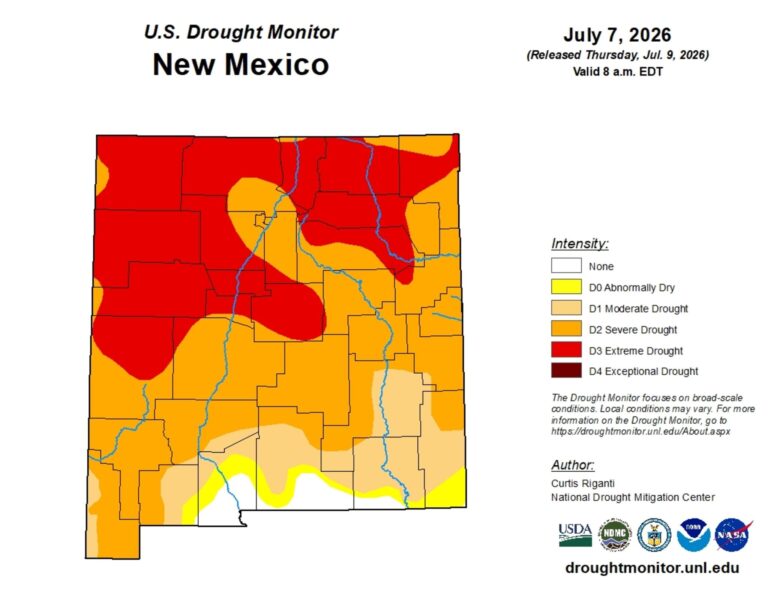
Most of Eddy County remained under drought conditions as of July 7, with 88.4% listed as such by the U.S. Drought Monitor.
The Drought Monitor, operated by the University of Nebraska, reports drought conditions throughout the U.S.
The monitor reported Eddy County’s drought conditions could be marked by increased fire danger and low soil moisture, meaning livestock may need supplemental water to survive.
About 97% of New Mexico was under drought, the monitor reported, with the most intense conditions in the northwest and central regions around major cities such as Albuquerque and Rio Rancho.
‘Not the best situation’
Coley Burgess, manager of the Carlsbad Irrigation District, said the level of dryness that remained despite the early-summer rainfall was “concerning.”
The Irrigation District services about 580 water users, mostly agricultural, in southern Eddy County from farmlands near Lake Avalon to south of Malaga. The district operates a canal that sends water from the reservoirs at Avalon and Brantley Lake to others in the district.
That water is measured in “acre feet,” or the amount of water it takes to cover an acre of land a foot deep – approximately 325,851 gallons. The district’s board decides each year how much to allot per acre.
Burgess said this year’s allotment of 2.5 acre feet for each user was lower than he would like to see. A “full allotment” is 3.5 acre feet, a goal Burgess said the district has not met “in several years.”
That means that although the grass is greener, and vegetation has grown, farmers are unlikely to “break out” fallowed farmlands into operation, Burgess said.
“It’s still not the best situation even though we’ve had these rains,” Burgess said. “Even though the rains have been nice and they’re welcome, it’s still not enough to put more water in the reservoirs.”
Burgess said the district will need some heavy rains in August or September, which he said are the “wettest months” of the year as the late summer and early fall rainy period known as the “monsoon” takes hold.
Without a strong monsoon, Burgess said, the typically dry winter months could be perilous for farmers and ranchers.
And despite the apparent promise of moisture via El Niño, Burgess said, he’s hoping for the best but planning for more drought.
“Everybody prays for rain but I don’t see much sense banking on an El Niño pattern until you have the water in the system,” he said.
National Weather Service forecaster DeBerry agreed.
He said the region typically sees some rain in the early summer before drying out in July and early August. That appears to be happening with chances for rain remaining limited in the coming weeks.
“Usually through late spring we’ll some rainfall and get ahead,” DeBerry said. “Then that ridge shows up. Once it sets in, we drop below normal. We’re dropping now.”
Managing Editor Adrian Hedden can be reached at 575-628-5516, or @AdrianHedden on the social media platform X.