Home Blog Page 192

Leadership

0

By: Pastor Ty Houghtaling


Jesus knew who He was, where He came from, where He was going, and to whom He belonged. He knew His mission and purpose. He never deviated from His mission, using every opportunity in His life to point people to His Father. He led with humility and strength. He led with love and compassion. He led with the authority He had been given, never using His position for His own advantage. I encourage you to read John 10 for a really good chapter on Jesus knowing exactly who He was.


We are doing some men’s leadership training at our church. We are reminding ourselves that we are called to lead out in our families, churches, vocations, and our community. Most of us feel unworthy to lead. Most of us know that we have done some things in our past that limits our influence on others. Yet, we still are asked to lead. A major part of leading well starts with a clear sense of our identity in Jesus (a few verses on our identity in Christ are 1 Corinthians 5:17-21, 1 Peter 2:9, & Ephesians 5:8). It has been good to remind ourselves what is true about who we are in Christ. We have emphasized what we believe; the beliefs that we have been forgiven, empowered, equipped, and called. We are studying Jesus as our leadership role model. He was undoubtably a servant leader. He focused on the mission and He knew exactly how to ignore the distractions. He was completely obedient to His Father’s will and He trained up some men to be the same. Those men passed on that training to a new generation of leaders, and that new generation did the same, generation after generation until our time. It is our time, men! Leading like Jesus isn’t easy in our culture, but it is possible. Do you know anyone who leads like Jesus? Jesus was tough on the ones who should have known better and more patient with the downtrodden and kicked around in society. Jesus ignored the distractions of wealth, comfort, and pleasure. He was content with what He had, content with His calling, and endured the hardships that came with responsibility. Men, we can learn to be the same. He has called us to it; and He has given us every resource we need to pursue His mission for this world.   


Ty Houghtaling is the Pastor at the First Baptist Church in Artesia.

Electric Hummer is 1,000 horsepower strong 

0

By Len Ingrassia
Automotive columnist
 

Bigger is better we are told and, if so, the 2025 electric Hummer takes it to new heights – literally. Available as a pickup and SUV, GMC’s brainchild is outrageous, invincible off-road, heavier than six Clydesdales and faster than a Corvette.


Perspective buyers will be forking over six-figure plus for the tester we enjoyed for a week. And to keep it going, a fast charge (90 minutes) at Electrify America will set you back $100 plus but who’s counting – the joy of this 5- ton vehicle is worth the coin for some.


For the big bucks, you get 1,000 horsepower from three motors supported by a 19.2 kW high voltage battery. Stomp on the pedal and the Hummer front end jumps up and grips its way to 60 miles per hour in 3.3 seconds or, said differently, it’s moving 10,000 pounds to 60 extremely fast.


Originating as a military vehicle in 1983 by AM General, a civilian Hummer was released in 1992 but it lacked refinement. General Motors purchased the rights and developed the H1, H2 and H3 but all three fell victim to the times with high prices, poor fuel economy and a lack of sophistication.


Then in 2020, GM marketed the all-electric Hummer with more than 65,000 pre-orders. It’s built at Factory Zero in Michigan, GM’s first EV dedicated facility.


King of the mountain is a Hummer trait and it compares favorably with a Rivian R1T on steroids, Ford F150 Lightning and Tesla Cybertruck.


The Hummer takes the cake for innovative actions like rear wheel steering. In Crab Walk mode, it allows rear wheels to turn equal with front wheels at low speeds to diagonally exit a tight parking space or off-road situation. The EV 3X has 35-inch tires to support its massive size, hefty ground clearance and extreme power making it seemingly invincible off road.

With an optioned 24-module battery, this beast has an unmatched 212 kWh of capacity and will power your house in a crisis. Really. Electric range varies from 311 to 380 miles depending on battery size.

We found the Hummer’s sheer power isn’t always a good thing. Rapid acceleration tips the front end upward and makes steering loose for a bit. Its super-size and weight require patience and precise steering to stay within your lane around corners. Critics jest a Carnival cruise liner has more turning capability.

Braking is surprisingly strong for such a massive SUV. The tri motors also provide regenerative braking while slowing at intersections and heavy traffic.

Inside its large cabin the Hummer shows off its dual digital screens displaying engine vitals and navigation/entertainment essentials although we expect more glitz at this price point. Seating is adequate for front and rear seat passengers. Cargo room behind second row seats accommodates 36 cubic feet and grows to 82 cubes with the second row folded.

A few quirks came to mind during our time with the Hummer. Overhead traffic lights are not visible out of its narrow windshield if you find yourself in the front row. We’d save the $1,495 infinity roof – four tinted plastic sky panels that let the sun shine in on occupants.

If you are considering an EV Hummer-like experience, we recommend test drives in the above rivals before making a purchase.

(Contact independent automotive columnist Len Ingrassia at editor@ptd.net)


What was reviewed:

2025 GMC Hummer EV 3X SUV

Engine: Tri-motor performance AWD – 19.2 kW high voltage – 1,000 horsepower

MSRP/as tested: $104,650 / $112,505

EPA mileage:  52 combined, 58 city, 46 highway

Assembled: The Hummer EV is fully assembled in Detroit, MI at Factory Zero, GM’s first all-electric assembly plant. Parts content information was not available.

Crash test ratings: Neither the National Highway Traffic Safety Administration (NHTSA) nor the Insurance Institute for Highway Safety (IIHS) had rated the 2025 Hummer EV as of this writing.

Warranty: 3-year/36,000-mile bumper to bumper; 5-year/60,000-mile powertrain; electrical components are covered for 8 years/100,000 miles. Complimentary first maintenance visit.

Carlsbad Caverns rebuilds elevators, plans upgrades for second century of visitors

0

Story and photos by Adrian Hedden
El Rito Media
achedden@currentargus.com

A 752-foot ride into the underground via a one-stop elevator system to view the world-renowned rock formations at Carlsbad Caverns will be easier for visitors thanks to a $20 million project completed last year.

Carlsbad Caverns National Park, established in 1923 by then-President Calvin Coolidge is about 46,000 acres, and boasts 119 known caves. The park is situated about a 30-minute drive southwest of the city of Carlsbad amid the Guadalupe Mountains.

The most popular cave, and the one the park focuses on for daily visits, is the Big Room. It offers about a mile of lit underground walking trails, accessible to people with disabilities or who are wheelchair bound.

To get there, visitors can either hike down and up the extremely steep natural entrance or use the massive elevator system.

The system was first built in 1931 and has two sets of two cars: the 16-person primary elevators and the eight-person secondary elevators.

Before the elevators were installed, a wooden staircase painstakingly led visitors down into the cave.

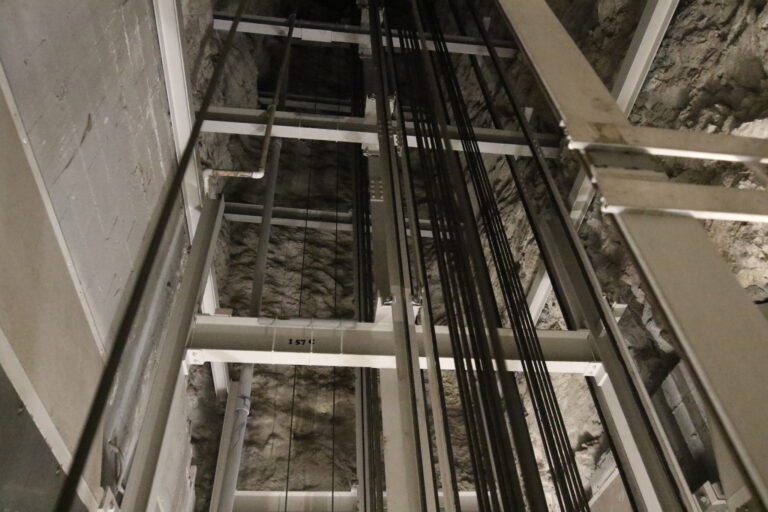
In fall 2024, work to replace the secondary elevators was completed, meaning they can be used when the main elevators are down for maintenance. Those were rebuilt about six years ago, but require continual upkeep due to the unique environment in the cave, said Park Superintendent Carmen Chapin.

“One of the biggest challenges in this environment is the humidity,” Chapin said. “Things are extremely sensitive.”

The secondary elevators can also be used to move staff and equipment in and out of the cave without interrupting visitor trips that can number up to 60-80 a day, said Keenan Comer, operations chief at the park. They can also be used in busy times to alleviate congestion when the wait time to catch a ride back to the surface exceeds 15 to 20 minutes.

The rebuild included replacing structural steel in the shaft, after it became corroded and warped by the heavy moisture. Along with rebuilding the cars and adding digital screens, the project also added new lighting.

‘A huge expense’

The cars travel about eight feet per second, Comer said, and about 33 miles a day.

Over the decades, the wear and tear of all those rides meant the park service replaced and refurbished individual components of the elevators as needed, Comer said. The recent projects were the first the time the systems were completely rebuilt.

“It had to do with cost,” he said. “It was a huge expense, and that’s taxpayer money. When our visitors come in here, it’s their money at work. It’s all brand new.”

Rebuilding the elevators was part of a park-wide infrastructure overhaul. Last year, Chapin said, the park service requested about $30 million in federal funds for deferred maintenance, or projects such as infrastructure that were delayed because leaving them unfinished would not immediately interrupt park operations.

The elevator modernization project was mostly funded through the 2020 Great American Outdoors Act, which sent about $40 million to the park for several infrastructure projects including modernizing the secondary lifts. A total of $1.9 billion was allocated to the National Park Service via the Outdoors Act.

Deferred maintenance projects require funding from Congress, Chapin said, as they would be unachievable with the park’s annual budget of about $9 million.

“When you get those big-ticket projects, it’s not something that would come out of the park’s budget,” she said.

But the work still needed to get done, she said, especially as Carlsbad Caverns celebrated its 100th anniversary on Oct. 23, 2023.

“There is infrastructure that is still here from the 1930s,” Comer said. “We have a lot of projects going on.”

The projects include new water and sewer lines tying into the lines within the park’s historic area where housing for staff is located alongside decades-old structures. The park also plans to restore its underground lighting system, which includes 10 miles of power lines in the underground, and add electric vehicle charging stations for park service vehicles.

Airlock nearing completion

A project was underway to install a series of airlocks at the bottom of the elevator shafts, serving as the entryway in and out of the cavern to prevent the release of radon on the surface after it was detected in the air of the Visitor Center in 2018.

That should be completed by early 2025.

Radon is an odorless, colorless and tasteless gas that results from the gradual decay of uranium in rocks and soil. Breathing in high levels of radon over a long period of time can lead to lung cancer and other health impacts.

Levels in the Big Room and Visitors Center are “very, very low,” Chapin said, but were high enough in deeper, less accessible areas of the cave system such as the Spider or Lechuguilla caves to see those areas closed temporarily.

How the airlock works: Once exiting the elevator, visitors walk through a door into a lobby area. A second door from the lobby into the cave cannot open until the first door is securely closed.

This prevents radon from escaping into the elevator and traveling to the surface, potentially exposing visitors and staff to higher levels over time. The possibility of radon exposure is also why staff is limited in how much time they can spend in the cave – 40 hours a week in winter and 30 hours a week in summer when radon levels are higher, Comer said.

“The only thing you can do is monitor it and manage your time,” he said of the radon.

The airlocks also prevent moisture from escaping the cavern, which can cause pools of water in the cave to dry up and impact underground species of plants and animals.

“The elevator shafts act like huge chimneys,” Chapin said. “Even when they are slightly cracked, we lose a lot.”

Carley Simer of Artesia Named to University of Alabama Fall 2024 Deans List

0

Carley Simer was named to The University of Alabama Deans List for Fall Semester 2024.

A total of 14,631 students enrolled Fall Semester 2024 at The University of Alabama were named to the dean’s list with an academic record of 3.5 (or above) or the president’s list with an academic record of 4.0 (all A’s). These driven students are making waves across UA’s more than 70 undergraduate programs and 12 colleges and schools.

The UA dean’s and president’s lists recognize full-time undergraduate students. The lists do not apply to graduate students or undergraduate students who take less than a full course load.

South Plains College announces Fall 2024 Deans’ List

LEVELLAND, TX (01/03/2025)– South Plains College congratulates over 700 students named to the Fall 2024 Deans’ List.

Caden Golden of Artesia, NM

Isabella Griffin of Artesia, NM

South Plains College is a comprehensive, two-year community college that serves the greater South Plains area of Texas with innovative educational programs that span the arts and sciences, technical education, continuing education and workforce development. Serving a 13-county area that comprises the southern portion of the Texas High Plains, the college’s main campus is located in Levelland. SPC also offers educational programs at three locations in Lubbock – the SPC Lubbock Downtown Center, the SPC Lubbock Career and Technical Center and the SPC Reese Center – as well as an extension center in Plainview.

Jesus in your heart makes hate impossible

0


By: Pastor David Grousnick

We all tend to despise people who challenge our cherished myths and kick us out of our comfort zones. The truth is that when Jesus sets about the task of saving us, he has to heal us of any myth or prejudice that is contrary to the spirit of Christ.

Billy Sunday was the Billy Graham of a previous generation. He was conducting a crusade in a particular city. In one of his sermons he said something critical of the labor conditions for workers in that area.

After the service, several prominent businessmen sent a message to him by one of the local pastors. The message was this – Billy, leave labor matters alone. Concentrate on getting people saved. Stay away from political issues. You’re rubbing the fur the wrong way.”

Billy Sunday sent this message back to them: “If I’m rubbing the fur the wrong way, tell the cats to turn around.”

Sunday, February 9th will be a National Day of Prayer.

Okay, not “officially.” Not sanctioned by any denomination or government decree. But there will still be more prayers hurtled heavenward that day than on any other given Sunday.

Superbowl Sunday is actually a very religious day, if you will. People who never darken the door of any church will be praying for a favorite team by player, family members, coaches, investment brokers, and, of course, fans, all over this country.

Remember that one year when “Papa John’s” promised a free pizza to anyone who correctly called the “head or tails” coin toss that starts the game? Half of the people had their prayers “answered.” Half did not.

Sorry. Coin tosses and football games are not the testing grounds for our prayer life. “Hail Mary’s” aren’t the only way to connect with the divine.

“Arrow prayers – “Dear God, please let me pass this math test,” “Dear Lord, please keep the car on the road,” “Dear Jesus, please find me a job,” aren’t really “prayers” at all. They are simply heart-felt and soul-felt pleas.

Prayer is something quite different. Prayer is paying attention to the movement of the Spirit in our lives. Praying is an attitude that embraces amplitude. Prayer elevates us to the portals of eternity and opens us up to the presence of the divine. A prayer-conditioned life is a Spirit-filled life!

Consider the movie titled, Ruby Bridges. It tells the story of Ruby Bridges, a six-year-old African American girl, who was the first person to integrate the schools in New Orleans. Every day, federal marshals escorted her into the schoolhouse because both sides of the sidewalk would be lined with people who were screaming threats.

Robert Coles, a noted Harvard psychiatrist, volunteered his time to work with young Ruby. Every day he would talk with her, trying to help her weather the crisis.

On the news one night, he noticed her walking up the sidewalk and the people were screaming and throwing things, but suddenly she stopped and said something and started backing down the sidewalk. Then the marshals picked her up and took her into the building.

That night, Cole asked her what she said to the marshals.

She said, “I was not talking to the marshals.”

He said, “Yes, you were. I saw you on the news. I saw your lips moving. You were talking to the marshals.” She said, “I was not talking to the marshals.” He said, “Well, what were you doing?”

She said, “I was praying for those people who were hollering at me. I had forgotten to pray, and I was trying to go back and pray for them as I walked to the school building.”

Cole shook his head and said, “You were praying for the people who were screaming at you?”

She said, “Yes, my mama taught me that when people speak mean of you, you pray for them just like Jesus prayed for the people who spoke mean of him.”

You see, when Jesus lives in your heart, you just can’t hate anybody.

Consider making this prayer part of your daily faith routine:

“Our Father, each day is a little life, each night a tiny death; help us to live with faith and hope and love. Lift our duty above drudgery; let not our strength fail, or the vision fade, in the heat and burden of the day.

“O God, make us patient and pitiful one with another in the fret and jar of life, remembering that each fights a hard fight and walks a lonely way. Forgive us, Lord, if we hurt our fellow souls; teach us a gentler tone, a sweeter charity of words, and a more healing touch.

“Sustain us, O God, when we must face sorrow; give us courage for the day and hope for tomorrow. Day by day, may we hold your hand and look up into your face, whatever befall, until our work is finished, and the day is done. Amen.

Francis of Assisi, 1181-1226.

David Grousnick, is the Pastor at the First Christian Church in Artesia.

Future disaster costs shadow state tax bills

0

By Sherry Robinson
All She Wrote
 

            Republicans want to get rid of personal income taxes in the state, and they’ve made it their priority for the current legislative session. It’s a big step, but in recent years a surge in oil and gas revenues have fattened state coffers so much that we can think about it.

    “Eliminating the personal income tax will return more than $2 billion a year to New Mexico’s families, without disrupting our public services or tax credits that many families rely on,” wrote House Minority Leader Gail Armstrong, R-Magdalena, in an op-ed.

     Freshman Rep. Elaine Sena Cortez, R-Hobbs, has said she will carry legislation to eliminate the personal income tax, noting that nine states don’t tax personal income.

     You can’t deny the appeal. Wouldn’t we all like to be free of state income taxes?

     But lately the president has lobbed a deal killer into this proposal and the Democrats’ plans to reduce taxes. The whole picture of state revenues just changed.

While touring disaster areas in North Carolina and California, the president said he was thinking about getting rid of FEMA. “It’s very bureaucratic, and it’s very slow,” he said.

He’s got that right.

“I’d like to see the states take care of disasters,” he said. “Let the state take care of the tornadoes and the hurricanes and all of the other things that happen.” That would be faster and cheaper than sending in FEMA. He suggested that Washington might provide money directly to the states.

The way FEMA has operated for decades is that after a major disaster, local officials ask the president to declare an emergency. That ask tells the president that the disaster is beyond local and state governments’ ability to respond, according to an Associated Press explainer. The emergency declaration opens the federal purse and involves FEMA, which can reimburse local governments for rebuilding roads, bridges and public buildings. The agency will also help individuals with short-term needs like food, clothing or a motel room or longer-term help like rent assistance or some money to help rebuild. FEMA will also pay for projects intended to protect the community in the future.

It’s not there to manage disaster recovery or to make disaster victims whole.

As I’ve written previously, from its creation in 1979 to 2003, FEMA was a small, agile, independent agency that responded quickly. After it became a division of the Department of Homeland Security, it became another bureaucratic cog. Decision making, spending and communications bogged down. President Trump criticized former President Biden for not fixing the problem, but none of the presidents have fixed the problem.

Whatever criticism we have of FEMA, we can probably agree that it’s better than nothing. Are states ready to shoulder these responsibilities? I doubt it. New Mexico certainly isn’t. Is it even cost efficient for states to replicate 50 little FEMAs?

Now throw in politics. The president plans to help red North Carolina, which voted for him, but he’s placing conditions on help for blue California, which didn’t vote for him and whose governor he despises. During his first term he held up disaster aid to Puerto Rico and California. The traditional political promise – I’m here to serve you whether or not you voted for me – no longer holds.

How might New Mexico fare? I predict New Mexico will look more like California than North Carolina in terms of the administration’s future treatment.

Returning to the president’s recent comments, the big question is how much the administration is willing to pay states for disaster recovery. The answer so far is, less. Much less. And yet the disasters are getting bigger, and we are even now in another drought.

Until we know more, it’s premature to give up any revenue streams.

Sherry Robinson is a longtime New Mexico reporter and editor. She has worked in Grants, Gallup, the Albuquerque Journal, New Mexico Business Weekly and Albuquerque Tribune. She is the author of four books. Her columns won first place in 2024 from New Mexico Press Women.

Artesia senior key for return to state

0

Mike Smith
Artesia Daily Press
msmith@currentargus.com

Artesia Lady Bulldogs head coach Candice Pollard knows a healthy Hattie Harrison could be a key contributor to the team repeating as district champion and returning to the 4A state playoffs in March.

Artesia won the District 4-4A regular season title last season and made it to the semifinals of the state tournament before being eliminated by Albuquerque St. Pius X, 61-41.

The Lady Bulldogs (8-11) start league play Jan. 31 at Lovington with a healthy Harrison, who was out of the lineup for two games due to a left pinky injury suffered in a game against the Carlsbad Cavegirls Jan. 7.

“I think it was in the second quarter, I think a ball was just passed to me and it may have deflected off a girl’s hand and it hit my hand and somehow managed to break my pinky finger and I was put into a cast just to be cautious and to make sure I was not doing some crazy things to make it worse,” Harrison said.

Pollard was not aware of Harrison’s injury as the Lady Bulldogs lost to the Cavegirls 52-46 in Carlsbad.

“I didn’t know she was hurt until after the game. That really goes to show her maturity,” Pollard said.

The 17-year-old senior had a cast on the injured finger while wearing her uniform jersey during a Jan. 10 home game against Santa Teresa and was in street clothes during another home game Jan. 14 against Chaparral.

“It was sad not being able to play. I’ve played basketball for long I’m so used to being with the girls and playing with them,” Harrison said.

Pollard said the cast was removed Jan. 15 as Artesia embarked on a trip to Albuquerque for the Jan. 16-18 Hope Christian Tournament.

While she was sidelined, the 5-foot-10 senior post and wing player said she was able to run drills but could not dribble with her dominant hand because of the injury.

Pollard said she eased Harrison back into the lineup during the tournament in Albuquerque then started her in a Jan. 21 home game against Roswell. The senior scored two points against the Lady Coyotes in a 57-38 win at the Bulldog Pit.

Harrison scored eight points and snagged two rebounds Jan. 24 in a 79-30 loss at Hobbs.

Harrison said making it to the semifinal round in the 2024 state playoffs was a positive experience for her and her teammates.

“We didn’t make it to the championship, but I think we put ourselves all out there and we played for one another and that’s what’s important,” she said.

Harrison said she’ll stay positive from now until the end of the regular season on Feb. 21.

“I plan on just leading the team,” she said. “One thing I try to strive for is keeping a positive atmosphere. I want to be there for the girls whatever they’re going through. I just want them to know that I’m there and that’s a goal I have.”

Pollard has coached Harrison since she was in ninth grade and said she has grown during that time.

“To say she has matured and grown this year is an understatement,” the coach said. “She has really taken a leadership role. She’s one our team captains. She’s very mature on and off the floor. Very coachable.”

Harrison has elevated her play this season despite the injury, Pollard said, and contributes at both ends of the floor:

“She’s been putting up points, she’s been killing the rebounds … I don’t think there’s anybody in our district that can jump like she can and really clean up those boards around the basket and hopefully get some points around the basket, too. Defensively, she’s hard to shoot over because she can jump out of the gym and block a shot.”

Harrison is a three-sport student-athlete at Artesia High. She participated in volleyball in the fall and once basketball season ends, she will turn her attention to track and field, competing in hurdles and relay races.

Track and field is her favorite sport, she said, “because it’s an individual sport and I can focus on myself and set my own goals and just live by that.”

Harrison plans to attend West Texas A&M in Canyon, Texas, on a track scholarship.

She’s undecided on a college major but her favorite high school subject is science. Her mom is Robbie Harrison, her grandmother is Verna Harrison and she has two siblings, Elliot Harrison and Hollis Harrison-Madrid.

Mike Smith can be reached at 575-308-8734 or email at msmith@currentargus.com.

Southeast New Mexico lawmakers assigned to committees

0

El Rito Media News Services

ROSWELL — Southern New Mexico lawmakers have been assigned to legislative committees as activity at the Roundhouse kicks into high gear.

On Jan. 21, opening day of the session, the 42 members of the New Mexico Senate and 69 members of the New Mexico House of Representatives learned which committees they would be on. There are nine standing committees in the Senate and 14 in the House, each tasked with screening and considering legislation before it goes to the floor for a vote by all representatives and senators.

Committee assignments in the New Mexico Senate are determined by the Senate Committees’ Committee, which is chaired by Senate President Pro Tempore Mimi Stewart (D-Albuquerque), according to Chris Nordstrum, spokesperson for the New Mexico Senate Democrats.

As the committee chair, Stewart appointed a bipartisan slate of members to mete out the assignments.

Brittany Dickerson, spokesperson for the New Mexico House Republican Caucus, said the speaker provides the assignments in the House with recommendations from the minority party.

State Rep. Mark Murphy (R-Roswell) of House District 59 will be on the House Energy, Environment and Natural Resources Committee and the House Commerce and Economic Development Committee.

Murphy, the president of an oil production company, said his position on the Energy, Environment and Natural Resources Committee will allow him to analyze bills related to the oil and gas industry.

Murphy also expressed enthusiasm for the role he will play as a member of the Commerce and Economic Development Committee, which he claimed could help him with efforts to secure additional state funding for the National Championship Air Races scheduled to happen in Roswell later this year.

State Rep. Angelita Mejia (R-Dexter) of House District 58 was tapped for the House Government, Elections and Indian Affairs Committee and for the House, Labor, Veterans and Military Affairs Committee.

House District 54 state Rep. Jonathan Henry (R-Artesia) was placed on the House Energy, Environment and Natural Resources Committee and the House Tax and Revenue Committee.

The top Republican on the House Commerce and Economic Development Committee will be state Rep. Jimmy Mason (R-Artesia) of House District 66, which includes parts of Chaves, Eddy and Lea counties.

Mason also holds a spot on the House Rural Development, Land Grants and Cultural Affairs Committee.

Sen. Candy Ezzell (R-Roswell) of Senate District 32 is now the ranking member, also known as the top Republican, on the Senate Conservation Committee. That panel of lawmakers will consider legislation related to water resources, the environment, natural resources and some issues that could impact the energy industry.

Ezzell will also be on the Senate Education Committee. Democrats hold a majority on all committees, but Ezzell said the Education Committee consists of five Democrats and four Republicans.

Sen. Larry Scott (R-Hobbs) of Senate District 42 will be on the Conservation Committee and be a ranking member of the Senate Health & Public Affairs Committee.

Senate District 42 encompasses parts of Eddy, Lea and Chaves County.

Residents, chamber, and the city work to tame ‘aquatic bloom’ in Pecos River

0

Jake Cooper
El Rito Media

A river algae problem that threatened to sink Carlsbad’s popular Christmas on the Pecos festivities appears to be under control, at least for now.

City officials say measures taken to subdue the burgeoning vegetation, including the use of mechanical harvesters that pull algae out of the water, have reduced the growth to a manageable level.

The harvesters were deployed last fall to combat the heavy algae that reportedly started appearing in the river in July 2022.

Nancy Brantley, who lives along the river on Riverside Drive, said the bloom eventually became “a solid mat across the river.”

Deputy City Administrator KC Cass said the city bought two Weedoo TC Work Series mechanical aquatic weed harvesters for about $175,000 to remove the algae from the water. So far, he said, the city has removed and disposed of 125 dumpsters (about 30 cubic yards each) of the algae.

City officials notified the New Mexico Department of Game and Fish of the problem in 2022, and samples were collected. The New Mexico State University Plant Diagnostic Clinic identified the samples as brittle naiad and Eurasian milfoil, both plants that are considered invasive by the clinic.

A third species, sago pondweed, was identified by Game and Fish in April 2024, according to a letter sent by the city to residents with homes along the river.

The “aquatic bloom” has barbs that attach to swimmers, researchers said. Many have reported that the weeds can easily tangle with the blades of boats.

Brantley said her family stopped boating on the river “because it’s so bad, it sucks up the growth, and then (the motor) gets stopped up and then you’ll ruin your motor.”

‘Acting responsibly’

A diagnostic report from NMSU Plant Diagnostic Clinic said herbicides should not be used. The clinic suggested the city try physically removing the weeds. Cass said the city decided to proceed as the clinic suggested and set out to address the problem without contaminating the water with chemicals from herbicides.

“I think acting responsibly is the way to go,” he said. “We were fortunate to find the people that we did to come and help us. They did a tremendous job to help train us and get some of this stuff out.”

Not only did the bloom affect private boat owners, but it also was on the verge of impacting Christmas on the Pecos, the annual event that features boat tours along the river to view homes decorated for Christmas. The 45-minute boat rides start the day after Thanksgiving and continue until New Year’s Eve.

Sponsored by the Carlsbad Chamber of Commerce, Christmas on the Pecos is one of the chamber’s biggest fundraisers each year. Chamber Chief Executive Officer Chad Ingram said about 15,000 people rode the boats last year, an estimated 75% percent of them from outside Eddy County.

Two Weedoos could be spotted on the Pecos harvesting the algae through early November, clearing the way for Christmas on the Pecos. The harvesters did their job, and the boat rides continued as planned.

Ingram said that although business was not affected by the algae, he felt bad for those who came to Carlsbad over the summer and “probably didn’t have the best experience. I think it affected our local individuals a lot, not being able to get out there.”

Long-term solutions

The machines weren’t the city’s first attempt to combat the algae.

New Mexico Game and Fish permitted the introduction of triploid grass carp into the river to eat the algae, reducing its size and clearing the water. From July 2022 to June of last year, 4,750 carp were released at a cost of $35,750, according to a letter city officials sent to residents.

Cass said that once the Weedoo trims the algae to an acceptable level, the carp eat the plants to keep the bloom at bay. He said the river will be monitored for algae growth.

“We’ll continue to run our boat and cruise five days a week,” he said.

Michael Miller

0

Michael Ray Miller “Mikey” March 13, 1958 – January 19, 2025 Artesia, N.M. – With hearts both heavy and full, we bid farewell to Michael Ray Miller, known to all as “Mikey”, who left us on January 19, 2025, at the age of 66, surrounded by the love of his family and friends at home. Born in the sun-drenched landscapes of Artesia, New Mexico, on March 13, 1958, Mikey was the beloved son of A.K. and Margie Miller.

He danced into the next world, joining his parents, his cherished daughter Suzie Quezada, his great-grandson Atlas, his brothers Joe, Timmy, and Danny.

Honorary pall bearers are: Tito Quezada, Matthew Quezada, Cal Leavitt, Jett Leavitt, Anthony Havens, Duston Spearman, Blake Milligan, Kevin Lewis, Justin Levario, Guy Stevenson, and Robby Miller.

On October 29, 2009, Mikey found the love of his life in Jan ’Moore’ Miller, embarking on a journey filled with laughter, love, and countless adventures. He leaves behind his heart’s partner, Jan; his daughters Stephanie Domer (Shawn), Tosha Wragg (Jason), Marissa Leavitt (Cal), and Sheena Smith (Zach); his son Chad Miller (Cayla); his son-in-law, Tito Quezada; and a constellation of grandchildren – Ashlynn, Kaelynn, Jett, Matthew, Charli, Evie, and Grayson – and great-grandchildren, Draven and Aurora; his brother Steve Miller and his sister in law, Karen Miller, along with a sea of friends who felt like family. Mikey was more than just a man; he was a beacon of joy, with a heart as big as the New Mexico sky.

His quick wit and the one-of-a-kind nicknames he gave everyone painted our lives with laughter. An adventurer at heart, you’d find him under the vast outdoors, fishing, hunting, or roaring through the desert in his Jeep or dune buggies. Inside, he’d lose himself in the timeless tales of Westerns, but his heart truly belonged to “The Lion King”, which he considered “the best movie ever made!” His love for the color purple was as vivid as his personality, bringing a splash of color to every moment. Mikey’s departure leaves a vibrant void, but in our hearts, he’ll forever be the man who loved without measure, laughed with abandon, and lived life in full, glorious color. We take solace knowing he’s now painting the skies of heaven with Suzie, their laughter echoing through eternity. #HUH-What’d you say?