The possibility of a radioactive release while waste is shipped to a repository near Carlsbad drew concerns from locals along the route.
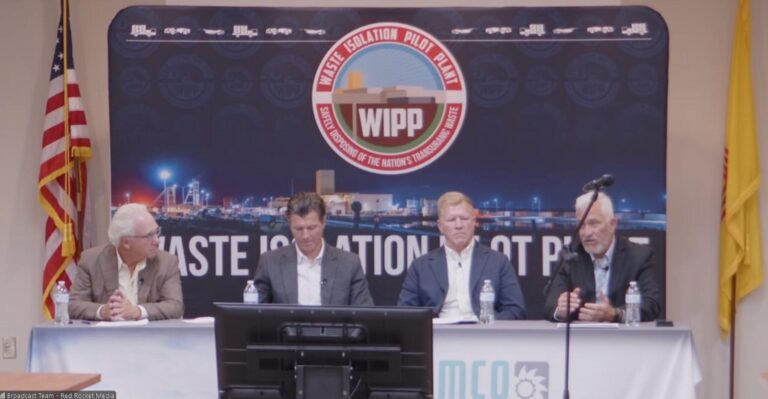
Santa Fe County resident Cynthia Weehler raised the issue during a Wednesday, Aug. 5, town hall held by the U.S. Department of Energy in Hobbs to give a public update on operations at the Waste Isolation Pilot Plant.
At WIPP, the Energy Department disposes of transuranic nuclear waste (TRU), which is clothing materials, equipment and other debris irradiated during nuclear activities.
The waste is buried at WIPP in a salt deposit about 2,000 feet underground. The salt gradually collapses on the waste, burying the refuse and blocking radiation from escaping.
Weehler, a frequent WIPP critic with the 285 Alliance, questioned WIPP’s preparation should an incident occur while waste is being shipped to the facility, specifically on U.S. Highway 285 from Los Alamos National Laboratory south to the repository.
The 285 Alliance is a consortium of mostly northern New Mexico residents who live along U.S. 285 around Santa Fe and Los Alamos. The group advocates frequently for transportation safety in shipping waste through those areas.
Officials at the town hall explained that the Department of Energy works with first responders along the WIPP routes, in towns such as Vaughn and Carlsbad along U.S. 285.
Weehler was unconvinced.
“What if something happened that is not on a transportation route?” she asked. “What if there was a plume of something that carried radioactive material that wasn’t on a transportation route? People don’t know when to evacuate or shelter in place should there be a plutonium release. They need to know that information.”
James Mason, intergovernmental affairs manager with the Department of Energy’s Carlsbad Field Office, said a release was unlikely, but that it would not be “airborne” or able to migrate beyond the immediate area where it would occur.
“We have a high level of confidence in our packaging and that there will not be a release. Should there be a release, this will not be an airborne event,” Mason said. “It may contaminate the ground, but it would not be what we consider airborne.”
‘Legacy waste’ from Los Alamos
The discussion came as shipments from Los Alamos were being debated by the federal government and the New Mexico Environment Department amid a proposed change to the WIPP permit that would require disposal of more waste from within New Mexico.
The proposal, announced April 23 by the state, would require that 55% of waste shipments to the repository come from Los Alamos from 2027 to 2031. The requirement would increase to 75% in 2032.
Under the proposal, all waste currently stored at the surface of Los Alamos must be sent to WIPP by 2028.
A public comment period on the permit modification ended June 22, initiating a mediation period between the state and federal government. If no agreement is reached, a subsequent public hearing will be held before the proposal can be approved.
Deputy Program Manager Ryan Flynn with Salado Isolation Mining Contractors – the contractor hired by the federal government to oversee WIPP operations – said discussions were “ongoing” and he was unsure of when a subsequent hearing would occur.
Flynn said that while the energy department and its contractor understand the intention of the state’s proposal, there were multiple “issues” the permittees raised regarding how the requirement could disrupt shipments from other sites.
“We certainly understand the desire to clean up waste at Los Alamos National Laboratory,” Flynn said.
But he pointed to a letter submitted by the U.S. Environmental Protection Agency’s Region 6 Administrator Scott Mason opposing the changes and threatening intervention from President Donald Trump, who the EPA official said could issue a “presidential waiver” to nullify the state rule should it take effect.
“We have issues in the way that the language of the agency-initiated modification was proposed,” Flynn said. “We are also mindful of the EPA’s comments, and we support those comments.”
The facility does “prioritize” legacy waste but also newly generated waste from ongoing nuclear development across the U.S., he said.
One such program is a plan by the Department of Energy to produce plutonium pits – the triggers of nuclear warheads. The plan calls for 80 plutonium pits per year by 2030 – 30 at Los Alamos and 50 at the Savannah River Site in South Carolina.
Cleaning up the waste from such projects was a critical part of WIPP’s “mission,” Flynn said, while mitigating the lingering impacts of past nuclear programs.
“We have both an environmental and a national security mission,” Flynn said. “We are looking to clean up waste that is from the Cold War, but we also need to be able to dispose of waste we are generating from our national defense programs.”
Flynn said WIPP is about 46% full toward its statutory capacity of 6.2 million cubic feet of waste. Officials recently estimated that could mean WIPP will remain open until 2080.
Of the remaining 54% of space left for waste, Flynn said, about 5% was expected to account for legacy waste remaining at Los Alamos, based on current estimates of the volume awaiting disposal.
“So, we have plenty of space for Los Alamos waste left at our facility,” Flynn said.
Managing Editor Adrian Hedden can be reached at 575-628-5516, or @AdrianHedden on the social media platform X.