New Mexico could face future screwworm outbreaks in livestock, and officals say the state should do more to prepare for it.
Tom Paterson, president of the New Mexico Cattle Growers Association, gave the warning during a meeting of the interim Economic and Rural Development and Policy Committee Monday, Aug. 3, at Eastern New Mexico University-Roswell.
He encouraged lawmakers to support efforts to proactively deal with screwworm and other disease outbreaks that could affect New Mexico herds.
“We ask the legislature to look favorably upon budget requests to help maintain a dedicated animal disease preparedness capacity,” Paterson said.
New World screwworm is a species of parasitic fly that can cause infection and often deadly damage to livestock, pets, birds and occasionally humans, according to the U.S. Department of Agriculture. It was detected in a dog in Eunice earlier this year, but the case was quickly deemed inactive after the animal was treated and no subsequent infections were reported.
Still, Paterson argued prevention methods such as rapid detection, educating producers and veterinary response protocols must be conducted with state support to address future spread of the parasite.
Plans should also be made to coordinate with federal officials, he said, such as the New Mexico Department of Agriculture and U.S. Department of Agriculture (USDA).
“An introduction to New World screwworm in New Mexico would threaten livestock, wildlife, pets and potentially people, while imposing enormous costs on producers and government,” Paterson said.
Screwworm could have ‘devastating consequences’ in New Mexico
According to the Centers for Disease Control and Prevention, screwworm is native to South America but since 2023 it has migrated north into Central America, Mexico and the United States.
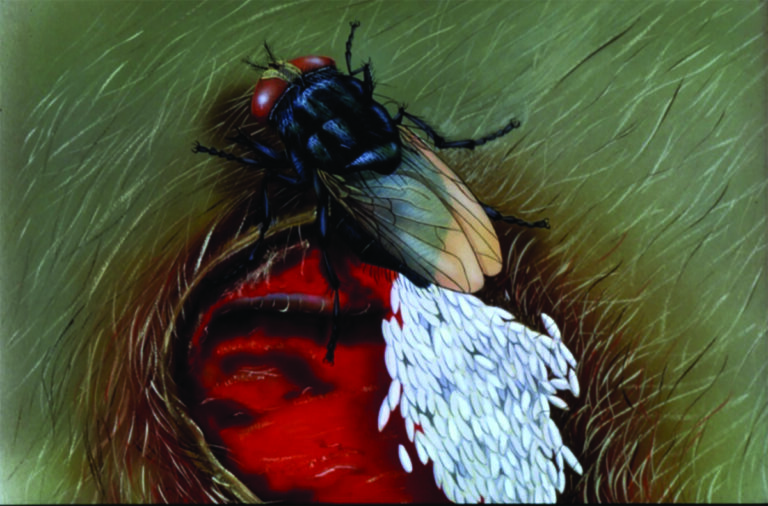
Screwworm flies enter animals through exposed wounds or other openings such as the mouth, ears, nose or eyes, laying eggs that form into maggots that eat away at the flesh and tissue of the creature. The USDA states on its website that signs of screwworm in mammals and birds include head shaking, irritated behavior, the smell of decay and the presence of maggots in open wounds.
As of Aug. 5, the USDA had confirmed 45 detections of New World screwworm in U.S. animals since June, including the Eunice dog. The USDA data shows only five cases, all in Texas, remain active. In all other cases, the animal has either recovered or mitigation efforts concluded.
In May 2025, the United States halted all imports of live animals from Mexico at ports of entry to protect U.S. livestock herds following a confirmed case of screwworm about 370 miles south of the U.S.-Mexico border.
A press release from the USDA, issued in July, stated that a port of entry in Douglas, Arizona, would be reopened to live agriculture on Aug. 24. After an evaluation of that reopening and the continued risks, livestock could again be allowed to flow from Mexico through ports of entry in Santa Teresa and Columbus, New Mexico at a date yet to be determined.
In August 2025, a coalition of farming and ranching advocacy organizations estimated in a letter to Secretary of Agriculture Brooke Rollins that an outbreak of New World screwworm could cause an overall economic loss of $10.6 billion.
Paterson applauded the federal government for taking measures, including suspending livestock from being brought across the border due to the risk of screwworm, but warned that such activity should only resume when the data says it is safe to do so.
State Rep. Mark Murphy (R-59) of Roswell asked Paterson how prepared he believed New Mexico was for potential future resurgences of the New World screwworm, and what kind of impacts the state could face.
Paterson responded that the association is continuing to monitor the situation, but that the fallout from an outbreak could have an enormous impact on ranchers and local officials tasked with monitoring herds and mitigating the spread of the screwworm.
Paterson recalled having asked Wayne Shockley, an extension agent in Eddy County, back in May, if there would be a capacity to do inspections on each individual animal if there was an outbreak of New World screwworm in southeast New Mexico.
He said that Shockey indicated the region was unprepared and that there were only two people qualified in that area to perform those inspections.
Paterson added that the New Mexico Department of Agriculture is moving aggressively to increase the number of people trained to perform such inspections but “if we get New World screwworm in New Mexico, it could have devastating consequences.”
In August 2025, a coalition of farming and ranching advocacy organizations estimated in a letter to Secretary of Agriculture Brooke Rollins that an outbreak of New World screwworm could cause an overall economic loss of $10.6 billion. Paterson urged caution on resuming cross-border trade.
“Restoring trade is economically important but it must proceed with rigorous surveillance, inspections and safeguards sufficient to preventing New World screwworm from being established in the United States,” he said.
Murphy also asked Paterson how he would grade the USDA so far on its response to New World screwworm. Paterson said he believes the USDA has done a very credible job and, through actions such as suspending cross-border trade of livestock, has bought time to put protocols in place.