Home Blog Page 204

Eddy County to ‘IGNITE’ change at jail

0

Mike Smith
Artesia Daily Press
msmith@currentargus.com

A nationwide program designed to help jailed inmates attain education and life skills after release has made its way to Eddy County.

The program, wielding the unwieldy name “Inmate Growth Naturally and Intentionally Through Education” – better known as IGNITE – was founded in 2020 by a sheriff in Genesee County, Michigan, and later replicated by the National Sheriff’s Association. Sheriff Mark Cage began the process of bringing it to Eddy County last January.

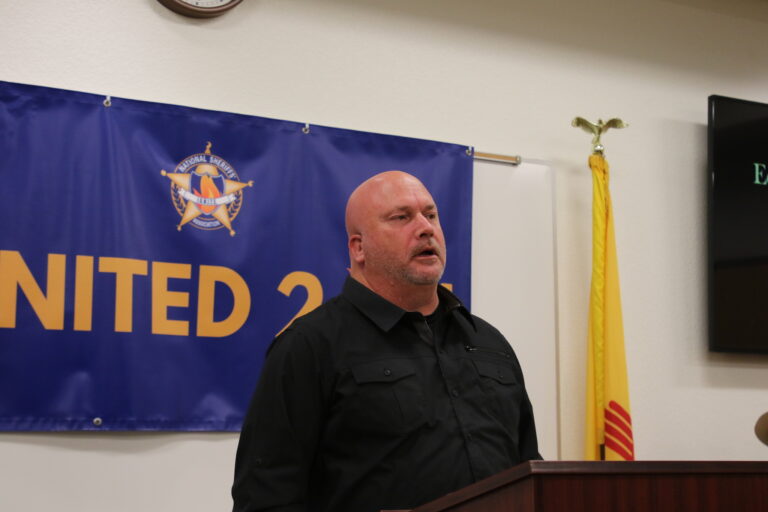
Cage made its arrival official during a Dec. 5 press conference at the sheriff’s office along with Billy Massingill, warden of the Eddy County Detention Center, and Fayette County, Pennsylvania, Sheriff James Custer who embraced the program after seeing it in action in Michigan.

Custer was instrumental in helping Eddy County get access to the program, according to Cage who called IGNITE “a hand up, not a handout.”

“This is good for our society,” he said. “I believe we’re going to bring down violence.”

Massingill said the program benefits not only inmates and jails but entire communities. He said IGNITE will advance Eddy County’s commitment to “improving our correctional facility and the lives of those within it.”

He said the program “will play a pivotal role in achieving that goal by reducing recidivism, enhancing safety and fostering positive change.”

Cage said partnerships with other Eddy County entities will be key to ensuring the program’s success.

“We need help from our community partners,” he said.

Southeast New Mexico College President Kevin Beardmore attended the press conference and affirmed support for the program. He said IGNITE gives inmates a chance to show society believes in them after they are released.

“When I hear them talking about this it makes all the sense in the world to me, and Southeast New Mexico College plans to be part of this,” he said.

Beardmore said the college will work with IGNITE to help prisoners prepare for life after confinement.

“I can immediately think of things in welding, commercial driver’s license, nurse’s aid that would probably fit in very well,” he said. “Really, it comes down to the nuts and bolts from one transition to another.”

Beardmore said offering classes in halfway houses or at the jail are possibilities for the school’s involvement with the program.

“Our college is all about second chances,” he said. “So many times, when you are looking to improve yourself through education you have family needs and work; it’s hard to squeeze everything in. The one thing that I have seen with a program like this is that transition – we’re the next step in the chain of hope that leads to the next step,” he said.

County spokesperson Savannah Cabezuela said Eddy County is the 20th site in the nation to adopt the IGNITE program and the first in New Mexico.

Mike Smith can be reached at 575-308-8734 or email at msmith@currentargus.com.

Fish still biting in December

0

New Mexico Department of Game and Fish

Winter is less than three weeks away but the fishing season continues at lakes and streams across southwest and southeast New Mexico.

In Lincoln County, fishing for trout was fair to good at Bonito Lake using olive-green Pistol Pete spinner flies.

At Corona Pond, fishing was good using earthworms.

Near Portales, fishing for trout was good using homemade dough bait.

Timberon Ponds in Otero County had good fishing conditions for trout using Orange PowerBait Trout Nuggets.

Near Truth or Consequences, fishing for catfish was fair at Elephant Butte Lake using worms and cut bait.

This fishing report, provided by the Department of Game and Fish in cooperation with Dustin Berg of www.gounlimited.org, has been generated from the best information available from area officers and anglers. Conditions encountered after the report is compiled may differ, as stream, lake and weather conditions alter fish and angler activities.

New Mexico producers are invited to meet with Mexican cattle buyers

0

ALBUQUERQUE, N.M. – New Mexico ranchers are invited to meet with Mexican cattle buyers from 9 a.m. to 12 p.m. Friday, Dec. 13, 2024, at the Hotel Albuquerque, located at 800 Rio Grande Blvd. NW in Albuquerque, New Mexico. The New Mexico Department of Agriculture (NMDA) is hosting the meeting in the International Room for attendees of the annual Joint Stockmen’s Convention, which will take place Wednesday, Dec. 11 through Saturday, Dec. 14.


New Mexico Secretary of Agriculture Jeff Witte looks forward to this opportunity for New Mexico producers.


“This buyers’ meeting at Joint Stockmen’s Convention serves as a dedicated space for cross-border discussions on livestock trade,” said Witte. “This setup allows ranchers from both countries to showcase cattle breeds, which helps sustain and grow the livestock genetics trade, and ultimately supports both local economies and the broader agricultural community by enabling valuable exchanges of knowledge and resources.”


Mexican buyers are interested in Angus, Hereford, Charolais, Santa Gertrudis and Brangus cattle breeds. Ranchers are encouraged to bring catalogs, photos, expected progeny differences and videos, as laptops will be available. Ranchers who have production sales are also encouraged to attend the meeting.


Ranchers attending the meeting do not have to be members of the New Mexico Cattle Growers Association (NMCGA), but they must register for the Joint Stockmen’s Convention. Ranchers interested in attending the meeting must also notify NMDA Marketing Specialist Juan Sanchez at 575-339-5047 to ensure proper sign-up. Registration for the event can be found on the NMCGA website. For more information about the convention, call 505-247-0584 or email nmcga@nmagriculture.org.


For more information regarding the international meeting, or if you are unable to attend, contact NMDA Marketing Specialist Juan Sanchez at 575-339-5047 or jsanchez@nmda.nmsu.edu.


Photo 1: International Room

Cutline: The New Mexico Department of Agriculture (NMDA) is hosting a meeting Friday, Dec. 13 in the International Room for attendees of the annual Joint Stockmen’s Convention, which is from Wednesday, Dec. 11 through Saturday, Dec. 14. This meeting will include buyers from Mexico along with producers across the state of New Mexico. The meeting will allow both parties to discuss the industry and will build opportunities for the future. (Photo courtesy of New Mexico Department of Agriculture)
Photo 2: Cattle Buyers<n>Cutline: The New Mexico Department of Agriculture (NMDA) is hosting a meeting Friday, Dec. 13 in the International Room for attendees of the annual Joint Stockmen’s Convention, which is from Wednesday, Dec. 11 through Saturday, Dec. 14. This meeting will include buyers from Mexico along with producers from across the state of New Mexico. The meeting will facilitate networking and new learning opportunities for both parties. (Photo courtesy of New Mexico Department of Agriculture)

<n>

Higher ed and ‘playtime for adults’

0

By Sherry Robinson
All She Wrote

I’m going to tell you a story about entitlement, misuse of public money, poor judgment, and fuzzy ethics. The only reason we know about it is because one journalist, doing his job, brought it to the public eye. Other media outlets followed suit and the State Auditor investigated. It’s now before the state Ethics Commission.

A year ago Joshua Bowling at the online Searchlight New Mexico broke this story: Since 2018, Western New Mexico University President Joseph Shepard had spent nearly $100,000 on travel to Zambia, Spain and Greece to recruit international students and their higher tuition dollars. With him at times were other university executives, members of the WNMU Board of Regents and his wife, former spy, author and congressional candidate Valerie Plame.

“All have traveled on the university’s dime,” Bowling wrote.

Also, Shepard spent nearly $28,000 in university money at a high-end Santa Fe store to furnish his on-campus house. It was necessary for entertaining potential donors, he told Bowling. “The president’s house has to look presidential. People expect it.”

The university tab has included $12,000 to lease a 5,400-square-foot home in Santa Fe for two months and $25,500 to send six people to the Ritz-Carlton Rancho Mirage, a resort in Palm Springs, California, for a seminar that was also available online.

WNMU has 3,500 students; 64 of them are foreign. Silver City’s economy depends on copper mining, tourism and the college. The median income of its 9,300 population is $21,000, and nearly 30% of its people are poor.

Regents have raised Shepard’s salary by $87,000 to $365,000 since 2020. And they’ve ignored two red flags.

In 2019, the school’s financial director resigned. Cheryl Hain told Bowling: “As a director of financial aid who can go to jail for the s— the school is doing… this is not worth the risk to me. Our taxpayers are funding playtime for adults.”

In 2018 the vice president of business affairs, Brenda Findley, sued regents over

Shepard’s “improprieties.” He ordered raises for employees he liked and directed university janitors to clean his house, run errands, cook meals and do laundry. When Findley complained, he fired her. Regents settled the lawsuit in June with a payout to Findley.

The Silver City Daily Press published the Searchlight story, along with a response from Shepard justifying the spending. It also reported on a crowded regents’ meeting in which many defended Shepard and criticized the Searchlight story as sensational and unfair. Searchlight then said the newspaper could no longer use Searchlight material.

The Santa Fe New Mexican chimed in early this year, reporting that the state Higher Education Department chastised Shepard in a letter for not performing a cost-benefit analysis on overseas travel spending and for issuing a state procurement card to his famous wife, who is not an employee. The department suggested suspending overseas travel until the benefits could be determined.

WNMU regents blew off the department. Their lawyer wrote back that WNMU was not part of state government. Translation: We don’t answer to you.

Next the State Auditor began investigating and on Nov. 19 stated that between 2018 and 2023, WNMU violated its own policies with $363,525.99 in wasteful and improper spending. The auditor’s report got wide news coverage.

Regents claim to be addressing the auditor’s “strong concerns,” but on a performance review last summer they gave Shepard high marks plus a $50,000 bonus. And they’ve ordered an independent audit. Wait, isn’t that what the State Auditor has already done?

Here we see two kinds of journalism. Searchlight dug into the numbers of a small-town institution and wielded an outsider’s objectivity. The Daily Press covers WNMU every day and sees the institution’s shades of gray.

At a time when real journalism is under fire, both approaches serve an informed readership.

Sherry Robinson is a longtime New Mexico reporter and editor. She has worked in Grants, Gallup, the Albuquerque Journal, New Mexico Business Weekly and Albuquerque Tribune. She is the author of four books. Her columns won first place in 2024 from New Mexico Press Women.

Mike Gallagher named Eddy County manager

0

Adrian Hedden and Mike Smith
Carlsbad Current-Argus
achedden@currentargus.com
msmith@currentargus.com

Former Lea County Manager Mike Gallagher has been selected as county manager for Eddy County.

Gallagher’s appointment was announced Thursday, Dec. 5. He replaces Steve McCutcheon, who served as interim county manager for about four months after Roberta Gonzales stepped down as county manager in August.

Gallagher will assume the manager’s post Jan.1 He said his contract included a $249,500 salary for an indefinite period, a slight increase from the $246,000 he was paid in Lea County.

The county manager oversees day-to-day operations and all of Eddy County’s government departments, including its regional fire service, sheriff’s office, clerk’s office and public works department.

He said he looks forward to leveraging his experience in Lea County and its similarities with Eddy as a leading oil and revenue producer for the state.

“I think there’s a lot in common with Eddy and Lea County economically, and our way of life,” Gallagher said. “I’ve represented Lea County at the federal, state and local levels and I believe that will be applicable in Eddy County.”

Lea and Eddy counties share the Permian Basin in the southeast corner of the state and are New Mexico’s top producers of oil and gas. Eddy and Lea were also the fastest growing counties in the state since 2010, according to the 2020 U.S. Census. Eddy County’s population growth during that period was 15.8% and Lea County’s population increased by 15%.

The region is a “driver” for the state, Gallagher said, due to its heavy oil and gas production. It’s a story he said needs to be told on a state-wide level, not just for the benefits but the costs associated with supporting the industry for needs like road maintenance.

He said during his tenure as county manager, Lea County partnered with oil and gas companies to help fund projects, but also coordinated projects with extraction operations “to minimize interruptions and make sure our roads are safe.”

“I think Eddy and Lea counties, with other counties, we have the ability to educate the state on some of our local costs with oil and gas,” Gallagher said. “A lot of counties are envious of Eddy County. Eddy County is very blessed. Not a lot of counties are sympathetic that we don’t get our fair share (of revenue) back.”

Eddy County Commission Chair Bo Bowen said 12 people applied for the job, and the field was narrowed to six before Gallagher was chosen.

Bowen said he looked forward to working with Gallagher.

“I was pleasantly surprised he put in his resume and intent to interview with Eddy County,” Bowen said. “From my perspective, he was the right candidate. His expertise, his leadership, his experience in a similar county is going to transfer well to Eddy County.”

Gallager served as Lea County’s manager for about 14 years beginning in December 2010, according to his LinkedIn page. During that time, he oversaw an annual budget of about $680 million and more than 400 employees, the page read.

Gallagher worked as an advanced urban and regional planner at the New Mexico Department of Transportation in the Las Cruces region from 2008 to 2010, and as an urban planner with Dona Ana County from 2005 to 2008.

Gallagher brings with him to Eddy County his wife Rachel Gallagher, who serves and will continue to as a vice president at New Mexico Junior College in Hobbs, along with his son and four daughters ranging in age from 21 to seven.

He’s originally from St. Louis, Missouri and attended college, like his wife, at New Mexico State University before moving to southeast New Mexico in 2010.

“I think Eddy County is a great community,” he said. “Me and my family love Artesia, love Carlsbad and the river walk. “Folks (in Eddy County) have a desire to make some impressive legacy decisions, to flourish and be a leader in the state. Eddy County has all the right ingredients.”

McCutcheon, who retired as Carlsbad city administrator in 2018, served mostly in an advisory role ahead of Gallagher’s appointment, collecting a salary of $10 a month during his time with the county.

Gonzales took the county manager job in 2023 to replace retiring Al Davis. She was promoted from the county finance director position she held for the previous nine years. Gonzales returned to that job after stepping down as county manager.

New Mexico can “move the needle” with a regulatory sandbox

0

By Paul Gessing

Among the numerous economic policy areas that hold New Mexico back is its heavy regulatory burden. Unnecessarily heavy regulations on business can make it harder than necessary to start and grow a business in New Mexico. The good news is that at least some regulatory reforms show real potential for bipartisanship in Santa Fe.

New Mexico could (and should) take a step toward regulatory reform by embracing what are known as “regulatory sandboxes.” In 2023 Albuquerque Democrat Rep. Meredith Dixon introduced an innovative form of legislation (HB 356), “The Technology Sandbox Act.”

While it didn’t pass or get so much as a hearing in 2023, the concept is relatively new to New Mexico and needs to be at least heard and discussed in legislative committees in the upcoming 60-day session. The concept of “regulatory sandboxes” is one that could be applied successfully to other areas of the State economy.

First and foremost, what is a “sandbox?” Simply put, it is a regulatory “space” for entrepreneurs and innovators, from small start-ups to large corporations, to try new ways of doing things without excessive, outdated regulations. Sandboxes allow regulators the flexibility to safely monitor and foster new ideas instead of simply shutting them down.

The concept didn’t come from a “red” state like Texas or “blue” state like California. It started in the UK in 2014 for financial technology innovations and quickly spread to other countries. In the US, several states targeted the fintech, insurance, and property tech industries while more states have begun to look at the industries of agriculture, healthcare, and energy.

Industry-specific sandboxes are a good way to start, but the goal is to allow for a universal sandbox to provide flexibility to all industries, creating a fair process that boosts economic growth while empowering businesses both big and small. Four states (Arizona, Kentucky, Utah, and now Missouri) have these broad sandboxes.

Outdated and unnecessary regulations don’t just hurt business people. We can’t know how many business ideas either fail or aren’t attempted due to archaic regulations that are inapplicable to modern models. Sandboxes let businesses do what they do best: solve problems for consumers.

Hopefully New Mexico’s newly minted and much-changed Legislature will take a more business-friendly approach to all manner of public policy issues starting with the upcoming 60-day session. With a more moderate approach we can certainly hope that a focus on actually growing our economy and diversifying it while continuing to benefit from the oil and gas boom would be winning approaches for Republicans and Democrats alike.

We have made the case for tax reform and reduction, but New Mexico’s thicket of regulations also holds us back. Regulatory “sandboxes” are a bi-partisan approach that is worth exploring this session.

Paul Gessing is president of New Mexico’s Rio Grande Foundation, an independent, nonpartisan, tax-exempt research and educational organization dedicated to promoting prosperity for New Mexico based on principles of limited government, economic freedom and individual responsibility.

Light Up Artesia is happening tonight!

0

From: Artesia Daily Press Reports

Artesia MainStreet’s annual Light Up Artesia event will kick off the holiday season Dec. 5 with a full day of shopping, the annual Christmas tree lighting and the traditional Parade of Lights.

Shoppers can support local businesses during Shop Local from 11a.m. to 8 p.m., strolling through Main Street shops or visiting the indoor Pop Up Vendor Market at 302 W. Main Street.

The festivities rev up at 5 p.m. with the lighting of Artesia’s Christmas tree at the Derrick Floor and continue with the Parade of Lights featuring colorful floats and twinkling lights.

Parade staging will be at the Bulldog Bowl parking lot from 5-5:45 p.m. The parade gets underway at 6 p.m.

The parade route runs along Main Street and ends at 2nd Street. Spectators can enjoy the show from any point along Main Street but organizers advise parade watchers to arrive early to grab their favorite viewing spots.

For more information, visit www.artesiamainstreet.com.

Eddy County tax collections increase

0

Mike Smith
El Rito Media
msmith@currentargus.com

Eddy County collected $5.9 million in sales taxes for October, finance director Roberta Gonzales reported during the county commissioners meeting Dec. 3.

Gonzales said the total was $2.1 million more than October 2023.

Oil and gas tax collections for October were $7.8 million, Gonzales reported.

“We’re up almost $4 million from last fiscal year,” she said.

October’s oil and gas tax receipts represent July business activity, she said. “For July’s business activity, we collected 26 million barrels (of oil) at about $76 a barrel.”

Gonzales said the county’s tax revenue from the oil and gas industry is based on West Texas Intermediate sweet crude oil prices.

“They are the most accurate with (the) current landscape in Eddy County,” she said.

As of Dec. 3, Gonzales said, the county was taxing an average of 24.5 million barrels of oil a month at a price of $78 per barrel.

Oil and gas tax collections could increase in Eddy County between now and the end of the 2024-25 fiscal year on June 30, Gonzales said.

The county has budgeted $5 million per month in revenue from oil and gas taxes, she said, except for December when $14 million was budgeted.

Gonzales said the additional revenue in December is generated by oil and gas equipment taxes not budgeted in other months.

Mike Smith can be reached at 575-308-8734 or email at msmith@currentargus.com.

Artesia to begin tournament play

0

At 10 a.m. Thursday at the Bulldog Pit, the Artesia Bulldogs start the 2024-2025 season against Kirtland Central in the opening round of the City of Champions Classic.

At 11:30 a.m. Thursday, the Lady Bulldogs start the tournament against Goddard. 

Here is the complete bracket.

Council approves Officer Safety Plan

0

By: Rebecca Hauschild

The Artesia Police Department’s use of high-tech tools to fight crime will take another step forward with the purchase of a $470,000 Officer Safety Plan bundle from Arizona-based weapon/technology developer Axon.

The city council approved the purchase and related budget adjustments along with several other budget changes during its meeting Nov. 26.

Axon Enterprise Inc. of Scottsdale, Arizona, manufactures and markets the Taser, which police officers use to incapacitate criminal suspects with electrical current. Axon’s Officer Safety Plan bundle includes the latest version of the Taser, officials said, as well as virtual reality training, streamlined reporting, body cameras and interview room recorders.

The Axon contract will be a recurring expenditure, according to Summer Valverde, Artesia’s city clerk/treasurer.

“We will be replacing about $192,000 in expenditures that are currently within our 2025 budget, so the net is $201,000,” Valverde said. “The total contract is $470,000 but the LEPF fund is going to pay for some of the hardware that will come in the bundle.”

Another budget change will provide city employees with extra pay for maintaining their employment. As part of the budget adjustment resolution, the council approved $3300 in retention pay for employees in departments other than fire and police. The cost of the program is $449,000, Valverde said.

Other items in the fiscal year 2025 budget adjustment resolution included grants received from the Federal Aviation Administration for the taxiway rehab project at the Artesia airport; a $495,000 grant received for a water well project; and a $26,500 increase in expenditures for the law enforcement retention fund.

In other action:

• Community Development/Infrastructure Director Byron Landfair reported that Jaycee Park will be open for winter hours, 8 a.m. to 8 p.m., and the new restrooms will be open during those hours.

• Landfair offered a progress report on 26th Street bridge work. “The northbound lane got poured this week,” he said. “They are starting to work on pads and suspension pieces underneath. As a reminder, please be mindful when you detour in that area and watch for kids playing.”

• Valverde discussed the government committee’s recent review of architecture designs for remodeling the airport: “We are waiting for bids on the hangar, but plans are to have the hangar building and taxiway rehab done by the end of February 2025.”