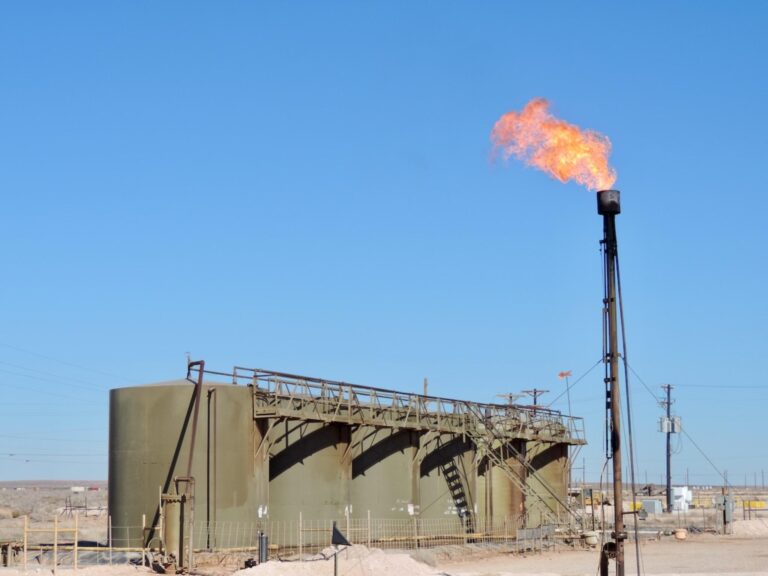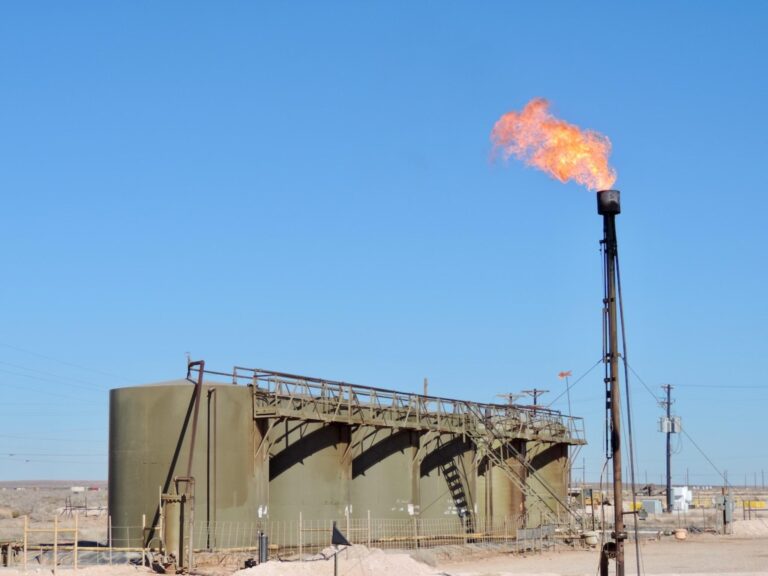
Oil and gas facilities deemed “super emitters” of methane could face more stringent state rules if a pair of proposed regulations take effect.
The New Mexico Environment Department on July 16 proposed new rules intended to reduce methane emissions in the state’s two oilfields: the southeast Permian Basin and northwest San Juan Basin.
Notably, the proposal would establish a “Super Emitter Program” that would define such a facility as one emitting at least 50 kilograms per hour in a single event. The proposal also includes language allowing the use of third-party data taken from satellite readings or other sources outside of state agencies in identifying such emissions.
Third parties would be certified by the state of New Mexico, and when a plume is discovered, the environment department would notify the owner of the site and require the company to conduct an investigation and report on steps taken to mitigate the emissions.
The proposed regulations also include a requirement that by 2031 all oilfield facilities, including those currently in operation, must be outfitted with zero-emission electric pneumatic pumps rather than more emission-prone gas-driven pumps.
The environment department collected feedback from the public and other stakeholders, including oil and gas and environmental groups, during a public comment period that ended July 29.
The agency intends to propose the rules to its governing body, the Environmental Improvement Board, “in the next couple of weeks” said Environmental Protection Division Director Michelle Miano.
The board will hold its own public meetings and vote on approving or rejecting the rules.
‘One step further’
The proposal follows rules enacted in 2022 to address ground-level ozone, or “smog,” produced when volatile organic compounds are emitted by oilfield sites and interact with sunlight. The regulations increased reporting requirements for oil and gas operators on their emissions of the compounds – a group of air-polluting chemicals identified by the state as ozone “precursors.”
The latest proposal is part of Gov. Michelle Lujan Grisham’s broader agenda – implemented in 2019 via an executive order as she first took office – to cut air pollution emissions throughout New Mexico with a goal of 100% “carbon-free” energy production by 2045.
Miano said the methane proposal “is one step further along the path” of achieving the governor’s goals and would also help prevent gas from being released into the air – keeping more of it “in the pipe” so it can be processed at a refinery or other facility or sold to downstream customers.
“Not only is it a potent greenhouse gas but a valuable product. We want companies not to waste it,” she said.
But Missi Currier, president of trade group the New Mexico Oil and Gas Association, questioned the timing of new rulemaking in the final months of the Lujan Grisham administration and so soon after the state’s previous round of air quality regulations.
The governor is term-limited and will leave office at the end of 2026 after serving two four-year terms.
Currier also criticized what she characterized as limited public involvement, noting that the state’s previous ozone rules were devised after a multi-year rulemaking process involving extensive discussion and multiple public hearings.
“We are concerned that the current compressed timeline will not allow enough time for robust stakeholder input and collaboration in developing and completing the rulemaking process,” Currier said.
The proposed rules, she said, create “inconsistencies with current state and federal regulatory frameworks and could negatively impact business across the state.”
Oil and gas companies, Currier said, are already taking steps to limit air pollution and currently “invest billions of dollars” in technologies to do so.
“The New Mexico Oil and Gas Association supports practical, science-based measures that reduce methane emissions while maintaining safe, reliable, and affordable energy production,” Currier said.
Although many oil and gas operators do monitor and mitigate such gas leaks, Miano said, the new rules are needed to create “a level playing field” by requiring all companies to follow the same standards.
“We know that there are already investments coming into the Permian for facilities, so if you are in compliance there should not be a huge surprise because you’re already doing the work,” she said. “If you’re not, we want to make sure that you are.”
The rules drew support from environmental groups arguing they were a needed step in reducing the impacts of New Mexico’s booming oil and gas industry centered in the southeast and to counteract anti-regulatory measures enacted by the administration of President Donald Trump.
“New Mexico is standing against the Trump administration’s reckless attack on our health and standing up for state climate action,” said Nini Gu of the Washington, D.C.-based Environmental Defense Fund, which sued the Environmental Protection Agency in June in response to the proposed cancellation of methane standards enacted under Trump’s predecessor Joe Biden. The organization also opposed a July 7 EPA plan allowing state agencies to shorten public comment periods when considering permits for facilities releasing carbon emissions.
“By advancing this new methane rule,” Gu said, “Gov. Michelle Lujan Grisham builds on New Mexico’s methane leadership and reinforces her legacy as a national leader in cutting oil and gas methane waste and pollution.”
Managing Editor Adrian Hedden can be reached at 575-628-5516, or @AdrianHedden on the social media platform X.