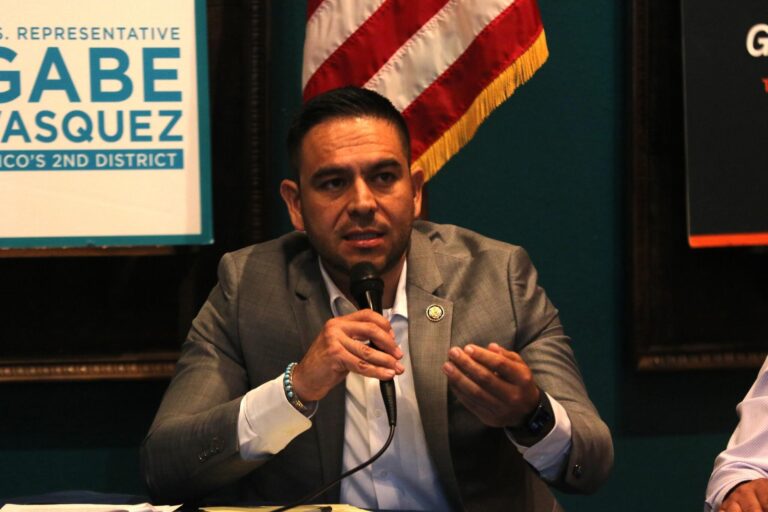
Concern that public lands could be sold to industry led U.S. Rep. Gabe Vasquez to try to limit the practice via a bill in Congress.
Vasquez (D-NM) represents New Mexico’s 2nd Congressional District, which encompasses most of the southern portion of the state including the Permian Basin oilfield to the southeast.
He’s seeking reelection in the Nov. 3 general election against GOP nominee Gregory Cunningham, a former deputy with the Bernalillo County Sheriff’s Office.
Vasquez is also co-chair of the House Public Lands Caucus, alongside former Interior Secretary Ryan Zinke (R-MT). The caucus is a bipartisan coalition of House members focused on legislation related to public lands policy across the U.S.
In Vasquez’s district, more than half of the oil and gas production that drives about half of the state’s revenue occurs on federal public land leased and managed by the Bureau of Land Management, a subagency of the Department of Interior.
The Public Lands Integrity Act, which Vasquez introduced Friday, June 5, would make it more difficult to sell those lands. The bill was cosponsored by Vasquez, Democratic Reps. Joe Neguse of Colorado and Dina Titus of Nevada, and Republican Rep. Juan Ciscomani from Arizona.
If passed, the bill would block any provision involving the sale or transfer of federal public land from being included in the budget reconciliation process, which is used by congressional committees to propose amendments to the annual federal budget.
The action would mean such a measure would require 60 votes in the Senate to take effect, rather than the simple majority of 51 votes required to pass a reconciliation bill.
Reconciliation bills also go through an expedited process that bypasses a required one-day delay in voting on a bill after it is introduced. In addition, senators are barred from stalling the bill by debating a motion to proceed.
Debate on a reconciliation bill is limited to 20 hours.
If passed, Vasquez’s bill would dictate that any public land sales would be considered “extraneous” under a section of the Congressional Budget Act known as the “Byrd Rule.” The rule details reasons why a proposal would be blocked from the reconciliation process.
Included are clauses that the measure is considered extraneous if it does not produce changes in revenues or spending, is outside the authority of the committee proposing the clause or increases the deficit beyond the years covered by the budget at issue.
Under Vasquez’s bill, the sale, transfer or disposal of public lands would be included in the Byrd Rule.
Vasquez said a public lands sale should go through the consideration of the full Congress, not through the expedited budget process.
“Public lands are America’s best idea, and they belong to all of us and must remain in the public trust,” Vasquez said. “Treating public lands as another item on a balance sheet goes against the will of the people, and Americans have made it clear that our public lands are not for sale.”
Zinke, who did not sign on as a sponsor but voiced support for the bill, said it would prevent any lawmaker from “circumventing” the traditional procedure requiring a two-thirds vote of the Senate to sell public lands.
“Any proposal involving the future of America’s public lands deserves full public debate, conducted in the light of day and with the highest level of scrutiny,” Zinke said in a statement. “This bill helps ensure that the public will always have a seat at the table when it comes to protecting our public lands.”
Concerns for public land ‘sell-off’
The bill was the latest manifestation of concerns by conservationists and members of Congress that Republicans, including Interior Secretary Doug Burgum and recently confirmed Bureau of Land Management Director Steve Pearce, intended to permanently sell lands managed by the federal government to private companies.
Last June, the GOP-led Senate Energy and Natural Resources Committee proposed a reconciliation bill during the budget process that would have made 250 million acres of public land in the American West – including 14 million acres in New Mexico – eligible for sale, according to a report from national conservation group the Wilderness Society.
But during his February confirmation hearing before that same committee, Pearce, a former Republican congressman representing the same district as Vasquez, said he did not believe the Interior Department planned “large scale” public lands sales and he would look to Congress for guidance on future direction and policies.
“From my time in office, I know that I would have understood better than another director of the BLM the sensitivity of this piece of land or that piece of land,” Pearce said.
Burgum and Scott Turner, Secretary of Housing and Urban Development, formed a joint task force in March 2025 aimed at finding “underused federal properties” that the agencies could “transfer or lease” to other entities to build housing developments, according to a Burgum and Turner commentary published in the Wall Street Journal.
“Working together, our agencies can take inventory of underused federal properties, transfer or lease them to states or localities to address housing needs, and support the infrastructure required to make development viable – all while ensuring affordability remains at the core of the mission,” the Cabinet members wrote.
Such proposals drew outcry from Democrats who accused the GOP of attempting to sell off public land to fund other spending initiatives such as increased border security and immigration enforcement.
U.S. Sen. Martin Heinrich (D-NM), who is the ranking member of the energy and natural resources committee and opposed Pearce’s confirmation because “he called for the selling off of public lands,” cosponsored the Senate version of the bill.
“The Public Lands Integrity Act will protect access to our public lands by preventing Senate Republicans from selling them off to bankroll massive, unchecked spending on ICE and Border Patrol – or to finance future tax giveaways for their billionaire donors,” Heinrich said.
Managing Editor Adrian Hedden can be reached at 575-628-5516, or @AdrianHedden on the social media platform X.