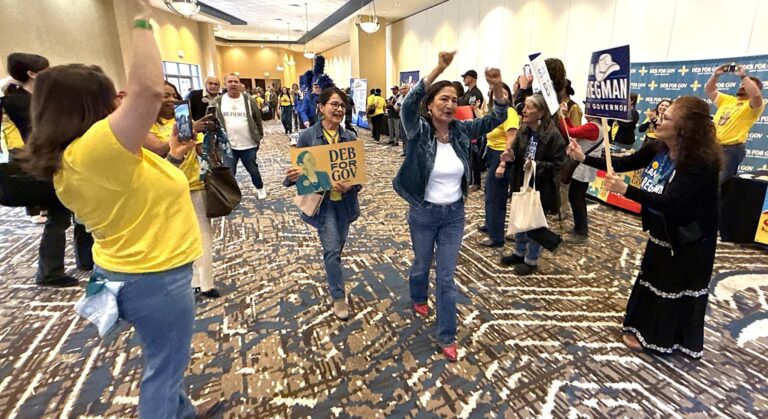
Former U.S. Interior Secretary Deb Haaland was poised to be the Democratic nominee for governor, as the Associated Press called Tuesday’s Primary Election in her favor.
The race was called as Haaland led with 87,128 votes or 72.4% of the electorate, according to unofficial results from the Associated Press.
That’s with about 51% of votes counted as of 8:30 p.m., the AP reported.
As the race was called, Bernalillo County District Attorney Sam Bregman tallied 33,142 votes or 27.6% of the electorate.
Haaland declared victory minutes after the race was called in a Facebook post.
“New Mexico, thank you for believing in what we can build together,” read the post. “I’m honored to officially accept the Democratic nomination for Governor of New Mexico.”
Vote tallies are unofficial until canvassed in a special meeting by a county commission where the ballots were collected. The Democratic and Republican nominees who win in the Primary Election will face off for the Governor’s Office in the Nov. 3 General Election.
Haaland, 65, served in the U.S. House of Representatives for one term from 2019 to 2021 when she was tapped by former-President Joe Biden to lead the Department of the Interior, which notably oversees the Bureau of Land Management, the agency tasked with managing public land uses including oil and gas drilling.
The interior department also leads the National Park Service and the U.S. Fish and Wildlife Service.
Throughout her campaign for the party’s nomination, Haaland was in favor of tighter regulations on fossil fuel production while supporting other forms of power such as renewable energy.
In an interview with El Rito Media ahead of election day, Haaland criticized the administration of President Donald Trump for opening up more public lands to industries such as potential uranium mining in Carson National Forest. She said indigenous leaders should be consulted before such plans move forward.
“If I’m the next governor, I’m going to press them to make sure they are actively doing tribal consultation because that isn’t happening with the Trump administration,” Haaland said in the interview. “The tribes have a real say in what happens on these lands.”
Bregman, 63, was appointed as the Bernalillo County District Attorney in January 2023 by current Gov. Michelle Lujan Grisham, and he oversees criminal cases and litigation in New Mexico’s most populous judicial district. He also previously served as assistant district attorney for New Mexico’s Second Judicial District, deputy state auditor and served on the Albuquerque City Council.
He tapped into his criminal justice experience in his interview with El Rito Media, calling for better mental healthcare to address drug addiction, which Bregman said is responsible for up to “50 of the new cases we get every morning” in Bernalillo County.
“I can’t prosecute my way out of this problem,” Bregman said. “If you’ve been arrested four or five times for using illicit drugs that are felonies and are a homeless person, we have to involuntarily commit you.”
Hull leads in GOP Primary for governor
For the GOP, Former Rio Rancho Mayor Gregg Hull was leading with 31,696 votes or 47.8% as of 8:30 p.m., according to the Associated Press.
Taos businessman Doug Turner was second with 24,357 votes or 36.8% of the electorate, while Duke Rodriguez tallied 10,204 or 15.4% of the vote, according to unofficial results from the Associated Press.
Hull argued for New Mexico to be more “business friendly,” and touted his experience at the helm of New Mexico’s third-biggest city in Rio Rancho while recruiting new, high-tech industries and companies such as California-based aerospace company Castelion, which earlier this year began construction of a missile manufacturing plant about three miles outside the city’s limits.
The plant is a $220 million project expected to create 300 jobs and $650 million in economic impact over the next decade, according to the company’s website.
“I think to make ourselves more attractive, it is developing and building a strong workforce, a good pipeline of workforce, kids coming up the pipeline when it comes to construction jobs, so on and so forth,” he said during an interview with El Rito Media.
During his campaign Turner, 57, pointed to his experience as a business owner of Albuquerque-based public relations firm Agenda Global, pointing to quality-of-life issues such as crime and public education as crucial to attracting new businesses to New Mexico and growing its economy.
“They (companies) have to have schools that they can send their kids to and feel like they’re getting the education that their kids deserve,” Turner said in an interview with El Rito Media. “They want their kids to be able to go out and play and not get shot. I mean, this stuff happens all the time.”
U.S. Senate
U.S. Sen. Ben Ray Lujan (D-NM) was declared the victor by the AP in the Democratic primary against Matt Dodson, with 81,110 votes or 85.9% for the incumbent. Dodson had 13,317 as of about 8 p.m. when the race was called for 14.1% of the vote.
“In the Senate, I will keep fighting to lower costs, protect access to health care, help families put food on the table, and ensure New Mexico’s kids can grow up in safe, strong communities,” Lujan said. “I will continue standing up to the Trump administration’s cruel agenda and working to make sure federal investments reach every corner of our state.”
U.S. House
Incumbent U.S. Reps. Gabe Vasquez for the Second Congressional District, Melanie Stansbury for the First Congressional District and Teresa Leger Fernandez for the Third Congressional District were unopposed in the Democratic Primary.
“Thank you to all the voters across this district that put their faith in me and chose me to represent them in Congress,” Vasquez said in a statement the night of the primary. “There is no doubt this will be another competitive general election, but I know that New Mexicans are ready to fight for what is important.”
So was Martin Zamora for the GOP nomination to the Third District and Didi Okpareke for the First District. Gregory Cunningham was declared the winner by AP in his bid for the GOP nod to the Second District with 13,083 votes or 85.6% of the electorate over Jose Orozco, who tallied 2,205 votes, 14.4% of those available.
Lt. Governor
The Associated Press also called the race for the Democratic nomination for Lieutenant Governor handing the apparent victory to current New Mexico Secretary of State Maggie Toulouse Oliver with 76,285 or 81.8% of the vote, compared to State Sen. Harold Pope’s 16,977 votes or 18.2%.
State Sen. David Gallegos was in the lead for the GOP nomination at 47.7% of the vote or 20,939, compared with 17,735 votes or 40.4% for Attorney Aubrey Blair Dunn as of 8 p.m..