Adrian Hedden
Carlsbad Current-Argus
achedden@currentargus.com
Federal nuclear waste managers denied elevators that bring radioactive refuse underground for disposal at a repository near Carlsbad were in disrepair or endangering workers, despite a series of concerns expressed by state officials and federal oversight agencies.
The Waste Isolation Pilot Plant, about 30 miles east of Carlsbad, is where transuranic (TRU) nuclear waste from federal labs and facilities around the country is disposed of via burial in a salt deposit about 2,000 feet underground.
The waste, made up of clothing materials, equipment and other debris irradiated during nuclear activities is disposed of when the salt gradually collapses, burying the refuse and blocking radiation from escaping.
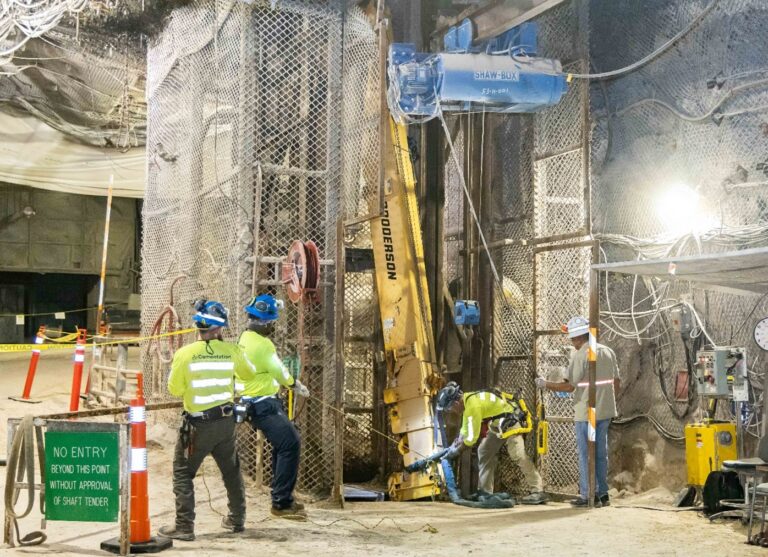
Moving workers in and out of the underground requires the use of three hoists. The main elevator can move people and waste into the underground, while a lift carrying salt to the surface can also be used for workers. A third hoist doubles as an air intake shaft. A fourth shaft serves only for exhaust and has no lifting ability.
The New Mexico Environment Department in July issued a compliance order, citing several provisions of WIPP’s 10-year state operations permit that the agency said the U.S. Department of Energy and its contractor Salado Isolation Mining Contractors (SIMCO) were violating in regard to the condition of the elevators and other underground infrastructure.
That was followed by a response from the energy department and SIMCO on Aug. 25, with the permittees denying all the state’s allegations and arguing that a recent increase of waste shipments – to 17 per week – accepted at WIPP was evidence that there was little interruption in operations due to worker safety, infrastructure issues or any other reason.
The Department of Energy and SIMCO’s “highly effective infrastructure management approach and system health monitoring protocols have allowed WIPP to increase operational capabilities over the last two years notwithstanding aging infrastructure,” read the denial. “WIPP has not experienced a situation where personnel safety has been compromised by aging infrastructure.”
Environment Department Cabinet Secretary James Kenney said during a Sept. 10 interview that the denial and what he said were continuing infrastructure issues at WIPP were putting workers in jeopardy.
“What I am surprised about is that SIMCO as a co-permittee would challenge the functional health and wellness of systems that could put their employees at risk,” Kenney said. “It really speaks to how they value their own employees in New Mexico. If I worked there, I would question my employer.”
Contained in the federal government’s denial of the state’s compliance order was a request for a hearing, which was yet to be scheduled. Kenney said the denial and request were within the agency’s rights as state permit holder.
Deputy Cabinet Secretary John Rhoderick will preside over the hearing and be the “decision maker” on the final order, Kenney said.
Kenney said the findings that led to the order, which outlined five separate permit violations, were indicative of widespread safety problems at WIPP.
“It does not surprise me that the DOE and SIMCO are taking a position that is adversarial to the operations that are needed for safe operation of WIPP,” Kenney said. “Safety doesn’t seem to be the priority.”
As outlined in the state order, violations were found in the alleged failures to maintain infrastructure, including the hoists and underground electrical substations, along with evacuation equipment and data on the condition of WIPP’s infrastructure.
The environment department also contended the federal government did not properly document equipment inspections or adequately prove the hoists could withstand dangerous events such as earthquakes.
Similar concerns were described in a June 25 report from the U.S. Government Accountability Office (GAO) and another on June 18 by the Defense Nuclear Facilities Safety Board (DNFSB) – both agencies within the federal government, and both cited by the state of New Mexico in its order.
The federal government’s denial letter argued that the reports issued by the GAO and DNFSB were not enforceable by the state, and not adequate evidence the permit was violated.
“We have frequently written to the GAO and the DNFSB and have said we don’t think WIPP is properly resourced,” Kenney said. “I’m glad that both those organizations have leaned in and taken a look at WIPP.”
The order will stay in effect until the environment department and the federal government reach a settlement agreement, which could include fines, or until the energy department is able to certify it has taken correction actions.
But the entire dispute could be unnecessary, said Jack Volpato who chairs the Carlsbad Mayor’s Nuclear Task Force. The task force advocates for WIPP’s continued operations and for other nuclear developments in the area.
“I think it’s overreach,” Volpato said of the state’s compliance order. “Right now, the mine is safe and there is no danger to anyone going down there.”
He pointed to several ongoing projects such as upgrades to the salt shaft and a newly installed ventilation system and fire water loop in operation at WIPP, which Volpato said would ensure safe operations for years to come.
“They’ve sunk millions of dollars into these projects. Maintenance and renovation are going on constantly,” Volpato said. “There’s a whole list of projects.”
A challenge for maintaining WIPP’s infrastructure could arise when the federal budget, which funds agencies such as the Department of Energy and its facilities such as WIPP, is released for the next fiscal year.
Federal fiscal years run from Oct. 1 to Sept. 30 of each year, and Volpato said there was some concern that efforts by the administration of President Donald Trump to shrink government spending could mean less funding for WIPP.
“We have come to the realization that this is an ongoing project and will need to be funded accordingly,” he said. “The DOE recognizes that, but the federal administration has really hampered our efforts. It’s all about funding.”
Managing Editor Adrian Hedden can be reached at 575-628-5516, or @AdrianHedden on the social media platform X.