Home Blog Page 97

Welcome back, students

0

Missi Currier

New Mexico Oil and Gas Association

Welcome back to school, New Mexico! With families getting back to their school routines, the usual checklist comes out: notebooks, pencils, backpacks, lunchboxes. As we stock up on school supplies, it’s easy to overlook the science and energy behind the scenes. From powering classrooms to producing the materials we rely on, oil and gas quietly support nearly every aspect of our educational system—making schools more accessible, comfortable, and functional for students and teachers alike.

That backpack your child slings over his or her shoulder? It’s likely made from nylon or polyester—petroleum-based fabrics. The pens and markers they use? Plastics and inks derived from petrochemicals. Even the glossy covers of notebooks, the adhesives in binders, and the synthetic soles of gym shoes trace back to hydrocarbons.

Without oil and gas, these everyday items would be harder to produce, more expensive, and often less durable. Alternatives exist, but they’re not yet scalable or affordable for the millions of students who rely on them.

Walk into any classroom and you’ll see petroleum’s fingerprints everywhere. Desks, chairs, whiteboards, flooring, lighting, HVAC systems—all rely on materials or energy sourced from oil and gas. These aren’t luxury items; they’re the infrastructure of learning. They create safe, comfortable environments where students can focus, collaborate, and grow.

The school day begins and ends with transportation. Most school buses still run on diesel. Many teachers and parents commute in gas-powered vehicles. Delivery trucks bring food, books and supplies. While electric options are emerging, petroleum fuels remain essential for ensuring students can physically get to school—especially in areas where distances are long and infrastructure is limited.

The pandemic accelerated our reliance on digital tools. Tablets, laptops, smartboards and routers all contain petroleum-based components. Even the data centers that store educational content often run on electricity generated from natural gas. The very tools that enable remote learning and digital equity are built on the backbone of traditional energy.

Schools are among the largest energy consumers in many communities. Oil and gas heat buildings, power emergency systems, and keep water hot for cafeterias and science labs. Vocational programs—from welding to automotive tech—use petroleum products directly in their curriculum. These aren’t just tools; they’re teaching aids.

Beyond materials and energy, the oil and gas industry contributes financially to education. In New Mexico and other energy-rich states, taxes and royalties from oil and gas fund public schools, universities, and community programs. In the last year alone, the New Mexico oil and gas industry generated over $2.3 billion for our schools. These dollars help build the very workforce we all rely on for generations to come—engineers, geologists, safety experts, environmental scientists, and even our future teachers.

Back-to-school season is more than a shopping spree—it’s a reminder of the complex systems that support learning. Oil and gas byproducts are in almost every backpack zipper, bus ride, and warm classroom on a cold morning.

The oil and gas industry is proud to produce the resources that help generations of students learn, grow, and succeed. Because when it comes to education, energy isn’t just part of the story—it’s foundational.

We wish all New Mexico students and teachers a fun, productive year full of growth!

Missi Currier President and CEO New Mexico Oil & Gas Association

Lawmakers tour detention center

0

Sarah Rubinstein

Carlsbad Current-Argus

A group of New Mexico Republican state legislators and one Democrat on Monday toured the Otero County Processing Center, the state’s largest immigration detention facility.

The tour was arranged after Gov. Michelle Lujan Grisham announced she was considering proposing legislation that would ban Immigration and Customs Enforcement (ICE) detention centers in the state during a special session, said Rep. Andrea Reeb (R-NM).

A date for the session was not yet set as of Wednesday.

New Mexico House and Senate Republicans invited the governor to join the tour via an Aug. 20 post on X, but she did not attend due to her schedule already being full, said spokesperson Michael Coleman.

During the tour, views about the conditions of the facility depended on which political party was asked.

Reeb spoke highly of the facility, noting she was impressed with how safe, clean and well-maintained it was. She also detailed all the amenities at the facility, such as iPads available for detainees, a church accommodating of all religions and food adhering to all dietary restrictions.

“We are very glad we got to tour it, and we felt it was very safe and stable,” she said. “I’ve seen schools dirtier than this place.”

Based on her experience, Reeb said she doesn’t see the need for the governor to call a special session. She noted that shutting down the facility will only transfer detainees to a new place. She also said that shutting down the location would cause up to 300 facility workers to be relocated, upending their families.

Otero County Commissioner Vickie Marquardt, who also attended the tour with Commissioner and New Mexico GOP Chairwoman Amy Barela and Commissioner Gerald Matherly, described the conditions as “clean and organized” in a press release on Monday. She noted that they were free to ask questions and that all questions were answered by facility employees.

“I would be surprised if any other country in the world tries to accommodate detainees the way we do in America,” she wrote.

On the other hand, Rep. Andrea Romero (D-NM) agreed that the facility was “squeaky clean” but noted that the Management and Training Corporation, which runs the center, had a week to prepare for the lawmakers’ visit.

“It was really rosy picture painted as to how everybody’s treated,” she said. “We were able to kind of get a curated viewpoint of what was happening.”

Romero said that while the staff described detainees as having access to amenities such as a library and healthcare, she saw detainees confined to their bunk beds and not speaking, saying it was “eerily quiet.”

Romero said that she agrees with the governor potentially looking into these facilities during a special session, noting “due process” violations she encountered at the facility. She explained that instead of detainees getting processed through the system, they have been “rounded up” in facilities like the detention center in Otero County.

She also explained that it was unclear from her visit whether these detainees will be allowed back into the U.S. or if they will be deported back to their home country or another country after spending an average of 65 days in the facility.

“I do agree that, if there’s anything that we can do to ensure that this isn’t happening in our own backyard, if we have to talk about being able to arrange new jobs and figure out new economic development programs, we cannot in good conscience continue this practice of taking away people’s rights,” she said.

The Republican lawmakers’ accounts were also in contrast to Democratic U.S. Rep. Gabe Vasquez’s (NM-02) findings when he visited the same facility on July 30. In a press release, Vasquez described a lack of transparency from workers when asked about the treatment of detainees. He also noted that detainees’ phones were broken and toilets did not flush.

“I am all for measures that keep our borders and communities secure, but after my visit to the Otero Processing Center, it is only more clear that ICE is not making our communities safer,” he wrote.

When asked if she noticed any of the conditions that Vasquez described, Reeb said that besides seeing maybe one bug on the floor, she saw “nothing of the sort.”

Romero said they did not see any sanitation facilities like toilets that did not flush and did not see any detainee with a cell phone, so she could not confirm or deny what Vasquez saw.

The Bulldog Standard, a way to leave a legacy on players

0

JT Keith

Artesia Daily Press

jtkeith@elritomedia.com

In the August 26 football poll, MaxPreps has the Artesia Bulldogs ranked No. 1 in 5A  followed by Class 5A-District 2 rivals Roswell at No. 2, and Lovington at No. 3. There is a lot of football left in the next nine weeks. Each team will face off against the others to determine who will win district and advance to the playoffs.

Bulldogs’ football coach Jeremy Maupin said he ignores the polls, and his main goal is to improve his team by tournament time.

Bulldog Standard

Artesia has played in the championship game the last four years. Maupin said his team is setting “The Bulldog Standard” this season. Maupin said the team has a new motto heading into the upcoming season, and that every letter in their BULLDOG mascot name has a different meaning.

B-Be the best version of yourself

U-Unity, we are united

L-Leadership

L-Loyalty

D-Discipline

O-Off the field, what you do matters

G-Grit

“As a department, we are using that as a standard and fitting all we want and making it happen,” Maupin said. “People make fun of us because we all wear the same-colored cleats and our socks are the same, but that’s unity. That’s something we feel separates us when we walk down the ramp; we look like one unit. We can find something meaningful in all those words.”

Maupin acknowledges that the Artesia coaches have a significant impact on the athletes who play for them for four years, and he wants his players to become good men, husbands, and fathers, as well as productive citizens in society.

“It goes back to our standard,” Maupin said, “what we do today is what we become tomorrow.”

Maupin does not want his athlete’s most significant accomplishment to be winning a high school championship, and that is it. Maupin said he wants his athletes to use high school as a platform to build a successful life.

“We invite these guys to come other a meal at our house,” Maupin said. “We want them to see shat a family looks we don’t have to have alcohol to have a good time and be productive. That some of the things kids get pressured into, they don’t have to do that to have a good time.

Maupin said he had 10 former players that want to come back and coach this summer. He feels like that is the culture Artesia builds to where former players want to come back and be a part of it. He said that four or five guys that were in college came back and helped coach this summer.

“We make an impact and get invited to a former player’s wedding,” Maupin said, “the baby showers and they want to come coach with you and that is what we want. If we are doing what we are supposed to do here, it is not about winning, but about developing them into productive humans.

New Mexico ‘downwinders’ face possible scams

0

Advocates sound alarm as companies target residents impacted by nuclear testing

Elva K. Österreich

Southern New Mexico Journalism Collaborative

TULAROSA – From confusing websites to fraudulent phone calls and even people knockingon doors, those seeking to take advantage of New Mexicans affected by nuclear radiation are coming out of the woodwork with silver tongues and outlandish offers.

On July 3, Congress passed an expansion and extension of the Radiation Exposure Compensation Act that adds New Mexico to a previously expired RECA program and increases a one-time reparations payment to people exposed to radiation from nuclear testing, a group often referred to as “downwinders.”

The law allows for a lump-sum payment of $100,000 to qualifying individuals. The expanded eligibility covers those affected by certain cancers and diseases who lived in New Mexico during a specific time period in the mid-20th century.

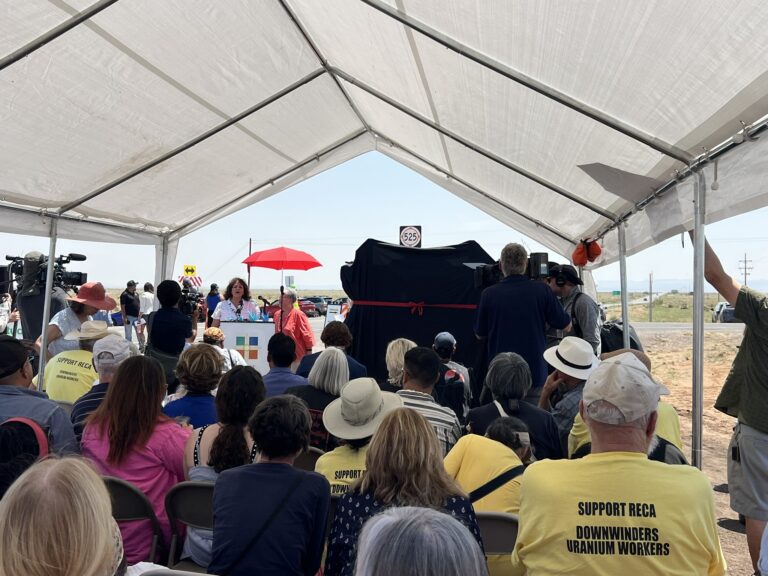
Advocates have said the expanded law was a big win for New Mexicans affected by nuclear testing and uranium mining. But they’re also cautioning residents to not fall for potential scams that have popped up prolifically since the law was passed.

In recent days, the federal government has released guidance for downwinders, including New Mexicans, who are eligible for compensation.

Congressman: Watch out for possible scams

U.S. Rep. Gabe Vasquez of New Mexico’s 2nd Congressional District said he’s had calls from constituents approached by people claiming to be attorneys and offering to assist with RECA claims for a fee.

“That is something we don’t advise anybody in New Mexico to do,” said Vasquez, a Democrat whose district covers much of Southern New Mexico.

Although it is not improper for claimants to contract with licensed attorneys to help file a claim, in exchange for a percentage of the potential financial reparations, New Mexicans should check credentials and be cautious about sharing personal information with any organization or individual claiming to be qualified to help with RECA claims, officials said.

Given the newness of the law, the Department of Justice only issued guidance about how to submit these claims to RECA in recent days.

“What a lot of predatory folks are doing is they want a cut of this money that is rightfully due to RECA claimants,” Vasquez said.

New Mexico lawmakers and others had asked the DOJ to put out the guidance as quickly as possible, given the limited time frame claimants to file.

“As you develop the necessary guidance and regulations, we encourage the Department to post for notice and comment guidance in waves, recognizing that certain parts of the program require simpler updates and can be implemented immediately,” wrote U.S. Sens. Ben Ray Luján, D-New Mexico, and Mike Crapo, R- Idaho, in a letter to U.S. Attorney General Pam Bondi.

State officials are working to make sure information and technical assistance is available to help fill out claims. Vasquez’s office will offer mobile office hours to help put claims together.

Deadline to file a RECA claim

July 16 marked the 80th anniversary of the U.S. government’s detonation of the world’s first nuclear device at Trinity Site, located about 35 miles south of Socorro and 50 miles north of Tularosa. Despite the hazards, local residents were not warned or evacuated from the region.

RECA compensation for downwinders across New Mexico and other locations across the country was approved as part of the “Big Beautiful Bill.”

The expanded eligibility for filing a downwinders compensation claim covers people who lived in any county in New Mexico during the designated time frame and were diagnosed with one of the cancers listed in the bill. Eligibility is not limited to people who lived near Trinity Site.

Tina Cordova, co-founder of the Tularosa Basin Downwinders Consortium, explained the law’s extension allowing for New Mexicans to file claims lasts only through Dec. 31, 2027. Claimants must file before then to have a chance at receiving compensation.

The consortium lobbied for years to include New Mexicans as eligible for RECA funds, supporting multiple bills in Congress that failed to pass.

People who are eligible as downwinders must have lived, worked or gone to school in New Mexico for at least one year between Sept. 24, 1944 and Nov. 6, 1962 and have had at least one of the 19 compensable cancers, according to a notice from U.S. Sen. Ben Ray Luján.

In addition to the downwinders, people in the northwest part of New Mexico who worked in uranium mines, also during a specified time window in the 20th century, are included in the July 3 expansion. If they became ill with certain diseases, they may qualify for a $100,000 lump sum under RECA, “as well as an additional $50,000 plus medical benefits from Energy Employees Occupational Illness Compensation Program Act,” according to Luján’s office.

Yet another category of claimants includes “on-site participants,” those who worked at or near the Trinity Test Site in 1945 and developed a qualifying disease, according to Lujan’s office.

Cordova said the DOJ is in the process of re-establishing staff and ramping up RECA because the previous version of the program expired in 2024. In addition to New Mexicans, the new expansion adds a cohort of people in zip codes around St. Louis, Kentucky and Tennessee who aren’t downwinders of a test site but are downwinders of nuclear storage or waste sites. The DOJ has to set up a new program to address that cohort, as well, which holds up the process.

“If you submit a claim and it’s rejected, there are three opportunities, then you are never allowed to submit again,” she explained.

Cordova said people don’t need to hire an attorney or outside organization to file a claim. It’s about accessing documentation and filling out paperwork, and there will be people trained to help with the process.

“It’s pretty straightforward,” she said.

Attorneys can charge a fee of 2% when they help with a claim, but if that claim is rejected, they can charge 10 percent on the next filing.

Cordova said she is hearing from people who are getting phone calls from people saying: “I understand you had cancer, and we can help you qualify for RECA.” She is concerned about how those companies are getting medical records. She advises using caution in accepting any offers. Scammers could be trying to take advantage of New Mexicans, Cordova said.

“If you turn over all this sensitive information, you don’t even know who you are turning it over to,” she said. “It could be people trying to steal identities, and you are likely going to get scammed. No one should be working with any organization outside of New Mexico.”

‘It’s horrible’

Cordova and TBDC worked for more than 20 years to get compensation for the downwinders of the Trinity Test in southern New Mexico, and she is horrified about the apparent misdirection that is happening to people.

“It’s horrible because I think people feel like they have waited so long they just want to do it,” she said. “They are afraid that there will be no money. But there is going to be adequate resources, both in help to file claims and in the money that is available.”

Loretta Anderson is co-founder of the Southwest Uranium Miners Coalition Post-71 and an adamant advocate of RECA compensation for affected miners.

“I cannot believe it,” she said. “I am amazed how people have just jumped on this and they are just scamming out people. They are coming door to door (at Laguna Pueblo), harassing with phone calls and emails and even having meetings in the Grants area.”

Entities from out of state, including attorneys and home health organizations, are offering to share information and sign people up for RECA compensation. Home health organizations are trying to take advantage of the fact the compensation for the miners includes health care, she said.

Anderson said some people are being told the only way to apply is with a qualified attorney, which is not true. New Mexicans may choose to work with an attorney at their own discretion, but it’s not required.

“It’s just so disheartening, all these years we worked so hard,” Anderson said. “The ones (organizations) that are from New Mexico are not doing this. It’s coming from the outside. Help do it in the right way – that’s all I’m asking. Don’t deceive our people. They have already been deceived enough.”

If you’ve been targeted with fraud

Potentially deceptive websites pop up when searching Google and other search engines for keywords like “downwinders,” “RECA compensation,” and “uranium workers.” New Mexicans seeking information on the web should understand that no matter how professional those websites appear, they should not enter any personal information into them, advocates said.

“New Mexicans should be aware that claim filings in New Mexico are not yet available, and anyone claiming the ability to file a claim on your behalf is likely fraudulent,” New Mexico Attorney General Raúl Torrez said in a news release.

Resources include:

Anyone feeling they have been approached with a fraudulent offer or have encountered undue coercion should contact the New Mexico Department of Justice’s office through a portal at NMDOJ.gov/submit-a-complaint, or by phone at 505-490-4060.

The U.S. Department of Justice has posted RECA application instructions, and claim forms can be found at the www.justice.gov website.

Anderson can be reached at 505-274-1052 for questions regarding uranium miners’ issues.

The TBDC website is http://www.trinitydownwinders.com/ and will be on track to let possible claimants know how to apply for RECA compensation.

Elva K. Österreich is a freelance journalist working with the Southern New Mexico Journalism Collaborative. For more info, visit www.southNMnews.org.


Trinity Site 80th anniversary commemoration: Jumbo

0

Staff Reports

The device designed to be tested at Trinity Site involved two steps: First there would be a conventional ignition involving TNT, and a fraction of a second later, the nuclear ignition if a chain reaction were maintained.

This two-step process created a problem. The Manhattan Project scientists and engineers were sure the TNT would ignite but were initially unsure if the plutonium core inside the device would ignite as planned. If the chain reaction failed to occur, the TNT would release the exceedingly rare plutonium. Of note, it is estimated the plutonium within the device would be valued at more than a billion dollars today.

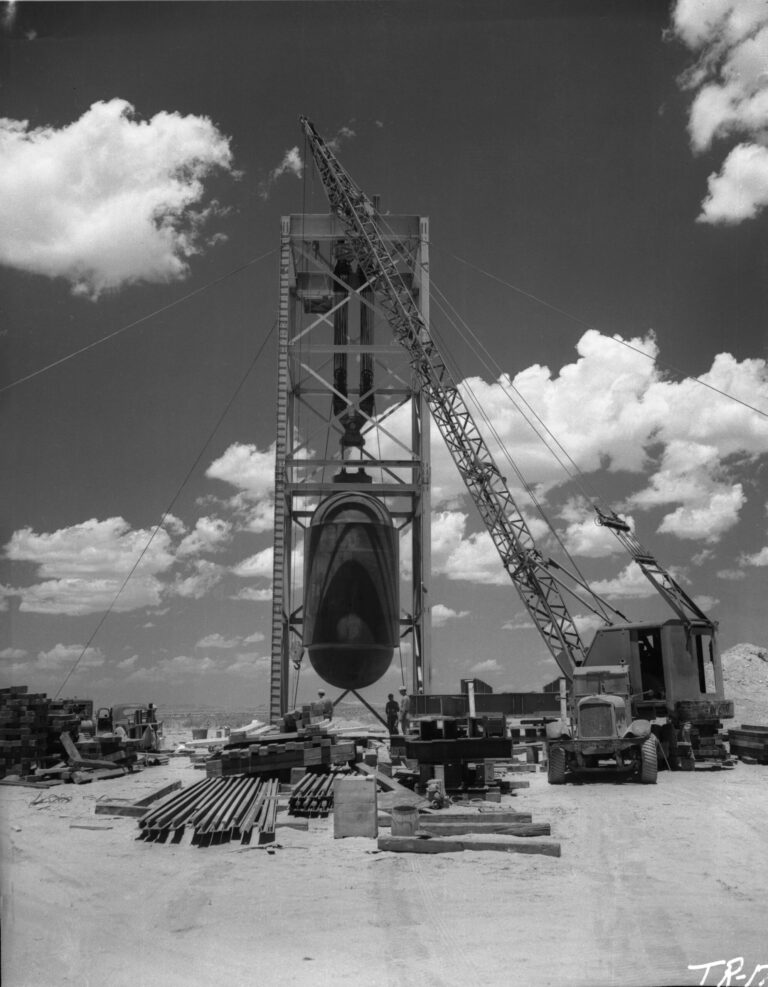
Because of this possibility, Jumbo was designed and constructed. Originally it was 25 feet long, 10 feet in diameter and weighed 214 tons. Scientists were planning to suspend the device in the center of this huge steel barrel so it could contain the plutonium if the chain reaction failed to materialize, thus preventing the plutonium from being lost. If the test occurred as planned, Jumbo would be vaporized.

Jumbo was built in Ohio and brought by train to the now-abandoned railroad siding in Pope, N.M. It was unloaded and a specially built trailer with 64 wheels was used to slowly move Jumbo 25 miles to ground zero.

As the scientist and engineers gained confidence in the design of the device, they decided Jumbo was not needed. Jumbo was then suspended under a steel tower 800 yards from ground zero. The blast destroyed the tower, but Jumbo survived intact. The remnants of the tower location are still visible today.

When you now view Jumbo, you will notice the ends are missing. This is because in 1946, the Army attempted to destroy Jumbo by using eight 500-pound bombs. At the time, Jumbo was standing on end, and the bombs were stacked from the bottom. This asymmetrical detonation only blew the ends off but left the body intact. Just like before, Jumbo survived the explosion and lay abandoned in the desert.

Jumbo remained at the tower location until 1979, when White Sands Missile Range personnel moved it to its current location next to the entrance to ground zero. After the obelisk, Jumbo is the most visited and photographed feature available during the Trinity Site Open House.

All American Oaks purse tops $700K

0

Staff reports

Ohana Spirit, a 3-year-old filly, has been named the 5/2 morning line favorite in the Sept. 1 running of the $700,000 All American Oaks at the of Albuquerque. The race’s purse sets an all-time record in that division and will be the eighth race on the card set for approximately 5:05 p.m.

The filly will be ridden by Ali Rivera for trainer John Stinebaugh. Her resume includes making the finals of the Los Alamitos Futurity, All American Juvenile and Rainbow Futurity as a 2-year-old. She won her qualifying trial for the All American by a neck.

“She’s capable of running you down,” trainer John Stinebaugh said. “She may not break on top but she’ll try to catch you. Four-forty is the perfect distance.”

Razor Sharp and jockey Sergio Becerra Jr. proved to be fastest in the qualifying trials on Aug. 6 winning her trial in a time of 20.997 seconds. The two fillies will start alongside each other in starting gates three and four.

“She’s a very happy horse right now,” trainer Eric Valenzuela said. “If she jumps to the front when the gate opens that should help her chances. She’ll need to be close early.” Razor Sharp is 4-1 on the morning line.

Curl Happy Wagon and jockey Jesse Levario also qualified for the Oaks and is 10-1 on the morning line. The filly also won her trial race after setting the fastest time in the Rainbow Oaks trials mid-summer at Ruidoso Downs for trainer Ricardo Armendariz Jr.

Weather cannot stop a thriller in the Bulldog Bowl

0

JT Keith

Artesia Daily Press

jtkeith@elritomedia.com

The only thing that stopped the back-and-forth scoring action between the Artesia Bulldogs’ football team and the Hobbs Eagles was Mother Nature. The action was fast and furious as the Bulldogs came from behind to defeat Hobbs 51-41 on Friday night at the Bulldog Bowl.

Weather Delay

With 9:54 to play in the fourth quarter and the Bulldogs leading 37-34. And with Hobbs ready to punt the ball, the officials sent both teams to the locker room because of lightening in the sky. Fans were asked to leave the stadium until the game was restarted.

The game was delayed 40 minutes because of lightning in the sky. Play resumed at 10: 10 p.m. Maupin said his team is the kind of team that will stay until midnight to play the game if necessary. Maupin said he knows the rules and it is about safety and his trainers let the team play as long as they could.

“We told our guys to get off their feet and rest in the locker room,” Maupin said during the weather delay. “Our guys came out of the locker room and really responded in the third quarter. The weather does not affect us. I never questioned once, if we can throw the ball with the wind. I have that much faith in our guys that we can do whatever we want, no matter what the weather is.”

Hobbs takes lead at halftime

Hobbs led 28-23 at halftime after being behind by nine points with less than two minutes to play in the half. Maupin said he told his team in the locker room during intermission, that they were OK. He (Maupin) said that being in a close game with Hobbs was right where they wanted to be and they had a chance to win.

“I thought we had a bad second quarter,” Maupin said, “especially offensively. I thought we went out two drives and shot ourselves in the foot. It was not anything that we saw, we had a couple of holding penalties, we go to throw the ball and it slips out of our hands. We gave them (Hobbs) two quick scores, that we can’t do, but really, I challenged them at half to come out … I thought we won the first quarter and lost the second quarter.”

Artesia comes back

In the second half, the Bulldogs came out and scored when quarterback Derrick Warren threw a 4-yard touchdown pass to wide receiver Jack Byers, giving the ‘Dogs a 29-28 lead at the end of the third quarter. Hobbs’ quarterback Junior Medrano came back on the next possession and ran around the right side for a 10-yard touchdown, to give the Eagles a 34-29 lead.

Maupin said he has been impressed by the play of senior quarterback (Derrick) Warren, who always has a smile on his face. Maupin said that when he gets on him, Warren just responds and comes to Maupin with suggestions about certain plays to run.

“I wrote in Warren’s notebook last week,” Maupin said, ‘hey man, this is your time, enjoy every minute of it.’ I know that he is going to get better the more games he (Warren) gets under his belt. The thing that is fun about Derrick (Warren) is he grows in the game and is a solid player.”

With 10 minutes to go, senior running back Bryce ‘White Lightning’ Parra scored on a 10-yard touchdown run to give the Bulldogs a 35-34 lead. Instead of kicking a field goal, Maupin went for a 2-point conversion and snapped the ball to Byers, who lined up in the backfield and threw a jump pass to Julian Baeza to give the Bulldogs a 37-34 lead.

JT Keith | Artesia Daily Press

Big Plays

With six minutes to go in the game, Warren threw a 24-yard pass to Parra, giving the Bulldogs a 44-34 lead. The Eagles came back to make the game closer when wide receiver Braddock Beaty scored on a 21-yard touchdown pass from quarterback Junior Medrano to make the score 44-41 with 3:53 to play in the game.

On the ensuing kickoff, instead of the Eagles kicking an onsides kick, they kicked the ball deep to Parra. Parra ran the ball 82-yards for a touchdown with Dominguez adding the Point After Touchdown to extend the Bulldogs’ lead to 51-41 with three minutes to play.

After Parra scored on the kickoff return, Maupin had Dominguez onsides kick (bloop) and the Bulldogs recovered with less than three minutes to play in the game.

“You just have to find ways to get him (Parra) the ball,” Maupin said. “we put him out at receiver and motion him back to get the ball to him and we try to get him outside. Bryce (Parra), can make people miss and most of the time he makes the right cut. You get the ball in his hands with space and he is going to get you positive yards. I am just really glad he is on my team because he is hard to stop.”

Maupin said of the onside kick, that they (Artesia) did not want to kick it to Hobbs deep. he thought his team did a good job covering Hobbs kickoff’s return in the game. Maupin said the last time he had his kicker Dominguez bloop a kick to Hobbs, Hobbs’ fair caught it. This time the ball bounced into the arms of the Bulldogs.

“I thought we covered their Starburst really well,”Maupin said. “We said the worst case is Hobbs fair catches it, best case is the ball hits the ground and we have a chance to go recover. Our kicker is really good at putting the ball however we want it. That was a big time play.”

Artesia will face Centennial at 7 p.m. Friday at the Bulldog Bowl.

Offense

The Bulldogs had 22 first downs in the game, they ran the ball 28 times for 167 yards, passed the ball for 234 yards. And was 22-of-38 for 234 yards, with two touchdowns and no interceptions.

Bryce Parra ran the ball 15 times for 169 yards and scored one touchdown

Derrick Warren was 22-of-36 for 234 yards and threw two touchdowns

Jack Byers has 5 receptions for 78 yards and one touchdown

Jett Fuentes had 5 receptions for 49 yards

Cael Houghtaling had 3 receptions for 44 yards

Parra had 2 receptions for 28 yards and one touchdown

Sawyer Whitehead had 3 receptions for 18 yards

Trent Egeland had 4 receptions for 17 yards

Through two games

Offense

Derrick Warren is 31-of 51 for 415 yards 3 touchdowns

Bryce Parra has carried the ball 26 times for 320 yards

Jett Fuentes has 5 receptions for 48 yards

Bryce Parra 4 receptions for 128 yards

Sawyer Whitehead 4 receptions for 23 yards

Cael Houghtaling 3 receptions for 43 yards

Trent Egeland 8 receptions for 76 yards and 2 touchdowns

Jack Byers 7 receptions for 99 yards

Defense

Julian Baeza has 10 solo tackles and 2 assist tackles

Edel Villa has 15 solo tackles and 3 assisted tackles and 1 interception

Marco Soto Jr. has 18 solo tackles and nine assisted tackles, one fumble recovery and caused one fumble

Daelon Pacheco has 6 solo tackles and 4 assisted tackles

Alejandro Ontiveros has 5 solo tackles and 5 assisted tackles

Sergio Robles Jr has 10 solo tackles and 4 assisted tackles

J.S. Ward & Son celebrates 100 years with the ‘Party of the Century’

0

Local insruance company J.S. Ward & Son, announced its 100th anniversary celebration, and plans to host the Party of the Century, a street celebration 5 to 9 .m. on Thursday, Sept. 4, on 4th Street in Artesia.

Guests can expect an evening filled with local food, a DJ, family-friendly entertainment, and plenty of “small-town charm,” read a news release from the company. The event is free and open to anyne in the Artesia community and surrounding areas.

The company started in 1925, and today serves a broad list of clients in industries like oil and gas, farming and ranching and local families through auto and home insurance, among several other categories.

“For a century, J.S. Ward & Son has stood by families, neighbors, and businesses, offering trusted insurance solutions built on timeless values and forward-thinking service,” read as statement from J.S. Ward & Son. “This celebration is more than a company milestone. It is a thank-you to the community that has supported them for generations.”

If you go

What: J.S. Ward & Son’s Party of the Century, 100th Anniversary Celebration

When: 5 to 9 p.m., Thursday, Sept. 4, 2025

Where: 4th Street, Artesia

To RSVP or learn more, visit https://jswspartyofthecentury.rsvpify.com/

Meals With Wheels

0

Step up your breakfast game with Dutch baby

Wheeler Cowperthwaite

Once in a while, it’s nice to make something fancy for breakfast, brunch, or for the really brave, breakfast for dinner.

With hot weather, I’m increasingly having people over for breakfast in the morning so we can dine outside, which means I’ve been thinking more about breakfast and brunch food.

Pancakes are a simple go-to, so is quiche, while leftover ham from Easter goes well with eggs and corned beef from St. Patrick’s Day makes a perfect hash.

Sometimes though, you want something different. You want something that doesn’t require its own kitchen appliance, like waffles. If you can make it in a cast iron pan that requires little clean up and looks fancy, all the better.

Enter the Dutch baby pancake. It’s based on German pancakes (pfannkuchen) but it’s not Dutch and no babies are involved in making them.

Instead, as the legend goes, it was first developed at a restaurant in Seattle and Deutsch pancakes (German in German) got corrupted to Dutch.

How the baby got in there, no one knows.

Dutch baby is a type of popover, but instead of being baked small, they’re baked big, like, the size of a cast iron skillet big. Being a popover, it’s made with an egg-based batter.

This easy-to-bake dish is so versatile, it can even be served for dessert.

After all, what are many sweet breakfast dishes if not dessert with different name?

Dutch baby has a softer texture than a pancake, hearkening back to its German origin, which is closer to crepes.

Instead of being fried in the pan, they are baked in the oven, but still in that pan.

Like crepes, they can be served sweet or savory. Think some ham, or some smoked salmon, or maybe onions and a fried egg on top.

When it comes to making and then baking the Dutch baby, you need a couple of things: a blender and a cast-iron skillet.

Ingredients

½ cup flour

½ cup milk

3 eggs

2 tablespoons granulated sugar

1 teaspoon vanilla

½ teaspoon kosher salt

2 tablespoons unsalted butter

Syrup, sugar, jam or fruit to top and serve

Optional: spice (ground ginger, nutmeg or other sweet spices)

Directions

In a blender, blend the milk, eggs, flour, sugar, vanilla and salt for 10 to 20 seconds. You can also mix by hand.

Make sure the batter is well-mixed. Using a spatula, push the batter back down into the blender and re-blend if necessary.

Preheat the oven to 425 degrees with the 10-12 inch cast-iron skillet inside.

Let the batter sit for 20 minutes.

Remove the skillet from the oven, place the butter in the skillet, swirl to melt and coat.

Pour the batter into the skillet, maneuver the batter to fill the pan and put in the oven.

Bake for 15-20 minutes, until brown on the top, darker on the edges.

Serve while hot, with fruit, jam, syrup, sugar, whatever your sweet tooth desires.

Recipe adapted from The Kitchen

Flashlight tour at Fort Stanton

0

Staff reports

Fort Stanton’s nighttime flashlight tours give visitors a chance to poke around historic buildings and satisfy curiosity about secret spaces and what lies behind closed doors. the next tour is scheduled for Aug. 30 from 7:30-9:30 p.m. at the Fort Stanton Historic Site at 104 Kit Carson Road near Capitan.

Participants must be comfortable exploring historic buildings and stairs by flashlight beam and walking through areas usually off-limits to the public. Admission is $25 per person, and tickets are available online at https://my.nmculture.org. Ticketholders must arrive on time for the tour and sign a waiver prior to the start of the event. Tickets are non-refundable, and this tour is not intended for children younger than 16 years old.