

JT Keith
Artesia Daily Press
Daily work behind the show ring
With the 81st Eddy County Fair approaching July 21–25, Artesia High School student Kyle Bean is giving the Artesia Daily Press a look at the work that goes into preparing dairy heifers for show week. For the Bean family, summer isn’t a vacation season — it’s a season of steady, hands‑on care.
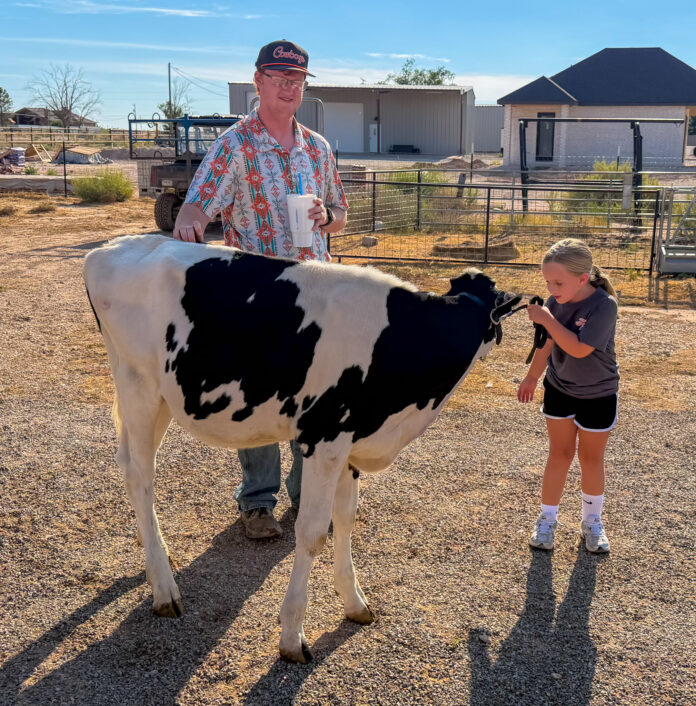
Kyle’s eight dairy heifers require at least 30 minutes of exercise three times a week. He walks four at a time by tying them to the back of his Polaris and leading them in a slow circle around the field. The schedule shifts depending on the family’s workload, but the routine stays consistent. After walking, the heifers are rinsed, and later they’ll receive a full haircut to prepare them for the fair.
The Beans rarely travel during the summer. Their family time is spent working with the animals, and any vacation they take usually happens during Christmas break.
Preparing heifers for the fair
With less than two weeks until show day, Bean tested his heifers for tuberculosis and discovered that two were five and six months pregnant.
“The whole point of a dairy heifer is for them to get pregnant so they can have a baby,” Bean said. “That way they can produce milk and then sell it later on. It is very good that they are pregnant, and we are glad they are pregnant.”
In a few months, the Beans expect new calves on the ground. The two pregnant heifers will eventually be sold to another dairy, where they will enter full production. The calves will stay with the Beans as the next generation of show animals.
The family also owns P7 Dairy in Roswell and regularly purchases embryos. They expect two Jersey embryo calves in September. Bean said a heifer might cost $2,000–$3,000, while an embryo runs about $500.
Improving genetics through embryology
Dusty Bean, Kyle’s father, said embryology is becoming a major part of the dairy industry.
“I think that the next big thing in the dairy industry is embryology,” he said. “If I can reproduce those genetics and make my herd better, I can do it faster through embryos than I can through natural breeding.”
For the Beans, embryos are a cost‑effective way to produce high‑quality show cows and strengthen their herd.
What happens after the fair
Dairy heifers are not terminal animals. After the fair, they return to their regular routines — breeding, calving and milk production. Their productive lifespan typically ranges from five to 11 years, with each pregnancy marking a new lactation cycle.
Other livestock at the fair have different purposes. After the steer, lamb, goat, pig and poultry shows conclude, those animals enter the food supply through professional processors. Families raise them specifically for meat production, and the fair marks the end of their project cycle.
Bean said dairy heifers eventually reach the end of their productive years as well. When they no longer produce enough milk, they transition into the beef market.
A message about agriculture’s future
“In the whole world, out of eight billion people, only one percent of those people are farmers,” Bean said. “If you think about it, it is the one percent feeding the 99%. And that one percent is feeding the entire world. Agriculture provides food, shelter, and clothing. The number of farmers in the world is dwindling, and it is very scary for the future of agriculture.”
Bean said he hopes more people learn about FFA and agricultural education, so the next generation understands how essential farming is.
He worries that if the number of agriculturalists continues to shrink, feeding the world will become increasingly difficult.