




JT Keith
Artesia’s girls’ basketball program closes every season the same way — by playing hard on the court and valuing each other just as much off it.
That approach was evident Tuesday night at Faith Baptist Church, where the Lady ’Dogs celebrated their first winning season under second-year coach Candace Pollard and honored seven seniors at the team’s end-of-season banquet.
The banquet drew one of the largest crowds the program has ever seen, with Pollard sharing stories from the season and showing game highlights as players and families ate.
“We had a huge turnout,” Pollard said. “I think we had 150 to 160 people here. That is huge. It has never happened before, and it keeps growing. The people in the community want to keep giving back to these girls, and they did it by showing up tonight.”
Pollard said the night was especially meaningful given the obstacles the team faced throughout the season, including three injuries that forced players into new roles.
“I have seven seniors,” Pollard said. “I see all the things that people don’t see — all the work the players put in. I am super proud of my team and the work they put in. It was an exciting time, and what an opportunity to get together and celebrate everything we’ve accomplished.”
Pollard said the injuries helped her grow as a coach and reinforced the identity she wants for the program.
“Basketball is a physical sport, and that comes with the territory,” Pollard said. “I want my team to get in there, play hard and compete. All the injuries happened while the players were playing extremely hard.”

Pollard said the team responded well, even when roles shifted due to injuries, including a season-ending injury to Kailee Padilla.
“You always try to find a silver lining with injuries,” Pollard said. “With Kailee and her injury, I thought we did a great job of figuring it out. Our roles may have shifted, but the players took that on in stride. They did a great job, and I couldn’t be prouder of them.”
The banquet also featured the presentation of several awards. The Leadership Award went to sophomore Gracen Kuykendall. Jordan Rone received the Sportsmanship Award. The newly created Hard Hat Award went to Jenna Whitmire, and Zaleigh Greer earned the Sixth Man Award. Desiray Savoie received the Bulldog Heart Award.
The Dog Tag Award went to Kailee Padilla and Peyton Barela. Brooklyn Fuentes was named Most Improved Player and Defensive Player of the Year, also earning the Steals, Assists, and Effort Award. Kuykendall also earned the Offensive Player of the Year award for her rebounding and free-throw shooting. The Most Valuable Player Award went to Ashton Craft, who also led the team in 3-point shooting.
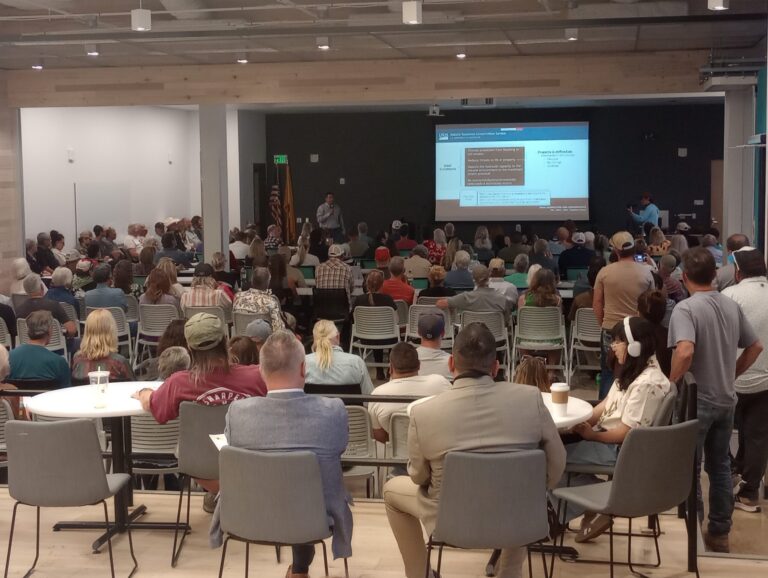
Tim Keithley | Ruidoso News
Lincoln County officials said they have set aside $230 million in federal funds to buy properties from local landowners in the Ruidoso area threatened by floods.
More than 200 residents from around the area gathered on Wednesday, March 25 at ENMU Ruidoso to hear a presentation from the U.S. Department of Agriculture on its Watershed Protection Plan.
The plan will see the federal agency pay local landowners for their properties if they are proven to be in danger of future flood damage.
The announcement comes after the Ruidoso area was decimated by first the South Fork and Salt fires, which burned about 20,000 acres in Ruidoso and Ruidoso Downs, and caused at least three deaths in the summer of 2024. The fires were followed by heavy flooding that summer and in 2025, which destroyed hundreds more homes, caused another three deaths and led to closure of the Ruidoso Downs Race Track.
Lincoln County Manager Jason Burns said the federal program was a step toward relief for Ruidoso’s property owners struggling in the wake of the fires and floods.
“We have about $230 million in this federal program to purchase properties,” said Lincoln County Manager Jason Burns.
The crowd consisted of many residential and commercial property owners that suffered extreme damage over the past two years during the spring and summer monsoons.
“The process begins now, and we will be working with each property owner individually on a first come, first served basis,” Burns said.
The federal funding comes to Lincoln County through the Natural Resources Conservation Service (NRCS). It is an attempt to clear structures and obstacles from property along newly drawn flood maps by purchasing the properties, demolishing blighted structures and turning the land into green space, officials said.
Property owners at the meeting immediately began completing applications known as “expressions of interest” that allow representatives from the county and the NRCS to visit the property in order to start their initial evaluation.
Burns said the process ends with the county making an offer on eligible properties and closing on them just like an ordinary real estate transaction. He said the federal program is completely voluntary. Once the officer is made, property owners can decide to accept or reject it.
“This seems like a complicated process, but it is basically straight forward,” Burns told the audience. “Each property will be evaluated by an independent appraisal firm using pre-fire and flood values dating back to 2024.”
Burns said the county has not yet hired an independent appraisal team to date but is searching for a New Mexico firm willing to do the work. He said property owners who have signed the initial application to participate in the federal program could expect to be contacted quickly.
“The timeline is as soon as we can,” Burns said. “There are other programs with existing deadlines and I commit that we will try to reach an agreement with individual property owners in advance of those deadlines.”
Kenneth Branch, NRCS assistant state conservationist for programs, said the program was intended to mitigate ongoing danger, not to restore all losses suffered in the floods.
“This program is not intended to make people whole,” Branch said. “We are providing funding to the county for the purpose of purchasing properties where danger to life and property still exists.”
“Our goal is to make this program beneficial for all of you,” Burns concluded. “This is our
solution.”
Eligibility: Properties must be owned by “willing, voluntary sellers” and meet specific criteria. The list of eligibility requirements can be found on the USDA website
Process: After a qualifying disaster event, eligible sponsors must submit a request in writing to their local NRCS State Conservationist within 60 days. If approved, NRCS will work with the project sponsor to define the terms of a cooperative agreement.
Acquisition: The acquisition is handled by the sponsor, who then purchases the property and becomes the owner. A deed restriction is placed on the title limiting land use to open space and natural resource conservation. Structures will either be demolished or relocated outside of the flood zone.
Funding: NRCS provides financial assistance to purchase and preserve the land for the purpose of restoring the natural environment, covering up to 75% percent of site restoration costs.
How to apply: Anyone interested was asked to visit ewpbuyout@lincolncountynm.gov to view a recording of Wednesday’s presentation and download an application. A dedicated phone line, 575-973-0523, has been set up by the county so that individuals and ask specific questions about their individual properties. A second public hearing is scheduled April 15 at ENMU Ruidoso, 709 Mechem Drive, at 5 p.m.

JT Keith
There was plenty to celebrate for the Artesia Lady Dogs basketball team following a 14-13 season in head coach Candace Pollard’s second year at the helm.
The District 4A-4 All-District team, announced on Tuesday, March 24, features three Lady Dogs: seniors Jenna Whitmire and Ashton Craft, and sophomore center Gracen Kuykendall.
The honor continued a recent trend for the program, which placed two players — Hattie Harrison and Kailee Padilla — on the All-District team a season ago.
“It’s pretty cool to see how other coaches in the district see your kids,” Pollard said. “These players didn’t just stand out to us — they stood out across the district, and our district is pretty tough.”
Whitmire also received the Hard Hat Award, a new honor created to recognize her value to the team. The Lady Dogs felt her absence early in the season after she suffered an injury. Without her, Artesia lost four of five games. When she returned, the Lady Dogs responded with seven consecutive wins.

“She was a huge force for us all season because of the way she competed every possession,” Pollard said. “She’s the player diving on the floor for loose balls, stepping in to take charges, fighting for extra possessions and never backing down from anybody.”
Pollard said what makes Whitmire special is that she plays at one speed — full speed — and that toughness and competitiveness helped set the tone for the entire team.
Craft continued to develop her game throughout the season, emerging as an offensive threat who could knock down the 3-pointer while also playing top-level defense against opposing teams’ best scorers.
“What made her all-district caliber was the consistency she brought every single day,” Pollard said. “The same mindset in practice, the same toughness in games. She came up with big offensive plays for us in key moments, hitting important shots when we needed them.”
Pollard said what truly separated Craft was her willingness to take on defensive challenges. Night after night, she accepted the task of guarding the opponent’s top player, and her confidence grew as the season progressed and her role as a scorer and leader expanded.
Kuykendall established herself as a reliable low-post presence, helping Artesia adopt an inside-out approach on offense. When running their sets, the Lady Dogs looked inside first, allowing Kuykendall to score or kick the ball back out for open perimeter looks.
Her importance was never more evident than when she suffered a broken nose and concussion during a 48-41 victory at Goddard. As a precaution, Kuykendall was sidelined, and Artesia dropped the two games she missed.
Once she returned, the Lady Dogs won two straight games, highlighted by a road upset of No. 8 Lovington, 40-37, on Feb. 24.

“She took one of the biggest steps forward offensively of anyone on our team this season,” Pollard said. “Compared to last year, she really came out of her shell and grew more confident every game, especially with the ball in her hands.”
Pollard said Kuykendall became a dependable option in the post when the team needed a basket, and her size, presence and willingness to put in the work made her a difficult matchup all season.

Steve Fischmann
What happens when the owner of a public utility also becomes its dominant customer?
Private equity behemoth Blackstone will own New Mexico’s largest utility, PNM, by year end if it receives PRC approval. It has publicly declared a strategy to aggressively expand its global data center business while buying public utilities to serve tech’s huge energy needs. Ten years from now, up to 70% of the energy generated by Blackstone-owned PNM could be serving data centers also owned by Blackstone.
Hugely profitable Blackstone-owned data centers would drive PNM strategy and operations as de-facto owner-managers. Residential and small commercial ratepayers stand to be big losers as their needs become an afterthought. If data centers fail, or chip technology advances to the point that data center energy needs collapse, small ratepayers could be on the hook for billions in excess investment in plants and transmission never intended to serve them.
The only sure protection for small PNM ratepayers is to require data centers to supply their own power at their own expense and for the legislature to enact appropriate environmental and safety requirements to govern these private generation facilities.
Blackstone claims it has no current plans for New Mexico data centers; but doesn’t comment on how that might change if it acquires PNM. Not comforting.
Blackstone ownership poses similar issues when PNM works with suppliers. Blackstone’s portfolio includes many companies that supply equipment and services to the utility industry, and the company is actively pursuing the purchase of more. Sweetheart deals between these companies and PNM become an additional risk. Folks often assume these can be tracked easily. Not so. By conducting transactions through a tangle of subsidiaries,or acting as a sub-contractor for large projects, or creating complicated deal structures, Blackstone affiliate transactions could easily be concealed.
Blackstone’s application to buy PNM tacitly assumes the PRC will protect small customers from potential abuse. Theoretically true, but unachievable. In recent years the PRC failed to enforce NM Gas commitments after it was acquired by Emera, took no action after EPE’s failure to report $150 million in planned transmission investments until well after they were underway, and was oblivious to TXNM’s failure to gain required commission approval before the sale of $800 million in stock. A recent proceeding discovered PRC staff failed to review monthly fuel and power purchase reports representing a significant portion of customer billings for years!
Blackstone’s proposed acquisition of PNM creates massive temptations for self-dealing by a mammoth corporation known for its ruthless pursuit of profit. It would demand that an undermanned and overwhelmed PRC take on exponentially larger regulatory burdens.
No regulator can, or should, control everything. Sound regulation best protects the public by reducing opportunities and temptations to cheat. Blackstone ownership of PNM increases both these threats. It creates the impossible task of monitoring potential sweetheart deals not only with Blackstone owned data centers, but with the many Blackstone owned affiliates that supply utilities.
The PRC must face reality and let go of this tiger’s tail before small ratepayers get mauled.
Tell Blackstone no!
Steve Fischmann is former Chair of the PRC and former New Mexico State Senator District 37.

Photos provided by Luke Burns, City of Artesia
Tuesday night was the final meeting Artesia City Councilors George Mullen, Wade Nelson, and Dickie Townley.

Artesia Mayor Jon Henry also presided over his final council meeting.
All four decided not to seek another term during the municipal elections, which took place earlier this month.

A new mayor and council will be sworn in next month.


Story and words by Adrian Hedden
Dancing with the Eddy County Stars wows locals, raises funds
Becky Thompson took the stage at 84 years old, performing a Pink Panther-inspired dance routine, complete with a pink cat-print costume.
She was lost in the crowd after Dancing with the Eddy County Stars concluded, mobbed by her adoring fans.
But Thompson, a local Carlsbad sports legend known as the owner of Becky’s Drive-In, would not take first place in the annual competition hosted by the United Way.
That honor was bestowed via the “Mirror Ball” trophy to Sandra Borges, executive director of Artesia-based nonprofit the PY Foundation.
Borges also took the award for the most funds raised in the days leading up to the competition at $31,520.
In second was Elizabeth Higgins, president of the Carlsbad Rotary Club, who raised $25,630.
The contest sees eight competitors, local celebrities from around Eddy County, train for a week with a professional dancer from the Utah Ballroom Dance Company. The company also hosts the culminating event where the competitors display their performances for a panel of judges and the crowd.
Crowd members submit votes, along with the three judge’s scores. Judges scores are averaged, and the contestant with the highest audience score gets 10 points. The scores are added to the points contestants receive through fundraising – one point per $1,000 raised, with the top fundraiser getting an extra three points.
All three scores – judges, audience and fundraising – are totaled to choose the winner.
To Higgins, 39, the show was all about giving back to the community, and keeping her footing during her dance inspired by the TV show Friends.
“I was just focused on getting through the steps and finishing,” she said. “It’s amazing to hear the support of the fans, and it’s great to support the community.”

Bruce Lesman
When I entertain at home, I’m always looking for dishes that feel indulgent yet leave guests satisfied—not weighed down. This Zucchini Lasagna baked in a loaf pan delivers all the comfort of traditional lasagna while replacing pasta with delicate ribbons of zucchini. Layered with sautéed mushrooms, sweet caramelized onions, creamy ricotta, and bubbling mozzarella, it slices beautifully and presents elegantly on the plate.
Baking it in a loaf pan gives it structure and height, making it perfect for dinner parties or intimate gatherings. It’s rustic, hearty, and surprisingly refined. The mushrooms provide depth and umami, the onions bring gentle sweetness, and the zucchini keeps the dish light yet satisfying.
Why This Version Works
• Naturally lower in carbohydrates
• Elegant loaf presentation for entertaining
• Rich flavor from caramelized onions and mushrooms
• Make-ahead friendly and reheats beautifully
Zucchini Lasagna Loaf (Serves 4–6)
Ingredients
• Vegetable Layers
• 3–4 large zucchini, sliced lengthwise ¼-inch thick
• 2 tablespoons olive oil
• 1 large sweet onion, thinly sliced
• 8 ounces cremini or button mushrooms, sliced
• 2 cloves garlic, minced
• Salt and freshly cracked black pepper
• ½ teaspoon dried Italian seasoning
• Cheese Layer
• 1½ cups whole milk ricotta
• 1 large egg
• ½ cup freshly grated Parmesan
• 2 tablespoons chopped fresh parsley
• Pinch of nutmeg
• Sauce & Topping
• 2 cups high-quality marinara sauce
• 1½ cups shredded mozzarella
• Additional Parmesan for finishing
Preparation
1. Prepare the Zucchini: Lay zucchini slices on paper towels and lightly salt. Let rest 20–30 minutes to draw out excess moisture. Pat dry thoroughly. For best texture, lightly roast at 400°F for 8–10 minutes to remove additional moisture.
2. Sauté the Vegetables: Heat olive oil over medium heat. Cook onions until soft and lightly caramelized, about 8–10 minutes. Add mushrooms, garlic, Italian seasoning, salt, and pepper. Cook until mushrooms release moisture and become golden. Cool slightly.
3. Mix the Cheese Filling: Combine ricotta, egg, Parmesan, parsley, nutmeg, salt, and pepper in a bowl.
4. Assemble the Loaf: Preheat oven to 375°F. Line a loaf pan with parchment paper. Spread a thin layer of marinara, add zucchini slices, ricotta mixture, mushroom-onion mixture, and mozzarella. Repeat layers, finishing with marinara and mozzarella on top.
5. Bake: Cover loosely with foil and bake 40 minutes. Remove foil and bake an additional 15–20 minutes until golden and bubbling.
6. Rest Before Slicing: Allow lasagna to rest at least 20–30 minutes before removing from the pan. This ensures clean, structured slices perfect for presentation.
Serving Suggestions
Serve thick slices with a crisp arugula salad dressed in lemon vinaigrette, warm crusty sourdough, and a medium-bodied Italian red wine such as Chianti. For an elegant presentation, spoon a small amount of warm marinara around the base of the slice and finish with fresh basil and shaved Parmesan.
Bruce Lesman is a seasoned culinary professional with decades of experience in fine dining, resort cuisine, and private entertaining. Prior positions, Corporate Director of Cunard and Seabourn Cruise Lines, Vice President of Canyon Ranch Wellness Resorts, Lead consultant, Miami Culinary Institute.







Copyright © 2026 El Rito Media, LLC. All rights reserved.