Home Blog Page 186

Reindeer and The Gospel of Luke

0

By: Pastor David Grousnick

According to the Alaska Department of Fish and Game, both male and female reindeer grow antlers in the summer each year. Male reindeer drop their antlers at the beginning of winter, usually late November to mid-December.

Female reindeer, however, retain their antlers until after they give birth in the spring.

Therefore, according to every historical rendition depicting Santa’s reindeer, every single one of them, from Rudolph to Blitzen had to be a female.

We should’ve known this because they were able to find their way.

This fact introduces us to the Gospel of Luke which, above all the books in the New Testament, highlights women.

One of my all-time favorite Christmas hymns is “O Little Town of Bethlehem.” It has been around since 1868 although it wasn’t formally used in churches until 1892.

It is a hymn which is packed with emotion, a song about the Christ Child, born to Mary, a song filled with the creative power of God intervening in history with the gift of a savior.

“O Little Town of Bethlehem,” depicts the Christmas story as a story of hope, a story where the divine and the human come together in an amazing but humble way. It is also an invitation for both the non-believer and the believer.

For the non-believer it is an announcement of what God has done and for the believer it is a challenge to increase one’s faith.

What might surprise you is how this great hymn came to be.

It was written by Phillips Brooks, Episcopal priest. Brooks was serving the Holy Trinity Church in the City of Brotherly Love (Philadelphia, PA). He had just returned from a trip to The Holy Land which inspired him to write the words. “When he returned to America, he still had Palestine singing in his soul.”

Brooks was a bachelor. His church organist and Sunday School superintendent, Lewis Redner was also a bachelor, and Brooks gave the words to him and asked him to create a tune for the upcoming Christmas celebration.

Redner procrastinated and struggled with the creation of a tune to go with the 5 stanzas that Brooks had written. It wasn’t until the night before the celebration that Redner got inspired in the middle of the night and created the song as we know it.

The following day, a group of 36 children and 6 Sunday school teachers introduced the song created by the 2 bachelors. That was on December 27th, 1968. It wasn’t published as an official hymn of the Episcopal Church until 1892.

The following January, Phillips Brooks died, never knowing the magnitude of the hymn that he created.

For some reason the 4th stanza has been dropped from the original score. “Where children pure and happy Pray to the blessed Child, Where misery cries out to thee, Son of the mother mild; Where charity stands watching And faith holds wide the door, The dark night wakes, the glory breaks, And Christmas comes once more.”

The stanza includes the line, “And faith holds wide the door.”

This hymn, like the story of the annunciation of Mary in the gospel of Luke 1:39-56, is a story about faith.

I pray you the greatest of Christmas joy and blessings! Keep the faith!

David Grousnick is the Pastor at the First Christian Church in Artesia.

SIMCO caps off year with generous donation

0

From Staff Reports

Salado Isolation Mining Contractors, LLC (SIMCO) announced its combined corporate and employee contributions to the United Way reached $105,000, underscoring the company’s dedication to building stronger, more resilient communities throughout Eddy and Lea counties.

“We are incredibly proud and thankful for our employees’ generosity, compassion, and commitment to making a meaningful impact in our community,” said Ryan Flynn, a SIMCO vice president and Environmental, Safety & Health manager. “Their generosity and volunteer spirit truly embodies SIMCO’s values.”

Flynn also serves on United Way of Eddy County’s Board of Directors.

Beyond monetary donations, SIMCO’s employees also volunteered at essential United Way initiatives throughout the year.

“The United Way of Eddy County sincerely appreciates the incredible dedication that SIMCO and its employees have for this community,” said Kyle Marksteiner, Executive Director of United Way of Eddy County. “Together, we are making an impact in serving the residents of our community.”

SIMCO’s employees participate monthly in food distributions with United Way of Eddy County working alongside its participating agencies and community partners. During United Way’s Day of Caring, SIMCO volunteers contributed by painting a fence for Affirming Heart Victim Services and packaging food bags for WHI Hobbs. During the summer, employees participated in United Way of Eddy County’s Stuff the Bus campaign, seeking school supplies. In a separate initiative, SIMCO volunteers supported United Way of Lea County’s Project Santa’s PJs by distributing 600 blankets to people in need.

Becca Titus, Executive Director of United Way of Lea County explained, “Here at United Way of Lea County, we are thankful to have the opportunity to tell our story and the story of the local nonprofits we serve. We are grateful for SIMCO for being a part of our story by making a difference in their own communities as they give where they live. Each donation and contribution represents hope, support, and tangible assistance for our neighbors who need it most.”

About SIMCO Salado Isolation Mining Contractors, LLC (SIMCO) was formed to support the mission of the U.S. Department of Energy’s Waste Isolation Pilot Plant. SIMCO’s member is Bechtel National Inc. and its WIPP team includes Los Alamos Technical Associates as a teaming subcontractor.

Radio sets broke rural isolation 100 years ago

0

By Sherry Robinson
All She Wrote

A century ago, shoppers bought their Christmas cards from the local printer. A little bottled cheer required a visit to the local bootlegger because Prohibition was still in force. And a thoughtful gift was radio batteries.

“You would be surprised if you knew how many people are giving radio batteries this Christmas,” said an ad in the Albuquerque Journal. “Some are people whose friends have entertained them with their radio sets.”

By 1924 radio set had been around for a few years, but they were still a novelty. Basically a wooden box with dials and headphones, they were so pricey that few people could afford one. Deming Ice & Electric Co. offered radio sets for $85 to $200, comparable to a major appliance. Then there were the added costs of tubes and batteries.

So those who had a radio set invited friends and neighbors to gather around the device for an evening’s entertainment.

What could they hear? KOB, “the voice of the great Southwest,” was broadcasting from the New Mexico College of Agriculture and Mechanic Arts, now NMSU.

In 1922 Ralph Goddard, dean of engineering, got a license for the radio station he and his students built. It was New Mexico’s first radio station and one of few in the West. With 10,000 watts of power, KOB could be heard statewide. Goddard broadcast dramas, farm shows, news and live music. He personally provided play-by-play coverage of an Aggie football game in 1922, the first such broadcast west of the Mississippi.

Radio sets became more affordable after the federal government published instructions on how to build one. And Goddard, in early 1924, circulated “instructions on how to build a receiving set which is suitable to the needs of ranchmen and others living in isolated places,” wrote the Alamagordo Daily News. Cost: $20.

Newspaper columns offered tips to improve operations, abetting the endless tinkering needed to reduce static and achieve better reception.

In 1924 a dance at the Golf Club in Alamogordo featured two radio sets so that attendees could hear election returns, wrote the Alamogordo Daily News. And some Carlsbad residents heard a speech by President Calvin Coolidge. The Carlsbad Current Argus opined that December: “It may be that the radio set is going to take the place of the old-time fireside as a local center of family life.”

While the radio set was just another amenity to city folks, it was life changing in the rural areas. Think about just how isolated most New Mexicans were. Roads were mostly wagon tracks with no bridges or road signs. Distances were daunting. The state wouldn’t be electrified for years (and some places still don’t have electricity). For people with addresses in the mountains, plains and desert, being cut off from the world was reality.

A battery-operated radio set changed everything. Suddenly, New Mexico’s farmers, ranchers, miners, loggers and reservation dwellers could hear breaking news and weather reports. They could hear the voice of the president. They were humming the latest tunes.

In 1923 the Gallup Independent reported that Charles Berger bought “a radio outfit” for his farm near McGaffey. “Now the wilds of the Zuni Mountains are about to be filled with the operatic and scientific wonders of the world,” the newspaper observed.

Still, in the 1920s not many radio sets were in use – just one in ten homes had a radio set, and rural use was half that amount – but the curve was bending ever upward. In December 1924 manufacturers promised radio sets with increased range and less static. And in what’s become a familiar pattern, performance improved as costs came down, until nearly everyone had one.

Radio sets broke the barriers of isolation and introduced the concept of interconnection that we’ve been chasing ever since. Today, every broadband project tells rural people, you don’t have to be isolated any more. It echoes the revolution that gave us radio.

Sherry Robinson is a longtime New Mexico reporter and editor. She has worked in Grants, Gallup, the Albuquerque Journal, New Mexico Business Weekly and Albuquerque Tribune. She is the author of four books. Her columns won first place in 2024 from New Mexico Press Women.

Equinox goes electric

0

By Len Ingrassia
Automotive columnist

How much should an electric car set you back and how practical is one in your daily driving? Good questions as consumers wrestle with limitations of electrics, pricey acquisition costs and time needed to charge.

A newcomer entered the pack this year with the Equinox EV, not a new name but this SUV has a driving range of up to 319 miles while not sacrificing its SUV roominess and sporty looks.

The Equinox will soon be available in five trim levels ranging in price between upper $30s to low $50s depending on your penchant for options.

Our test car for the week was the top-of-the-line 3RS, an all-wheel drive dual motor version that drops to 280 miles range.

Fortunately, all trims include an 11-inch digital instrument cluster behind the steering wheel and an extra-large nearly 19-inch center touchscreen featuring Google apps combined with an Android-based infotainment system.

Both are adequate for short term and urban driving but you will need to schedule your charging on longer trips. With a 240-volt garage charger, the EV will take approximately 10 hours for a full charge. While a 110-volt cord is available, the charge time is a week or longer for a full charge. Conversely, an ultra-fast commercial charger will shorten the time to several hours.

Our tester included one-pedal driving, a feature that uses the accelerator pedal to accelerate and decelerate to a stop with an adjustable regenerative braking system that slowing the SUV using the motor instead of regular friction brakes while optimizing vehicle range.

The 3RS outputs a combined 288 horsepower and 333 lb.ft of torque using GM’s Ultium platform with 85-kWh battery pack. The 2025 models increase to 300 and 355 respectively.

Upper trims utilize 21-inch black aluminum wheels while all feature a center lit headlamp bar marking its electric – ness. Exterior lines are bold and side panels appear larger than they really are. LED head and taillamps set off a sporty look while approach and walk-away lighting add a nice touch along with flush door handles that extend when walking nearby.

We found the infotainment system easy to maneuver although on several occasions our screen blacked out and the adaptive cruise system faltered. The interior is roomy with front and rear legroom accommodating four adults. With rear seats folded, cargo space is a generous 58 cubic feet.

Cushioning around the center console, door panels and dashboard could be better.

Acceleration is brisk but lacks the oomph present in many electric rivals. Suspension is firm but can get spongy with potholes. Steering is stiff at times and body lean is noticeable. We found the Equinox delivered a compliant ride in highway travel with minimal cabin noise.

GM’s Super Cruise highway driving system ($2,700) works on mapped interstates throughout the country while delivering hands free driving and lane changes providing your eyes are kept on the road although we found it tends to hug the right lane.

Rivals to consider include the Hyundai Ioniq 5, Kia EV6, VW ID4 and Tesla Model Y.

Contact independent automotive columnist Len Ingrassia at editor@ptd.net

What was reviewed:

2024 Chevrolet Equinox EV 3RS

Engine: 85 kWh battery rated energy, 288 horsepower, 333 lb.-ft torque

MSRP/as tested: $45,400 / $49,495

EPA mileage: 108 MPGe

Assembled: Final assembly at Ramos Arizpe,CZ Mexico U.S./Canadian parts content – 62 percent. Major source of foreign parts content, CN – 15 percent. Country of origin; motor and transmission – Mexico.

Crash test ratings: Neither the National Highway Traffic Safety Administration (NHTSA) nor Insurance Institute for Highway Safety (IIHS) had rated the 2024 Equinox EV.

Warranty: 3-year/36,000-mile bumper to bumper; 8-year/100,000-mile electric vehicle propulsion battery warranty, first maintenance visit.

Spice up the holidays with Mexican chocolate fudge

0

By Kelley Coffeen

For El Rito Media

Happy Holidays! In the midst of this busy season, we are making lists, shopping, wrapping, and hosting in one month more than some of us do all year. I do love it, though, and always try to make special dishes and sweet treats for family and friends.

I am not a big baker, but I do enjoy making candy and confections this time of year. I usually take a couple of days in the kitchen to make family favorites like pralines full of New Mexico pecans, peanut butter fudge and my Mexican Chocolate Fudge.

Growing up along the southern border has given me an appreciation for Mexican chocolate.

I developed this recipe after falling in love with its combination of cacao, cinnamon and a spicy chile flavor. It is a rich, rustic flavor more complex than regular chocolate. Try it – you may surprise your guests with this elevated holiday fudge. You can find it in my latest cookbook, The Big Book of Hatch Chile (UNM Press, 2023)

Creamy Mexican Chocolate Fudge

(makes 10 to 12 servings)

INGREDIENTS

3/4 cup butter

2/3 cup evaporated milk

3 cups white sugar

2 tsp. cinnamon

2 tsp. Hatch red chile powder*

One 7-oz. jar of marshmallow cream

1-1/2 cups semi-sweet chocolate chips

1 tsp. vanilla

1 cup pecans, chopped**

DIRECTIONS

1. Prepare a glass baking dish by coating with butter; use a 10 × 10 inch pan

for thicker fudge or a 7 × 11 inch for pan a thinner fudge.

2. In a large, heavy saucepan, melt butter over medium heat. Add evaporated

milk, sugar, cinnamon, and chile powder, then stir with a long

wooden spoon until dissolved in butter. Scrape all sugar crystals on

the side of the pot into the butter. Stir until sugar is dissolved.

3. Bring sugar mixture to a full boil for 4 to 5 minutes or until candy thermometer

reaching 235 degrees. Remove saucepan from heat.

4. Working quickly, add marshmallow cream to the sugar mixture, mixing well.

5. Slowly stir in chocolate chips, then stir quickly as they melt until smooth.

6. Fold in vanilla and pecans, again, stirring until smooth.

Pour into the prepared baking dish and allow to cool at room temperature for at

least 3 hours or overnight. Cut into -inch squares and serve.

*Look for Hatch or New Mexico Red Chile Powder at your local grocery store.

** For toasted pecans, spread pecans out on a baking sheet and bake at 200 degrees

for 4 to 5 minutes, just until they become fragrant.

This recipe is from The Big Book of Hatch Chile (UNM Press 2023). It is available at Amazon, Barnes & Noble, UNM Press https://www.unmpress.com/9780826365439/the-big-book-of-hatch-chile/

Follow me on Instagram at @kelleys_kitchen.

Entrepreneurs given opportunity in Artesia

0

Mike Smith
Artesia Daily Press
msmith@currentargus.com

A stay-at-home mom, Danyon Solano wanted to do a little bit more with her life. So she took her talents as a baker and seamstress and sold her creations regularly at Artesia MainStreet’s Oil Patch Market, which opened this year at the Derrick Floor in downtown Artesia.

Solano, with her business Needle and Whisk, became a regular vendor at the community farmers and crafts market, which ended its inaugural run Dec. 14.

“I started my business in February of this year and it took off” Solano said. “Social media is a great way to get it started and get people talking. I just love it, it’s turned into something I didn’t think it would be,” she said.

Solano liked the response she got from customers buying items baked and made locally and not trucked in from an out-of-state vendor.

On Dec. 14, she offered homemade cakes and cookies along with sewn and embroidered items to people seeking a different kind of Christmas gift.

“There’s lots of foot traffic, having conversations with lots of different people, friendly faces. People are from everywhere and that’s fascinating to me,” Solano said.

She said markets held during summer months were nice with people looking for some kind of activity during the workday.

The summer markets were held on Tuesdays at 5:30 p.m. from June 4 to Aug. 6. The fall markets took place on Saturdays.

“I’m an eager business owner that loves serving my community and participating in these kinds of events,” Solano said.

Christopher Archuleta and his family also set up shop at the market, selling various flavors of beef jerky as part of Arch Family Meats.

Archuleta first came to the first market in June and all meat was hand-sliced and marinated for 72 hours and dehydrated before public consumption.

“I’m the slicer. I do all the cleaning of the meat and slicing, and my wife handles all the marinates. I started off doing the marinates, but she does it better,” Archuleta said.

His wife, Britany, was tired of him buying jerky at commercial retailers, he said with a chuckle.

“I was buying two bags of jerky every time I would go out to work,” he said.

He said Arch Family Meats is a true family business.

“We put family on our bag because they’re involved 100 percent. My children even help with the bagging of the jerky,” Archuleta said.

Archuleta’s children are 14-year-old Zayden, 9-year-old Zakstyn, 7-year-old Kinlea and 5-year-old Zane.

Britany said the children like to label the bags once the meat is packed in them.

“We make a fresh batch every week,” said Archuleta. “I try not to have carryover jerky and if I do, then I get to it.”

He said the family also delivers jerky along with selling it at the Oil Patch Market.

Morgan Fox, Artesia MainStreet’s executive director, said the market will return in either the late spring or early summer of 2025.

She said the original plan for the market was to have local farmers sell healthy fresh-grown fruits and vegetables.

“It morphed into an opportunity (for local vendors) to sell items without a storefront,” she said.

Fox said the main rule for the Oil Patch Market is items must be handcrafted or homemade.

She was happy and surprised by the market’s first-year success.

“Vendors wanted to participate, and the community came out to support them,” Fox said.

She said plans for next year’s market are still in the works.

Mike Smith can be reached at 575-308-8734 or email at msmith@currentargus.com

Bulldogs take one round of Eddy County War

0

Mike Smith
Artesia Daily Press
msmith@currentargus.com

Braylon Vega scored 18 points as Artesia downed Carlsbad 64-51 in the second game at the Bulldog Pit.

Two Artesia players joined Vega in double figures as 6-foot-8 junior center/power forward Clay Kincaid scored 15 points and junior guard Charlie Campbell added 11.

“Artesia played hard,” Carlsbad head coach John Zumbrun said after the game. “They’re huge. It was hard to keep them off the boards and we didn’t shoot enough high percentage 3s. We’ve lived by them all year and died by them tonight. Thought we had open looks – just got to knock them down. That’s what it comes down to. Coach (Michael) Mondragon does a good job. Those kids played hard and they beat us up on the offensive boards. We kind of knew that was going to happen.”

Three-pointers have been 6-2 Carlsbad’s mainstay in all of its wins this season.

“I was happy with our kids that they played hard,” Zumbrun said. “Give Artesia credit for making us miss shots. You’ve got to give Artesia credit for that.”

Mondragon said the Bulldogs used its length and height to wear down Carlsbad.

“I thought we did a really good job limiting them to one shot,” he said. “We rebounded the ball really, really well. We’re getting there, we’re slowly getting in shape seeing some of that basketball cohesiveness. What a great, great team job, especially on the offensive end with execution.”

Artesia ended the week with a Saturday trip to Albuquerque and lost to the Valley Vikings 50-46.

The 4-3 Bulldogs travel to Hobbs Dec. 26 through Dec. 28 for the 65th Annual Hobbs Holiday Tournament.

Artesia opens play at 3 p.m. Dec. 26 at the Ralph Tasker Arena against Albuquerque El Dorado.

Friday, the Bulldogs will face either Albuquerque El Dorado or Wichita Falls, Texas Legacy in the second round.

Cavegirls need extra frame in win

The Carlsbad Cavegirls came from behind to defeat Artesia’s Lady Bulldogs, 58-49, Dec. 20 in the opening game of the Eddy County Basketball War in Artesia.

After trailing Artesia most of the way, Carlsbad closed to within two points, 45-43, in the closing seconds of the fourth quarter and senior point guard Abbey Dugan scored as the buzzer sounded to send the game into overtime.

The Cavegirls outscored Artesia 13-4 in the extra period and Dugan finished with 20 points.

Dugan had some help from her teammates, including 5-foot-10 senior center/power forward Jasmynn Gonzales and senior reserve guard Maci Garcia, who sank some key 3-pointers and free throws as Carlsbad picked up its eighth win of the season against two losses.

“Our goals have been working hard on 3s and they started going down,” Carlsbad head coach Matt Enloe said after the game. “We kind of got the momentum after a couple of 3s by Macie Garcia. She stepped up big time as a senior, that’s kind of her role on the team. From what we saw today, we’re just proud of Macie, “he said.

Garcia said the first part of the game was tough as the Cavegirls worked out the kinks before making their closing push.

Dugan’s buzzer beater and the overtime period “gave us more time to come back and win,” she said.

Artesia head coach Candace Pollard said the Lady Bulldogs were “tapped out” due to long practice sessions and final exams before the start of Christmas break.

“They came out against a real good Carlsbad team, and they fought hard for four quarters …. we went into overtime with a really good team,” she said.

Pollard said lack of consistency has been a problem for Artesia this season.

“We’ve struggled with trying to find some cohesiveness playing as a team,” she said.

Pollard praised freshman post player Gracen Kuykendall’s contributions as some upper classmen fought illness.

“Gracen had to step up a little bit in the minutes,” the coach said. “We led most of the game and Gracen was able to contribute. I think she has been kind of searching to kind of find her place and I think with the help of Kailee (Padilla) and Ashton (Craft) she found it tonight.”

Saturday, the Lady Bulldogs avenged the loss to Carlsbad with a 56-39 victory over the Gadsden Panthers at the Bulldog Pit.

Jenna Whitmire was Artesia’s leading scorer with 17 points in the victory and junior guard Ashton Craft had 15 points for the Lady Bulldogs.

Artesia’s next game is Jan. 4 at Taos. The second round of the Eddy County Basketball War is Jan. 7 at Carlsbad.

More photos from the game can be found on B2.

Mike Smith can be reached at 575-308-8734 or email at msmith@currentargus.com.

Eddy County’s departing elected officials bid goodbye

0

Mike Smith
Artesia Daily Press
msmith@currentargus.com

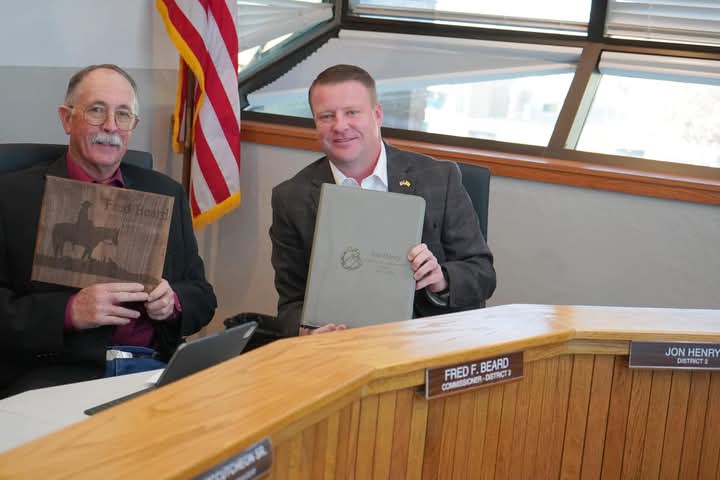
Outgoing elected officials highlighted their accomplishments and addressed the Eddy County Board of County Commissioners during the final meeting of 2024 on Dec. 17.

District 2 Commissioner Jon Henry, Treasurer Laurie Pruitt and Sheriff Mark Cage all served two four-year terms and were prohibited by term limits from seeking re-election.

District 3 Commissioner Fred Beard served one four-year term and decided not to seek a second term.

“It’s been a pleasure the last four years,” Beard said.

“We get things done around here,” he said, describing Eddy County as “the best county in the state of New Mexico.”

“It’s been a good ride. I appreciate everything,” he said.

Beard will be replaced by Philip John Troost, who defeated Justin Wilson in the June 4 Republican primary and ran unopposed in the Nov. 5 general election.

Troost is a farmer and lives in Artesia. He will serve an area that covers parts of western, northern and southern Eddy County.

Henry, who won his first term in 2016, said he was not sure what to expect when sought elective public office for the first time.

“It’s a lot different than being class president. It took a little more discussion on the thought process,” Henry said.

“I have loved being an Eddy County commissioner,” Henry said, describing his first two years on the commission as “shaky” but saying the county has made strides in tax collections and budgeting during his tenure.

“Hope that continues,” he said. “I think we use that money wisely. I’ve been proud of the commission and the other elected officials. Department heads make sure we just don’t spend wildly. We make sure everything we do has been impactful to the people that we have been elected to serve.”

Henry also serves as mayor of Artesia and will replace outgoing State Rep. Jim Townsend (R-54) in the New Mexico Legislature in 2025.

Townsend was elected in November to serve as state senator in District 34.

Artesia Chamber of Commerce Director Hayley Klein replaces Henry next year. She was unopposed in the Republican primary and in the general election.

Cage will stay on as undersheriff when Matthew Hutchinson assumes the job as sheriff in 2025.

Before the meeting, Cage told the Current-Argus in a text message he was honored to serve the citizens of Eddy County.

“We accomplished some amazing things and transformed the sheriff’s office. I’m blessed to have had the opportunity and to be able to continue to serve as undersheriff once again,” he wrote.

Pruitt did not address commissioners during the meeting. Eddy County spokesperson Savannah Cabezuela said she will continue working in the treasurer’s office with treasurer-elect Patricia Carrasco.

Mike Smith can be reached at 575-308-8734 or email at msmith@currentargus.com.

Clayton appointed chair of banking council

0

Daily Press Staff Report

Ken Clayton, Chairman and chief executive officer of Western Bank – Artesia, has been appointed chair of the American Bankers Association’s (ABA) Government Relations Council (GRC) for the 2024-2025 association year.

As GRC chair Clayton will also serve the year as an appointed member of the ABA Board of Directors.

The council is responsible for helping to shape and advance the association’s policy priorities through advocacy with Congress and the federal banking regulators and has the exclusive responsibility for recommending annual policy priorities to ABA’s Board of Directors. It also provides ongoing policy guidance to ABA leadership as policy issues arise during the year.

“It is an honor to chair this important council and to participate in the success of America’s banks of all sizes” Clayton said. “My participation gives me the opportunity to collaborate with my industry peers to develop solutions that will help our bank and other institutions better meet the needs of our customers and the broader economy”

The ABA Councils diverse membership is reflective of the industry at large, representing banks from across the country of varying asset size, charter type, and business structure, making it a critical committee in representing both the specific interests of the industry segments and the broader industry. GRC members also participate in ABA’s political engagement programs.

Clayton is a 37-year veteran of the community banking sector, having served Western Bank since 1998. Clayton is a past President of the New Mexico Bankers Association, a past member of the ABA’s Community Bankers Council as well as the ABA Membership Council.

Clayton is a graduate of the University of Colorado Graduate School of Banking and the New Mexico School of Banking.

Fish not taking holiday break

0

Information and photo provided by New Mexico Department of Game and Fish

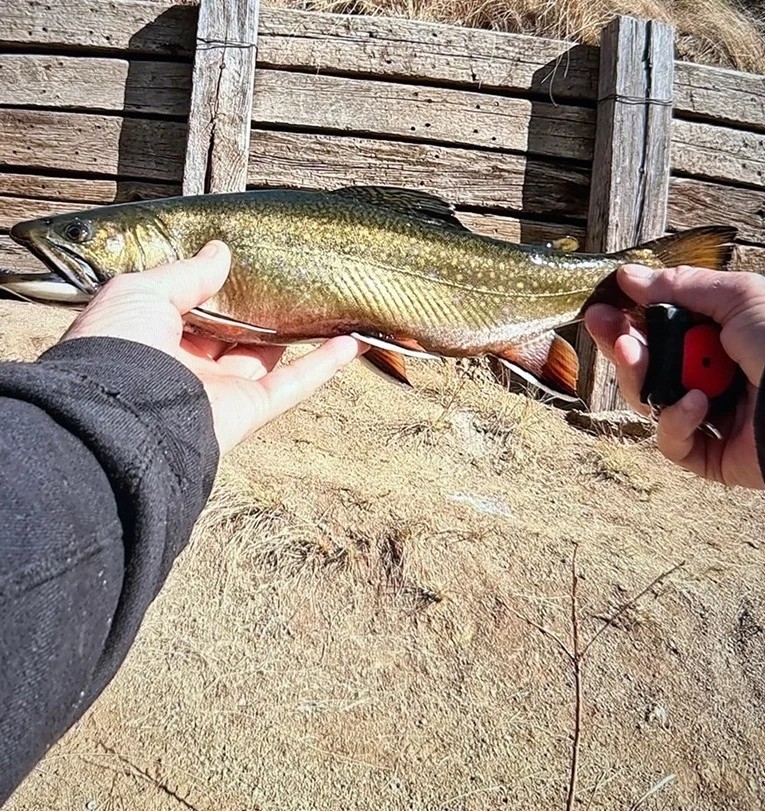
People might be taking time off for the Christmas and New Year’s holiday. Fish are still biting in December at lakes and streams across southern and southeast New Mexico this week.

In Lincoln County, fishing for trout was very good using flies at Bonito Lake. Fishing for trout was good using PowerBait at Grindstone Lake.

At Corona Pond, fishing for trout was good using earthworms.

At Oasis Lake State Park near Portales, fishing for trout was good using homemade dough bait.

Near Truth or Consequences, fishing for catfish was fair using worms and cut bait.

In Las Cruces, fishing for trout was fair to good using small rainbow-pattern spoons at Young Park Pound.

In Otero County, at Timerbon Ponds, fishing for trout was good using Orange PowerBait Trout Nuggets.

This fishing report, provided by the Department of Game and Fish in cooperation with Dustin Berg of www.gounlimited.org, has been generated from the best information available from area officers and anglers. Conditions encountered after the report is compiled may differ, as stream, lake and weather conditions alter fish and angler activities.

Want to brag on latest big fish catch?

The New Mexico Department of Game and Fish’s weekly fishing report has been a staple for anglers in the Land of Enchantment for decades, regardless of the format. Whether it has been on a printed newspaper page or a smartphone screen, this report has provided fishing enthusiasts with important information to ensure that their next fishing trip with be as successful and enjoyable as possible.

With that in mind, the Department in recent years has been looking at ways to keep this weekly report relevant — not just now, but for years to come. After months of hard work by Department staff, we are excited to announce the launch of iFish, the Department’s new web interface where you, the angler, can submit your catches and fish stories through an easy-to-use form. An iFish smartphone app is in the works as well and should be available for download on Android and Apple devices in the months to come. iFish will be the only way to submit Catches of the Week and other fishing data going forward. Submitting your catches isn’t just about bragging rights, however. Your submissions help Department staff plan fish management, stocking and improvements, as well as providing other anglers with valuable tips to help them reel in the big one as well.

How does iFish work?

Here’s how you can tell everyone about your latest fishing adventure or Catch of the Week:

1. Visit: https://wildlife.dgf.nm.gov/fishing/weekly-report/.

2. Use the iFish form at the bottom of this page to tell us about your fishing adventures over the past week. Note: Conditions change, so the Department will use only the most recent week’s entries to create the Weekly Fishing Report.

3. Fill out the form once for each species you catch (i.e., one form for largemouth bass, another for rainbow trout, etc.).

4. Did you catch a big fish? Did you take a kid fishing? Did you achieve a fishing milestone? Click the Catch of the Week checkbox at the bottom of the form and upload your best photo and catch details. This is optional.

5. Click “Submit.” If you caught more than one species, just click “Add Another Form” after submitting and follow the steps above for each additional species.

Only submissions received through the iFish form (https://wildlife.dgf.nm.gov/fishing/weekly-report/) will be accepted for publication in the weekly Fishing and Stocking Report beginning Jan. 1, 2025.