Home Blog Page 81

New Mexico special tackles session Trump-backed funding cuts

0

Sarah Rubinstein and Adrian Hedden | Artesia Daily Press

Lawmakers moved quickly in the opening days of a special session convened in Santa Fe, passing a $162 million budget bill intended to overcome federal cuts backed by Republicans in Congress, and appropriating state funds to make up the difference should Congress allow the Affordable Care Act to expire at the end of the year.

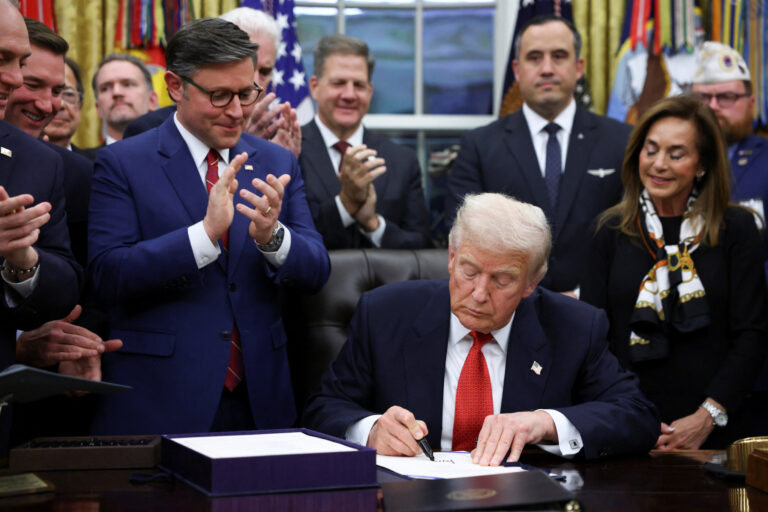
The special session, the first of 2025, was called by Gov. Michelle Lujan Grisham Oct. 1 to address a sweeping list of topics, namely the state’s efforts to account for federal funding cuts enacted by President Donald Trump when he signed a spending bill July 4, known by supporters as the “One Big Beautiful Bill.”

The session ended Thursday night, after lawmakers passed five of 11 bills introduced during the two days of committee meetings, debates and votes on the House and Senate floors.

First among Lujan Grisham and Democrat priorities, House Bill 1, the funding bill, passed the House on Oct. 1 after a 43-24 vote, and the Senate later that day, 25-13. It will next go to Lujan Grisham’s desk to be signed into law.

HB 1 entailed a $30 million food assistance program, making up for cuts to the federal Supplemental Nutrition Assistance Program, or SNAP, which came under fire in the federal spending bill, along with $17 million in healthcare subsidies and $50 million to the state’s Rural Health Delivery Fund used to supplement health care facilities in small towns and remote communities.

“Over the last several months in meetings across our state, our Legislative Finance Committee has been closely reviewing the massive federal funding cuts and changes coming out of Washington, D.C. to understand how they will impact New Mexicans,” said Rep. Nathan Small (D-36), who chairs the Legislative Finance Committee and was a lead sponsor of HB 1.

“The investments we are making today are about responding in a responsible way to protect the things families across our state need most: healthcare and food.”

The House and Senate also passed House Bill 2, which would allow the state’s Healthcare Affordability Fund to be used to maintain healthcare coverage for New Mexicans, should the federal government repeal or allow the Affordable Care Act to expire, meaning tax credits offered to U.S. policyholders would be eliminated.

Republicans in Congress signaled they intended to do so, with the ACA expected to expire at the end of 2025. That was a sticking point for Democrats in Congress who refused to agree to a federal budget by the Oct. 1 start of the 2026 fiscal year, leading to a government shut down that continued as the state’s special session began.

HB 2 passed the House 49-13 Oct. 1, and the Senate 34-3 on Oct. 2.

Other bills passed included Senate Bill 1, which appropriated $50 million to the state’s Rural Health Care Delivery Fund to aid hospitals in small towns and remote communities. Senate Bill 2 would allow local or metropolitan courts to preside over criminal competency hearings, reversing legislation enacted during the 2025 regular session requiring these matters be taken up by district courts.

Senate Bill 3 will allow the New Mexico Department of Health and Human Services to enact vaccine requirements for children enrolled in public schools, linking the regulations to recommendations set out by the American Academy of Pediatrics.

“The legislation passed during the special session protects families from being priced out of health care when their premiums double or triple, and we’re supporting providers who are keeping the doors open in our smallest communities,” Lujan Grisham said at the outset of the session.

Session opens with plea for peace

The session opened with lawmakers in the State House and Senate opining on political violence about three weeks after the public murder of conservative social media influencer Charlie Kirk.

Kirk was fatally shot during a speaking event at Utah Valley University, and 22-year-old Taylor Robinson was subsequently arrested for the shooting and is being tried for first-degree murder.

Alluding to the shooting for about 10 minutes before the session began, members from both parties in the Senate took turns to share the need for open disagreement and discussion during speeches at their respective chambers at the opening of the session.

“Let’s rebuild a culture of dialogue where we listen as fiercely as we speak, where we argue with passion, but never lose sight of our shared humanity,” said Sen. William E. Sharer (R-1).

Lawmakers cited Kirk’s death and also that of former Democratic Speaker of the Minnesota House Melissa Hortman, who was shot to death on June 14 at her home in Brooklyn Park, Minnesota along with husband Mark Hortman. Fifty-seven-year-old Luther Boelter was arrested and charged with two counts of second-degree murder.

Boelter was also charged with two counts of attempted second-degree murder after police said he shot and injured Democratic State Sen. John Hoffman and wife Yvette Hoffman earlier that day at their home near Champlin, Minnesota.

Before the session began, New Mexico lawmakers held a moment of silence for the victims of the shootings, and their families.

“I know that it shouldn’t matter what party or ideology Melissa or Charlie had, we should feel the same pit in our stomachs about every act of political violence, no matter who was murdered,” said Sen. Mimi Stewart (D-17).

In the House, legislators from both sides also spoke of the need to be civil in policy disagreement.

“The people of this state are demanding that we change course, to tone down the dangerous rhetoric that has seeped into our discourse,” said Rep. Gail Armstrong (R-49).

Williams wants to continue public service on ASHD

0

Mike Smith
Artesia Daily Press
msmith@currentargus.com

Editor’s note: The Artesia Daily Press has submitted questionnaires to candidates for Artesia Special Hospital District and school board in this year’s general election. The paper is publishing the responses in print in the order they were received.

Perry Williams is an Artesia native and resident who is a retired Army veteran and emergency medical technician.

Now he is a project lead for Conoco Phillips’ in Carlsbad. He is running against Artesia Special Hospital District (ASHD) District 5 incumbent Karen Waldrip.

Also running is retired rancher David Romine.

What made you decide to run for this office?

“I’m running for the hospital board to continue a lifetime of service. With over 30 years as an Emergency Medical Technician and as a proud U.S. Army veteran, I’ve seen firsthand the critical importance of timely, quality healthcare. I believe the people of Eddy County deserve the very best care close to home, and I’m committed to working hard to make that a reality.”

What is your day-one priority if elected to this office?

“My day one priority would be to listen to our medical staff, patients, and community so that I clearly understand their most urgent needs. With that input, I will focus on strengthening the quality of care at Artesia General Hospital by supporting our healthcare workers, addressing staffing challenges, and ensuring that every citizen of Eddy County can access safe, reliable, and timely medical services close to home.”

What do you see as the biggest needs for ASHD?

“The biggest needs I see for Artesia General Hospital are improving access to specialized care, supporting and retaining quality medical staff, and keeping the hospital financially strong for the future. As a veteran, I know firsthand the challenge of traveling great distances—even out of state—for care through the VA Community Care Program. I don’t want our citizens, especially our veterans, to face those same struggles.”

“As a board member, I will work to bring more specialty doctors to Artesia, so patients can get the care they need closer to home. I will also focus on supporting our front-line healthcare workers with the resources they need and ensuring strong financial oversight so the hospital can continue to expand services responsibly. My goal is to make Artesia General Hospital a place where every citizen of Eddy County, including our veterans, can count on receiving high-quality care without having to leave the community.”

Forgiveness or revenge?

0

Cal Thomas

It’s been 10 years since a white supremacist shot and killed nine people studying the Bible at the Mother Emanuel AME Church in Charleston, South Carolina. In a statement that shocked many people, relatives of the dead offered their forgiveness to the gunman. A similar opportunity came last Sunday at a memorial for Charlie Kirk in Phoenix, Arizona.

Kirk’s widow, Erika, told the thousands who attended and many more likely watching on television: “I forgive (the shooter) because it was what Christ did, and it is what Charlie would do.”

President Trump was having none of it. Instead of echoing Erika’s powerful statement, the president chose the low road. He said he disagrees with Erika,”hates my opponents” and “doesn’t want what’s best for them.” So much for lowering the political temperature.

If you were to take a survey and didn’t attach names to those contrasting quotes, which one do you think respondents, even those who are not Christians, would say reflect Christian beliefs? The president, who claims to be a Christian – and many of his followers who believe him to be one – displayed none of the biblical admonitions that include Jesus’ final words from the cross: “Forgive them, Father, for they know not what they do.” (Luke 23:34)

By one count there are 30 verses about forgiveness in the New Testament. Among them are these other words of Jesus:” For if you forgive others their trespasses, your heavenly Father will also forgive you, but if you do not forgive others their trespasses, neither will your Father forgive your trespasses.” (Matthew 6:14)

How about this one: “Then Peter came up and said to him, ‘Lord, how often will my brother sin against me, and I forgive him? As many as seven times? Jesus said to him, “I do not say to you seven times, but seventy-seven times.’” I’m not counting but given the president’s record I would say he likely falls far short of that number (as everyone does). (Matthew 18:21-22)

Last December, following his election to a second term, Trump promised not to seek revenge against his political enemies. “Retribution will be through success,” he said. What happened to that softer tone?

In remarks given by several other members of his administration and enthusiastically applauded by the crowd in Phoenix, there again seemed to be a desire to bind the kingdom Jesus said is His and not of this world with the perishing kingdom that is. These supporters of what some critics have called “Christian nationalism” never say how political power alone is going to convince non-Christians, and even some fellow Christians, to accept their earthly and temporal agenda.

Erika Kirk and the people at Mother Emanuel Church have discovered something far greater than the fleeting power of politics, government and especially revenge. Forgiveness robs the offending person of whatever influence he might think he had in committing a heinous act. It also cleanses the person who has been unjustly wronged from bitterness which can infect the soul. Must I add this does not absolve one from the legal consequences of a criminal act?

Two more verses that should focus attention. The Apostle Paul writes: “Do not take revenge, my dear friends, but leave room for God’s wrath, for it is written: ‘It is mine to avenge; I will repay,’ says the Lord.” (Romans 12:19) This verse is also quoted in Hebrews 10:30 and is a direct quote from Deuteronomy 32:35, where God claims the right to enact justice is His alone. It is a warning against taking personal vengeance. Instead, the believer is told to trust in God’s perfect justice and retribution.

What a difference between the way President Trump thinks, and the commands in Scripture. Erika Kirk has it right. Sadly, the president does not.

Readers may email Cal Thomas at tcaeditors@tribpub.com. Look for Cal Thomas’ latest book “A Watchman in the Night: What I’ve Seen Over 50 Years Reporting on America” (HumanixBooks).

Karen Waldrip looks to retain ASHD seat

0

Mike Smith
Artesia Daily Press
msmith@currentargus.com

Editor’s note: The Artesia Daily Press has submitted questionnaires to candidates for Artesia Special Hospital District and school board in this year’s general election. The paper is publishing the responses in print in the order they were received.

Karen Waldrip, 45, was raised in Texico, New Mexico and moved to Artesia 17 years ago.

She is a pharmacist at Lowell’s Pharmacy and is seeking re-election in District 5 for the Artesia Special Hospital District Board of Directors.

She was elected to the position in 2021 and faces opposition from Perry Williams, project leader for Conoco Phillips and retired rancher David Romine.

What made you want to run for this office?

“I am running for re-election for the Artesia Special Hospital District 5 position. I would like to continue serving on the board to build on the progress we’ve made over the last four years. As a board we have approved funds for important upgrades to the hospital’s equipment including a new CT device, a new state-of-the-art MRI and most recently the baby box.”

What is your day-one priority if elected to this office?

“My first priority as a board member is to support and improve the hospital. Living in rural New Mexico, it is essential we have quality healthcare close to home.”

What do you see as the biggest needs for ASHD?

“Our biggest need currently is the community’s support for the Mill Levy. These crucial funds help upgrade the hospital’s equipment, maintain emergency services and recruit new providers. I will be sharing information about the Mill Levy and what the funds have provided for Artesia and the surrounding communities. We are blessed in Southeast New Mexico to have the oil and gas industry which predominately funds our MiIl Levy.”

Human remains found by police

0

Adrian Hedden

Artesia Daily Press

achedden@currentargus.com

A human skeleton was found along the train tracks near North 1st Street in Artesia, and police are investigating the discovery as a homicide.

A train conductor with BNSF alerted police to the remains at about 2:50 p.m. Monday, Sept. 29, after seeing what initially appeared to be a decomposed foot along the tracks in the 300 block of North First Street, near a loading dock for a tire warehouse operated by Artesia Ford Company.

The rest of the body was found beneath the dock after police responded, said Commander Pete Quinones with the Artesia Police Department.

Quinones said it was unclear which specific bones were found, but that all the remains at the scene were recovered. Quinones said the incident, like all death investigations, was being treated as a homicide until evidence is found to the contrary.

“We have to look at every death investigation as a homicide until we have evidence that it is not,” he said.

Initial reports indicated the remains appeared to be at the location for more than a year, and that the foot bone appeared to have been dragged from the dock to the tracks, possibly “by an animal,” Quinones said.

The area is occasionally frequented by people who are homeless and sleep nearby under the dock, Quinones said. He said investigators planned to canvass the area and speak with people nearby, searching for any information leading to the identity of the body and manner of death.

“It is a kind of like a hidden area back behind the train tracks,” Quinones said. “We are still trying to follow leads and investigate this.”

The remains were sent to the University of New Mexico’s Laboratory of Osteology for analysis to determine the possible cause of death and any trauma apparent on the remains.

Cadaver dogs were deployed by police working with the Office of the Medical Investigator on Tuesday to search for additional evidence. Quinones said police also were checking missing persons reports in the area, hoping to uncover the identity of the deceased.

The investigation is ongoing. Stay with the Artesia Daily Press for updates as information is made available.

Managing Editor Adrian Hedden can be reached at 575-628-5516, or @AdrianHedden on the social media platform X.

The silencing of Jimmy Kimmel (and its hit to free speech)

0

Mary Sanchez

The government shouldn’t be trying to crash a comedian’s career because the president decided the monologue wasn’t to his liking. To do so is an act of government censorship.

The government shouldn’t be threatening to yank a broadcast license, or stifle a merger of media companies, because a cable news host who has the president’s ear is miffed about news coverage. Doing so is censorship – plain and simple.

And the government shouldn’t be slashing millions of dollars in already approved research funding to universities because a professor said something that a social media influencer deemed “woke.” Doing so is a form of censorship.

And yet, all of these things have happened in recent months.

In fact, cases of censorship seem to be picking up, especially in the aftermath of the assassination of conservative activist Charlie Kirk.

Kirk’s murder by a sniper was horrifically gruesome, brutally cruel, and gallingly calculated.

But now, those deemed to be insufficiently genuflecting to Kirk’s stature in conservative circles can be silenced, and even fired.

Late night talk show host Jimmy Kimmel flew into that web. ABC caved at the first whiff of controversy, putting Jimmy Kimmel Live on indefinite suspension, although Kimmel has entered into negotiations with the network to reinstate the show.

Red flags and flares should have gone off when it was reported that Brendan Carr, the chairman of the Federal Communications Commission, remarked that he’d consider retaliating against ABC and its affiliates because of what Kimmel said about the man now charged with murdering Kirk.

“These companies can find ways to change conduct and take action, frankly, on Kimmel, or there’s going to be additional work for the F.C.C. ahead,” said Carr.

Here are the “offending” remarks from Kimmel:

“We hit some new lows over the weekend with the MAGA gang desperately trying to characterize this kid who murdered Charlie Kirk as anything other than one of them, and doing everything they can to score political points from it.”

Kimmel’s take didn’t prove to be accurate, and the statements weren’t wise to utter early in the investigation. Prosecutors appear to be focusing on the alleged shooter’s disdain for Kirk’s anti-trans rhetoric, and 22-year-old Tyler Robinson’s obsession with video game culture. But Kimmel has every right to be offensive, inaccurate, or state something that he later wishes had been framed more eloquently or simply not said at all.

His right to do so – without the government’s interference – is getting lost.

Columnists, pundits, and a range of other people who wouldn’t qualify as public figures have lost their jobs for what might be inarticulate, and in some cases crude, commentary about Kirk’s murder.

The firings are stunning examples of overreach, and deeply concerning. The nation feels like it’s walking on eggshells, on guard for anything that might anger President Donald Trump, his inner circle, or the MAGA faithful.

Large swaths of the public – left and right-leaning – must have skipped a core lesson from middle school civics. The First Amendment, our right to free speech, is the bedrock of what makes America great. It guarantees our right to think and speak freely.

To a certain extent, it is understandable that people are hyper-attuned to the exact words that got Kimmel and increasing numbers of other people censored.

We’re curious to dissect each phrase, turn them inside out, and decide for ourselves if the statements went too far, or not far enough. Yet it’s not what is said that should be the focus now. It’s upholding someone’s right to say it. And that goes for Kimmel, as much as it does for Trump, or any of us.

What we have limits on is what we can do when we dislike what someone says, who they associate with, or what they believe. The First Amendment protects all of it: the right to speech, beliefs, and association.

Instead of protecting this fundamental right, too many people are distracted by the peripheral arguments around the suspension of Kimmel’s talk show.

The nation needs Civics101.

We’re focused on bickering, and all while the government is lying in wait, lurking for the next speaker it might choose to censor and cancel.

(Readers can reach Mary Sanchez at msanchezcolumn@gmail.com and follow her on Twitter @msanchezcolumn.)

City looking into ‘micromobility’

0

Rebecca Hauschild
For the Artesia Daily Press

The city of Artesia is grappling with evolving modes of transportation used by residents and the resulting safety issues.

During the City Council’s Sept. 23 meeting, residents voiced concerns about potential traffic hazards caused by motorized vehicles classified by the city as “micromobility” vehicles, including scooters, electric bikes and electric skateboards.

Police Chief Kirk Roberts said city officials were looking at stronger regulations to clarify where such vehicles can be used and how to separate them from car and truck traffic.

“The manner in which people get around is changing,” Roberts said. “There is a larger and larger mix of traffic. It becomes confusing who belongs where and it becomes more dangerous. I think it may become more normalized for that to be the only form of transportation for people.”

He said the city has options such as creating ordinances to better control the flow of such vehicles, which are usually much smaller and slower than cars and trucks. He said it would also likely take grants from the state of New Mexico to help fund new infrastructure such as bike lanes.

“There is no state law against them,” Roberts said. “For us to mandate, we could do city ordinances. Larger communities have bike paths and more options. We may want to look for grants to put in more bike lanes that will handle this.”

Mayor Jon Henry asked Roberts to provide the council with a report on what is allowed, what is legal and what is possible.

In other business:

– Councilors voted to shift the city’s observance of Halloween from Friday, Oct. 31, to Saturday, Nov. 1, due to Artesia High School’s Oct. 31 football game against Mayfield at the Bulldog Bowl.

– The council approved an exchange of property with Artesia Public Schools. The city will exchange 11.987 acres on the north part of Roberts Park valued at $480,000 for the 6.4 -acre location of Roselawn Elementary School, valued at $1,530,000. The school district plans to build a new Roselawn school on the Roberts Park land.

“This is the first stage to approve the exchange agreement,” said Community Development/Infrastructure Director Byron Landfair. “No money is changing hands. After the new school is built then the old school site will be transferred to us at no cost.”

Roselawn Elementary has an enrollment of 183 students in first through fifth grade and provides programs such as English as a second language; science, technology, engineering and math (STEM); and special education. The 39,037-square-foot building was built between 1949 and 1951.

– The council granted a variance for a fence in the alleyway of 1005 Mahone Drive owned by Frank and Adelina Lopez. Frank Lopez said he received a permit to construct the fence on city property in the 1970s to keep people from driving between a utility pole and his property fence.

The Pride of Life

0

Rick Smith

“For all that is in the world, the lust of the flesh, and the lust of the eyes, and the pride of life, is not of the Father, but is of the world.” (1 John 2:16)..

Today we will consider from this verse “the pride of life”.   1 John 2:16 is the only place in the whole Bible that this phrase is used.  At the heart of it is a rebellion against God Himself.  The atheist, agnostic, and the secular humanist are just a few examples of this rebellious pride.  It is the pride that caused Eve to take the forbidden fruit: “a tree to be desired to make one wise, she took of the fruit thereof, and did eat, and gave also unto her husband with her; and he did eat.” (Genesis 3:6).  This is the pride that turned the angel Lucifer into Satan (Isaiah 14:12-14).  Likewise we are warned not to choose a new believer as an overseer of the church “…lest being puffed up with pride he fall into the same condemnation as the devil.” (1 Timothy 3:6).   And every soul that refuses to repent and trust in Jesus has this same pride.  “He, that being often reproved hardeneth his neck, shall suddenly be destroyed, and that without remedy.” (Proverbs 29:1).

This pride leaves God out in every area of life.  This kind of pride fulfills the serpent’s temptation of Eve.  “For God doth know that in the day ye eat thereof, then your eyes shall be opened, and ye shall be as gods, knowing good and evil.” (Genesis 3:5).  It is this kind of pride that causes the reprobate to indulge his flesh in all kinds of sins and perversions.  This pride caused the fall of Lucifer, the fall of man, the rebellion before the flood, Babel after the flood, the perversions and wickedness of Sodom and Gomorrah, the plagues of Egypt, and caused Nebuchadnezzar to eat grass like an ox.  And it will keep you from repenting to God of your sins and placing your trust in Jesus Christ alone.

How then shall we overcome “the pride of life”?  First, we must face the fact that we are sinners by nature as well as in our actions.  The proud heart must not only be humbled – it must die.  “Knowing this, that our old man is crucified with him, that the body of sin might be destroyed, that henceforth we should not serve sin.” (Romans 6:6).  Secondly, we must understand that this sinful world works to lure us back into its ways.  Therefore, “Be sober, be vigilant; because your adversary the devil, as a roaring lion, walketh about, seeking whom he may devour:” (1 Peter 5:8).  Finally, we must surrender our lives to the Lord Jesus Christ.  We must look beyond what we can do to what Jesus has done. Following Jesus is not an easy life.  It is a constant battle against pride in general.  At no point can we claim any credit for our salvation or sanctification.  It is all of Christ.  “For by grace you have been saved through faith, and that not of yourselves; it is the gift of God, not of works, lest anyone should boast.  For we are His workmanship, created in Christ Jesus for good works, which God prepared beforehand that we should walk in them.” (Ephesian 2:8-10).  Yet, there are the disciplines that draw us closer to Jesus: prayer, reading and studying the Bible and obeying what we read, gathering with the church, and telling others about Jesus.  All these help to strengthen the new man and defeat the old man and grows a greater love for God and our desire to please Him in all things.

Remember the wages of sin is death.  The devil and your flesh will tell you that doing certain things will make you acceptable to God.  These are nothing but fig leaves covering the nakedness of you sin.  But God sees you as you are.  You are a rebellious sinner and what you need is Jesus.  Jesus is the Gift of God. “For the wages of sin is death, but the gift of God is eternal life in Christ Jesus our Lord.” (Romans 6:23 NKJV)  Repent of your sin and cast all you trust on the Lord Jesus Christ.  I pray that you will.

If you have any questions, we invite you to visit with us this Sunday.   Worship at 10:50 A.M.  We are located at 711 West Washington Ave.  Check our sermon videos on Youtube @ricksmith2541.  Send comments and prayer requests to prayerlinecmbc@gmail.com.

Trinity Site 80th anniversary commemoration: The bunkers

0

Staff Reports

In preparation for the test, three observation points were established at 10,000 yards from ground zero to the south, north and west, and each had a direct line-of-sight to ground zero. These bunkers were known as South 10k, North 10k and West 10k. These were concrete shelters protected by wood structures and earthen berms. These three bunkers were the closest manned positions to ground zero during the test.

South 10k was the control center for all test activities and where the device was triggered. Due to deterioration, the Army dismantled South 10k in 1965, leaving only a concrete slab to mark this historic location. The concrete bunkers at North 10k and West 10k remain but the supporting wood structures and earthen berms were removed.

The test leadership were at different locations during the test: Dr. J. Robert Oppenheimer, head of Los Alamos National Lab, was at South 10k and controlled the execution of the test; while the Director of the Manhattan Project, Maj. Gen. Leslie Groves, observed the test from base camp, ten miles southwest of ground zero and four miles from South 10K; and Dr. Edwar Teller, a leading project scientist, watched from Compania Hill, 20 miles northwest of ground zero.

According to Jim Eckles in his book “Trinity,” a few small instrumentation bunkers were also constructed closer to ground zero. One of those bunkers, which can be seen when driving into the site, is only 800 yards from ground zero. That bunker was originally built to protect Fastax cameras. These bunkers are small and were only built to protect test equipment.

According to Berlyn Brixner, Los Alamos photographer, he had to change plans for some of these cameras. Tests determined that cameras close to ground zero, like the ones at the west 800-yard bunker, would be exposed to high levels of radiation and the film would never survive. Before the test, the cameras were moved to a sled outside the bunker. Brixner and his team fabricated lead boxes to protect the cameras. The boxes were mounted on the sled that was placed at the 800-yard bunkers. The cameras were pointed straight up through windows made of leaded glass. Mirrors were positioned over the cameras and angled so each camera was focused on the tower. These “periscopes” protected the cameras from the direct effects of the test.

After the test, the crews used the thousand-foot cable attached to the sled to pull it back to their position. This eliminated any unnecessary exposure to the high levels of radiation in the immediate ground zero area right after the explosion.

Eckles goes on to write that on the night of the test, personnel stationed at various bunkers didn’t receive much information about the rain delay from 4:00 a.m. to 5:30 a.m. for the detonation. On one of his visits to Trinity Site, Brixner told Eckles he knew there was a delay at 4 a.m. but had no idea of the new test time. Brixner was on top of the North 10k (he was one of the few people allowed to watch the test from outside a bunker) as he operated a 35mm Mitchell motion picture camera mounted on a machine gun turret that allowed him to track the fireball and cloud. The camera was equipped with a 75mm lens and was running at 24 frames per second.

According to Eckles, Brixner said he was never told the new detonation time, but some seconds before the blast his camera powered up, so he knew it was time to go to work (the camera was switched on by the automatic sequencing system located in the South 10k). Then the switch was thrown to start the process, cameras and other instruments sprang to life, flares were ignited, and the device was triggered at a precise moment in the sequence, and history was made in the New Mexico desert.

David Romine says current ASHD lacks transparency

0

Mike Smith
Artesia Daily Press
msmith@currentargus.com

Editor’s note: The Artesia Daily Press has submitted questionnaires to candidates for Artesia Special Hospital District and school board in this year’s general election. The paper is publishing the responses in print in the order they were received.

David Romine, 78, is a retired rancher, construction worker and business consultant. He was raised in Athens, Ohio and has lived in New Mexico since 1979.

For 34 years his family had a ranch between Hope and Mayhill near the Flying H Ranch.

He is running against Artesia Special Hospital District (ASHD) Board of Directors’ District 5 incumbent Karen Waldrip and Conoco Phillips project leader Perry Williams.

What made you decide to run for office?

“There are internal problems with the hospital, the way I look at it, and they’re not being addressed. The elected board at this time, they tell me they have no jurisdiction over it. But they are looking at changing the contract of how the hospital is leased. There is an appointed board and I’ve been to them trying to get my medical records straightened out and so far, I’ve gotten nowhere with them. You cannot go in to visit with anybody at the hospital, I have tried. Artesia (General Hospital) and the Hospital District needs to be transparent.

“They are wanting a new hospital, when the hospital that they’ve got now, they can’t keep this hospital running. I’m handicapped, I’m a Vietnam veteran, I am handicapped, and I can’t use the hospital very often. It’s inaccessible to a lot of people. I visit with a lot of seniors; they’ve all voiced their concerns and we get nowhere.

“I have been asked to run for the hospital board. I was the physical plant supervisor for AGH, and I was the director of the safety board. I know a lot of the problems and I know what needs to be done. The way tax dollars are being used and the way it appears with the lack of transparency, they’re being misused.”

What is your day-one priority if elected to this office?

“I need to understand how the present contract is, because when I worked for the hospital, it was under Presbyterian out of Albuquerque, and you could talk to anybody you wanted. The way it is now you can’t. The open transparency to me is a major concern. The people in this district need to be able to talk somebody at that hospital.

“That’s probably the biggest thing. I have received three letters from the hospital about my medical records being sent off somewhere, or somebody having access to it, and this has been going on for many years. They tell me I’m not allowed to see my medical records.”

What do you see as the biggest needs for ASHD?

“Most of my life I have been in building construction. I have been a consultant for businesses here in Artesia. The way the hospital is being run; the elected board needs to be able to see what is going on in the hospital so that they can answer to the taxpayers. The communication between the taxpayer, the elected board, and the operation of the hospital from what I see right now is nonexistent.”