Adrian Hedden
Carlsbad Current-Argus
achedden@currentargus.com
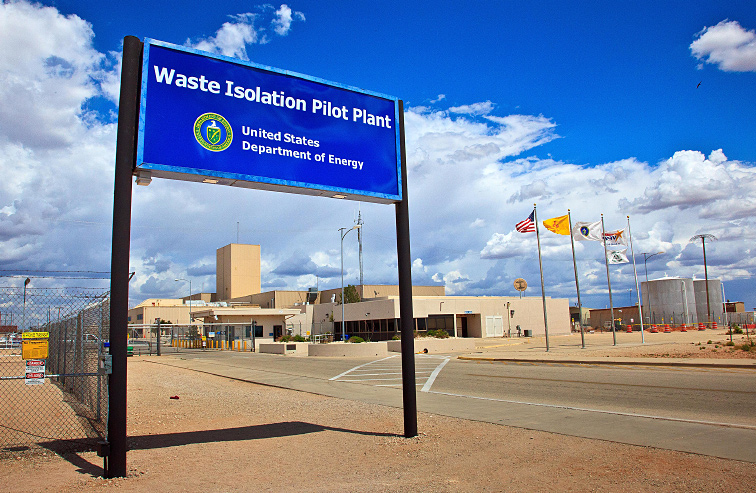
The federal government is “failing” in its commitment to clean up Cold War nuclear waste sitting in refuse at Los Alamos National Laboratory, according to New Mexico Environment Department Secretary James Kenney who said the state could respond by suspending waste shipments to the Waste Isolation Pilot Plant near Carlsbad.
Under a 10-year state permit signed by the Environment Department and the U.S. Department of Energy in 2023, the federal facility was required to prioritize waste from Los Alamos for disposal at WIPP.
Kenney said the federal agencies that run WIPP were “failing” to fulfill the requirement and that he was prepared to use a separate clause in the 2023 permit, which is active for 10 years, allowing the state to suspend waste shipments to WIPP when the state’s terms are unmet.
“They get an F from the NMED,” Kenney said in a Sept. 10 interview with the Current-Argus. “Maybe shipments around the country need to be suspended, except from LANL, until they meet the conditions that they negotiated. I’m well down the path of concluding that the DOE and its contractors need a wake-up call.”
At WIPP, the Energy Department disposes of transuranic nuclear waste (TRU), which is clothing materials, equipment and other debris irradiated during nuclear activities from LANL in northern New Mexico and several other federal nuclear facilities around the U.S. The waste is buried in a salt deposit about 2,000 feet underground and the salt gradually collapses on the waste, burying the refuse and blocking radiation from escaping.
Kenney’s remarks coincided with a town hall meeting where Jessica Kunkle, manager of the Department of Energy’s Los Alamos field office, provided an update on shipments and said disposing of the lab’s Tru waste remained a top federal priority.
She said that since May 2000, the TRU waste containers held on the surface at the lab were reduced from about 24,000 containers to 2,500 as of Sept. 7. She noted that as the lab continues to exhume waste buried at the site in the past, including a landfill dating back to the 1960s and ’70s, that inventory may increase.
But meanwhile, Kunkle said, the federal government was working “as quickly as possible” to send the lab’s waste to WIPP.
“Shipping our legacy TRU waste from Los Alamos to the Waste Isolation Pilot Plant continues to be one of our top priorities,” she said. “The department has made incredible progress.”
Part of that progress, Kunkle said, was a series of corrugated metal pipes containing plutonium residue, which lab staff recently exhumed, cut into smaller containers and shipped to WIPP. So far, Kunkle said, 63 boxes of this waste were sent to WIPP.
“I know this doesn’t seem like a lot,” she said, “but I do want to emphasize that our waste characterization ability was down for about a year.”
Characterization, or the ability to check and ensure the waste meets federal disposal requirements, was restored at the site in March, Kunkle said.
“We are going to continue moving that waste off the hill as fast as we can,” she added, referring to the lab’s location on a hill that oversees the city of Los Alamos.
Federal officials said about four shipments from Los Alamos were being sent to WIPP each week, out of about 15-17 total shipments.
During the town hall meeting, Santa Fe resident Cindy Weehler, a frequent critic of the Los Alamos lab and WIPP, pointed to federal plans for Los Alamos to restart the production of plutonium pits – the triggers of nuclear warheads – and asked why that process would begin, potentially creating more waste, before existing waste is cleaned up.
The energy department’s National Nuclear Security Administration planned to produce 80 such pits a year by 2030 – 30 a year at Los Alamos and 50 at the Savannah River Site in South Carolina.
“In order to prioritize your bomb making, you’re willing to risk New Mexico property and lives,” Weehler said, arguing the existing waste was further at risk due to the area’s propensity for wildfires. “All we ask is that you do not harm us; you have harmed us.”
Kunkle responded that WIPP had sufficient space, having used only 40% of its 6.2 million cubic foot capacity as outlined by the federal Land Withdrawal Act.
“The new waste will go to the Waste Isolation Pilot Plant, but the good news is that there is plenty of room for all the waste,” Kunkle said. “When we have legacy waste ready for shipment, we get priority.”
But Kenny said the energy department seemed to prefer taking in waste from out-of-state facilities such as Idaho National Laboratory.
In total, Los Alamos sent 1,730 shipments of waste to WIPP since the repository opened in 1999, compared with 7,701 shipments from Idaho. Waste from Idaho is shipped to WIPP under a 1995 agreement between that state and the federal government.
An amendment to the agreement in 2018 said 55% of WIPP’s shipping capacity and all unused capacity should be reserved for Idaho waste disposal.
Kenney said that while the federal government should work to meet commitments to the states, New Mexico should be prioritized as it takes on all the risk with waste being disposed of in the southeast region of the state.
“We would like to be treated equivalently to Idaho and the other states,” he said. “The notion that the federal government can do what it wants when it wants is not cooperative federalism in the way Congress intended.
“Apparently, we’re going to need to make a bigger issue out of it.”
Managing Editor Adrian Hedden can be reached at 575-628-5516, or @AdrianHedden on the social media platform X.