Home Blog Page 108

County briefed on flood response

0

Adrian Hedden
Artesia Daily Press

Heavy rainfall this summer prompted several flood warnings and road closures in Eddy County, meaning emergency personnel were out blocking roads and ready to rescue those trapped by water.

Eddy County Emergency Manager Jennifer Armendariz reported that 7.47 inches of rainfall fell between June 1 and July 11 at Carlsbad Caverns, while 4.42 inches fell at the Carlsbad Airport and 3.77 inches in Artesia.

She said during a presentation at Tuesday’s Eddy County Commission meeting that the monsoon weather meant the county’s Office of Emergency Management was out documenting flooding, staffing road closures and conducting water rescues throughout the summer.

Armendariz said the county has more than 100 low-water crossings – roadways at lower elevations that frequently flood during heavy rain events – and 12 bridges also at-risk during rains.

Extensive flooding was reported in rural areas of Eddy County, Armendariz said, at road crossings on McDonald Road, Longhorn Road and Deer Canyon. She said motorists should avoid these areas during heavy rainfall and not attempt to drive through flooded intersections.

“Any education that we can talk about, we do. Turn around don’t drown – it’s just a phrase until it happens,” Armendariz said.

During destructive storms, Armendariz said, the department collaborates with first responders in the area to collect photos and document the impacts. That can help the county apply for federal disaster funds when rains turn to deadly floods.

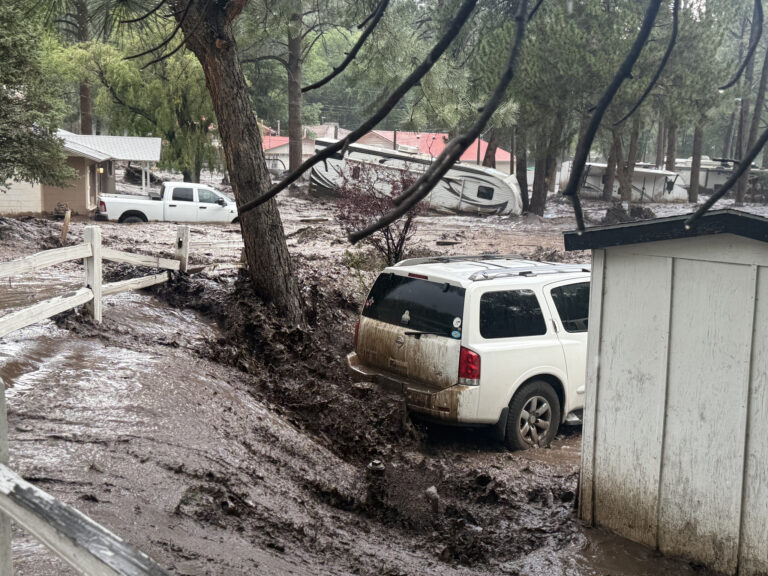
This year’s monsoonal weather in Eddy County came amid catastrophic flooding in the Ruidoso area on July 8, a flood that killed three people, destroyed several homes and shut down the Ruidoso Downs Race Track for the season. The races were moved to the Albuquerque Downs, and flood risks remained throughout the month.

A federal Major Disaster Declaration was issued by the Federal Emergency Management Agency (FEMA) July 23 in Ruidoso, allowing those impacted by the floods to apply for federal money to aid in the subsequent rebuilding and other relief efforts. That followed an Emergency Declaration issued by FEMA in the immediate aftermath to aid in first response.

Should a similar flood event happen in Eddy County, Armendariz said the county would be ready.

“In the event that there’s ever a FEMA declaration, they usually ask for pictures. It’s a collaboration between a lot of people,” she said.

As of Tuesday’s meeting, Director Hazer Archer said floodwaters had receded and most roads were drivable throughout the county. He said the McDonald Road crossing remained closed as county workers repaired the road.

Archer said the county was planning to add gates at some low-water crossings. The gates could be closed to prevent drivers from entering flooded areas.

“We have a road crew on call 24 hours a day,” he said. “At this point, all the roads are safe to travel.”

District 4 County Commissioner Bo Bowen commended emergency responders for their work during the floods.

“There was a lot of unexpected rain, a lot of washed-out roads,” he said. “Everyone was panicking over this, but it was great to see a lot of successes coming out of it.”

Managing Editor Adrian Hedden can be reached at 575-628-5516, or @AdrianHedden on the social media platform X.
Family’s love helps girl discover she’s got game

0

JT Keith
Artesia Daily Press
jtkeith@artesiadailypress.com

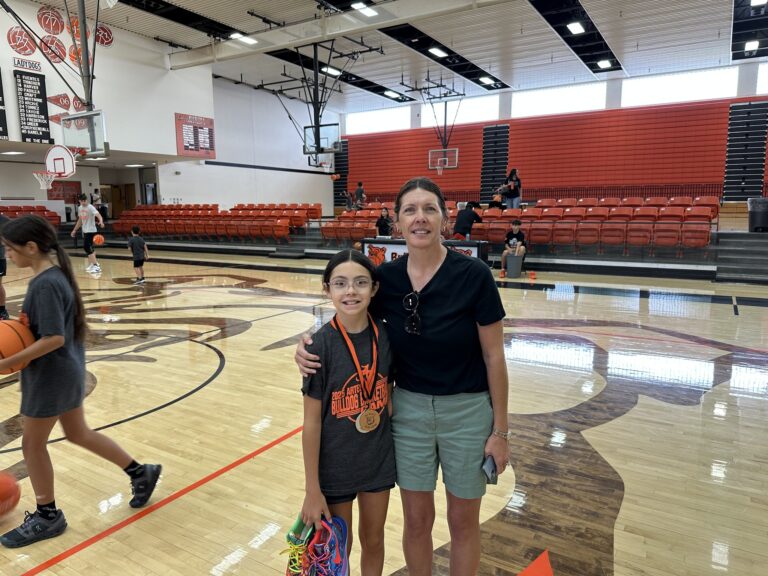
Kylee Lujan, 12, who will be a seventh-grader at Zia Intermediate School, loves basketball. She was born with her left arm missing at the elbow, but she refuses to let that stop her.

Kylee became a basketball fan after watching a Milwaukee Bucks basketball game when she was 5 years old. She said she fell in love with Bucks forward Giannis Antetokounmpo because of his playing style and his ability to get to the rim. As a birthday gift, her parents took her to see Antetokounmpo play in Dallas against the Dallas Mavericks in December 2023.

“She fell in love with Giannis,” said her mother, Stacy Lujan. “She told us that she wanted to play basketball. It has become her passion. That’s all she wants to do. She eats, sleeps and breathes basketball.”

Kylee came in second place in the free throw shooting contest and third place in the jump shooting contest at the 11th annual Artesia basketball camp from June 2 to 4 against 50 fifth- and sixth-graders.

“I was proud of myself,” she said after winning her awards at the basketball camp. “My dad was proud of me and told me good job.”

And she did it with one arm. “It does not bother me,” Kylee said. “I try to do things. My parents help me learn and help me practice.”

Kylee was born with her left arm missing at the elbow, said her mother. Stacy Lujan said that when she and her husband, Luis, went to get a sonogram, the doctors told her that they couldn’t see the condition of Kylee’s arm, but that they could tell that she was a girl.

Stacy, 46, said that from that day forward, she had a feeling that she was either going to have a Down syndrome baby or that there would be another problem.

As soon as Kylee came out, the doctors told Stacy, “We have a problem,” and that was the first time they knew.

“They told me her arm did not develop,” Stacy said. “I said, ‘Give her to me.’”

“When Kylee came out,” Stacy said, “I just knew she would do good things whether she had an arm or not.”

“When she was four months old, the doctors told us that she needed therapy because she had to get her core strength (stomach) developed to sit up. The doctors told the family that Kylee would need two to three years in the program, but Kylee graduated in nine months.”

“We raised her normally,” Stacy said. “Kylee does this (basketball camp) and will play some summer league basketball and go to open gyms. She has chores and responsibilities.”

Stacy said they have never taught Kylee how to tie her shoes or dress herself, but she has done them independently. As for hobbies, she likes to play tennis.

Kylee started playing basketball when she attended Seek 1st Sports, a church league in Artesia. She became so good that her mother said an opposing coach triple-teamed her to stop her from scoring.

“When they did that, it made it harder for me to shoot,” Kylee said. “So I just started to pass.”

Her dad, Luis Lujan, 42, works with her several times a week and taught her how to shoot a basketball.

Kylee said that two years ago, she became a fan of Caitlin Clark, who formerly played for the Iowa Hawkeyes and now plays professionally for the Indiana Fever.

“She (Clark) is a great shooter,” Kylee said. “I try to shoot like her. I would like to play for the Artesia High School girls’ basketball team.”

The family believes in Kylee’s dream to play basketball, and they asked her if she wanted to move or stay in the same house. Kylee said she wanted to stay, and the family tore up their backyard and built her a half-court, regulation-size basketball court in 2023.

“I feel like she’s grown up in Artesia for so long, and she has been involved in so many things,” Stacy said. “No one realizes she does not have an arm. And they are like, ‘That’s just Kylee.’”

JT Keith can be reached at 575-420-0061, or on X @JTKEITH1.

Evolution of White Sands

0

Staff Reports

A look back at missile range during the 1950s and 1960s

The 1950s and 1960s marked a significant era in the history of White Sands Missile Range, a period characterized by dynamic advancements in missile testing and development. When reflecting on this decade, one cannot overlook the monumental impact of V-2 rockets and the innovative testing methodologies that emerged at the facility.

The 1950s were not only marked by advancements in V-2 rocket technology but also by other significant accomplishments that helped shape White Sands Missile Range as we know it today. In 1952, the Department of Defense integrated the Alamogordo Bombing Range into the White Sands Proving Grounds, which resulted in the proving ground assuming control of the Trinity Site.

In the short span from 1945 to 1954, White Sands experienced a remarkable surge in missile launches, increasing from just 14 to a staggering 656. This dramatic increase highlights the growing significance of White Sands as a hub for missile testing and development in the United States. Between 1946 and 1952 alone, approximately 67 V-2 rockets were meticulously assembled and tested at the proving ground. These efforts provided invaluable experience to the U.S. military in handling key aspects of missile operations, including assembly, preflight testing, fueling, launching and tracking.

By the mid-1950s and early 1960s, the central area of the proving ground was evolving into a city. The housing units were equipped with gas, water, sewer and electrical facilities, and telephone and telegraph services were accessible. The first post newspaper was published on March 16, 1950. Additionally, the area had a post office, an elementary school and a bank.

Another significant milestone was the completion of the LLS-1 USS Desert Ship by the Desert Navy at the White Sands Proving Grounds in 1953. This unique structure, designed as a concrete block house complex, provided essential assembly and launch facilities that simulated the conditions found on actual naval ships.

The July 1953 edition of Wind & Sand, the proving ground’s newspaper at the time, featured a story titled “Desert Navy’s Collaboration with the Army at White Sands Creates Unique Operations.” At that time, the Desert Navy’s mission was to train Navy personnel in the fields of rockets and missiles while also coordinating with the Army to utilize the White Sands Proving Grounds and its facilities efficiently.

Another unique aspect at the time was the shared recreational facilities. The article states, “While the post swimming pool is officially designated as the Navy Training Pool, soldiers and sailors alike share its refreshing coolness after duty hours.” However, this is now standard practice today.

Another interesting tidbit from Wind & Sand was an article announcing a contest to name the USS Desert Ship. A $10 prize was offered by the Navy Welfare Committee.

On May 1, 1958, the proving ground officially became White Sands Missile Range. This was accomplished through a Department of the Army General Order.

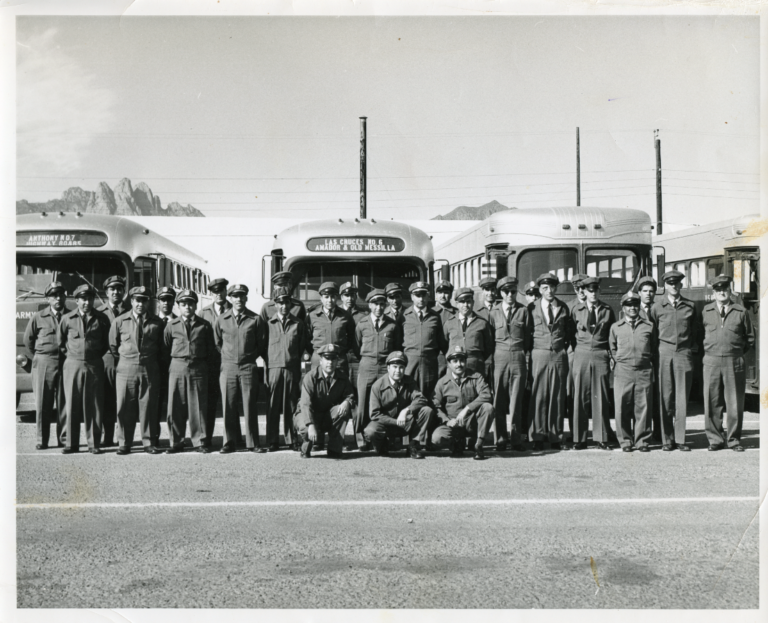
Do you think your drive to White Sands Missile Range is tedious? In the 1950s, the transportation section of White Sands Proving Grounds was responsible for transporting over 2,100 passengers daily via caravans of G.I. buses. The passengers included military personnel and civilians who worked at the proving ground and lived in El Paso, Las Cruces or Alamogordo. People still made the long trek on U.S. Highway 70 to Las Cruces or traveled north on the desert road to El Paso.

During the 1960s, comprehensive bus schedules were developed to accommodate various work schedules and to meet the needs of White Sands Missile Range.

In the 1960s, the Army began conducting “overflight” tests to gather essential flight performance data for one of its newest missiles, the Pershing ballistic missile. Today, similar off-range equipment tests are known as “long-range missiles.” These tests were scheduled to occur over populated areas and originated from two locations: Blanding, Utah, and the Wingate Ordnance Depot, located just south of Gallup, New Mexico. In each instance, the warhead was designed for impact within the White Sands Missile Range and not equipped with explosive capabilities.

During this time, Maj. Gen. J. Frederick Thorlin, the commander of White Sands Missile Range, reassured the local community that the possibility of a missile dropping mid-flight is unfounded. He also noted that in the nearly 20 years since White Sands began operations, the electronic and visual tracking techniques for missiles have become one of the range’s standout capabilities.

These advancements during the 1950s and 1960s laid the groundwork for the modern White Sands Missile Range, shaping it into a vital hub for missile and space research. As the range continued to evolve, it built on the experiences and technologies developed during these transformative decades, ensuring its place in the history of military and aerospace technology.

The legacy of America’s Range serves as a reminder of the relentless pursuit of innovation and excellence in missile testing, setting the stage for future developments in the years to come.

Ribbon cuttings celebrate businesses

0

Artesia Chamber of Commerce

Catalyst Church-We were honored to recently celebrate a ribbon cutting with Catalyst Church at their brand new facility!! Chelsea and Nolan Frederick were raised in Artesia and have a passion for helping people find and follow Jesus! Check out this gorgeous new facility (It even has a touch of bulldog orange) located on west Hermosa! Join them Sundays at 10:00am.

 Native Air- Another ribbon cutting in the books for one of our newest members, Native Air, another option for emergency air service in Artesia! Thank you for your membership!

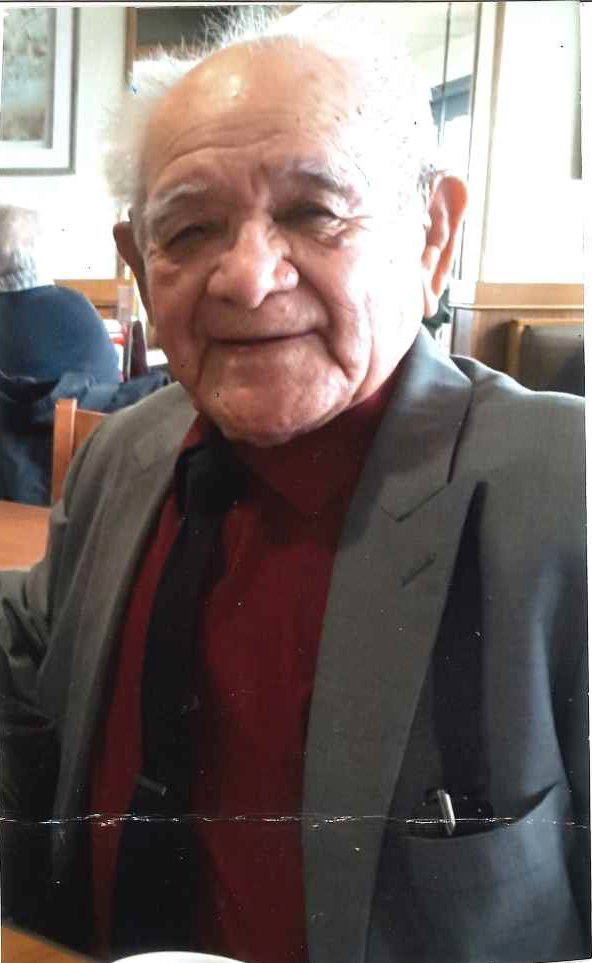
Benito “Ben” Brizeno

0

Benito Brizeno was born on March 21, 1928, to Florencio and Jesusita Cardenas Brizeno in Artesia, NM.

Benito 97 passed away on July 30, 2025, in Sparta Wisconsin.

Benito was raised in Artesia, New Mexico. He served his country and was a veteran of the United States Army.

Preceded in death was his loving wife Catalina Villa Brizeno, his parents Florencio and Jesusita Brizeno, brothers Antonio Carendoz, Raymundo Cardenas, Juan Brizeno, Santiago “Jim” Brizeno, Frank “Bugar” Brizeno, sisters Herlinda Huerta, Rita Dominguez, Miguela Florez, Marcelina Brizeno.

Bentio is survived by sister Ricarda Salsberry of Artesia, brother Paul Brizeno and wife Imelda, from Edgewood NM. Prior to his death, Benito lived with Kurt and Terry Ritter, daughter and son-in-law, Monica Logan, and Mary Kae Orcutt(granddaughters). He is also survived by several grandchildren, nieces and nephews who loved him dearly.

Benito was an Elder and member of the Kingdom Hall of Jehovah Witness in Hobbs NM, and Artesia NM. He also was a member in Sparta, Wisconsin. Benito had a special relationship with Jehovah and loved to spend time reading his bible daily.

Benito spent time in Colorado farming. He then relocated to Hobbs NM and worked numerous years for the city of Hobbs where he retired. He relocated to Sparta in 2013 and spent his retirement years there. He enjoyed the location and spent his days going for long walks and enjoying nature and woodland animals.

Special thanks from the family to his daughter Terry Ritter and Kurt, son-in-law and granddaughters, Monica and Mary Kae, for lovingly providing a happy safe home for Benito until his passing. No local services are pending at this time.

Permian Strategic Partnership invests $5M for Artesia students

0

Staff reports

The Permian Strategic Partnership (PSP) is investing $5 million into Artesia Public Schools (APS) to help build a new Career Technical Education (CTE) Center. By expanding access to hands-on workforce development programs, APS’s newest CTE center will enhance career readiness and create opportunities for students.

The new facility, expected to open in 2026, will build on Artesia’s existing career center, which opened last year. With PSP’s investment, the district will be able to expand those offerings and reach even more students.

“This project is a win for students, families, and our Permian community,” said Tracee Bentley, president and CEO of the Permian Strategic Partnership. “PSP is proud to partner with Artesia Public Schools to give more students a chance to learn critically important skills that translate directly into strong, stable careers.”

APS’s existing CTE programs prepare students for real-world opportunities in high-demand trades through business/marketing, mass communications, culinary and life skills programs. Targeting a 2026-2027 opening for the second facility, APS is expected to select a construction contractor by fall 2025.

“Artesia Public Schools is incredibly grateful for PSP’s investment in our students,” said Darian Jaramillo, superintendent of APS. “Our new CTE Center will help students find their path and equip them with the tools to succeed, whether they choose to enter the workforce immediately after graduation or pursue post-secondary education.”

The investment is part of PSP’s broader mission to strengthen education, healthcare, workforce development, and road safety while enhancing overall quality of life across the Permian Basin. To learn more about PSP, visit www.permianpartnership.org.

Garden workshops aid “green thumbs” at SENMC

0

Raymond Dominguez
Title V Activity Manager

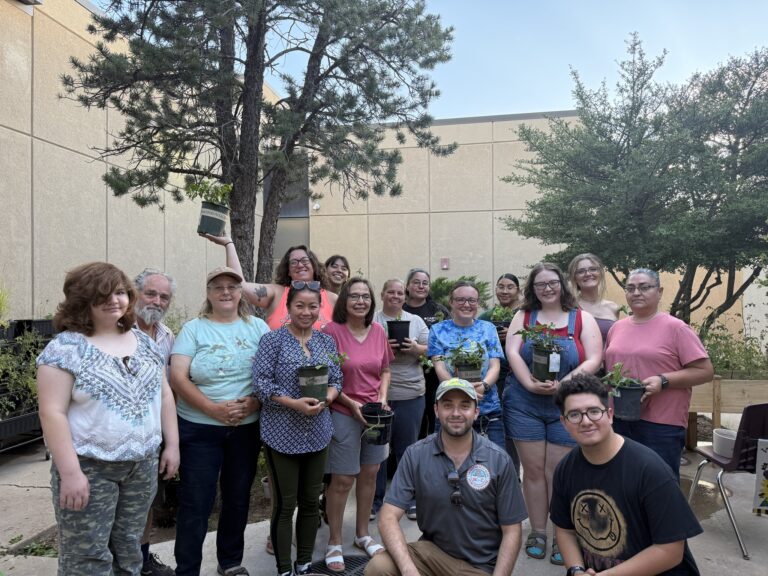
Over the summer, we hosted a series of workshops called Green Thumb 101, and I can honestly say it was one of the most rewarding projects we’ve worked on. We weren’t sure how many people would be interested, but each session brought a great mix of students, employees, and community members who were genuinely excited to learn and share. Whether it was choosing the right plants or figuring out the best way to water them, people showed up ready to get involved and that energy really stuck with us.That’s where the idea for the Hidden Gardeners Haven came from.

Thanks to a great partnership with the Eddy County Health Council, we’re starting something that goes beyond workshops. The Hidden Gardeners Haven is a space where anyone, whether you’re new to gardening or have years of experience, can gather, connect, and grow something meaningful together.

We’ll be meeting once a month in the SENMC Hidden Garden (behind the Main Building, near the back parking lot and the central stairway entrance.), and instead of formal workshops, these gatherings will be more casual and community driven. It’s a time for us to check in on the garden, share gardening tips and ideas, ask questions, and exchange plants or cuttings. If you have a plant that’s struggling or one that’s thriving and you’d like to trade, bring it! If you’re not sure what to grow next season, come talk it out with someone who’s been there. Our meetings will take place on the second Monday of each month in the afternoon. For Fall 2025, the meeting dates are: September 8, October 13, November 10, and December 8.

This space is meant to be hands-on, flexible, and welcoming. We’ll also take time during each visit to take care of the garden together, watering, weeding, harvesting, and/or whatever the garden needs that day. It’s not just about growing plants; it’s about growing a community that values sustainability, wellness, and being outside in a meaningful way. This isn’t a class. There’s no pressure. It’s just a space for people who want to connect and contribute, one plant, one conversation, one season at a time. If you’re interested in joining, just scan the QR code on the flier and fill out the quick form to sign up. After that, you’ll start getting updates on meeting dates and times.

And if you missed the summer series, don’t worry! We’re already working on the Fall 2025 Gardening Workshops, so be on the lookout for those as well. The new topics will focus more on seasonal gardening and community-driven ideas, based on feedback we received this summer.

Thanks again to everyone who has helped shape this project so far. I hope you’ll consider joining us, whether you’re a master gardener or just looking for a new hobby, the Hidden Gardeners Haven is for you.

Feel free to reach out if you have questions or want to get involved in other ways:

Raymond Dominguez

575.234.9260

rdominguez@senmc.edu

WIPP safety questioned at forum

0

Adrian Hedden
Carlsbad Current-Argus
achedden@currentargus.com

Federal officials maintained that the Waste Isolation Pilot Plant was continuing to successfully dispose of nuclear waste at the underground repository near Carlsbad, even amid concerns that the facility was aging and becoming unsafe.

Mark Bollinger, manager of the Department of Energy’s Carlsbad Field Office which oversees WIPP’s operations, said during a Wednesday public forum held in Hobbs that the site was continuing to increase shipments to about 17 per week, potentially continuing disposal until 2080.

But that purported success came as the New Mexico Environment Department filed an administrative compliance order to the Department of Energy and its primary WIPP contractor Salado Isolation Mining Contractors (SIMCO), citing five violations of the state permit related to infrastructure safety.

The environment department demanded the federal agency provide a schedule and detailed plan to address its infrastructure within 60 days of the July 25 order.

As evidence of the problem, the state cited a June 24 report by the Government Accountability Office calling on the department to increase oversight of SIMCO and its maintenance operations at WIPP.

That report said “more than half” of WIPP’s infrastructure was in substandard condition, including hoists and electrical substations in the underground.

“This independent federal audit presents evidence of systemic failures in infrastructure maintenance and oversight at WIPP that raise concerns about the Facility’s continued compliance with Permit conditions requiring operational maintenance of the Facility,” read the order.

The report followed a June 18 letter from the Defense Nuclear Facilities Safety Board to the Department of Energy detailing an alleged state of disrepair at WIPP’s three underground elevators and other infrastructure in the underground.

“These are very disturbing issues that I think the public should be concerned about,” said Lawrence Fioretta, an attendee at the forum.

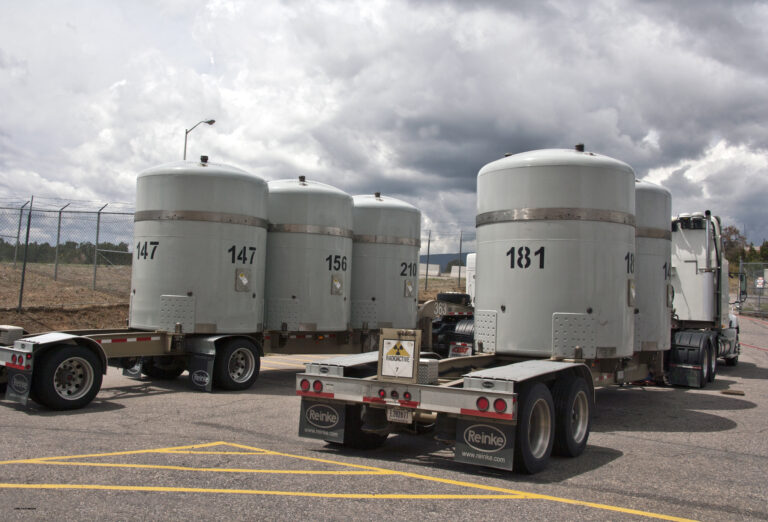
At the site, the federal government disposes of transuranic nuclear waste (TRU), which is clothing materials, equipment and other debris irradiated during nuclear activities.

The waste is buried at WIPP in a salt deposit about 2,000 feet underground. The salt gradually collapses on the waste, burying the refuse and blocking radiation from escaping.

Moving workers in and out of the underground requires the use of three hoists. The main elevator can move people and waste into the underground, while a lift carrying salt to the surface can also be used for workers. A third hoist doubles as an air intake shaft. A fourth shaft serves only for exhaust and has no lifting ability.

Bollinger argued that the infrastructure concerns were being addressed and that all WIPP’s hoists are functioning and can pass inspections.

“We won’t operate if we can’t do it safely,” Bollinger said, noting “a billion dollars” was spent on recent infrastructure improvements. “We move at the speed of safety. We will continue to make progress on infrastructure and not have any safety problems as a result.”

SIMCO Capital Asset Manager Brandon Jones said the contractor was taking several steps to rebuild infrastructure at the WIPP site. He said some such projects were delayed by supply chain problems and recently imposed tariffs on imported materials.

“We upgrade the infrastructure so that we have reliable hoists. They’re needed for waste disposal,” Jones said. “We have seen supply chain issues, delays in critical components, some because of tariffs.”

Los Alamos ‘highest priority’

Concerns for WIPP’s safety could worsen over the next 50 years, said Cynthia Weehler, a Santa Fe resident and frequent WPP critic who attended Tuesday’s forum. She said that as WIPP planned to take in waste from federal facilities across the country, it was also in danger of failing to clean up waste left over from the Cold War at Los Alamos National Laboratory (LANL).

Cleaning up Los Alamos in northern New Mexico was a mission Weehler said New Mexicans were promised in agreeing to host the WIPP site.

“I’m wondering where New Mexico fits in that and finishing that original mission at WIPP,” Weehler said. “We’re quite concerned and want to make sure LANL waste is the waste that is addressed first.”

Bollinger responded that Los Alamos was WIPP’s “highest priority site” and that when waste is ready it is taken from the lab, where the United States’ first nuclear weapons were developed during the Manhattan Project.

He told those in attendance a recent estimate that WIPP would continue accepting waste until 2083 was based on predicted availability of waste and could change over the years. As of Wednesday, Bollinger said, the WIPP underground was at 45% of its capacity.

“Our goal is to always take LANL waste first when it’s ready. We want to take their waste whenever it’s ready,” Bollinger said. “They have that authorization. Whatever number they want, they’ll get.”

Managing Editor Adrian Hedden can be reached at 575-628-5516, or @AdrianHedden on the social media platform X.
Dana Coupland

0

Dana Lee Coupland

Dana Lee (Johnson) Coupland was born 6-1-1949 to Henry Oliver and Wilmoth Fay (Newton) Johnson in Roswell NM. Dana and her family lived in Roswell until 1962 when they moved to the Neatherlin ranch in Pinon NM. She was baptized in 1963 at the First Baptist Church of Pinon.

Dana graduated the 8th grade at Penasco Elementary School as Valedictorian. Then she attended Artesia High School through 10th grade. After that she attended and graduated from Weed School, where she was the Valedictorian of her graduating class. She then attended Eastern New Mexico University Roswell and received her Associates Degree in 1969.

On June 1st, 1969, Dana married her High School sweetheart Jack Coupland and together they moved to Las Cruces where she continued her education at New Mexico State University. There she received her BA in Early Education in 1980, graduating with Highest Honors.

Dana gave birth to twins Dan and Jerry on 4/5/1972 in Albuquerque NM. The family moved back to Las Cruces where Scott was born 12/28/1975.

In 1980, the family moved home to Pinon to be on the ranch. Dana worked for the Alamogordo Public School system as an Elementary school teacher at Weed School. Dana then worked as Substitute Postmaster at Pinon Post Office for several years which led to her becoming Postmaster at Sacramento Post Office.

Dana is survived by her husband Jack, son Dan and wife Lori, son Scott and wife Julie, sister Peggy Montgomery and husband Danny, sister Kelly Hibbard and husband Mitch, brother-in-law Bobby Melton, sister-in-law Jeanette Coupland, grandson Rawley Coupland, granddaughter Kylee Mydock and husband KY, grandson Curt Coupland, nephew Justin Montgomery and wife Angela, nephew James Hibbard and wife Staci, nephew John Hibbard and wife Kristal, nephew Joe Hibbard and wife Alia, nephew Jacob Hibbard and wife Felicity, nephew Jesse Hibbard, niece Amanda Hibbard, niece Sara Hibbard, niece Melissa Hibbard, niece Becca Hibbard, nephew Josh Hibbard, her aunt Marilyn Johnson, cousin Mark Johnson and wife Patty, and cousin Michelle and husband Chuck Pattison.

Dana was preceded in death by parents Oliver and Wilmoth Johnson, sister Sue Melton, brother-in-law James Owen Coupland, son Jerry Coupland and nephew Earl Montgomery.

Services will be held on Saturday, August 2, 2025, at 11:00 AM, held at Pinon Baptist Church with Pastor Wayne Brazil.

In lieu of flowers, the family asked donations to be made to the New Mexico CowBelles or the Pinon Extension Club.

Affordable housing getting closer to reality

0

Ruidoso News

RUIDOSO — With ground broken on a new housing complex in Ruidoso on July 18, the village’s long quest to provide more affordable housing for working families is closer to reality.

Village officials and representatives from Housing NM and Dallas-based development company Enriched Communities gathered at the Ruidoso Convention Center to celebrate the soon-to-be constructed Elk Meadows apartments at 1104 Mechem Drive.

“Getting to this point has been a complicated and challenging process,” said Colin Kruger, Enriched Communities representative. “I think it’s a good case study for affordable housing in general and not just in New Mexico. At the end of the day, we’ve got a $22 million project that has nine distinct and separate sources of capital.”

Ruidoso Mayor Lynn Crawford said there will be 72 one, two and three-bedroom units when the project is completed. He said the groundbreaking ceremony represents the realization of a seven-year dream for the village and for him.

“It’s a difficult process, and it’s a year before this is complete,” Crawford said. “So it’s just a dent in the housing shortage for working families, but this is the first movement that’s visible. We’re hoping to do more as a village, and hope this continues to stimulate private investment in the community.”

Crawford said things really got into gear when the village first pursued 9% low-income housing tax credits (LIHTC) for developers from Housing NM. It took three tries before the incentive was finally awarded at the Housing NM May 2024 board meeting, due to a very competitive process and stringent requirements.