Galen Farrington
The end of the Mexican-American War (1846-1848) drastically changed the political geography of North America with the United States and Mexico signing the Treaty of Guadalupe – Hidalgo granting the former, 55 percent of the latter’s land mass. The New Mexico Territory of then, comprised all or parts of the following current states: California, Nevada, Utah, Arizona, New Mexico, Colorado, Wyoming, Oklahoma and Kansas.
It was an extraordinary era of American history with the political complexities that existed. Of the nine future states occupying the latest example of manifest destiny, New Mexico with Arizona had the longest waits for statehood – some 64 years. Politicians (mostly lawyers) chipped away at the New Mexico Territory. Treaties and various agreements were signed and often changed in their final form. Even the final presentation of the Treaty of Guadalupe – Hidalgo was changed dramatically from the original document drafted by U.S. President Taft appointee, Nicholas P. Trist, in Hidalgo, Mexico with three Mexican representatives.
The Treaty was sent to Washington, D.C. and the Senate ratified the document except for Article X which, in the National Archives, is simply listed as “deleted.” Article X guaranteed the Mexicans owning land (land grants) protection under law; the land was theirs. The elimination of Article X resulted in not only significant land loss but created a legacy of inequality as “Americans” migrated from the east with new laws and a culture that valued property. Due to the lack of property and facing a cultural shift that, by Treaty dictate, required language and political absorption, poverty for the Mexicans and Native Americans also became a generational norm.
The Treaty did provide for all Mexicans who chose to remain in the acquired territory to have all of their debts to their Mexican homeland paid in full so that a “new start” was granted. Some left for the arduous journey south across the new border and those who remained petitioned for statehood and its benefits for decades. The New Mexico Territory was considered a “wild place” by those making the laws in Washington, D.C. and soldiers were sent to the newly acquired landscape to create forts to protect the small number of Anglo Americans (as the U.S. Citizens were called) who adventurously entered the untamed wilderness during the 1840s and 1850s. The first forts of protection in the future state of New Mexico were Fort Union (1851) and Fort Stanton (1855).
The New Mexico parcel became smaller as surrounding entities chipped away at its borders with Texas desiring the largest piece by claiming all land east of the Rio Grande and Arizona wanted the portion to the west of the river. Thankfully, more rational minds prevailed. The only border to gain land for the new territory was to the south as the original Treaty mistakenly surveyed the southern 30 miles to the north of the current line of demarcation.
The American Minister to Mexico, James Gadsden, negotiated another treaty (1853) with Mexico that would bare his name and the U.S. had the 30 mile land corridor it needed for the proposed trans-continental railroad and the agriculturally fertile Mesilla Valley; the border disputes were settled.
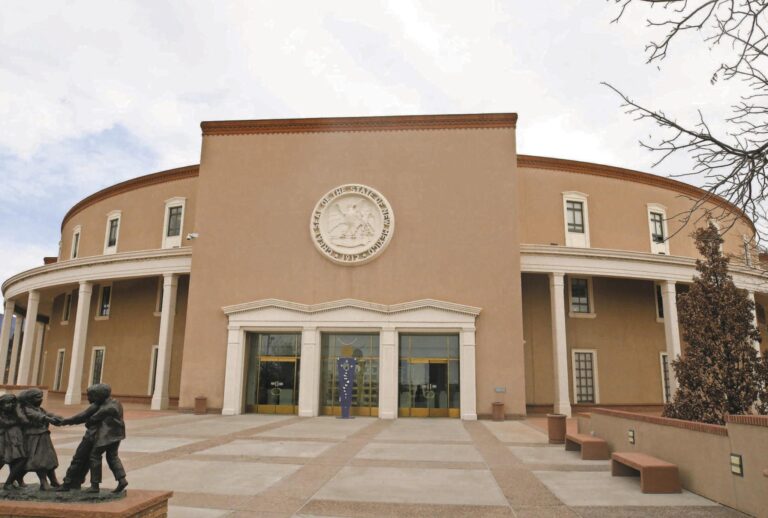
By 1880 an immigration office was established in the Territory to attract Easterners (“Americans”) to the new troubled frontier as it was a truly wild place with marauding Native Americans, disgruntled Mexicans, land-thirsty pioneers, and a political system that lawyers and soldiers enforced with often a brutal sword. Somehow the political core of the Territory was successful in convincing President Taft to cease the outrageous hostilities and create the Enabling Act of 1910 that allowed territories to form constitutions for congressional ratification and on January 06, 1912 New Mexico became the 47th state with Arizona the last of the “lower 48” admitted on February 14, 1912. The 64 year struggle resulted in a new people seeking “… the Blessings of Liberty … and … Posterity” granted to all Americans by the United States Constitution.
Happy Birthday New Mexico.
Galen has lived in Ruidoso with his wife Chris for more than fifty years, contributing to the education of our community for a shared eighty-five year experience. He may be contacted by email at: gcf88345@gmail.com