Home Blog Page 54

Opinion: Apathy won the runoff in Albuquerque

0

Jodi Hendricks

Tim Keller has won another term as mayor of Albuquerque, the first to be elected to a third term in our city’s history. Congratulations, Albuquerque. We will continue to experience unprecedented rates of homelessness, crime, and chaos.

But before anyone rushes to either celebrate or despair, we need to confront a harder truth. This election was not decided by a groundswell of confidence in the direction of our city. It was decided by apathy.

Only about 35 percent of eligible voters bothered to show up in this runoff election. In a city struggling with public safety, open drug use, failing infrastructure, and a visible humanitarian crisis on our streets, nearly two thirds of voters stayed home. That is not a mandate for Keller, it is indifference.

The biggest victims of the state of our city will not be those who live in gated communities or insulated neighborhoods. It will be the small business owners trying to survive downtown while theft, vandalism, and foot traffic decline. It will be the families raising children in neighborhoods overrun with drug addiction and encampments, where walking to a park no longer feels safe. And it will be the city as a whole, as businesses choose not to expand here or leave altogether, taking good paying jobs with them because no one wants to invest in a place where disorder feels permanent.

This outcome happened because too many people decided that voting was pointless, or that national political grudges mattered more than local leadership. For many, the calculation was simply: “Never vote Republican.” For others, it was about sending a message to Donald Trump, even though he was not on the ballot and has nothing to do with the day to day governance of our city.

Local elections are not symbolic protests, they are decisions with real life consequences. When voters sit out they should also sit out from complaining or criticizing the state of the city. After all, they did nothing when they had a chance to make a difference.

Apathy always favors the status quo. It favors incumbents. It favors systems already in place, even when those systems are failing. And it sends a clear message to city leadership that there is little political cost to continued dysfunction.

If Albuquerque is going to change, it will not come from slogans or social media outrage. It will come when voters decide that their city is worth showing up for. It will come when we demand accountability, not perfection, and are willing to vote for a different direction even when it feels uncomfortable or unpopular.

How much worse does it have to get before the voters of Albuquerque decide they want a change? I’m not sure we want to find out.

What we do know is this: a city cannot be rescued by the 35 percent. Until more of us are willing to engage, to vote, and to take responsibility for the future of our community, we will keep getting exactly what we are willing to tolerate.

Jodi Hendricks is executive director of the New Mexico Family Action Movment.
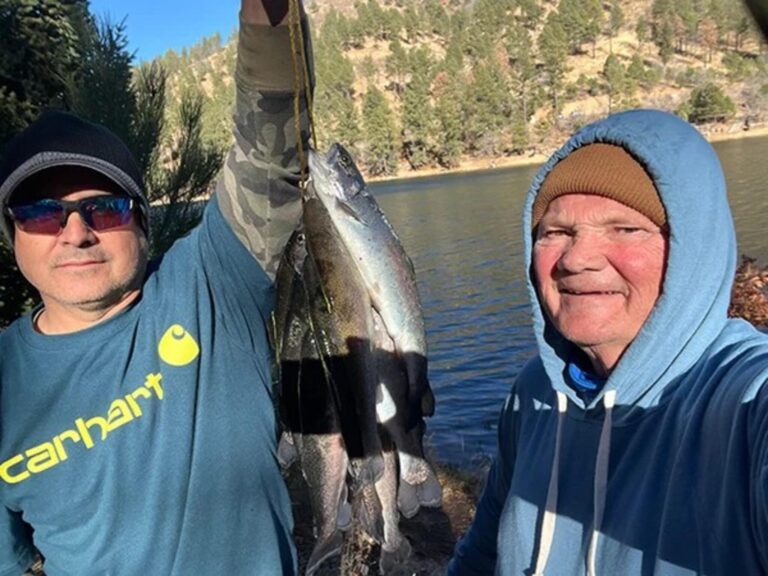
Trout biting in NM waters just in time for Christmas

0

Information and photos provided by New Mexico Department of Game and Fish

Holiday-weary New Mexicans looking for a break from shopping and other festivities might want to consider a Land of Enchantment fishing trip as trout-catching conditions are good at most lakes and rivers.

In northern New Mexico at Eagle Nest Lake, trout were biting on jigs and PowerBait.

Ice-fishing for trout was exceptionally good using Swedish pimples and tungsten jigs tipped with wax worms.

Along the San Juan River, the streamflow near Archuleta was 280 cubic feet per second (cfs). Fishing for brown trout was incredibly good using red annelids in the quality waters.

In southern New Mexico, trout fishing was good using PowerBait at Glenwood Pond.

In Lincoln County at Bonito Lake, trout fishing was slow to fair when using Garlic Cheese PowerBait and nightcrawlers.

Other species of fishing were also biting in New Mexico waters.

At Ute Lake, fishing for walleye, crappie, catfish and white bass was fair to good when using 3- and 4-inch Gulp minnows and jigs with green blades.

Around the Albuquerque Area Drains, fishing for carp was good when using worms.

Near Truth or Consequences at Elephant Butte Lake, catfish were biting on chicken.

This fishing report, provided by the New Mexico Department of Game and Fish, has been generated from the best information available from area officers and anglers. Conditions encountered after the report is compiled may differ, as stream, lake and weather conditions alter fish and angler activities.

The final week of Advent

0

Ty Houghtaling

The final week of our 7-week Advent will be known as the “Forefeast”. It is a time of intense spiritual focus. If you have ever prepared for a long trip, you know how it feels to get everything you need packed; your bank account/credit cards/travel documents ready, and your phone services updated. There is this “hurry up and wait” anxiety often during the few days leading up to your journey. For us this Advent season, let these last 7 days or so be a time of excitement, joy, and preparation. Maybe we could plan to attend the special services in our community, most churches will at the very least have a Christmas Eve service of some sort. Maybe we could plan a time each day and intentionally talk with family or friends recounting the events leading up to the birth of Christ, including the genealogies and the journey to Bethlehem. In some traditions the Church teaches that this is a time for final purification and renewal, culminating in the celebration of the Nativity. Let this week lead to an increase in personal and communal prayer, along with the reading of scriptures, especially the first chapters of each of the Gospels.

In addition, during the seven days leading up to Christmas maybe you should consider a “Nativity Fast”. The Nativity Fast in some religious circles is sometimes referred to as “Philip’s Fast” because it begins after the feast of St. Philip the Apostle, and it is a time set aside for spiritual cleansing and anticipation of Christ’s birth. The Eastern Orthodox Church, in their tradition, teaches that the purpose of this fast is not merely abstention from certain foods, but rather a holistic preparation involving the body, mind, and soul for the coming of the Messiah. For our purposes we will challenge ourselves to fast for seven days (December 18-24) leading up to Christmas Day. Maybe you might consider fasting from social media in the evening hours so that you might focus on your family or on scripture reading. Maybe you might choose to fast certain foods such as sweet treats or salty snacks during this week. You could always fast from food during the daylight hours or take on the bread and water only fast for the entire 7 days. I bet your Christmas Day or Christmas Eve meals will be even more delicious after such a fast. During this fast we will discover time and opportunities to focus on prayer, meeting the physical needs of the less advantaged, and repentance.

The Savior has come, and that’s why we celebrate Christmas. Don’t let the hustle and bustle of the holiday cause you to miss Him; and remember the other aspect of Advent is on our preparation for the Messiahs second coming. He is coming back; some predict very soon. Are you prepared?

Opinion: Legislature should health care worker compacts in 2026

0

Kristina Fisher

The most immediate way that New Mexico lawmakers can expand access to health care is by joining all the interstate compacts for health care workers, which would make it easier for health care professionals who are licensed in other states to care for patients here in New Mexico, including via telehealth.

States that join the doctor compact experience an increase of 10-15% in the number of doctors licensed every year.

This probably explains why states keep joining compacts and no state that has joined a compact has ever left. Forty-two states now participate in the doctor compact, 41 in the psychology compact, and 39 in the physical therapist compact. Meanwhile, New Mexico is one of only four states that participates in just one or no health care worker compacts. (We are a member of the nursing compact.)

During the 2025 legislative session, the House unanimously passed seven compacts, and Governor Lujan Grisham expressed her support. The only opposition came from a handful of powerful senators on the Senate Judiciary Committee, who blocked the compacts last session.

The good news is that, in response to increasing public pressure, the Senate Majority Leader pledged to consider the compacts for doctors and social workers during the upcoming 2026 session.

The bad news is that this leaves out the other eight compacts, even though New Mexico has shortages across all those health professions.

For example, in order to meet national benchmarks, New Mexico needs 2,510 more EMTs, 526 more physical therapists, 281 more physician assistants, and 114 more occupational therapists, among other professions. The state’s behavioral health care system has been in crisis for over a decade, with severe shortages of psychologists and counselors.

So what are the arguments against the compacts? We have heard three.

First, the senators who oppose the compacts object to several specific provisions, particularly the provision that prevents lawyers from suing the interstate compact commissions for their official acts. These commissions are made up of members of the medical boards of each of the participating states, and New Mexico’s medical board already has identical protection from lawsuits under our existing state law.

Notably, all of the provisions that senators object to in the compacts are included in the nursing compact, which New Mexico has participated in since 2003. The opponents of the compacts have not been able to identify any problems that have resulted from New Mexico’s participation in that compact over the past two decades.

Second, the opposing senators have inaccurately asserted that joining the compacts could jeopardize New Mexico’s protections for health care providers who provide reproductive and gender-affirming care.

In reality, the compacts clearly state that they do not alter any state’s authority to regulate the practice of medicine within its boundaries. The compacts also include strict limitations on information sharing between states. States like Colorado and Illinois, which have strong protections for reproductive and gender-affirming care similar to the laws in New Mexico, participate in multiple health care worker compacts without any issues.

Finally, these senators have said that there isn’t enough time to get the compacts ready for the 2026 session. However, because compacts are agreements between states, each state must agree to the same terms in order to participate. This means that if New Mexico passes a compact bill that materially changes the terms of the compact, it will not be allowed to participate.

The only changes that states can make are minor, technical tweaks to the compact wording that do not change any of the substantive terms. Legislators have had years to work with compact commission staff on crafting any wording changes they desire. The EMT compact was first introduced in 2017, and the doctor compact has been introduced repeatedly since 2019. Other compacts have also been introduced multiple times over the past five years.

It is time for legislators to stop playing political games with New Mexicans’ access to health care and pass all 10 health care worker compacts without further delay.

Kristina Fisher is associate director of Think New Mexico.

Debate rages on oilfield wastewater

0

Adrian Hedden
Artesia Daily Press
achedden@currentargus.com

Wastewater from oil and gas drilling could be reused by other industries next year, if a state body acts despite criticism from environmental groups.

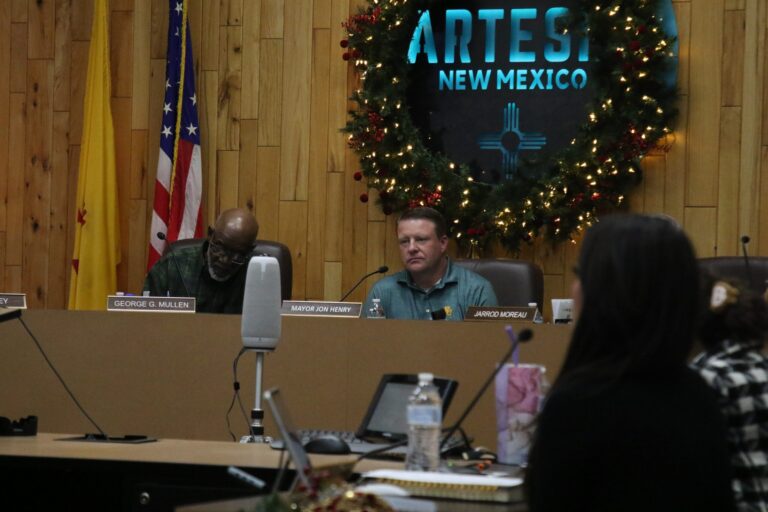
The state of New Mexico’s Water Quality Control Commission, which is considering regulations to permit some discharge of oilfield wastewater – known as “produced water” by the industry – heard public comments on the proposal during the commission’s Dec. 9 meeting.

Commission members voted in April to allow permits for produced water to be discharged in conjunction with pilot projects studying its potential for reuse. The commission reversed that decision in May and also opted to require permits even for pilot projects that do not discharge the fluid.

The commission has yet to vote on the specific language of the rule, which could be approved by the commission at its next meeting on Jan.13, 2026.

Among those commenting on the proposal during the Dec. 9 meeting was Christian Isely, a state government affairs representative for Chevron who said water extracted at mineral mines in northern New Mexico was already being reused. He said similar treatment could be applied to fluid produced by the oil and gas industry.

“The science is absolutely clear,” Isely said. “This water is safe after it is treated. Water treatment technology is evolving very quickly. Other states are moving ahead. If we use reclaimed mine water, why can’t we use produced water?”

The debate centered on the Permian Basin, where environmental group WildEarth Guardians contended that efforts to treat and reuse oilfield waste was resulting in more spills.

Meanwhile, oil and gas industry leaders in the state countered that energy companies were redoubling their investments in technologies intended to curb contamination while addressing water scarcity through reuse of wastewater.

State regulations were needed to ensure responsible reuse across the industry, said Missi Currier, president of the New Mexico Oil and Gas Association.

Spills are up, group contends

In the Permian, about four barrels of produced water are generated for every barrel of oil pumped during the drilling process.

The liquid is a combination of drilling fluids flowing back to the surface and formation water brought to the surface during the extraction of oil and gas from shale deposits.

The water is often high in brine and other chemicals and unsafe for human consumption.

In the third quarter of 2025 – July to September –produced waste spills increased by 244% in New Mexico when compared with the second quarter, according to a Nov. 11 report by Santa Fe-based WildEarth Guardians.

That amounted to about 2.9 million gallons of produced water spilled in about 350 spills of mostly produced water, the report read. The spills also included other substances such as crude oil and natural gas condensate, according to the study.

Of those, 165 spills were in Eddy County and 147 were in Lea County – the two counties that make up New Mexico’s portion of the Permian Basin.

Currier said spills necessitated the infrastructure to treat and recycle wastewater she said the industry was “heavily investing in,” such as better leak detection and automatic shutoffs.

“Spilled water is never treated – it must be contained and remediated immediately to meet or exceed regulatory requirements. That’s why prevention is critical,” Currier said. “These measures, combined with best practices and strict compliance, reflect our commitment to safe water management and environmental stewardship.”

WildEarth Guardians argued the problem was the result of increased drilling, higher volumes of water, and the industry’s struggles to handle its own growth.

The biggest spills were reported at recycling facilities the group contended were subject to frequent “equipment failures,” read the report.

“These ‘recycling’ facilities are ground zero for contamination,” said Melissa Troutman with WildEarth Guardians.

A ‘critical priority’

Despite such concerns, Currier maintained the facilities were crucial to addressing the environmental impacts of oil and gas production.

She called on the state of New Mexico to enact regulations allowing the use of produced water outside the oil and gas industry.

“Reuse is a critical priority for New Mexico because it addresses two pressing challenges: water scarcity and responsible resource management,” Currier said.

New Mexico’s regulations currently do not allow produced water to be used for any means other than drilling.

The “Produced Water Act,” passed in 2019, called on state agencies to adopt regulations to potentially expand reuse and the state created its Produced Water Research Consortium between its environment department and New Mexico State University.

The rulemaking remained ongoing six years later amid stern opposition from environmental groups who believe the fluid can never be made safe for reuse.

Currier said such rules were crucial to creating a level playing field for the industry, adding a layer of enforcement that would ensure companies of all sizes manage produced water correctly.

“We expect the Commission to act swiftly and decisively, because these rules are critical for responsible water management and for providing the regulatory certainty that industry and communities need,” she said.

Rebecca Sobel with WildEarth Guardians maintained that the reports of produced water spills proved the problem would only be worsened by state sanctioned discharges.

“If companies can’t safely contain produced water at their own recycling facilities inside the oilfield, there’s no justification for allowing them to transport this waste offsite to dump into rivers or spread onto fields,” she said.

Managing Editor Adrian Hedden can be reached at 575-628-5516, or @AdrianHedden on the social media platform X.

Push to return whole milk to schools advances

0

De Baca County News

The Senate’s approval of the Whole Milk for Healthy Kids Act could soon give schools the option to serve whole and 2% milk again.

A long-running push to restore whole and 2% milk to school cafeterias took a major step forward recently, as the U.S.

Senate passed the Whole Milk for Healthy Kids Act by unanimous consent.

If the House follows and the president sign the bill, schools would once again have the option to serve whole and reduced-fat milk alongside the fat-free and 1% varieties currently allowed. Supporters say this would better reflect what families buy at home and align school offerings with current nutrition science.

“Restoring schools’ option to offer whole and reduced-fat milk will mean more schoolkids will get the essential nutrients they need,” says NMPF president and

CEO Gregg Doud. “This commonsense legislation will help American children get back on solid nutritional footing.”

American Farm Bureau Federation president Zippy Duvall echoes that message, adding broader implications for both students and dairy producers.

This is a win-win for kids and dairy farmers because the nutritional benefits of whole milk are now broadly known,” Duvall says. “By lifting the restrictions on whole and reduced-fat 2% milk in schools, kids have more access to important protein, calcium and vitamins. Because school milk accounts for almost 8% of fluid milk demand, it’s a significant market driver, too.” Michael Dykes, president and CEO of the International Dairy Foods Association, also weighed in, highlighting the broader coalition behind the effort.

“The long wait is nearly over.

We’re closer than ever to bringing whole milk back to schools. Today’s Senate passage is a watershed moment for children’s health and for the dairy farmers, processors, parents and nutrition advocates who have fought for decades to restore whole and 2% milk to school meals.”

The Senate measure is sponsored by senators Roger Marshall (R-Kan.), Peter Welch (D-Vt.), Dave McCormick (R-Pen.) and John Fetterman, (D-Pen.). Senate agriculture chairman John Boozman (R-Ark.), and ranking member Amy Klobuchar (D-Min.), led the committee in approving the bill by voice vote in June.

Long road back

Whole and reduced-fat milk were removed from school menus in 2012 under nutrition standards set by the Healthy, Hunger-Free Kids Act, aimed at reducing childhood obesity. At the time, schools were restricted to serving only fat-free or 1% milk, and flavored options had to be fat-free as well.

While intended to improve student health, the change coincided with a noticeable drop in school milk consumption and left children without the milk choices most families rely on at home.

Over the past decade, research has shown milk fat, from skim to whole, has a neutral or even positive effect on health outcomes, prompting nutrition experts and policymakers to reconsider the restrictions.

The shift in understanding has helped build bipartisan support for restoring school flexibility.

A similar measure passed the House overwhelmingly in 2023 but stalled in the Senate. With Senate backing now secured, supporters expect the House to act swiftly under the leadership of chairman GT Thompson (R-Pen.) and Rep. Kim Schrier (D-Wash.), who have championed the issue for years.

Potential market impact

Beyond nutrition, the bill could meaningfully shift dairy markets. In 2024, the National School Lunch Program served 4.86 billion meals, with about 85% of students choosing milk, roughly 4.13 billion half-pint cartons.

Redirecting even a portion of those servings to whole milk would substantially increase butterfat demand.

Farm Bureau economist Daniel Munch estimates if 25% of schools adopt whole milk, butterfat utilization would rise by about 18 million pounds annually under an all-skim baseline. At 50% adoption, that figure climbs to roughly 36 million pounds, and at 75% it reaches 55 million pounds. Even under more conservative assumptions, additional butterfat demand ranges from 13 million to 46 million pounds.

“A near-universal shift to whole milk could divert the equivalent of 45 million to 66 million pounds of finished butter into fluid use each year, based on the Federal Milk Marketing Order yield assumption that 1 pound of butterfat produces about 1.21 pounds of butter. That amounts to roughly 2% to 3% of total U.S. butter production, a significant reallocation of components from manufactured to beverage markets.

This shift would come at a time when U.S. dairy farmers have already answered the call for more butterfat and would help capture greater value from that production in a market that often struggles to absorb the surplus fat,” he writes.

If passed, the Whole Milk for Healthy Kids Act could modestly tighten butter and cream supplies, increase Class I utilization, and lift overall blend prices.

As more milkfat moves into school milk, the market would see a subtle but meaningful shift in how butterfat is absorbed and valued.

Holiday Rum Cake with Rich Vanilla Frosting makes for a tasty treat

0

Bruce Lesman

The holiday season brings irresistible aromas of spice, butter, and warmth into our kitchens. This year’s featured dessert is a true showstopper—Holiday Rum Cake with Rich Vanilla Frosting, complete with festive sprinkles and candied pecans for a sparkling seasonal finish.

Moist, tender, and beautifully fragrant, this cake is soaked in a buttery rum syrup that melts into every bite. Finished with a luxurious swirl of vanilla frosting, it’s a dessert that feels both nostalgic and elegant—perfect for celebrations with family and friends.

Holiday Rum Cake Recipe

Ingredients

For the Cake

– 2 ½ cups all-purpose flour

– 1 ½ cups granulated sugar

– 1 cup unsalted butter, softened

– 4 large eggs

– 1 cup whole milk

– ½ cup dark rum

– 2 tsp baking powder

– 1 tsp vanilla extract

– ½ tsp salt

– ½ tsp ground nutmeg

– ½ tsp cinnamon

Rum Syrup

– ½ cup unsalted butter

– ½ cup water

– 1 cup granulated sugar

– ½ cup dark rum

– 1 tsp vanilla extract

Rich Vanilla Frosting

– 1 cup unsalted butter, softened

– 4 cups powdered sugar

– 2 tbsp heavy cream

– 1 tbsp vanilla bean paste or vanilla extract

– Pinch of salt

Garnish

– Candied pecans

– Festive holiday sprinkles

Instructions

1. Bake the Cake

– Preheat oven to 350°F. Grease a Bundt pan generously.

– Cream butter and sugar until light and fluffy.

– Add eggs one at a time.

– Stir in vanilla and rum.

– Combine dry ingredients separately.

– Add dry mixture to wet mixture, alternating with milk, mixing until smooth.

– Bake 50–60 minutes, or until a tester comes out clean.

2. Make the Rum Syrup

– Melt butter with water and sugar in a saucepan; boil 4–5 minutes.

– Remove from heat and stir in vanilla and rum.

3. Soak the Cake

– Poke the warm cake with a skewer.

– Slowly spoon syrup over the cake until fully absorbed.

– Allow to cool completely.

4. Make the Frosting

– Beat butter until creamy.

– Add powdered sugar gradually.

– Mix in cream, vanilla, and salt.

– Frost the top or coat the entire cake.

5. Garnish

– Finish with candied pecans and festive sprinkles.

About the Author

Bruce Lesman holds culinary and hospitality degrees and has traveled the world experiencing diverse cuisine.

He previously served as:

– Vice President, Canyon Ranch Wellness Resorts

– Corporate Food & Beverage Director, Seabourn and Cunard Cruise Lines

He now writes and consults from Nogal, New Mexico, sharing his passion for food, flavor, and storytelling.

City Council approves housing funds at special meeting

0

Mike Smith
Artesia Daily Press

The Artesia City Council approved $500,000 for housing incentives during a special City Council meeting Monday, Dec. 15.

The money transfer is part of a housing incentive program which was matched with another $500,000 from Eddy County to encourage additional housing developments in Artesia, according to a report from the City of Artesia Facebook page.

The Eddy County Board of County Commissioners approved matching funds during that body’s Dec. 16 meeting in Carlsbad, meaning the Artesia incentives entailed $1 million total.

The incentives will be provided to developers in $10,000 payments per rooftop built in the city.

Along with the incentive money, Commissioners also approved funding for two Artesia housing developments.

All three appropriations were paid for by a $15.6 million fund to set aside to help fund housing projects in the county’s four municipalities: Artesia, Hope, Loving and Carlsbad.

A total of 240 lots for homes in a development known as the Park Place Subdivision would be built on Hermosa Drive, near Jaycee Park.The city of Artesia requested $4 million in county funds to buy the land, which would see the first 72 lots developed.

Construction was slated to start in mid-March 2026.

The second project, known as EOG Development, includes 340 lots near the Federal Law Enforcement Training Center with the county providing $2 million to purchase land and begin developing property.

The land is owned and operated by EOG, an oil company and the money would be used the purchase the land and complete an engineering study.

“The housing incentive is based in part on a plan that the city of Hobbs has successfully used to spur new housing projects. We’re grateful that our $500,000 was matched by $500,000 from Eddy County. The investment in this incentive will be a big help in trying to meet Artesia’s housing need,” said Luke Burns, City of Artesia spokesperson.

Voting districts changed

During Monday night’s meeting, councilors also placed two recently annexed properties into new city council voting districts.

Land on North Richey was placed into District 2 and the Paris and York area was placed in to District 3.

Residents living in those areas would be allowed to run and vote in the March 2026 city elections, according to the Facebook post.

“The new areas were annexed back in April. The process on Monday was to assign them to voting districts so that residents in those areas can run and vote in our city elections in March. Local elections have a huge impact on the future of our city, so it’s important that all our residents get to be part of that process,” said Burns. 

Councilors also voted to take no action on pending litigation after a closed session but declined to clarify what litigation was discussed.

Mike Smith can be reached at 575-628-5546 extension-2361.

Opinion: The (non-Christmas) lists

0

Cal Thomas

‘Tis the season. No, not that season. It’s the season for end-of-year lists.

Time magazine, which, like so much in print journalism has suffered from a loss of readers, has published its annual list called the “most influential people of 2025.” The list includes “Artists, Innovators, Titans, Icons, Leaders, and Pioneers.” Time’s “Person of the Year” is Artificial Intelligence. That might also apply to Congress.

Most of the people Time considers influential I have never heard of, so they haven’t influenced me. Maybe it’s a generational thing.

You may be wondering (I was) how Time defines “influential”? Here it is: “The word influence is derived from an ancient astrological term describing the power of the stars to affect the destiny of human beings. The definition has changed a bit over the centuries, but influence remains a mysterious force and a difficult one to measure.” All together now as we sing “The Age of Aquarius.” May the Force be with you.

Time’s definition of influence begs the question: if the meaning keeps changing and is difficult to measure, what’s the point of publishing the list?

I put together my own (partial) list of people who have influenced me. Readers can likely identify and may have additions of their own.

A teacher whose knowledge and enthusiasm for a subject creates that desire for knowledge in a student (my American University history professor, Bill Cromwell, and books by David McCullough and Stephen Ambrose, among others)

An artist who creates and shares beauty (Julie Andrews). You can still find our interview on YouTube.

A writer who, by the power of his or her argument, sometimes causes me to think differently or understand their reasoning (Frank Rich when he was an opinion columnist with the New York Times and Maureen Dowd who still is. Also, Henry Louis Gates Jr. and his profound PBS series on race and Reconstruction).

An orator (where have you gone?) who can speak without notes, but with deep convictions that causes even people who might disagree with his/her positions to respect them and the way they communicate (the late Paul Harvey, Rush Limbaugh and Margaret Thatcher).

A mother who chooses to stay home with her children while they are young rather than putting them in daycare (mine).

A husband who is faithful to his wife and puts her needs before his own, thus getting what he couldn’t get by putting himself first.

The unsung, including the volunteer, who goes into prisons and builds relationships with inmates to help them lead a better life when they are released.

The pregnancy help centers that tell women who have unplanned pregnancies the truth about their unborn children and persuade them to parent or place them in adoptive homes.

The organizations that offer scholarships for children in failing public schools to attend private schools where they will receive a real education (The Children’s Scholarship Fund).

The pastor who is not associated with a mega church but works tirelessly to lead his congregation with financial and moral integrity (whom the media ignore as they focus only on those few who commit sexual or monetary sins).

For the person who has “everything” and you don’t know what to give them: If any on my list fit any on your list, give them a present this Christmas season that will never lose its value. Tell them how much they have meant to you and how they have positively influenced your life.

Readers may email Cal Thomas at tcaeditors@tribpub.com. Look for Cal Thomas’ latest book “A Watchman in the Night: What I’ve Seen Over 50 Years Reporting on America” (HumanixBooks).

Health care worker compacts gain bipartisan support

0

Think New Mexico

A growing coalition of organizations from across the political spectrum supports New Mexico joining the interstate compacts for health care workers.

Joining these interstate compacts was one of the top reforms recommended by the nonpartisan think tank Think New Mexico in its 2024 report, How to Solve New Mexico’s Health Care Worker Shortage.

Interstate health care worker compacts are agreements among states to recognize and accept professional licenses issued by the other states participating in the compact.

Similar to the way that a person can hold a driver’s license from one state and legally drive in another, states that participate in an interstate compacts agree to recognize licenses issued to health care professionals by other states. Without these agreements, doctors and other health care workers licensed in other states cannot legally provide services in New Mexico – even via telehealth – unless they go through New Mexico’s lengthy licensing process.

States that join the doctor compact experience an increase of 10-15% in the number of doctors licensed every year, according to the New Mexico Medical Board. Forty-three states and D.C. participate in the interstate compact for physicians, including all five states that border New Mexico.

A growing majority of states also participate in compacts for psychologists, counselors, physical therapists, audiologists and speech therapists, physician assistants, dentists, and emergency medical personnel – all fields where New Mexico has shortages.

New Mexico is one of just four states that participates in one or no compacts. Meanwhile Colorado has joined all ten compacts; Utah is in nine; Oklahoma is in eight; Arizona is in seven; and even Texas is in five. During the 2025 regular legislative session, the House unanimously passed seven health care worker compacts, and Governor Lujan Grisham expressed her support for them.

Senate Republicans also endorsed joining the compacts. However, during the 2025 session the Senate Judiciary Committee killed six of the seven compact bills without a hearing, and killed the doctor compact by making 32 amendments. (Because compacts are agreements among states, all states must agree to the same terms in order to join the compact.)

Senate Majority Leader Peter Wirth pledged to consider the compacts for doctors and social workers during the 2026 session. However, there was no commitment to pass the other eight compacts, even though New Mexico has shortages across all those health professions.

For example, in order to meet national benchmarks, New Mexico needs 2,510 more EMTs, 526 more physical therapists, 281 more physician assistants, and 114 more occupational therapists, among other professions.

The state’s behavioral health care system has been in crisis for over a decade, with severe shortages of psychologists and counselors. The coalition of groups supporting the interstate health care worker compacts spans the political spectrum, including representatives of business, like the NM Chamber of Commerce, the Greater Albuquerque Chamber of Commerce and the Albuquerque Hispano Chamber of Commerce, as well as labor unions AFSCME and the AFT. It ranges from progressive.

Indivisible chapters to the Coalition of Conservatives in Action. The doctor compact is supported by both the New Mexico Conference of Catholic Bishops and Planned Parenthood of the Rocky Mountains.

“Joining the interstate health care worker compacts unites New Mexicans all across the political spectrum,” said Fred Nathan, Jr., Executive Director of Think New Mexico. For more information, visit Think New Mexico’s website at: www.thinknewmexico.org.