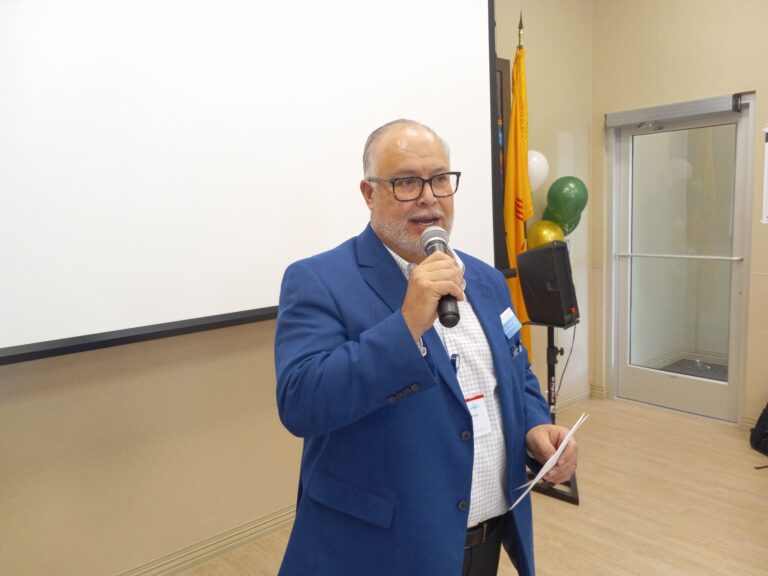
Trip Jennings
I have spent the last two weeks wondering what “left wing terrorism” is.
Back in the day, it was straightforward. A lone gunman shoots up a congressional baseball game and seriously injures a Republican congressman.
Leftwing terrorism.
An extremist sets Teslas on fire and firebombs the headquarters for the New Mexico Republican Party.
Leftwing extremism.
These days I am no longer sure.
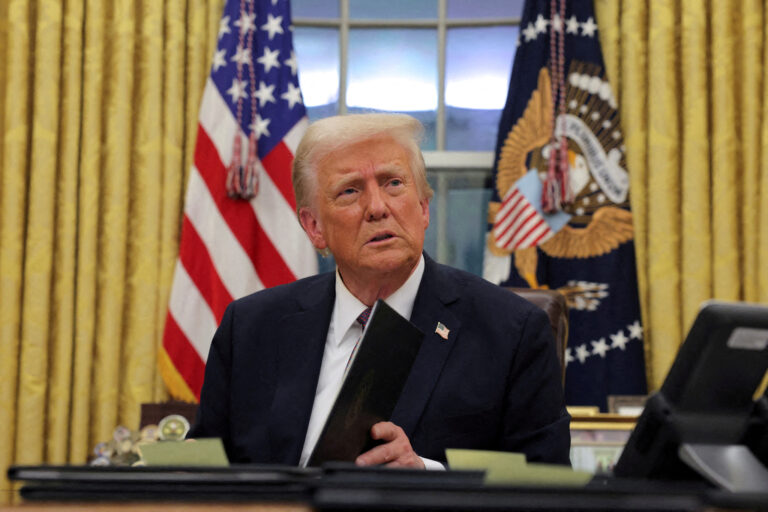
I owe my confusion to President Trump and his administration.
On October 4, Stephen Miller, the president’s deputy chief of staff took to X, formerly Twitter, to explain that “There is a large and growing movement of leftwing terrorism in this country. It is well organized and funded. And it is shielded by far-left Democrat judges, prosecutors and attorneys general. The only remedy is to use legitimate state power to dismantle terrorism and terror networks.”
The day before, Karoline Leavitt, Trump’s press secretary, had poured gasoline on the already-large bonfire of political hyperbole to defend the decision to deploy the military to Portland as necessary to end “The left wing’s reign of terror” in the city.
Not to be left out of the metaphorical auto-da-fé, last week Kristi Noem, Trump’s Homeland Security Secretary, described Antifa — a loosely organized, leftist movement that opposes far-right, racist and fascist groups — as ”just as sophisticated as MS13, as TDA, as ISIS, as Hezbollah, as Hamas, as all of them. They are just as dangerous. They have an agenda to destroy us just like the other terrorists we’ve dealt with for many, many years.”
Um … I think I know what’s going on here.
First, Mr. President, I would counsel you and your team to take a time out. It worked on my kids when they were tiny. I recognize “spiraling” when I see it. Spiraling, if you are not familiar with the term which my kids introduced to me years ago, is a cycle of negative thinking patterns that escalate and become overwhelming..
Next, I’d tell you and your entourage what my mom used to tell me when I was a teenager and was so overly dramatic, she had a hard time taking me seriously. You and your team need to unplug from whatever crazy, end-of-the-world films, documentaries, podcasts, and political commentators you’re imbibing, at least for a while until you calm down.
I offer this advice not as a terrorism expert but as a journalist who played a small role in reporting on the 1995 bombing in Oklahoma City that killed 168 people and later covered 9/11 and the anthrax attacks in 2001 and their collective aftermath for months.
Street protests in Portland and Los Angeles and Chicago and any number of other large American cities are not terrorism. Not in any definition of terrorism I’ve read, at least. In fact, they are constitutionally protected. The Constitution enshrines both freedom of speech and freedom of assembly. Protesting is about as American as the Boston Tea Party, which, as you will recall, was a galvanizing moment that fortified the colonists in their movement to throw off the tyranny of King George III.
But perhaps I am giving you and your entourage the benefit of the doubt when I shouldn’t. Perhaps y’all are not the over-caffeinated, hyper-stimulated grown-ups who resemble easily triggered teenagers. Perhaps, y’all are cynically exploiting the moment to target anyone that opposes the administration’s political agenda as “left-wing terrorists.” This includes federal judges appointed by you, Mr. President, who have blocked your actions. And conservatives and progressives who believe in the rule of law. And tens of millions of other Americans who just want to live their lives without having to sign loyalty pledges.
This explanation makes much more sense.
If you and your entourage are attempting to tamp down on political opposition, y’all are doing a remarkable job of channeling the spirit of Joe McCarthy and the Red Scare of the early 1950s. McCarthy’s hunt for communist influence across the country and infiltration across the federal government after World War II eventually led to nationally televised hearings.
McCarthy’s campaign eventually ended, due in part to his allegations that hundreds of communists had infiltrated the State Department and other agencies, including the U.S. Army.
During one of those hearings, in June 1954 McCarthy accused an attorney working with Joseph Welch, an attorney hired to represent the Army against McCarthy’s allegations, with having ties to a communist organization.
Welch responded forcefully.
“Until this moment, Senator, I think I never really gauged your cruelty or your recklessness. Let us not assassinate this lad further, senator. You have done enough. Have you no sense of decency?”
The moment undermined McCarthy’s popularity with the American public. Within six months, the Senate had censured him, and McCarthy spent the rest of his time in the chamber ostracized by his party and ignored by the press.
I guess my question in October 2025 is: Who will be our Joseph Welch?
Since 2005, Trip has covered politics and state government for the Albuquerque Journal, The New Mexico Independent and the Santa Fe New Mexican. In 2012, he co-founded New Mexico In Depth, a nonpartisan, nonprofit media outlet that produces investigative, data-rich stories with an eye on solutions that can be a catalyst for change.