Home Blog Page 92

Artesia girls soccer team wins three consecutive District 4-4A titles

0

The Lovington girls’ soccer team came into Robert Chase Field and played a physical game on Thursday, forcing the Artesia Lady ‘Dogs to get physical as well. 

The physical play did not deter the Lady ‘Dogs from achieving their goals and winning the game 7-0. With that victory, Artesia won its third consecutive District 4-4A championship, and fourth in five years. 

“I thought the win was huge for us,” Artesia girls soccer coach Tim Trentham said. “I thought it was a pretty big statement win for us, of course, in a district game, you never know what you are going to get. Once the goals started coming, it was like the nail in the coffin.”

The Wildcats held Artesia scoreless until six minutes to play in the first half, when Abigail Jowers scored a goal to give the Lady ‘Dogs a 1-0 lead. 

Less than two minutes later, Mayra Garcia scored a goal, followed by a score by Chloe Aguilar to give Artesia a 3-0 lead at halftime. Aguilar finished with two goals in the match. 

“I knew after we scored three goals on them in the first half, they were going to be defeated,” Trentham said. “It is tough to come back from being three goals down.” 

Physical game

After halftime, the floodgates opened with Artesia scoring four goals to match the physical play of the Lady Wildcats. The play was so intense that both teams were given yellow cards. Also, Artesia and Lovington had players injured and had to leave the game. Jowers said that the Wildcats played so physically because they knew that if they upset Artesia, Lovington had a chance to have a district playoff game with the Lady ‘Dogs. 

“It is a cultural thing,” Trentham said about the physical play by Lovington. “That is why I was trying to tell my girls to settle down. There is no reason to get physical, just play the ball. Be smart with the ball and let them foul. That would slow the game down anyway. Once we got the couple of other goals later on, it shut everything down. The wind wemt out of their sails, and the coach could not do anything.”

Artesia is now 16-3 overall and 5-0 in district. Thursday’ s victory gives Trentham a shot at his first undefeated district season in his 18 years of coaching. The Bulldogs are now on a 10-game winning streak and have confidence going into the playoffs.

The girls will try to make their dream of an unbeaten district season come true with a match at Portales at 6 p.m. on Oct. 23 to close out the regular season. 

“We have never had a 6-0 district season before,” Trentham said. “We have had some 4-2 and 5-1 seasons, but never a 6-0 season.” 

Artesia soccer player Abigail Jowers heads a ball in a game against Lovington on Thursday night.

Seniors  

Trentham said the key to his team this season balanced scoring from the entire team, lightening the load for everyone. 

Because of that, other teams cannot key on stopping one player. The team is deep enough that any player can score for the Lady ‘Dogs. 

Trentham also pointed out the importance of the eight seniors on this year’s squad. The chemistry has been there this season for the seniors, sharing their success.

“Our seniors have been a great group for us this year. They have been a big part of our success,” Trentham said. “During our Pink Out game, we had a lot of great fans out. I was trying to get all of the seniors out on the field together- it was just a great time for them to get some time in.”

Carlsbad Caverns closed during shutdown

0

Adrian Hedden
Carlsbad Current-Argus
achedden@currentargus.com

Carlsbad’s iconic underground rock formations were left inaccessible for the past two weeks as federal agencies shut down with Congress locked in a partisan stalemate over legislation to fund the government’s operations.

The shutdown means many federal programs will remain unfunded – and employees will be furloughed – until the deadlock is resolved. At the heart of the stalemate is an attempt by Democrats to force Republicans, who control both the U.S. Senate and the House of Representatives, to roll back cuts to a variety of government programs, particularly those that affect funding for health care.

Among Democrats’ major concerns were the scheduled expirations of tax credits to help families pay for health care under the Affordable Care Act and the ACA itself, which is set to expire at the end of 2025.

The Senate failed for the eighth time Tuesday night to pass a continuing resolution passed by the Republican-led House of Representatives on Sept. 19 to partially fund the government through Nov. 21.

At Carlsbad Caverns, the logjam meant the park and Visitors Center was closed during the funding cutoff that began with the Oct. 1 start of the federal fiscal year.

No access was being granted to the Cavern itself, nor were programs such as the bat flight shows being held with the park unstaffed throughout the shutdown.

Most national parks throughout the U.S. were accessible during the shutdown, but areas normally locked outside of business hours or secured for public safety were closed, according to a contingency plan published last month by the U.S. Department of the Interior – the parent agency of the National Parks Service.

Carlsbad Caverns is usually open from 9 a.m. to 5 p.m. daily except for Thanksgiving, Christmas Day and New Year’s Day, but all park access and services were shut down until Congress votes to reopen the government, according to an Oct. 1 Facebook post from the park.

Interrupted services included entry into the caverns, through the natural entrance of elevators, access to the visitors center, bat flight shows and all roads leading into the park.

Most park staff were furloughed. Those needed for security and critical functions such as water treatment were still working but were not receiving paychecks during the shutdown.

All park regulations remained in effect during the shutdown, despite limited enforcement staff.

The Facebook post also noted the park service would provide “critical information” about park access and safety, but that “services may be limited.”

“We will provide updates when we are able to reopen,” read the post.

Nearby Guadalupe Mountains National Park remained unstaffed but accessible during the shutdown, according to its website, with the gated access to McKittrick Canyon closed.

White Sands National Park near Alamogordo was partially reopened on Saturday, Oct. 11 until Friday, Oct. 17, according to that park’s website, with the Visitors Center open from 9 a.m. to 5 p.m. and several hiking trails accessible. It was unclear if the park will remain open should the shutdown continue into next week.

Federal oil and gas operations continue

Meanwhile, the Bureau of Land Management’s Carlsbad Field Office was partially shuttered, along with all bureau offices across the U.S.

This agency, also within the Interior Department, manages federal public land around the country, and in southeast New Mexico is responsible for 3.5 million acres of federal land and 7 million acres of mineral estate.

That means the agency oversees permitting for oil and gas drilling and operations in New Mexico’s booming Permian Basin oilfields.

Those activities continued during the shutdown, the contingency plan read, even as the Interior Department estimated 2,400 bureau employees would be furloughed. Before the plan was implemented, the agency estimated 9,250 workers were active across the Bureau of Land Management.

Throughout the lapse in funding, the bureau would continue its law enforcement and border security operations, read the plan, along with emergency response and inspections and enforcement of oil and gas operations.

Permitting also was expected to continue, including for transmission lines and rights of way where such activities could be funded by fee collections, the plan read, along with “activities necessary to protect life and property that are not otherwise exempted.”

Processing of oil and gas, coal or any other energy permit or documentation will be excepted by staff on an “on call” basis, read the plan “to the extent such plans are necessary to protect human life and federal property.”

Bureau of Land Management staff did not respond to a request for comment.

Managing Editor Adrian Hedden can be reached at 575-628-5516, or @AdrianHedden on the social media platform X.

Forgiveness wins?

0

Ty Houghtaling

In the early fourth century, a sect of the Christian church known as the Donatists emerged in North Africa. They became distinguished by their strict views on the purity of the Church and its clergy. The Donatists believed that the validity of sacraments depended on the moral character of the ministers administering them. They argued that priests who had fallen away or betrayed their faith during periods of persecution could not legitimately perform sacred rites, particularly baptism. This stance led to their rejection of the broader Church’s authority and sacraments performed by compromised clergy, creating a significant schism within Christianity that persisted for centuries. This division prompted ongoing debates about forgiveness, church unity, and the nature of Christian leadership.

Consider this scenario: What if you were baptized by a priest or pastor, and many years later, that priest or pastor was removed from their position due to some sin, rendering your baptism null and void? Would you get rebaptized? Reflect on 1 Corinthians 1:10-17. I wonder if this passage is applicable to the Donatists’ insistence on creating division due to fallen Christian leaders. Nowhere in Scripture does it say Jesus baptized anyone. His disciples were involved in this physical act of confessing sin and faith in Christ, and it is reasonable to believe that Jesus taught His disciples how to baptize, or perhaps they learned from John the Baptist. However, it doesn’t say that Jesus baptized anyone. Can you imagine the pride one might have felt if they had been baptized by Jesus?

In my own denomination, we do not believe that baptism is a sacrament or that it is necessary for salvation. Instead, we view it as a symbolic physical act of confession, an outward expression of what has happened inside a person when they trusted Jesus for the forgiveness of sin and the receiving of grace and God’s Holy Spirit. Baptism has been a topic of much debate throughout the history of the Christian church, and it is a topic that divides Christian denominations. That’s unfortunate.

Do you think that 1 Corinthians 1:10-17 could apply to the topic of worship music written by Christian leaders who later have some sort of moral failing or veer away from orthodox positions, thus making the songs illegitimate? I’d like to know your thoughts. Feel free to email me at ty@fbcartesia.org

There is significant context to the following verse, but I thought it worth including in this article (food for thought): “For if you forgive other people when they sin against you, your heavenly Father will also forgive you.” Matthew 6:14<n><n>

Artesia Lady ‘Dogs win their third District championship at home

0

The Lovington girls’ soccer team came into Robert Chase Field and played a physical game on Thursday, forcing the Artesia Lady ‘Dogs to get physical as well. The physical play did not deter the Lady ‘Dogs from achieving their goals and winning the game 7-0. And with that, it’s third consecutive District 4-4A championship, and fourth in five years.

“I thought the win was huge for us,” Artesia girls soccer coach Tim Trentham said. “I thought it was a pretty big statement win for us, of course, in a district game, you never know what you are going to get. Once the goals started coming, it was like the nail in the coffin.”

The Wildcats held Artesia scoreless until six minutes to play in the half, when Abigail Jowers scored a goal to give the Lady ‘Dogs a 1-0 lead. In less than two minutes, Mayra Garcia scored a goal, and then right before halftime, Chloe Aguilar scored the first of her two goals to give Artesia a 3-0 lead at halftime.

“I knew after we scored three goals on them in the first half, they were going to be defeated,” Trentham said. “It is tough to come back from being three goals down.

Physical game

After halftime, the scoring gates opened with Artesia scoring four goals to match the physical play of the Lady Wildcats. The play was so intense that both teams were given a yellow card. Also, Artesia and Lovington had players injured and had to leave the game. Jowers said that the Wildcats played so physically because they knew that if they upset Artesia, Lovington had a chance to have a district playoff game with the Lady ‘Dogs, having to play at Portales at 6 p.m. on Thursday, Oct. 23.

Artesia’s Alani Escareno tries to keep a Lovington player from getting the ball in the Lady ‘Dogs 7-0 win at Robert Chase Field on Thursday.

“It is a cultural thing,” Trentham said about the physical play from Lovington. “That is what I was trying to tell my girls to ‘settle down, there is no reason to be getting physical, just play the ball. Be smart with the ball and let them foul. That would slow the game down anyway. Once we got the couple of other goals later on, it shut everything down. The winds came out of their sails, and the coach could not do anything.”

Artesia is 16-3 overall and 5-0 in District 4-4A. The win gives Trentham his first undefeated district season in his 18th year. He said the key to the team this season is that they have received scoring from everyone, so they haven’t had to depend on one or two people to carry the scoring load, making the team an imposing threat. Because of that, other teams cannot key on stopping one player. The team is deep enough that any player can score for the Lady ‘Dogs.

Seniors

“Our seniors have been a great group for us this year,” Trentham said. “They have been a big part of our success this year. During our Pink Out game, we had a lot of great fans out. I was trying to get all of the seniors out on the field together- it was just a great time for them to get some time in. The seniors knew it was going to be an emotional game; luckily, it wasn’t too emotional during a Pink Out game. I think they played very well for us.”

Trentham said the seniors believe in each other and are clicking together. The chemistry has been there this season for the seniors, and they have jelled well together. The seniors have wanted to play well every game, play together, and have success together. Artesia is on a 10-game winning streak and has confidence going into the playoffs.

Undefeated in District

“We have never had a 6-0 district season before,” Trentham said. “We have had some 4-2 and 5-1 seasons, but never a 6-0 season.”

Scenes from Artesia girls’ soccer team, 7-0 district championship win over Lovington

0
Artesia goal keeper Aubrie Edwards kicks the ball back after a Lovington attempt on goal. Artesia won its third consecutive district championship and is 5-0 with one game against Portales left on Thursday, Oct. 23. JT Keith | Artesia Daily Press
Artesia’s Ayerim Alvidrez kicks the ball toward the Lady ‘Dogs goal on Thursday night at Robert Chase Field.
Artesia’s Kacy Neel looks at the ball after kicking it in the game against Lovington at The Chase on Thursday night.
Artesia’s Abigail Jowers heads the ball during Thursday night action against the Lady Wildcats.
Estrella Gutierrez looks to advance the ball against Lovington on Thursday night at Robert Chase Field.
The Lady ‘Dogs huddle up during a timeout against Lovington.
At the other end of the field the Lady ‘Dogs gather together at the other end of the field during the timeout.
Artesia senior Nataly Montanez-Acosta kicks the ball against Lovington on Thursday night.
Artesia’s Chloe Aguilar makes a move to score a goal against Lovington on Thursday night.
Chloe Aguilar scores a goal against Lovington on Thursday night at The Chase.
Myra Garcia celebrates after scoring a goal against Lovington on Thursday night.
Artesia’s Kaylee Berdoza looks to move the ball forward against Lovington.
Artesia’s Kaidence Hnulik tries to keep the ball away from a Lovington player during Thursday night action.

Alani Escareno tries to get the ball away from a Wildcats player at The Chase Thursday night.

Hayley Klein hired as Artesia city administrator

0

Adrian Hedden
Artesia Daily Press

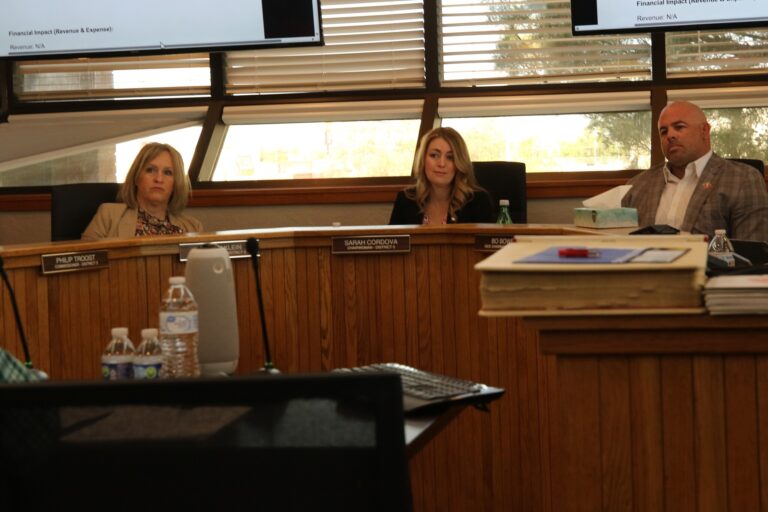
Eddy County Commissioner Hayley Klein was hired as Artesia’s first city administrator during the Tuesday, Oct. 14, city council meeting after months of candidate interviews and a unanimous vote by councilors.

The vote, following a motion made by District 4 City Councilor Michael Blunt and seconded by District 1 Councilor Raul Rodriguez, came after an executive session that lasted about two hours.

Rodriguez said Klein will be paid an annual salary of $135,000 and is expected to begin her job in November as she resigns her current position as executive director of the Artesia Chamber of Commerce, where she’s worked for more than 20 years, and aid in finding her replacement.

In her new job, which was created by the Artesia City Council by a unanimous vote at its July 22 meeting, Klein will be tasked with aiding Mayor Jon Henry in the city’s day-to-day operations. Officials said her responsibilities will include improving interdepartmental coordination, tracking ongoing projects and identifying funding sources such as grants for city projects.

Hayley Klein

“I hope I can bring my experience to the city, and maybe elevate the city’s communication internally and with the public,” Klein said, noting the she intends to help support city projects and funding sources.

She said she will also help maintain relationships with the city’s benefactors, as Klein noted much of its financial support comes from the private sector.

“Since it’s a new position, I’ll have to figure out the lay of the land and establish relationships with the different departments,” Klein said.

Henry, who also serves as a New Mexico state representative for District 54 covering portions of Eddy, Chaves and Otero counties, said when the city administrator position was created in July that adding the post to the city’s management structure would not only reduce strain on the mayor but also create consistency among municipal departments.

“The mayor has a tough job doing other political stuff, and his other obligations,” Rodriguez said. “Now, we’ll have a point of contact for the day-to-day operations.”

In addition to her job with the Chamber of Commerce, Klein serves as District 2 Eddy County Commissioner, an office previously held by Henry who did not seek reelection to the commission after opting to run for the Legislature in 2024. Klein was elected last November.

She said she intends to keep her position on the Eddy County Commission after assuming her duties with the city, but will abstain from “any votes related to city business.”

Rodriguez said the city researched state law and believes she can maintain the posts without any conflicts.

“She is able to maintain both positions without any issues,” Rodriguez said. “We did our research to make sure everything was kosher, and we didn’t have any conflicts.”

Henry recommended Klein for the administrator position at Tuesday’s meeting after “much thought and reviewing of several candidates.”

“I do appreciate everybody that applied,” he said. “It was a very, very tough decision.”

Rodriguez said the city received multiple applicants for the city administrator’s job and made its decision after months of interviews and discussions. He said the city ended with two finalists: Klein and the city’s Infrastructure Director Byron Landfair.

“I would like to thank the candidates for the city administrator,” he said. “That was probably the toughest decision I’ve had to make as a city councilor,” he said. “I think we are in a blessed position, and it is a win-win for the city.”

And Klein said the role will allow her to further share the story of Artesia’s and southeast New Mexico’s contributions to the broader State of New Mexico, as the region is known for generating much of the state revenue through the oil and gas industry.

“All of our little cities are really important to the state, and southeast New Mexico provides so much,” she said. “It’s important for the state to remember us.”

Managing Editor Adrian Hedden can be reached at 575-628-5516, or @AdrianHedden on the social media platform X.

Keep ICE detention centers but monitor them

0

Sherry Robinson
All She Wrote

Picking pumpkins just got a whole new spin.

Ellen Bernstein, president of the Albuquerque Teachers Federation, emailed her members that Torrance County Commissioner Kevin McCall was an ICE supporter and cautioned teachers against field trips to McCall’s Pumpkin Patch, a popular family-owned business, according to SourceNM.

The online uproar prompted McCall to clarify during a commission meeting: “Our business is in no way communicating or working with ICE, which is utterly false. From its start 28 years ago, our mission has always been to provide a fun, family-friendly place for guests to make cherished memories.”

In his role as county commissioner, McCall recently voted with fellow commissioners to extend the ICE contract with the Torrance County Detention Facility, which Bernstein wrote “has been the scene of various documented human rights violations against detainees, but Mr. McCall and the other commissioners excuse that in the name of economic gain for both the county and private interests.”

She ends with: “Spooky stuff. Beware rotten pumpkins.”

Let’s pause to roll our eyes.

Bernstein has been a champion of teachers for many years, but this was not her finest moment. Teachers understandably fear the impacts of ICE raids on their students. Bernstein should stick to that issue instead of inventing conspiracies.

This pumpkin story is really about the disconnect between rural and urban areas, especially around jobs, and it’s a subject I’ve written about often during my decades of reporting in New Mexico.

If you drive around Torrance County, and I have, you’d see that employers are few and far between. However flawed it is, the detention center is one of the county’s few large employers, with 100 workers. According to New Mexico Political Report, it spends $8 million a year in a county with a poverty rate of 20.4%.

So when Bernstein pans the detention center vote as excusing its lapses “in the name of economic gain for both the county and private interests,” she misses the point. Her “economic gain” looks more like survival in a poor county.

Last month, when I wrote about the state’s ICE detention centers in Estancia, Alamogordo and Milan, I heard from Linda Calhoun, a small business owner in Torrance County who sees a middle ground.

“This issue keeps being presented as a choice between closing the detention centers and leaving things as is because of the local financial considerations. But I see everyone overlooking another possibility, especially here in Torrance County. That possibility is to bring the facility up to current health department standards…

“I read somewhere that the New Mexico Health Department has no jurisdiction over the facility in Estancia because of its contract with the feds. I just don’t understand why that is. Our restaurant has to abide by Health Department standards, as well we should.”

“The building in Estancia is in serious disrepair. They should not be allowed to skate without any accountability. I have seen pictures of huge cracks in the concrete floors. The plumbing and heating don’t work. Detainees are fed frozen burritos that have not even been thawed, much less warmed…”

Calhoun has a point. If the state has the authority to collect gross receipts taxes from these entities, why does it not enforce standards? The answer is that it apparently hasn’t tried.

In September, the New Mexico Advisory Committee to the U.S. Commission on Civil Rights blamed many of the three facilities’ problems on a contracting process that creates “confusion when it comes to oversight and accountability and leaves each stakeholder only partially accountable for addressing issues.”

ICE contracts for space with Torrance, Otero and Cibola counties, which are pass-through agents for private owners. The Torrance County manager told New Mexico Political Report that because CoreCivic owns the facility, the county has limited oversight.

More likely, the county is reluctant to pressure CoreCivic because it closed the facility in 2017, and that had immediate economic fallout. The company reopened the center two years later with the ICE contract.

My reading of the civil rights advisory committee’s report is that the state should step up.

The committee recommended closing all three immigration detention facilities and expanding community-based alternatives to detention (the committee chair and vice-chair dissented). It also said the state should stop using these county pass-through contracts, and – most important to this discussion – “create a robust oversight system for monitoring immigrant detention centers in the state.”

The governor, some legislators and immigrant advocates are pushing legislation to close the facilities and ban ICE detention in New Mexico. However, economic development doesn’t always mean high tech or oil and gas. It would be smarter economically (and a kindness to immigrant inmates, who will be detained somewhere that may be worse) to preserve and monitor the state’s detention centers.

Downwinders documentary screened locally

0

Laurel Berry
Alamogordo News

Holloman Air Force Base and the Sacramento Mountains Foundation co-sponsored a free screening of the Lois Lipman movie “First We Bombed New Mexico” at the Flickinger Center for Performing Arts on Saturday, October 11. The film tells the stories of families that have been affected by the radiation released during the Trinity test, which was the first atomic bomb to ever be detonated, on July 16, 1945, some 50 miles from Alamogordo, and their efforts to be included in the Radiation Exposure Compensation Act (RECA).

Lipman, who has won 16 awards for the film, said: “My goal is to get this film shown, to get it into the communities, especially the smaller communities. It has been shown at 35 festivals, Barcelona, in Paris.” She was met with obstacles when she began to gather funding for making the film but remained determined.

“How do I make a film that will impact people? It’s too big. People can’t connect to thousands of people dying. But my way of making a film, the way I was taught, is that you have to find one character that people can connect with and it’s through the eyes of that one character that you tell a story that touches the world,” she said.

That character was Tina Cordova, whose family lives in Tularosa and has been affected by cancer. Cordova herself is a thyroid cancer survivor. Together with the late Fred Tyler, Cordova started the Tularosa Basin Downwinders Consortium in 2005 as a way to compile cancer statistics as well as other health data from communities around the Trinity test site. Generations of residents have suffered high rates of cancer.

RECA was enacted in 1990 to provide one-time payments as reparations to residents who may have developed cancer or other specified radiogenic illnesses as a result of exposure to radiation from atomic weapons testing or the process of mining or transporting uranium. However, it did not include New Mexico downwinders, as they are called.

It’s incomprehensible to Cordova that New Mexico was left out of the original RECA agreement.

“If you’re acknowledging that harm was done to people as a result of testing, wouldn’t you think first about the people of New Mexico, because the test at Trinity was incredibly fallout producing? They knew right afterwards that they had spread radiation all over New Mexico and beyond and so how they never acknowledged that when they recognized people in Nevada, I don’t know,” Cordova said.

“First We Bombed New Mexico” tells the story of those who experienced the Trinity test and the subsequent fallout as well as their children and grandchildren who continue to suffer unusually high rates of cancers, as noted by physicians who worked in the communities in the subsequent years. It follows Cordova and other members of the consortium as they fight to bring awareness to their cause, meet with members of Congress and eventually find an unlikely ally in Missouri Sen. Josh Hawley, who helps sway enough senators to vote in favor of adding New Mexico downwinders to RECA.

For the residents, being added to RECA is as much about being acknowledged as it is about the reparations. It should be noted that Congress did not extend reparations to include health care. Medical bills for treatment of these diseases often greatly exceed the $100,000 payment that the government is offering.

After the screening, Cordova and Lipman held a question and answer session to address concerns from those in the audience, and applications were available for residents to take home. Currently, applications are accepted only via the mail, but an online option will be available soon. Those affected now have until December 31, 2027, to apply for compensation. More information can be found at trinitydownwinders.com.

Editorial: Voters need to approve the Artesia hospital mill levy

0

Artesia Daily Press Editorial Board

The city’s hospital enjoys a good reputation and the levy, which raises between $4 million to $ 7 million a year, is used to fund operating expenses. There is no plan to use this money to pay for a new hospital that is envisioned for the future.

Artesia stands almost alone as a rural hospital that enjoys solid financial footing. By contrast, many rural hospitals throughout New Mexico are in danger of closing.

If there is a crack in the administrative structure and operation of Artesia General, it may be in its failure to communicate clearly with the public about the need for passage of the levy in the Nov. 4 election– compounded by a slight touch of institutional arrogance.

For instance, when the editorial board of the Artesia Daily Press met with hospital representatives to discuss the levy the only hospital executive in attendance was Khush Ghadiali, director of communication. No hospital administrators were on hand to explain the details of the levy or to discuss matters such as the total expenses and revenues of the hospital.

Hospital CEO Joe Salgado argued the need for approval of the levy in a letter to the editor that appears in today’s newspaper, and he showed up for a poorly attended public meeting last week at Kith and Kin, but he did not meet with our editorial board.

Instead of sending those who actually run the hospital to our meeting, the hospital sent two representatives of the governing board, Karen Waldrip and Danny Parker to explain how the board doles out the money after requests from the hospital. Both were informed and articulate, but they do not run the hospital.

Last spring the levy was narrowly defeated in a mail-only election with a dismal turnout of about 12% – of 10,000 ballots mailed to voters only 1,246 were filled out and returned to Eddy County officials to be included in the vote count. The mail-in ballots apparently left voters confused as to the purpose of the election, even to the point of thinking the ballots were junk mail and throwing them away.

Holding a mail-only election on such an important issue may in itself have demonstrated poor communication and arrogance, apparently reflecting a belief that voter approval was a done deal.

There is also reason to believe that some voters said no to the levy, or didn’t vote at all, because they were frustrated with the state of health care in New Mexico and decided to take it out on the hospital, or that they were concerned about lack of transparency regarding hospital-related issues such as air transport services for Eddy County patients.

As to the levy, our news story last week clearly explained its purpose and significance:

“The levy, paid on property taxes for homeowners and businesses within the Artesia Special Hospital District which encompasses most of the city limits and about 10,000 voters, is used to supplement the hospital’s operating costs.

“The district, which owns the land the hospital sits on, acts as a landlord while collecting the levy from taxpayers and providing the funds to the hospital at its board’s discretion and based on requests from hospital officials.

“The levy was first implemented in 1979, when the district was established mainly to spend the funds. It had been renewed every four years since.

“That changed on June 3, when a special mail-in election resulted in 638 votes against renewal and 608 in favor.

“Approval of the mill levy in next month’s election would not raise taxes but would maintain the current levy of $2.70 per every $1,000 of a property owners’ net taxable property value within the district. It was last renewed in 2021 and doesn’t expire until Dec. 31 of this year so passage in November would keep the levy in effect without interruption.

“Hospital officials maintain that about 80% to 90% of the levy is paid by commercial entities, mostly large oil and gas companies, and that it funds between 5% and 10% of the hospital’s operating budget.”

Artesia enjoys many benefits smaller communities lack – benefits that surpass even the city’s legendary high school football team and the spectacular Bulldog Bowl. Revenue and work provided by our rich oil and gas industry is a boon to us – and we have an excellent hospital, an institution that is essential to the health of our citizens.

But the hospital is lucky to have us, the voters, and perhaps the lesson here is for the citizens to be treated with more openness, consideration and respect.

In little we trust

0

Cal Thomas

Trust: “Reliance on the integrity, strength, ability, surety, etc., of a person or thing; confidence.”

Polls and simple observations show that Americans are placing less trust in institutions and individuals. A Wall Street Journal story notes that the current government “shutdown” has raised the distrust level between the two parties and the president to new heights – or depths.

Trust – or lack thereof — is also an issue in the Middle East. The president is proclaiming peace in the region because Hamas has said it will agree to some of his 20 demands, which include the release of the remaining hostages, living and dead. Hamas has refused to lay down their arms, or agree not to participate in a future Gaza government. Hamas also wants nearly 2,000 terrorist prisoners released from Israeli jails, including convicted murderers. We’ve seen how past bargains have gone with those who seek Israel’s destruction with many returning to the battlefield.

Hamas has never lived up to a single agreement or voided its charter that calls for the destruction of Israel and killing Jews. Why should they be trusted this time? No one knows who is in charge of Hamas or whether they have the authority to speak for the entire terrorist organization after their leadership has been wiped out by Israel’s attacks. Hamas is only one of several terrorist groups that are also untrustworthy and have given no sign they are willing to abandon goals identical to those of Hamas.

After the partial agreement to some of the 20 demands made by the president and agreed to by Israeli Prime Minister Benjamin Netanyahi, Trump told Israel to stop bombing Gaza. Imagine President Franklin Roosevelt agreeing to a deal that would stop the bombing of Japan and not finish off Germany’s Nazi regime. Instead, Roosevelt spoke of “total victory” over those two nations. British Prime Minister Winston Churchill echoed Roosevelt’s goal. Speaking in the House of Commons on May 13, 1940, Churchill said: “You ask what is our aim. I can answer in one word: Victory. Victory at all costs. Victory in spite of all terror. Victory however long and hard the road may be; for without victory there is no survival.”

Repeat that last part out loud: Without victory there is no survival.

Then, as now, there are factions in the U.S. and Israel that favor negotiating with the enemy. Hamas and its related groups are not only the enemy of Israel, but also the enemy of the U.S. and all “infidel” Western nations.

Negotiations, instead of victory, would allow Hamas to live and fight another day, guaranteeing more death and destruction. Since Gazans elected Hamas to run their government, maybe they should hold a special election that could oust them from office. Not that Hamas would willingly give up their political power, but it might reduce their legitimacy in the eyes of the world.

In reference to the definition above, what has Hamas – or any of Israel’s enemies – done to demonstrate their integrity or why any confidence should be placed in them? The answer is nothing and anyone who believes a deal can be made with the devil is a fool. A quote attributed to writer Kayla Krantz says: “Never make a deal with the devil unless you’re prepared to lose.”

Israel only has to lose once and it is finished as the Jewish state.

The president and Netanyahu should require that all 20 of their demands be met, or Israel should finish the job. Perhaps both. Otherwise, Hamas will survive and keep fighting. That’s the one thing they can be trusted to do.

Readers may email Cal Thomas at tcaeditors@tribpub.com. Look for Cal Thomas’ latest book “A Watchman in the Night: What I’ve Seen Over 50 Years Reporting on America” (HumanixBooks).