Staff Reports
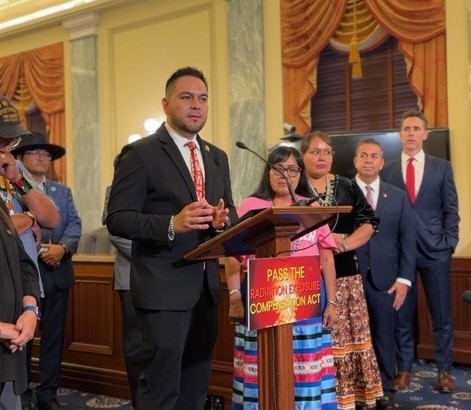
U.S. Rep. Gabe Vasquez (D-NM), who represents New Mexico’s 2nd Congressional District, launched his 2026 reelection campaign last week, making stops with supporters in Albuquerque’s West Side, Los Lunas, Truth or Consequences and Mesilla. Vasquez will be running against former radio talk show host and 2021 Albuquerque mayoral candidate Republican Eddy Aragon.
“From Silver City to Mesilla, Southern New Mexico is my home and the place I deeply care about,” Vasquez said in a statement. “Following in the footsteps of powerful women in my family and honoring our immigrant history, I’ve been able to represent my community in Congress with determination and authenticity. Constituents from across the district trust me to uphold our values, be objective and get things done when others can’t.”
His top priorities include lowering the cost of living, protecting access to affordable health care, border security and immigration reform, keeping communities safe and safeguarding New Mexico’s public lands, according to a press release.
“Their priorities are my priorities,” Vasquez said. “From protecting public lands, funding critical infrastructure projects, funding local police departments and fighting to lower health care costs, I’m proud of the wins I’ve delivered, and I’m just getting started.”
Aragon, who announced his candidacy in May said in a statement that he views immigration, crime, the economy and health care as the top issues of his campaign.
He supported the hard-line immigration stance of President Donald Trump, leading to increased deportations of migrants and stricter requirements for immigration into the U.S.
Aragon also supported the President’s push to reduce government spending on education.
“We need more privatization of education,” he said. “I think the approach that’s being taken at the national level is important. We don’t want to do without the money, but we definitely want to do without the bureaucracy.”
Aragon also ran for Congressional District 1 in 2021, against current U.S. Rep. Melanie Stansbury (D-NM).
He shifted to the Second District after New Mexico’s congressional district lines were redrawn following the 2020 U.S. Census, a process largely controlled by the state’s leadership in the Democratic Party, which holds a majority in the Legislature.
Vasquez narrowly defeated incumbent Republican Yvette Herrell in the 2022 by just more than 1,000 votes and again in 2024.
The redistricting added more votes to the district around New Mexico’s northern urban areas, including Albuquerque’s south valley, while removing votes from conservative-leaning Lea County.
Aragon said the shift could work in his favor, as he said he has ties to Albuquerque and nearby Valencia County, portions of which are also now included in the Second District.
“You are going to need somebody from up here, because this is where a majority of the population, the voting population, is going to be in Valencia County, where my family is from and the South Valley and West side, where I had grown up,” Aragon said in a campaign statement.