Sherry Robinson
All She Wrote
A Zia Pueblo farmer I know is debating how much corn to plant this year. “There’s no snow in the mountains,” he says. Irrigation will be tight, and he’s reluctant to draw from a pond he might need for emergencies.
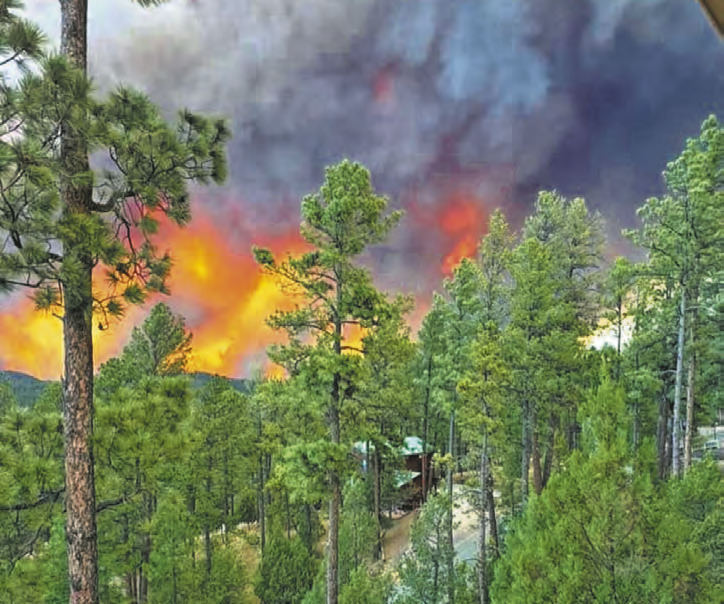
As water and weather experts confirm what our eyes already tell us, New Mexico is holding its collective breath for this fire season.
So allow me to sprinkle a little good news. State and federal governments and electric utilities have taken steps to better prepare for what’s coming.
Lincoln County’s new Rio Safe Program will provide state and federal funding for the county to buy and demolish about 400 homes in the flood path of the Rio Ruidoso and relocate residents. The program will also restore watershed and create a park from a disaster area.
It’s the first home buyout program in New Mexico and the first buyout funded by the federal Natural Resources Conservation Service for communities recovering from post-fire flooding.
In a second development, electric utilities are working hard to keep drought-stricken trees from falling onto power lines and igniting wildfires. In a recent hearing before the state Public Regulation Commission, utility executives said they have new mapping software to identify high-risk areas and artificial intelligence-enabled cameras to quickly detect wildfire starts. They’ve been replacing wooden power poles with steel structures that have non-exploding fuses and design features that prevent trees or wildlife from contacting live wires. And they’re ready to shut off power pre-emptively during acute fire weather.
It’s not cheap, which is one reason why your utility bills are rising.
Investor-owned and cooperative utilities aim to be responsible, but they also fear lawsuits like the $25 million action against the Jemez Electrical Cooperative, which doubled its cost of insurance. A bipartisan bill to give responsible utilities a little protection died in this year’s legislative session.
This is all from reporting by Patrick Lohmann, of Source NM, who knows more about fire here than any other journalist.
In Washington DC, a new agency could shake up the federal fire-fighting bureaucracy. Predictions are mixed.
The Trump administration plans to consolidate Interior Department firefighting operations in the new Wildland Fire Service. Firefighters and fire policy experts like the idea because it could streamline communications and speed up response times in a new era of megafires, according to the Washington Post. However, congressional Democrats, including our own Sen. Martin Heinrich, and public lands advocates warn it siphon off even more employees from land management agencies already weakened by DOGE layoffs.
The 4,500-person Wildland Fire Service combines firefighting entities from the Bureau of Land Management, National Park Service, Fish and Wildlife Service, Bureau of Indian Affairs, Office of Aviation Services and Office of Wildland Fire. The agency would have a new center for centralizing wildfire intelligence.
Supporters like the advocacy group Megafire Action say the old decentralized system doesn’t meet the demands of today’s bigger, faster-moving fires and longer fire seasons driven by climate change and drought.
Grassroots Wildland Firefighters has called for a unified agency since its founding in 2019, said president Riva Duncan. Her organization supports the administration’s eventual goal of moving the U.S. Forest Service’s firefighting operations out of the U.S. Department of Agriculture and into the new agency.
This super agency, envisioned in a 2025 presidential executive order, would have more than 11,300 employees, twice the size of current BLM, which has 5,000 employees, down from 10,000 in January 2025.
“They’re going to break our public land management agencies,” former BLM Director Tracy Stone-Manning told the Post.
Where workers fought fires during fire season and performed other land management tasks in the off season, the new agency will focus on fires year-round and call on land management agencies for help with fires.
In a letter to Interior Secretary Doug Burgum in February, Heinrich and others said separating wildfire management from land management could have life-or-death consequences.
“We are concerned that the DOI is advancing a rapid and consequential restructuring of wildfire management without adequate analysis, transparency, or planning to prevent disruption during what is expected to be a significant fire season or to safeguard long-term wildfire preparedness,” they wrote.
Proponents admit that much depends on how the new agency is rolled out but trust the service’s new director, Brian Fennessy, a former California fire chief with long experience. This could still be a great idea, but it adds another reason to hold your breath.
Sherry Robinson is a longtime New Mexico reporter and editor. She has worked in Grants, Gallup, the Albuquerque Journal, New Mexico Business Weekly and Albuquerque Tribune. She is the author of four books. Her columns won first place in 2024 from New Mexico Press Women.