Adrian Hedden
Artesia Daily Press
achedden@currentargus.com
No property damage of injuries were reported by officials in the earthquake that shook Carlsbad and Artesia this week, but it rattled area residents who felt it.
Reports began pouring into the U.S. Geological Survey’s website within minutes after the quake, which occurred about 2 p.m. Monday in northern Eddy County. The Survey logged 135 responses from as far east as Eunice and as far west as Cloudcroft.
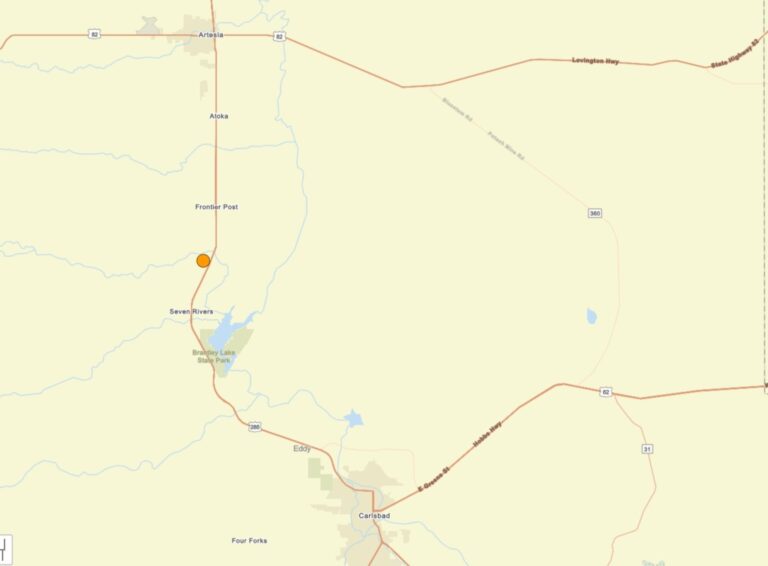
The epicenter, or focus point, of the magnitude 4.3 tremblor, the Geological Survey reported, was about 9 miles south of Atoka, a rural community of 1,200 residents 30 miles north of Carlsbad and 5 miles south of Artesia along U.S. Highway 285.
Magnitude 4.3 seismic events are considered moderate earthquakes, often felt at the earth’s surface and known to cause minor damage, according to a report from Michigan Technological University. There are about 500,000 quakes ranging in magnitude from 2.5 to 5.4 in the U.S. each year, the report read, with quakes in the lower range rarely felt at the surface while those of magnitude 5.5 or higher can cause serious structural damage and pose danger of injury to people in the affected area.
No reports of injuries or damage were received by Eddy County Emergency Management following Monday’s earthquake.
Damage or not, the quake was the largest of the 158 earthquakes of magnitude 2.5 or higher reported in the Permian Basin so far this year, according to the Geological Survey, and those who felt it quickly spread the word on social media.
“Just felt another earthquake over in the Hidalgo area. This shook my house and furniture,” wrote Facebook user Tracey Barwick in the page Neighborhood Watch And 411 Of Eddy County And Surrounding Areas.
“That was a big one,” commented user Gregg Davidson on the page What’s the 411 Carlsbad.
“Did everyone felt that earthquake?” Edgar Pinky Ray asked in the Facebook group Everything Artesia, prompting 15 comments in 52 minutes with commenters noting the shaking could be felt in Roswell.
Earthquakes in the Permian Basin region of New Mexico have declined the past few years following a significant increase in 2022 that geologists attributed to activities associated with oil and gas production, specifically the disposal of oilfield wastewater via injection wells.
The Permian Basin reached an all-time high of 5.51 million barrels of oil production per day in 2022, according to the Energy Information Administration, and 2,436 earthquakes of M 2 or higher were recorded by the Geological Survey that year between New Mexico and West Texas, which share the Permian Basin – the nation’s busiest oilfield.
That’s compared to 1,805 quakes M 2 or higher quakes the year before in the same region, and 2,348 events in 2023, 1,860 in 2024 and 1,608 in 2025.
The gradual decline in quakes followed the enactment of a series of state regulations by New Mexico’s Oil Conservation Division in 2021, calling for curtailing wastewater injection based on the proximity to and magnitude of a seismic event.
Whenever two M 2.5 quakes occur within 30 days, the OCD required weekly reporting of injection volumes at sites within 10 miles of the events.
After an M 3 event, injection rates must reduce by 50% within 0 to 3 miles of the epicenter, and by 25% within 3 to 6 miles.
If an M 3.5 event occurs, wells up to 3 miles away are shut down, and volumes are curbed by 50% within 3 to 6 miles and 25% percent within 6 to 10 miles from the epicenter.
Managing Editor Adrian Hedden can be reached at 575-628-5516, or @AdrianHedden on the social media platform X.