Home Blog Page 132

Ft Stanton Historical Site threatened by wildfire

0

Dave Tomlin | For the Ruidoso News
dave.tomlin74@gmail.com

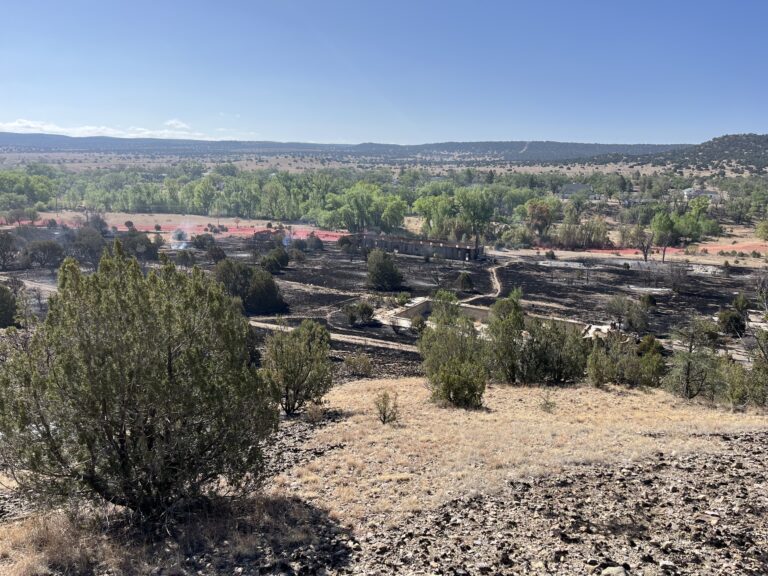
Wildfire destroyed or damaged a handful of historic structures at Fort Stanton Saturday, but quick response from a multi-agency team of firefighters that grew to about 150, along with three aircraft, prevented damage that could have been far worse.

“They saved the fort, there’s no doubt about it,” said Oliver Horn, regional manager of the Lincoln and Fort Stanton historic sites. Horn said the loss would have been a costly one.

“It’s arguably the most significant post-1848 cultural resource or historic site in the Southwest,” he said. “We lost historic structures, which is a tragedy. They’re irreplaceable. But the core of the site was saved.”

State Forestry Division spokesman George Drucker said in a statement that three buildings sustained serious damage in the blaze, which was dubbed the Camp Fire.

They included “two wooden structures from the 1930s built by the Civilian Conservation Corps (CCC) and a gymnasium built in 1944 by German sailors who were picked up after their ship sunk,” the statement said.

Horn praised all the firefighters who responded to the 911 call to fight the blaze, starting with Lincoln County emergency services director Arron Griewahn, who was the initial incident commander before additional state and federal crews arrived.

Horn said Griewahn and local volunteers “did an absolutely incredible job diverting the flow of the fire and essentially saved the core of the fort” as more help arrived.

Griewahn said resources deployed at the site included one helicopter and two single engine air tankers. The cause of the fire is under investigation, he said. By Tuesday, there appeared to be no further danger to fort structures, and crews were putting our hotspots and making sure there was no further spread.

Fort Stanton was built in 1855 as part of a system of military outposts established by the U.S. Army to defend settlers arriving to the region in the decades before the Civil War.

“Fort Stanton is one of the most intact 19th-century military forts in the country and is the best-preserved fort in New Mexico,” Drucker said in his statement. “The earliest known firefighters in the area were the Buffalo Soldiers in the 1870s who also contended with wildfires.”

The state historic site website contains these additional details:

“Fort Stanton is situated on 240 acres and surrounded by 25,000 acres of undeveloped BLM land in south-central New Mexico. There are 88 buildings on this historic site, some dating back to 1855. Built of local stone, the sturdy buildings have lasted to this day, but most are in great need of preservation and development.”

It has had several missions since its early days, according to the website.

“After closure as an Army post, the Fort served as a Merchant Marine Tuberculosis Hospital, a WWII internee camp, a training school for the mentally disabled and most recently as a low security women’s prison, and hosted several juvenile, drug and alcohol rehabilitation programs. It is currently a state monument and museum, visited by tens of thousands of tourists each year.”


ROGER GLEN ANDERSON

Tularosa, New Mexico

Roger Glen Anderson, a cherished husband, father, grandfather, great-grandfather, and beloved member of the Tularosa community, passed away peacefully on Monday, May 26, 2025. Known for his deep faith, steady devotion to family, and generous heart, Glen’s compassion and kindness left an enduring impact on everyone he met.
 Born on December 4, 1941, in Hagerman, New Mexico, to Roger Gaylord Anderson and Lillian Lee Bland, Glen was raised with strong values and an even stronger spirit. He graduated from Artesia High School in 1960 and proudly served in the Army Reserves from 1960 to 1968.
 Glen met the love of his life, Peggy Malone, at a dance in Loco Hills, NM a moment that sparked a remarkable 62-year marriage filled with love, laughter, and unwavering partnership. Together, they built a life in Tularosa grounded in family, faith, and service.
 Glen spent 14½ years managing Yates Farm & Ranch, planting 540 acres of pecan trees and alfalfa. He later became the farm manager for Three Rivers Cattle Company, where he worked until retirement. In addi­tion, he ran Anderson Appraisals, specializing in farm equipment and machinery. A dedicated member of New Heart Cowboy Church in Alamogordo, Glen offered his time and wisdom generously to people of all ages. His encouraging spirit and willingness to lend a helping hand made him a pillar of strength in the lives of many.
 Glen embraced life with joy and purpose. He loved time with his family, good food, traveling, fishing, live music, and his treasured weekly “date days” at the casino with Peggy. Affectionately known as “Daddy” and “Papa,” Glen will be remembered for his steadfast character, warm heart, and boundless empathy. He had a gift for making everyone feel like family – offering love, guidance, and support without hesitation.
 He is survived by his daughters Trey Lilly and Varsi Martin (Pat); grandchildren Seth Lilly (Taylor), Seren Derrick (Jeremiah), Christen Kalisek (PJ), and Bryce Martin; and nine great-grandchildren who brought him tremendous joy. He also leaves behind siblings Angi Bowen, Ross Anderson (Norma), and Gary Anderson (Debbie).
 Glen was preceded in death by his beloved wife Peggy, who passed just one month earlier on April 26, 2025. Their bond was so profound that life without her proved too much to bear. He is also preceded in death by his parents, Gaylord and Lillian Anderson; siblings Laverne Thompson, Billie Jane Anderson, and James Allan Anderson; and his beloved grandson, Ethen Lilly.
 A lifelong resident of Tularosa, Glen leaves behind a powerful legacy of love, humility, and service. He reminded us to live with open hearts, to cherish our time together, and to love without limits.
 A memorial service will be held on Saturday, June 14, 2025, at 10:00 a.m. at New Heart Cowboy Church, 1311 Galway, Alamogordo, NM, with Pastor Mike Cannon officiating.
 In lieu of flowers, donations may be made in Glen’s memory to:
Assurance Home 1000 E. 18th Street Roswell, NM 88201
 The family finds comfort knowing that Glen and Peggy are reunited just as they always were and always will be. Their love didn’t end; it simply moved beyond this world.
 Special thanks to Erva Yarborough, Alamogordo Home Health Care and Hospice, Suzanne Dennehy and Janice Smotherman for their care, support, and compassion.

Medical education now available at Artesia General Hospital

0

Staff reports

Artesia General Hospital (AGH) was granted Initial Provisional Accreditation by the New Mexico Medical Society (NMMS) to serve as a provider of Continuing Medical Education (CME) for healthcare professionals. The accreditation is valid from May 9, 2025, through May 7, 2027.

The designation enables AGH to offer locally accredited educational activities for physicians, nurses, technicians, and allied health professionals, further supporting clinical excellence and professional development in southeast New Mexico.

In its decision, NMMS cited several strengths in AGH’s education program, including leadership by a “committed group of educators and physicians,” the involvement of expert presenters, and a strong focus on interdisciplinary training. The committee noted that the hospital’s team-based approach to continuing education is a valuable asset to the region’s healthcare system.

The two-year provisional status allows AGH time to strengthen several program elements, including measuring long-term educational impact, identifying learning gaps, and expanding partnerships with other healthcare institutions.

AGH Chief Medical Officer Dr. Robert Ferraro, who led the application process, emphasized the importance of the accreditation to both providers and patients.

“This accreditation reflects our commitment to supporting the growth of our medical team and improving care across the region,” Ferraro said. “We know that continued education leads to better outcomes, and now we can provide that education right here in our community.”

CME activities help ensure healthcare providers stay current with evolving standards of care, medical technologies, and evidence-based practices. Offering accredited CME locally reduces the burden of travel and provides more accessible opportunities for ongoing training—especially important in rural settings like Artesia and surrounding areas.

AGH plans to build on the initial accreditation by developing a schedule of CME offerings and integrating feedback from both staff and external partners. Upcoming efforts will focus on enhancing evaluation tools, broadening participation across disciplines and expanding the use of data to guide educational planning.

One candidate gets real about New Mexico’s doctor exodus

0

Sherry Robinson
All She Wrote

Former Las Cruces Mayor Ken Miyagishima, in declaring his candidacy for governor, did something no other Democrat has been willing to do: he challenged his fellow Democratic candidates to refuse campaign funding from trial lawyers.

Miyagishima stated correctly that New Mexico’s malpractice laws and the spike in litigation and insurance premiums in recent years is driving doctors from the state.

“We are the only state that is losing doctors,” he told the Albuquerque Journal, referring to data from the New Mexico Medical Society, which reported that we lost 248 doctors across the state from 2019 to 2024 while neighboring states added doctors.

Thanks to Democrats and their benefactor, the New Mexico Trial Lawyers Association, changes in malpractice law since 2021 multiplied malpractice lawsuits and spiked court awards and settlement costs.

I’ve previously written about how Dems torpedoed the malpractice reform bill in this year’s legislative session. There’s more.

Think New Mexico had a package of bills to address our healthcare shortages. The bipartisan think tank has a long track record of advancing useful legislation, but this time David faced Goliath. The trial lawyers have deep pockets and matching clout.

One of the most important bills was the bipartisan HB 243 by Rep. Marian Matthews, a moderate Democrat from Albuquerque, and House Minority Leader Gail Armstrong, R-Magdalena. It would have allowed New Mexico to join the Interstate Medical Licensure Compact, an agreement among states to recognize each others’ professional licenses. Forty-three other states have joined.

“It’s the easiest way to have a substantial increase in doctors, Matthews said. “It could provide expertise that’s not even available in New Mexico.”

Companion bills would have done the same for other healthcare professions.

HB 243 passed the House unanimously and then sat in the Senate Judiciary Committee more than a week before being heard. Matthews and Armstrong were pleased that Rick Masters, the compact’s general counsel, came to New Mexico to present before the committee. “They went out of their way to work with us.”

Matthews, herself an attorney, was astounded by what happened next. Sen. Katy Duhigg, D-Albuquerque, spent hours reading every line and paragraph the Senate Judiciary committee wanted stricken. Duhigg made dozens of amendments that transformed the bill.

“We told them if they insist on changing the bill it would be unacceptable to the compact. They did it anyway. It was ugly,” Matthews said.

It should be noted that the law firm of committee Chairman Joseph Cervantes, D- Las Cruces, sues doctors. So does Duhigg’s lawfirm.

The gutted HB 243 died on the Senate calendar. The other compact bills also died.

Why? Because the trial lawyers object to a provision in the compacts that prevents them from suing the interstate compact commissions, which oversee the compacts. “There is no good reason to sue them, but the lawyers object to the idea of shielding anyone from potential lawsuits,” said Fred Nathan, of Think New Mexico.

In the aftermath, Republicans called out Dems for tanking these bills, and the governor agreed with them.

“People die when they can’t get access to healthcare,” she said. She complained that her public safety bills died in the same committees that defeated the healthcare bills, and she chastised the trial lawyers by name.

“Just look at the number of malpractice cases brought in New Mexico,” she said. “Look at the number of law firms coming from out of state to prosecute cases here.”

Duhigg sent her constituents a long letter bragging about her accomplishments during the session but didn’t mention her role in depriving them of doctors.

Meanwhile, I keep hearing from doctors. A surgeon describes colleagues planning to retire early or leave the state. “All of this is lawsuit driven,” she writes. “These are good surgeons! They are kind, thoughtful, skilled. They didn’t go into surgery for money; there are so many easier ways to make money.

“Ours is a stressful field at baseline. Complications hurt us and haunt us, but they are a reality of practicing surgery. As much as we would love to have perfect outcomes, as hard as we work for it, we know that complications will happen. In New Mexico, we are punished for situations we can’t control. And as the number of doctors declines, we get busier and busier, patients have less primary care, and we face uncontrollable emergency situations. It is truly a vicious cycle.”

Candidate Miyagishima worries his name might be an obstacle. If he champions healthcare providers and stands up to the trial lawyers, everybody will know his name.

Sherry Robinson is a longtime New Mexico reporter and editor. She has worked in Grants, Gallup, the Albuquerque Journal, New Mexico Business Weekly and Albuquerque Tribune. She is the author of four books. Her columns won first place in 2024 from New Mexico Press Women.

Eddy County listed as ‘sanctuary’ for migrants

0

Adrian Hedden
Carlsbad Current-Argus
achedden@currentargus.com

Eddy County may be in the sights of the federal government as a so-called “sanctuary” county for undocumented migrants, according to a list published Thursday, May 29, by the Department of Homeland Security.

The county, along with 22 other New Mexico counties including nearby Chaves, Otero and Lincoln counties and the cities of Santa Fe and Albuquerque were included on the list, which was apparently taken down by the federal agency as of Monday.

But that didn’t stop Eddy County Sheriff Matthew Hutchinson from decrying the “inaccurate information” presented by the federal release, contending Eddy County was not a “sanctuary for criminals.”

Hutchinson said that as sheriff his oath to defend the constitution will be upheld “without discrimination.”

“The Eddy County Sheriff’s Office, as it has in the past, will enforce the law regardless of the law enforcement origination,” Hutchinson said in the Monday statement. “This enforcement will be done without any biases. This county for as long as I am sheriff will not be a sanctuary for criminals.”

Department of Homeland Security Secretary Kristi Noem said in a Thursday statement as the list was released that “sanctuary city politicians” are putting Americans and local police in danger while protecting “violent criminal illegal aliens.”

Each jurisdiction on the list was to receive a “formal notification” of its non-compliance with federal immigration police and violations of federal statutes, according to the Department of Homeland Security news release.

The notice would include a demand that the jurisdictions immediately review their policies to be in compliance with federal policy, the release said.

It was unclear as of Monday if such notices were sent out or received by Eddy County or any of the other listed counties and cities.

“We are exposing these sanctuary politicians who harbor criminal illegal aliens and defy federal law,” Noem said. “President (Donald) Trump and I will always put the safety of the American people first. Sanctuary politicians are on notice: comply with federal law.”

The presence of rural, largely conservative New Mexico counties on the list sparked confusion among local leaders such as Hutchinson who vowed to uphold the law in the wake of their communities’ inclusion.

Amy Barela, chairwoman of the New Mexico Republican Party and an Otero County Commissioner, said her county in 2019 voted to pass a resolution expressly declaring that it was not a sanctuary for undocumented migrants.

“Despite misleading reports and inaccurate listings by outside organizations, Otero County has never adopted sanctuary policies, nor has the Board of County Commissioners ever made such declarations,” she said.

12th District Attorney Ryan Suggs, whose office covers Otero and Lincoln counties, said he stood ready to enforce federal immigration policies supported by the Trump administration.

“If any municipality or public agency has policies, procedures, or memorandums of understanding that may conflict with federal immigration law, my office stands ready to assist in reviewing and addressing those issues,” Suggs said.

The list, before it was apparently taken down over the weekend, was met with backlash from county sheriffs across the country.

Canyon County, Idaho Sheriff Kieran Donahue, who serves as president of the National Sheriff’s Association, a group known for supporting tighter immigration laws, said the list was published with a “lack of transparency” as to how and why jurisdictions were included.

“This is an unfortunate and unnecessary erosion of unity and collaboration with law enforcement and the enforcement of the rule of law at a time when that unity is needed most,” Donahue said in a Saturday statement. “This decision by DHS could create a vacuum of trust that may take years to overcome.”

Reuters contributed to this report.

Managing Editor Adrian Hedden can be reached at 575-628-5516, or @AdrianHedden on the social media platform X.

Dedication fuels Special Olympics chairs

0

Mike Smith
Carlsbad Current-Argus
msmith@currentargus.com

Caring for a son with developmental disabilities led to a lifelong calling for Lee and Patrick Kirksey.

And that calling led the couple to their current role as co-chairs of the Area 4 Special Olympics, a position they have held since succeeding Carolyn Olson of Carlsbad who retired six months ago after 50 years as the organization’s director.

“We are very fortunate to call Lee and Patrick Kirksey our new Special Olympics New Mexico Area 4 director and sidekick,” Olson said in an email. “They bring incredible heart, incredible thinking, incredible imagination, and incredible enthusiasm to the program. Our amazing athletes will continue to succeed under their expert leadership.”

Randy Mascorella, Special Olympics of New Mexico’s executive director, said the organization was “blessed beyond measure” to have the Kirkseys “assume the role now that Carolyn retired as the Area 4 Director.”

A closer look at the Kirkseys

Patrick Kirksey said the couple became involved with Special Olympics to help their son Nate, who had a lifelong history of seizures that started when he was 13 months old. Kirksey said testing revealed that Nate was autistic.

Lee Kirksey said Nate, now 21, played on regular sports teams until he was 10 years old.

“But we could see that was not the best fit for him,” she said. “We went looking for alternatives and found Special Olympics New Mexico. Our local program did not have a track program and our son wanted to run track so, with no experience, Patrick, Nate, (our daughter) Olivia and I learned track. Special Olympics continues to give our family so much.”

Olivia Kirksey, 16, became a certified coach for Special Olympics coach at the age of 12 and has led basketball skills development for Special Olympians, her mother said.

The Kirkseys were honored as New Mexico’s Special Olympics Family of the Year in 2021.

“Patrick, Olivia and I have all run on Special Olympics relay teams at various times,” Lee said. “Patrick and I coach several different sports for Special Olympics. I cannot express how proud I am of my son for how he has grown through Special Olympics and how proud I am of my husband and my daughter for the love, friendship and kindness they demonstrate through their involvement with Special Olympics. Special Olympics has grown our family by adding wonderful new friends who we might not have met otherwise.”

Nate competed in the Region IV Special Olympics Summer games in Carlsbad May 3. After 11 years of competing, Patrick Kirksey said, Nate has opened up to people during ribbon and medal ceremonies.

“It’s quite an accomplishment, seeing growth,” he said.

Joyce Munoz, organizer of Artesia-based Special Olympics Pecos Valley, said the Kirkseys’ contributions to Special Olympics in Lea County was a benefit for the communities of Area 4.

“They have a lot of knowledge and with the two of them more energy … they have the time and the effort to give to all of the delegations,” she said.

According to the Special Olympics of New Mexico website, Area 4 consists of Eddy, Lea, Lincoln, Chaves, Roosevelt, Curry, DeBaca and Quay counties.

Former director committed to service

Lee Kirksey said Carolyn Olson was a guiding force for Special Olympics in southeast New Mexico for half a century.

“She has never hesitated to reach out for the resources that our athletes and families need, and I think it is very rare that anyone said no to her because she is so highly respected,” Lee said. “Carolyn has made being Area IV director look effortless but after putting together the Summer Games, I can tell you that is not the case. It will be impossible for anyone to measure the amount of work and heart that Carolyn has put into Special Olympics.”

Kirksey said Olson is still involved in the program – she ran the bocce ball competition during the May 3 summer games in Carlsbad.

“I don’t have to be in charge,” Olson said while taking a break during the games at Ralph Bowyer Caveman Stadium in Carlsbad. “It’s been a part of my life. I’ve been doing it for so long.”

Olson said Special Olympics in Carlsbad was born during water safety classes.

“I was the water safety chairman of the American Red Cross in Eddy County in the early ’70s and I organized and directed an adapted aquatics program for developmentally disabled children,” she said. “This program grew to include CARC Inc. (a Carlsbad program for kids and adults with developmental disabilities) and in two years evolved into Special Olympics New Mexico, Carlsbad.”

Olson said when Special Olympics started in Area 4, there were only Summer Games. Since then the program has grown to include year-round sports.

“Special Olympics Carlsbad and Area 4 include track and field, bocce (ball), basketball, unified softball, poly hockey, flag football and of course aquatics,” she said.

Mike Smith can be reached at 575-308-8734.

Are some racist slurs OK?

0

Victor Davis Hanson

One reason why the public turned on diversity, equity, and inclusion (DEI) was its insistence that roughly 70 percent of the country was stereotyped as victimizers by virtue of their skin color.

In contrast, the other “diverse” 30% were de facto considered the victimized.

In such absurd binaries, the left returned to the old “one-drop” rule of the antebellum South, suggesting that anyone with any nonwhite ancestry was a minority victim.

And once that Marxist-inspired dichotomy was institutionalized, a corollary was established that the self-declared racially oppressed cannot themselves be racist oppressors.

But human nature is universal and transcends race.

One lamentable characteristic of our species is that we are all prone to excess and crudity if not deterred, especially once civilizational restraint is lost.

We are now witnessing examples of what follows when anti-white stereotyping and racism are given a pass — as long as the purveyors can claim their victimhood entitles them to bias.

Recently, WNBA basketball stars Angel Reese and Caitlin Clark got into one of their now-characteristic on-court rivalries. But this time around, Reese mocked Clark as a “White gyal (sic) running from the fade.”

Reese assumes that her status as a Black star grants her immunity from backlash — a privilege unlikely to be extended if the roles were reversed.

Or is her crassness a simple reflection that 60 years after the Civil Rights movement, it is deemed cool or deservedly acceptable to use the word “white” derogatorily?

After all, loose-cannon Rep. Jasmine Crockett, D-TX, in one of her accustomed racialist rants, recently went after her party’s big Democratic donors, who raised a record amount of money for Kamala Harris’s short-lived campaign.

Crockett played the race card when claiming that Democratic insiders were already backing the next party nominee as the “safest white boy.”

Her racist irritation is puzzling. After all, two out of the last four Democratic presidential nominees have been African-Americans.

Yet it is certainly easy to see why Crockett, who endlessly spouts off about race in congressional sessions, used the pejorative “white boy.” She knows that there are no repercussions given her race and, to a lesser extent, her gender and left-wing ideology.

Recently, a past 2018 slur resurfaced from another House Democrat, Rep. Ilhan Omar, D-MN. She had falsely claimed, “I would say our country should be more fearful of white men across our country because they are actually causing most of the deaths in this country.”

Omar’s stereotyped smear was not only racist but also factually incorrect.

The FBI’s 2018 data on perpetrators of murder, when the race of the offender was known, reveals that 54.9% of the nation’s murderers that year were African-American, who constitute about 13% of the population.

And when the race of the murderer in rare interracial killings was known, blacks were more than twice as likely to murder whites as whites were to kill blacks.

During recent controversies over leaks at the Pentagon, former UN Ambassador Susan Rice, during the Obama administration, injected race by smearing Secretary of Defense Pete Hegseth. She leveled a trifecta race/gender/sexual orientation slur — all irrelevant to the issue at hand: “Well, if you’re a white male Christian cisgender macho MAGA man, you can be as dumb as a rock and be deemed qualified to serve as Secretary of Defense.”

Rice still chafes that as a sometimes-official Obama administration spokeswoman, she serially and deliberately misled the country about the fatal 2012 terrorist attacks on the American consulate in Benghazi.

In all these cases, there was no fallout from racial categorization and demonization. Again, we apparently accept the pernicious idea that those identifying as an oppressed group cannot themselves voice illiberal stereotypes.

But while our political elites and celebrities seem fixated on using racial putdowns for career advantage and personal notoriety, the people increasingly ignore their entrenched and off-putting racism.

For example, in a recent Rasmussen poll surveying public attitudes toward Trump’s first 100 days in office, 62% of Hispanics voiced approval (higher than the 49% of whites). And 39% of blacks agreed.

One result of the 2024 campaign was that while Democrats seemed fixated on racial stereotypes, the public had moved on.

Voters increasingly see class considerations transcending race. That fact may explain why exasperated and flailing Democrats and leftists desperately seek to resurrect racial polarization instead of finding a popular middle-class agenda.

Historically, tribalism erodes a multiracial democracy.

It did when white leaders in the past expressed racist attitudes toward blacks. And it will again if black elites simply flip the paradigm and do the same.

(Victor Davis Hanson is a distinguished fellow of the Center for American Greatness. He is a classicist and historian at the Hoover Institution, Stanford University, and the author of “The Second World Wars: How the First Global Conflict Was Fought and Won,” from Basic Books. You can reach him by e-mailing authorvdh@gmail.com.)

Real Reels: NM Film & Media Conference almost here

0

By K. Jan Wafful
Otero County Film Liaison

Starting Friday, May 30th the Otero County Film Office (OCFO) liaison, will be traveling northward to represent Otero County at the weekend New Mexico Film Office activities.  On Friday at noon, Otero County will be present for the State Liaison Network meeting with the NM Film Office. This meeting is to inform, train, and answer the questions and concerns that our state network community liaisons encounter when scouting and helping all filmmakers who come to their communities with the prospect of possibly filming in their jurisdictions.

OCFO has always been proactive in helping new liaisons navigate their way in the industry. All offices must be sanctioned on local and state levels, and all must operate under the liaison rules and guidelines set for them in booklet form by the NM Film Office with state leadership approval. All liaison services provided are a part of the states’ economic development, and under state EDD these services are provided to the industry free of charge. The film project money spent in each community by these filmmakers can provide real economic development in New Mexico. Each $1 spent in communities can be re-spent within the same community up to 8 times and remains locally in the community in the form of products, goods, and services purchased — not to mention the obvious lodging and eating out expenses while filming.

The New Mexico Film & Media Conference 2025 now returns annually. This conference will bring filmmakers, crew, businesses, studios and industry leaders together for the first time since pandemic recovery and industry strikes. Featured activities will be leadership panel discussions, vendor presentations, networking opportunities and career development sessions designed to support the NM Film Industry and bring industry members together to highlight, collaborate and shape the future film industry of New Mexico. The Otero County Film Office expects to return with new information to plan for the future building of location filmmaking that pertains to all of the more rural southern New Mexico communities.

On the local level, a report on the conference will be available from the OCFO liaison at the next quarterly Actor’s Spotlight Social at the Alamogordo Chamber conference room from 4-6 pm on July 25th, 2025.

These quarterly meetings are open to the public and provide networking, support and training to all who want to find entry-level opportunities in the local film industry.

For more information contact Jan Wafful at the OCFO in the Chamber of Commerce or email to: jwafful@gmail.com

Medicaid reform/cuts are long overdue

0

Paul J. Gessing

Gov. Lujan Grisham recently went on the TV show Face the Nation to decry potential cuts to Medicaid. She even claimed the reforms would “destroy health care as we know it.” Pretty much every elected Democrat in New Mexico supports Medicaid as it currently exists. This is partially because they view it as an “economic development” program. That’s because the federal government picks up 72% of the bill while New Mexico pays “only” 28%.

That may sound like a great deal for New Mexicans until you realize that Medicaid spending is expected to grow by a mind-blowing 27% next year and spend an astonishing $15.5 billion. That’s 1/3rd larger than the State’s fast-growing general fund budget which pays for education and public safety (to name just two priorities). In other words, even with “just” 28% of that coming from New Mexicans, that’s STILL $4.34 billion state tax dollars. Of course, New Mexicans also pay federal taxes and bear the $36 trillion in federal debt, but who’s counting?

As part of their efforts to find savings to make way for the Trump tax cuts Republicans in Washington have put forth a few ideas that would constrain Medicaid spending. This is hardly a disaster for New Mexico, but our politicians have grown accustomed to “free” money and a bloated Medicaid budget.

As The Hill notes, “Provider taxes have been a lucrative loophole for states to get more federal Medicaid funding by taxing providers and then returning the money to them in the form of higher reimbursements for treatment.” The Republicans’ proposal would freeze all state taxes at their current rates and prevent states from imposing additional taxes. New Mexico has been imposing these taxes for years and In 2024 the Legislature passed a provider tax that helped the State fleece taxpayers in the other 49 states of $1.5 billion. This is abuse of the Medicaid system. Unfortunately, the Republicans’ plan only prohibits future such schemes, not existing ones.

It’s worth mentioning that New Mexico could easily afford to replace federal Medicaid dollars with its own money. The State is sitting on $61 billion in “savings.” In the recently-completed legislative session the State has set up a mechanism to accumulate another $2 billion for the explicit purpose of “replacing” federal Medicaid dollars if indeed cuts happen.

Another initiative of Congressional Republicans’ (again from The Hill) is “work requirements.” Under the proposal, states must enforce “community engagement” requirements on Medicaid enrollees beginning in 2029. Community engagement is defined as 80 hours of work, community service or a work program each month. Other options include at least half-time enrollment in an educational program or a combination of the available options.

We’d love to see that moved up (why wait until 2029), but with New Mexico’s abysmal workforce participation rate remains depressed by any historical metric. It is lower than it was before COVID and it is lower than it was going back to 1976. Adding work requirements to Medicaid is just common sense. Such requirements would actually improve the lives of the large numbers of New Mexicans who continue to sit on the sidelines of our labor force.

While Lujan Grisham and Democrats will undoubtedly claim that the sky is falling on New Mexico and other Medicaid-dependent states, reform of this bloated program is long overdue. Medicaid needs to be reformed dramatically and that really needs to come from the federal level.

We’d like to see the federal government block grant Medicaid dollars (and then shrink the program over time). That would both remove the incentive for New Mexico and other states to “game” the system as they clearly have been doing AND it would place the federal government on more sound budgetary footing.

If large numbers of New Mexicans fall through the cracks as Lujan Grisham and others claim, the State can easily step in with its own considerable resources.

Paul Gessing is president of New Mexico’s Rio Grande Foundation, an independent, nonpartisan, tax-exempt research and educational organization dedicated to promoting prosperity for New Mexico based on principles of limited government, economic freedom and individual responsibility.

Congrats grads!

0

Photos by JT Keith
Artesia Daily Press
jtkeith@elritomedia.com

Artesia High School celebrated its Class of 2025 graduates in a ceremony held Thursday, March 22 at the Bulldog Bowl.

Collecting their diplomas were 215 high school seniors who were joined by their family and friends at the annual ceremony.