Home Blog Page 152

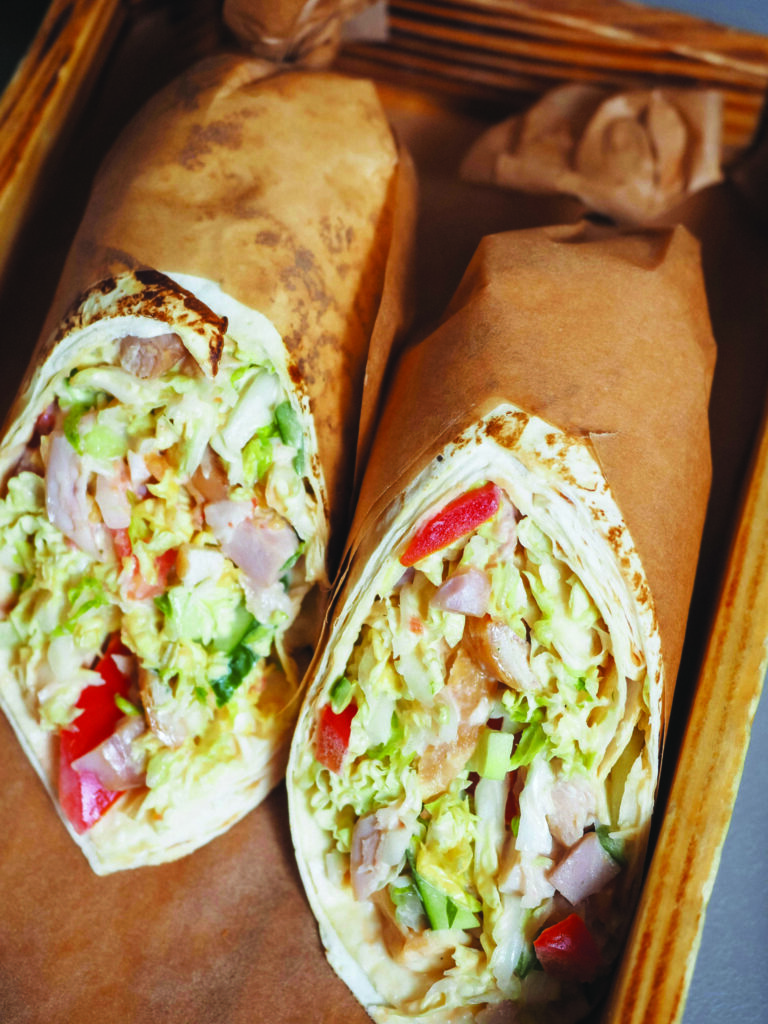
Meals with Wheels: Chicken wraps

0

By Wheeler Cowperthwaite

Now that we’re years beyond the pandemic and offices and schools are going back to in-person attendance, one question dominates my morning routine: What will I pack for lunch?

It’s the question that plagues everyone who goes to school or doesn’t work from home.

There are a lot of easy things to pack for a lunch: hummus (I make about two quarts at a time) and pita bread, rice bowls, pasta salad, or whatever leftovers there are in the house.

But sometimes you’ve got to up your game a little, or maybe gussy up your ingredients from two days ago and make them into something that looks or feels like something different.

For that, I find the wrap to be perfect. Buy some large flour tortillas at the store and use leftover grilled chicken, baked chicken or leftover rotisserie chicken. The carcass makes a great chicken soup in the pressure cooker, by the way.

You can go heavy on the veggies (because this is really about wraps, not about chicken), use any number of dips as seasoning, like hummus or tzatziki, and look like you’ve prepared something that’s come from a restaurant.

You can also make a wrap with chicken salad, making avocado the star of the show; steak, lunch meat (turkey, ham, bacon), and many of the basic dishes that you may have leftover.

Or, stuff it with regular salad, with some extras thrown in.

Moving in the opposite direction, possibly for picky eaters, fill that tortilla with ranch and cheese, in addition to the chicken, and have the chicken ranch wrap. Grill the tortilla for a few minutes on all sides, the cheese will melt and voíla! lunch is ready to be packed.

The recipe here is not all encompassing but rather, a series of suggestions for what to put in your wrap. Mix, match, use your leftovers, mix some more.

Chicken wraps

1 cooked chicken breast (grilled, baked, boiled), cut into bite-size pieces

1 tomato

Lettuce, spinach or other leafy mixture

1 large tortilla

Cheese

Cucumber

Peppers

Hummus (optional)

Avocado

Directions

Dice any vegetables to be used

Lay the tortilla on a flat surface

Place the sliced chicken in the middle of the tortilla and spread along the length. Add the desired vegetables, cheese, other additions and any seasoning spread, including salad dressing: hummus, tzatziki, or satay sauce.

Roll the tortilla with the ingredients and fold in the ends. Wrap in aluminum foil. Cut as necessary and pack.

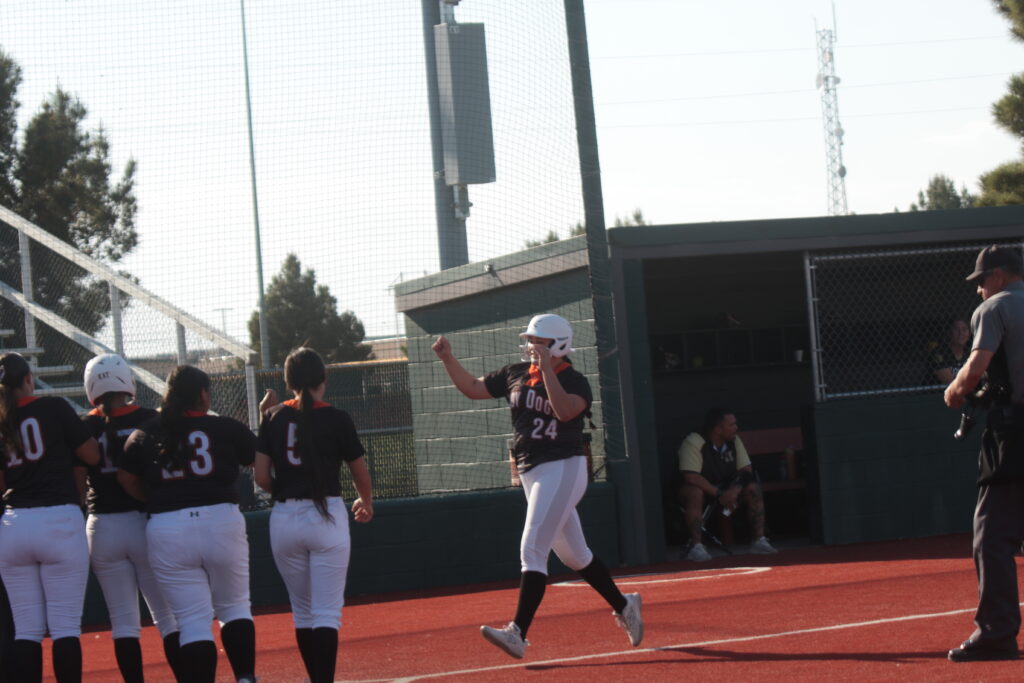
Lady Dogs take doubleheader over Roswell, 14-1 and 3-0 in Saturday softball action

0
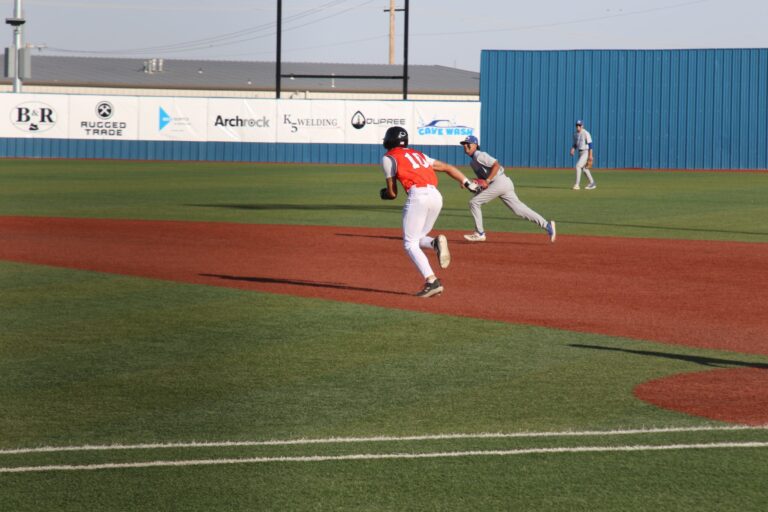
Photo by Shawn Naranjo- Artesia’s Brooklyn Fuentes gets ahead of a Roswell baserunner to force an out at second base. Artesia won 14-1, and 3-0, in Saturday’s doubleheader. The Lady Bulldogs are 11-6 on the season and begin district play at Goddard 5 p.m. Tuesday.

Artesia Lady Dogs use the long ball to defeat Hobbs 9-3

0
Photo JT Keith- Artesia’s Kayden Apodaca hit two home runs in Artesia’s 9-3 route over Hobbs Friday.

Million Dollar Jackpot eludes Capitan breakaway roper

0

By Rick Mauch
Special to El Rito Media

The sport of breakaway roping requires blinding speed, bullseye accuracy and at least a smidgen of patience. But patience isn’t easy.

With the world watching on live television and the Globe Life Field crowd in Arlington, Texas, roaring Friday night, 18-year-old Capitan roper Addison Kinser was poised on the brink of rodeo glory and a million-dollar payday.

But it wasn’t to be. In the blink of an eye, Kinser’s dreams of an American Rodeo championship in breakaway roping were dashed as her horse Jlo jumped an instant too soon, causing judges to add a 10-second penalty to her excellent time of 2.22 seconds.

“I left an inch too early. I roped my calf, but I just left too soon,” Kinser said.

To explain what happened to Kinser – and several others Friday night –, the calf in breakaway roping is given a head start by a barrier, which is a rope stretched across the roping box. The calf is attached to this barrier, and must break free before the horse and rider leave the roping box.

Failure to give the calf this head start, known as “breaking the barrier,” results in a penalty. So, Kinser’s time of 2.22 seconds was turned into 12.22. Instead of being in second place, she tied for ninth.

“I thought I did break the barrier,” she said. “Then, I looked back and saw the guy’s hands up and realized, yep, I did.”

Kinser was riding a horse she purchased just a few days before the event and had only ridden three times.

“I thought he would be better prepared for this situation with all the lights and sound, and he did great,” she said. “He handled all that well. I just left too early. And it was so loud. I’ve never competed in any event this big or this loud.”

The American Rodeo is unique in that it allows both professional and aspiring rodeo athletes, known as “contenders,” to compete side-by-side with a $1 million bonus for contenders should they win the overall championship in their event. Contenders qualify by advancing from their respective regions – Kinser qualified with a second-place finish in Tulsa, Oklahoma – and the top 10 compete against each other when they come to Arlington.

Kinser finished second in her region in February with a time of 2.16 seconds – the same mark posted by professional Sarah Angelone of Lipan, Texas, when she won the 2024 American Rodeo breakaway roping championship. Angelone was not among this year’s competitors in Arlington.

The top five finishers in Friday’s competition advanced to the Saturday morning second round/semifinals where they were to be joined by five renowned ropers who were invited to compete and given a first-round bye. Of those 10, the top four  will compete in Saturday afternoon’s championship round.

Kaydence Tindall, of Felda, Florida, had the fastest time among Friday’s top five, roping her calf in 2.20 seconds. She will be joined in the second round by Hali Williams, Comanche, Texas, 2.72; Harley Pryor, Moore Haven, Florida, 2.79; nine-time world champion Lari Dee Guy, Abilene, Texas, 2.80: and Sadie Grant, Santa Maria, California, 2.88.

The invited competitors are five women who topped the 2024 world standings: Kelsie Domer, Martha Angelone (Sarah Angelone’s sister), Josie Conner, Shelby Boisjoli-Meged and Jackie Crawford.

Other American Rodeo events being contested at Globe Life Field this weekend include saddle bronc, steer wrestling, tie-down roping, bull riding, bareback riding, barrel racing and team roping.

Despite her disappointment at not advancing, Kinser said the Globe Life Field experience was a definitive positive for her. While the night did not turn out as she had hoped, she proved that she has the potential to be among the best in the world at this sport. After all, she bested over 200 other hopefuls to reach Arlington.

Not bad for someone who left gymnastics to become a roper just over four years ago.

“I definitely feel it prepared my confidence level for more events like this,” she said. “I feel like I controlled my nerves pretty well. I think it was still a confidence booster.”

For now, she will return to a quieter life as a graduating homeschooled high school senior who works on her family’s ranch north of Capitan, riding, grooming and caring for the animals.

In the fall, she’ll join the rodeo team at Tarleton State University in Stephenville, Texas, one of the nation’s renowned college programs.

“I’m excited to go to school, hit some college rodeos and then on to the NFR (National Finals Rodeo),” Kinser said.

She plans to major in business and is already making plans to return to Arlington for another shot at the American Rodeo. After all, those college business courses might come in handy if she takes home the top prize next time.

“One of the best memories of my life”

0

By JT Keith


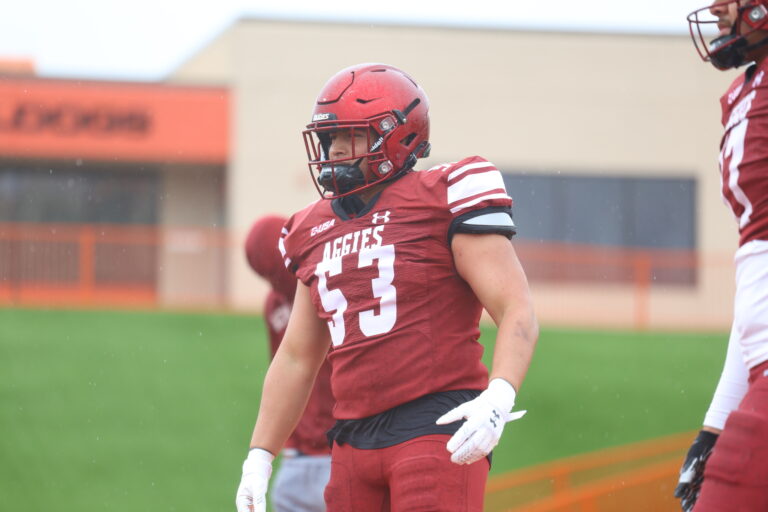
New Mexico State University’s football scrimmage at Artesia High School’s Bulldog Bowl last Saturday was a homecoming for former Artesia player Matthew Saiz.

Saiz, who helped the Bulldogs win their 31st and 32nd state football titles in 2022 and 2023, is now a sophomore defensive tackle for the New Mexico State Aggies and enjoyed getting back in action on his high school field, even though a surge of winter-like weather made the occasion less enjoyable than it might have been.

“It means a lot,” Saiz said. “I know the fans could not show up because of the weather, but it was pretty cool to see that… I get emotional … they (Artesia coaches) always told me that I will miss everything, and it will not be the same when I go to college and experience it myself.”

Artesia football coach Jeremy Maupin said he’s proud of Saiz, a great young man who has worked hard to earn a spot at NMSU.

NMSU Coach Tony Sanchez said having a local hero on hand was good for the Aggies as well for Artesia.

“Any time you can have local guys on the field, it makes a big difference,” Sanchez said. “I thought he did a good job, and I know he was fired up to be back here.”

The weather – sleet, rain, snow, 8-16 mph wind and temperatures in the 30s – made playing conditions treacherous and forced an early end to the scrimmage but Sanchez saw an upside.

“We got a chance to work on everything during the elements today,” he said.

Saiz said his teammates asked him if the weather was always like it was on Saturday. Saiz told them, ‘No, it is usually hot and only gets this way every two or three years.’”

Saiz’s cousin, Gavino Saiz, who played running back for Artesia from 2012-2014, was among the fewer than 20 spectators who braved the weather to watch the scrimmage.

“I love football, but I love my cousin more,” Gavino said.

Matt Saiz said his career as a Bulldog helped him mature. He said playing at Artesia taught him everything he needed to know to deal with the “real world” and he’s ready for what lies ahead.

“I find it amazing to be back out here,” Saiz said, “and it means so much to me. This day is one of the best memories so far. It may seem chaotic, but I loved every moment of it.”

A Deep Dive into New Mexico’s Lack of Economic Freedom

0

By Matthew Mitchell and Paul Gessing

A thousand years ago, a group of people settled along Red Willow Creek at the base of the Taos Mountains and never left. They were among the first, but hardly the last, to be enchanted by New Mexico’s snow-capped mountains and sun-drenched vistas. The state’s moderate climate, rich culture, and mouth-watering cuisine are peerless. And now that New Mexico churns out 2 million barrels of oil every day—more than 15 percent of all US production—you’d think New Mexicans would be riding high.

Instead, the state’s citizens struggle to get by. Over the last decade, New Mexico ranked 47th in employment growth and 36th in real GDP growth. It has the third-highest poverty rate in the union and more children on federal food assistance than any other state. Over the past decade, New Mexico’s population edged up just 1% while neighboring states grew by an average of 12%. State employment also grew 1% while neighboring state employment growth averaged 19%.

In a new report, published by the Fraser Institute and the Rio Grande Foundation, we examine these trends, comparing the state with its more prosperous neighbors.

One key explanation for New Mexico’s dismal economic record is its lack of economic freedom. People are more economically free when they are allowed to make more of their own economic choices. But New Mexico’s high spending, steep taxes, and burdensome regulations have made the state one of the least-economically free in the union. It ranks 47 out of 50, well behind each of its closest neighbors.

The Fraser Institute in Canada began measuring economic freedom nearly three decades ago, first at the national level and then at the state and provincial level. This data has been used in over a thousand peer-reviewed studies assessing the effects of economic freedom on wellbeing. And the evidence is overwhelming that economically freer people tend to be more prosperous people.

Economically free places attract people, entrepreneurship, and growth. They tend to experience lower levels of poverty, less homelessness, and less food insecurity. People in economically free places are more tolerant of others, more philanthropic, and more satisfied with their lives. They are even less likely to recommit crime.

Yet as this evidence has accumulated, New Mexico’s policymakers have moved to further restrict the economic freedom of New Mexicans. The state is the only one in the country to have reduced the economic freedom of its citizens over the four decades for which we have data.

In recent years New Mexico has had budget surpluses of more than $3 billion annually. This is a considerable surplus in a state where rapid spending growth has led to an annual general fund budget of $10.8 billion. Since Gov. Lujan Grisham took over in 2019, the budget has grown by 70%. New Mexico has also accumulated a whopping $61 billion fund for future government spending.

What can be done? New Mexicans themselves hold the key. When they head to the polls, they need to be acutely aware of candidates’ approaches to basic issues like taxes, spending, and regulations. They should question those who continue to believe that the government should be the dominant force in New Mexico’s economy.

They should respect New Mexicans who wish to engage in peaceful voluntary exchange with one another. They should question why the state’s top marginal income tax rate is nearly twice that of its neighbors or why its labor regulations are the second most burdensome in the country. Are its citizens served by especially heavy licensing requirements on low-income occupations?

Economic freedom isn’t the only thing that matters for prosperity. Geography, demography, culture, and luck also play a role. But policy makers can’t move mountains or fundamentally alter a state’s culture. What they can do is remove the barriers to prosperity that have held New Mexicans back for more than four decades.

Matthew Mitchell is a Senior Fellow in the Center for Human Freedom at the Fraser Institute in Canada. He lives in northern New Mexico. Paul Gessing is President of the Rio Grande Foundation in Albuquerque.

Jesus Went Before Them

0


By: Pastor Rick Smith

“And they were in the way going up to Jerusalem; and Jesus went before them: and they were amazed; and as they followed, they were afraid. And he took again the twelve, and began to tell them what things should happen unto him…” (Mark 10:32). We have been meditating on traveling with Jesus on the road to Calvary – in particular, we have been looking at how Jesus prepared His disciples for what would take place at Calvary. In our meditation on these things I think that we should consider why Jesus came. The angel to Joseph said, “And (Mary) will bring forth a Son, and you shall call His name JESUS, for He will save His people from their sins.” (Matthew 1:21). Christmas and Easter (the Resurrection day) are join together in this verse. Jesus came to save sinners (Mark 10:45, 1 Timothy 1:15), but the cross was the means by which the Father determined that we should be saved. The Lamb of God must be slain and His blood applied to our souls for us to be saved. Jesus took our place and died for our sins taking our punishment. As we listen to what Jesus said to the twelve and the others who were following Him to Jerusalem, remember that Jesus was leading the way to Calvary.

“And he took again the twelve, and began to tell them what things should happen unto him, Saying, Behold, we go up to Jerusalem; and the Son of man shall be delivered unto the chief priests, and unto the scribes; and they shall condemn him to death…” (Mark 10:32b-33a). Jesus told His disciples that He was going to be killed at Jerusalem. Jesus told them that He was going to be betrayed and turned over to the chief priests and the scribes. Two Jewish authorities were going to judge Jesus: the ecclesiastical authorities, which were the chief priests, and the theological authorities, which were the scribes. These held great power, but had no authority to execute anyone. The Jewish authorities could condemn Jesus, but they had no authority to execute Him. In telling these things to His disciples Jesus revealed that He knew all that was about to happen to Him in Jerusalem. Despite this Jesus willingly led the way to Jerusalem and His upcoming death on the cross.

“…and they shall condemn him to death, and shall deliver him to the Gentiles: And they shall mock him, and shall scourge him, and shall spit upon him, and shall kill him…” (Mark 10:33b-34a). The Jews were not an autonomous government. As we have seen they only had ecclesiastical and theological authority. They did not have the authority to execute Jesus. For that they needed a governmental authority and that government was under the control of the Romans. So they did what no Jew ever did, and that is to turn one of their own over to the Romans. The Romans, under Caesar, had only one rule that they governed by. They wanted to maintain peace and to back that peace they had the legions of Rome and Pontius Pilate, the governor. Jesus said that the Romans would do more that kill Him, they would mock, flog, spit on Him, and then kill Him. The Romans executed by the means of crucifixion. Jesus is now prophesying to His disciples how He would die. The Romans used crucifixion as a means of controlling those they conquered. It was a method that was cruel beyond measure to the victim and it was visually terrifying to those that observed the practice in action. It would be horrible to go through the process of dying on the cross, but it would be an unimaginable misery to think of someone you cared about dying that way. This is what the disciples could not grasp. They could not imagine Jesus dying on the cross.

The disciples and the others that followed had already heard what Jesus had said on the other two occasions about His death. Mark 10:32 tells us as they followed Jesus in the way that “…they were amazed; and as they followed, they were afraid.” Jesus had already spoken of His upcoming suffering and death. It is clear that they were following Jesus to His rejection, suffering, and death. Some believe that Jesus was trying to comfort them through this time with what He told them. Whether or not that was true, we don’t know. But it was necessary that those that followed Jesus clearly understood that what was about to take place was in the prophesied will and plan of God the Father. “Yet it pleased the LORD to bruise him; he hath put him to grief: when thou shalt make his soul an offering for sin, he shall see his seed, he shall prolong his days, and the pleasure of the LORD shall prosper in his hand. He shall see of the travail of his soul, and shall be satisfied: by his knowledge shall my righteous servant justify many; for he shall bear their iniquities.” (Isaiah 53:10-11).

Three times Jesus told His disciples of His death and three times Jesus ended with this precious promise: “…and the third day he shall rise again.” Each time that Jesus said it His disciples seemed to have missed it. Don’t you miss that promise, because your salvation and mine depend upon that one very precious promise. Why did Jesus come? Jesus came to be the Lamb of God that takes away the sin of the world. Belief in Jesus centers on both His death and resurrection. So “…if you confess with your mouth the Lord Jesus and believe in your heart that God has raised Him from the dead, you will be saved.” (Romans 10:9). Repent now of your sins and put your trust in Jesus Christ as your risen Lord and Savior. I pray that you will.

If you have any questions, we invite you to visit with us this Sunday. Worship at 10:50 A.M. We are located at 711 West Washington Ave. Check our sermon videos on Youtube @ricksmith2541. Send comments and prayer requests to prayerlinecmbc@gmail.com.

Rick Smith is the Pastor at Calvary Missionary Baptist Church in Artesia.

Artesia officials ready for air show

0

By Rebecca Hauschild

Traffic at the Artesia Airport is expected to be heavy when Roswell hosts the National Championship Air Races (NCAR) in September, Artesia Chamber of Commerce Executive Director Hayley Klein told the City Council at its meeting March 25.

Klein, along with chamber staff and Artesia councilors, recently met with Fred Telling, CEO and chairman of the board for the Reno Air Racing Association (RARA) and other RARA staff regarding the impact on Artesia of the upcoming air races.

Klein said Roswell will be closing its airport from 8 a.m.-5 p.m. beginning Sept. 6 and continuing through Sept.14. The races and related events are scheduled for Sept. 10-14.

“We feel like this will push a lot of traffic to Artesia,” she said. “Most of the traffic we expect will be small airplanes owned by pilots coming to attend the air races.”

“We have heard all the hotels in Roswell are already full and Artesia hotels are starting to fill up,” Klein said. “We are talking about how to get people out of the airport and to their hotels. We are hoping to get some rental cars and potential shuttle services. We are encouraging community members to rent out their vehicles through Turo, the online vehicle sharing/rental marketplace.”

Klein also said local officials and event organizers talked about “how area vendors can be involved. They are giving priority to New Mexico True vendors first but will be open to our vendors after that.”

The Artesia Chamber of Commerce has added an air-race page to its website that includes airport information, how to get around, area events, a countdown of rooms available in Artesia hotels, and a list of homes, RVs and other accommodations that aren’t listed on Airbnb or Vrbo but are available to rent, Klein said.

In addition, she said, six committees have been created to prepare for various aspects of the air races: airport, hospitality, transportation, events, marketing, and retail/food.

Artesia Main Street is planning entertainment downtown during the week, Klein said, and the chamber is planning to market Artesia throughout the air races.

“We are working on ways to market Artesia to the attendees, hoping they will see it this year and stay here next time,” she said.

Klein said there is some uncertainty about what to expect as this is the first time in 60 years the event has been held outside of Reno, Nevada, where it has typically drawn 80,000 visitors each year.

Other business

Klein reported that the Artesia Chamber received a letter from the AMC movie theater chain offering to donate the shuttered Land of the Sun Theater in downtown Artesia to the city of Artesia. City Attorney Cass Tabor is currently reviewing the offer.

Mayor Jon Henry asked Police Chief Kirk Roberts bring a proposal to the council to legalize the use of all-terrain vehicles (ATVs) in the city. Roberts agreed but noted he opposes the idea due to safety concerns. Henry, who also represents District 54 in the New Mexico House of Representatives, said the Legislature passed two bills during its recent session to broaden the use of ATVs. “I think it’s time to start looking at that and bring us a proposal back. I know it opens us up to some things, but I have a lot of citizens ask me about it,” Henry said.