Home Blog Page 201

Roswell becomes new home to the NCAR

0

After 60 years in Reno, NV, the National Championship Air Races (NCAR) are making a new home in neighboring Roswell, NM. What are air races, you ask? Just what the name says … airplanes racing each other in the sky. Think NASCAR a couple hundred feet above the ground!

Besides just having a cool event to attend nearby, why should we care? Roswell will be the permanent home of NCAR.  Over the last 60 years, the trend has been to see around 50,000 visitors to the site of the races daily over a five-day period. Events take place daily until 5:00. After that time, those visitors will be looking for places to eat, shop, play, visit, and generally be entertained. That means opportunity for a community like ours that is just down street, relatively speaking, from Roswell’s air center.

Race dates for 2025 are September 10-14. That’s when the actual events take place. Many volunteers and race teams will be coming in days before that to prepare. We can count on this event taking place each year around that same time. Let’s show our visitors some hospitality and make Artesia a place they want to come back to year after year!

Artesia Chamber of Commerce will be hosting meetings to share information about the event and discuss ways we can plan for an influx of visitors. If you are interested in knowing more, please call us at (575) 746-2744.

How do we attract doctors and healthcare workers? Think tank has a plan

0

By Sherry Robinson
All She Wrote


 How long does it take you to get an appointment with your doctor? If your answer is weeks or months, or “What doctor?” Think New Mexico has you in mind.

The nonpartisan think tank recently published a plan to solve New Mexico’s healthcare worker shortage. The group has done its usual thorough work of defining the problem and presenting a potentially do-able solution.

Most riveting, I thought, is the part about reforming the state’s medical malpractice act. This 48-year-old law, its changes and loopholes are a giveaway to malpractice attorneys. We might as well buy national advertising warning doctors to stay away from New Mexico.

Here are a few alarming facts from the report:

· New Mexico ranks second highest in the nation for the number of medical malpractice lawsuits per capita. The number is more than twice the national average.

· Medical malpractice insurance premiums are nearly twice as high as they are in Arizona, Colorado and Texas, and the costs are growing.

· Even with spiraling premiums, many malpractice insurance companies lose money. The statewide loss ratio for medical malpractice insurers was highest in the nation in 2022, at 183.6%. So for every $100 insurers received, they paid out $183.60.

“The high cost of malpractice insurance, and the high likelihood of being sued, discourage doctors and other health care workers from practicing in New Mexico,” says Think New Mexico.

It’s not that our doctors are worse; we have “a system in place that incentivizes lawyers to file malpractice lawsuits here,” according to the report.

Think New Mexico recommends six reforms:

· Cap attorney’s fees. Lawyers receive 30% to 40% of the verdict. That’s money that the patient doesn’t receive for future medical care. Lawyers are entitled to a reasonable living but not “multi-million dollar windfalls at the expense of gravely injured patients.

·End lump-sum payouts. Previously, the patient’s treatment over time was paid as expenses were incurred. In 2021 lawmakers reached a hard-won compromise on a controversial medical malpractice reform bill. In the uproar, somebody sneaked in wording that allowed a single, lump-sum payout based on an estimate of the client’s lifetime medical costs. But after the attorney’s share, the patient may not have enough left.

· Stop venue shopping. Lawyers can file medical malpractice lawsuits anywhere in the state, and they prefer places with sympathetic juries. Thirty states now require suits to be filed in the county where the alleged malpractice occurred. In New Mexico, “trial lawyers have repeatedly racked up record-breaking verdicts.”

· Raise the legal standard for punitive damages and cap them. The 2021 changes to malpractice law allow the highest caps of the 29 states that cap malpractice liabililty, and punitive damages aren’t capped. While punitive damages are rare in other places, they’re routine here, and unlike 32 other states, our burden of proof is minimal.

– Prohibit lawyers from filing multiple lawsuits over a single malpractice incident – a way lawyers get around caps on damages.

· Require that damages awarded for future medical costs reflect the actual cost of care.

 Spend five minutes in the Roundhouse and you quickly see the chummy relationship between the New Mexico Trial Lawyers Association and progressive Democrats. The 2021 changes passed with their support.

Then-Sen. Gay Kernan, R-Hobbs, said later: “It was the worst vote I have ever taken.” Doctors weren’t in the room, and the negotiation was “flawed from the beginning.” She voted for it out of fear the caps could disappear.

Last year another medical malpractice bill threatened to shutter outpatient facilities. Republicans opposed it. Dems dithered until the governor pulled their heads from the sand.

 When legislators ask for your vote, question them about medical malpractice reform. The answer will show whether or not they’re working for you.

Sherry Robinson is a longtime New Mexico reporter and editor. She has worked in Grants, Gallup, the Albuquerque Journal, New Mexico Business Weekly and Albuquerque Tribune. She is the author of four books. Her columns won first place in 2024 from New Mexico Press Women.

Artesia well represented at Eastern New Mexico State Fair

0

Artesia Daily Press Staff Report

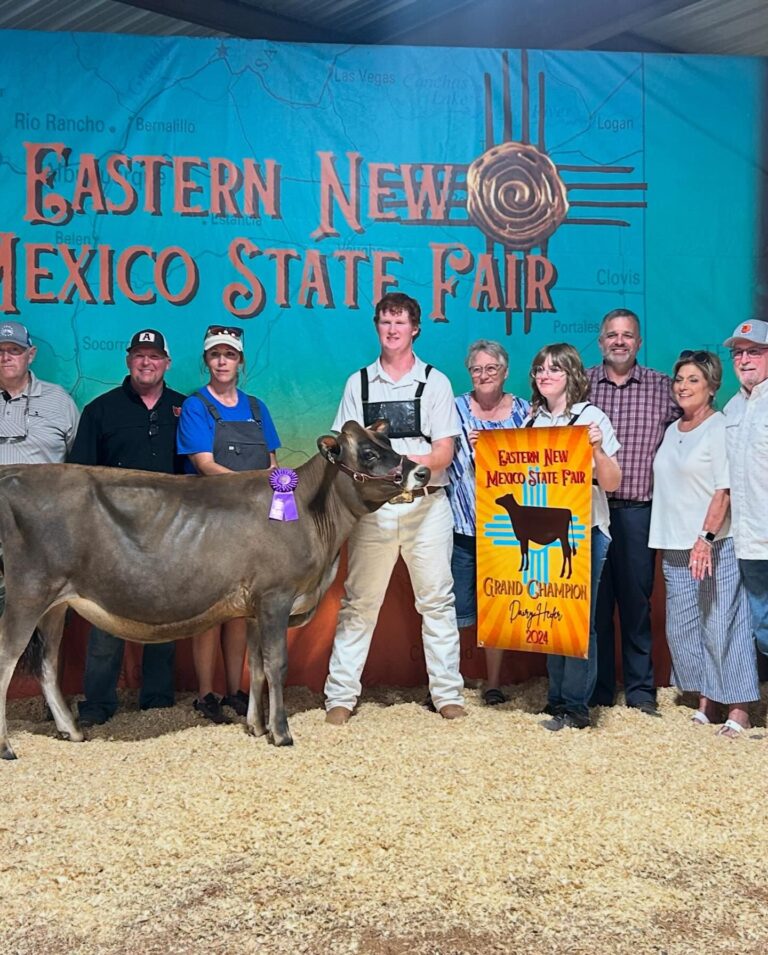
Nineteen kids from Artesia participated in the Oct. 5 junior livestock auction at the Eastern New Mexico State Fair in Roswell, said Eddy County 4-H Extension Agent Wayne Shockey.

He said more than 160 livestock exhibitors from Eddy County participated in the fair that started Sept. 30 and ended with the auction.

“I was impressed with how everybody did,” he said.

Shockey said 27 Eddy County kids had animals in the junior livestock auction.

“That’s the most we’ve had in a sale that I can remember,” said Shockey, who is in his eighth year as the 4-H agent.

Bulldogs dominate Santa Teresa in road football victory

0

Mike Smith
Artesia Daily Press
msmith@currentargus.com

Quarterback Izac Cazares threw three touchdown passes and slotback Ethan Conn scored twice as the Artesia Bulldogs surged to a 36-0 first quarter lead last week (Oct. 4) on their way to a 57-0 road victory over Santa Teresa.

New Mexico’s 50-point mercy rule was invoked at the end of the second period, boosting the Bulldogs’ record to 4-0 in District 5-2A and 5-2 overall.

Santa Teresa is 0-6 in league play and 1-6 overall.

Artesia is off this week before returning to action Oct. 18 at the Bulldog Bowl in a rematch of last year’s 35-21 victory over Roswell High School in the 5A state championship game.

The Bulldogs’ were none the worse for wear after traveling more than 200 miles to the southern New Mexico town of Santa Teresa near El Paso, Texas, pouncing on the Warriors with a 49-yard touchdown run by Conn at the 10:21 mark of the opening period. Derrick Warren threw a pass to Ayden Huffman for the two-point conversion and Artesia led 8-0.

Artesia scored again with six minutes left in the quarter as Cazares completed a 15-yard pass to Caleb Murray for a 14-0 advantage. Artesia missed the extra point try.

Less than three minutes later, Cazares threw a 22-yard strike to Bryce Parra for the Bulldogs’ third touchdown of the game and Diego Lopez ran for the two-point conversion to stretch the lead to 22-0.

The Bulldog defense stopped a Santa Teresa offensive drive with 2:38 left in the first quarter when Jayvien Garcia returned an interception 15 yards for a touchdown. Gael Ruiz converted the extra point kick and Artesia was in command, 29-0.

The Bulldogs recovered a Warrior fumble on the ensuing kickoff and Cazares capped a five play, 18-yard drive with a 28-yard touchdown toss to Conn. Ruiz kicked the extra point with 2:01 left as Artesia extended the lead 36-0.

Artesia continued the onslaught In the second quarter with TD runs by Frankie Galindo, Ray Ray Cano and Derrick Warren.

Offensive Stars of the Game:
Passing:

Izac Cazares: 7/11 for 163 yards, 3TD

Rushing:

Frankie Galindo: 3 carries for 49 yards, 1TD

Ethan Conn: 49-yard TD run

Receiving:

Ethan Conn: 2 catches for 77 yards, 1TD

Defensive Stars of the Game:

Grant Johnson: 4 tackles, 1 TFL

Axel Hartley: 2 tackles, 2TFL

Jayvien Garcia: 15-yard interception return for TD

Scoring Summary:
1st Quarter

Artesia-Ethan Conn 49-yard run, Derrick Warren pass to Ayden Huffman for two-point conversion, 10:21, 8-0.

Artesia-Cazares 15-yard pass to Caleb Murray, extra point no good, 5:56, 14-0.

Artesia-Cazares 22-yard pass to Bryce Parra, Diego Lopez runs two-point conversion, 3:00, 22-0.

Artesia-Jayvien Garcia 15-yard interception, Gael Ruiz kick, 2:38, 29-0.

Artesia-Cazares 28-yard pass to Conn, Ruiz kick, 2:01, 36-0.

2nd Quarter

Artesia-Frankie Galindo 39-yard run, Ruiz kick, 11:38, 43-0.

Artesia-Ray Ray Cano 4-yard run, Ruiz kick, 6:12, 50-0.

Artesia-Warren 1-yard run, Ruiz kick, 1:46, 57-0.

Mike Smith can be reached by phone at 575-308-8734 and can followed on X @MSmithartesianm.

Artesia General Hospital hosts Coffee with a Cop

0

By Mike Smith
Artesia Daily Press
msmith@currentargus.com

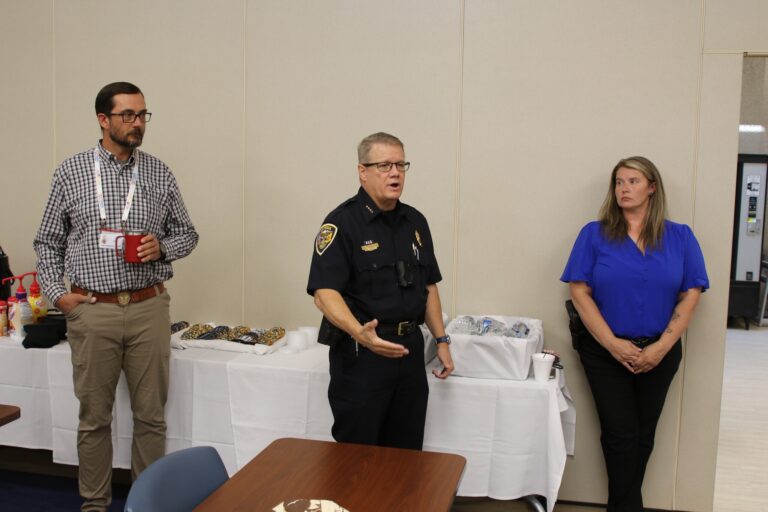
Eddy County Sheriff Mark Cage met with law enforcement, medical personnel and the general public during Coffee with a Cop Oct. 2 at Artesia General Hospital.

The gathering allowed people to meet one-on-one with Cage and other personnel from the Sheriff’s Office to talk about crime and other issues affecting the community.

REMEMBERING Dr. NO: JOHN ARTHUR SMITH

0

By: Jose Z. Garcia

I met John A. Smith early in 1980, probably at a Democratic Party function.  We had just been elected Democratic county chairs of Luna and Doña Ana counties, respectively.  John and I formed a small group of Democratic Party chairs from Hidalgo, Luna, Grant, Doña Ana, Sierra and Otero counties.  We would meet a few times a year and gossip about politics and at statewide conventions tried to maximize our weak clout within the party.

That year we faced a baptism by fire, a series of events that surely helped galvanize John’s resolve to think for himself in the face of heavy political pressure, a trait that would later earn him kudos as a statesman.  Harold Runnels, a conservative Democratic congressman from Hobbs, died of cancer in August; elections were in November.  Republicans, satisfied with Harold’s conservative voting record, had not run a candidate in the primary.  Despite strong public opposition and warnings from Southern party officials, the Democratic Party Central Committee—dominated by liberal Northerners—selected David King, from Santa Fe County, outside the district, to replace Harold as the only person on the ballot.  The public was outraged; Joe Skeen ran as a write-in, and won in a close race.  He remained Congressman until 2002.  The lesson from voters was clear:  voters are the constituents, not party officials.  Years later, when pressured by Roundhouse leaders, governors, and lobbyists to slip in a yes vote on a bill his constituents would not approve of, or the state could not afford, I pictured John remembering that moment of democratic action.

After he was elected to the NM Senate in 1988 John quickly made a name for himself as one of the few senators who truly understood where state monies were parked and the complex process by which a state budget is formed.  I was teaching a course on New Mexico government at NMSU and, realizing I knew no more about any of this than a chapter in the text I assigned, I asked him to explain to me and my students how it worked.  The notion that there is a huge difference to future budgets between a recurring expenditure and a one-time expenditure during a legislative session, was new to me, as it is today for many a freshman legislator, and I confess it took several visits to my class from John before I felt I had a basic understanding of the complexities by which funds in the state’s coffers are converted into which kinds of expenditures.

In 2002 Republican Joe Skeen retired from Congress.  John ran for the seat, opposed by Steve Pierce.  The Pew Foundation commissioned me to write about this race—they were interested in congressional races with no incumbent–so I had a ringside seat.  The Democratic Congressional Campaign Committee, in return for promising a hefty sum of campaign money, forced John to select from five campaign managers they had vetted, all from out-of-state.  None had worked in New Mexico.  Hispanic voters comprised about a third of the vote then, and tended to vote Democratic, but needed to be approached differently in each region.  The managers he was offered knew nothing of this.  The race was close until the end and I was proud of John, who began the race with limited speaking skills, but toward the end sounded every inch a congressman.  The DCCC, however, reneged on their promise to send money during the last few weeks.  The DCCC-vetted manager from New Jersey effectively suspended the campaign the last ten days and the momentum was lost.  Pierce won the race and John went back to his senate seat in Santa Fe.

It was, I believe, Bill Richardson who came up with Dr. No as a nickname for John, quickly picked up by media.  Richardson, who grew up in Mexico City, was an early example of the recent turn to autocratic rule in the US.  Hugely talented, larger than life, hungry for headlines, and never hesitant to ask someone to throw him a fundraiser, Richardson insisted on big-ticket items like the Railrunner and the Spaceport—both long-term financial drains—and he managed to provide tax cuts for the wealthy.  When John—Chair of Senate Finance, one of the most powerful positions in the legislature—spoke truth to power in public about the state’s inability to pay for imprudent levels of spending, Richardson called him Dr. No.  I saw the nickname as a badge of honor:  it takes courage to say no when the pressure is on and when those who agree with you rely on you to say no.

When I became a cabinet secretary in the first Susana Martinez administration, I found John’s door always open.  Despite our long friendship, he treated me exactly as he had treated Richarson and everyone else.  When he disagreed, he was kind and friendly but he tended not to budge and he told you why.  It was clear he enjoyed immense respect from his fellow legislators, even when disagreements were sharp. 

In recent years hyper-partisanship moved stealthily into the Roundhouse.  Several legislators, faithful to the moderate-to-conservative views of their constituents, were targeted in primary races by fellow Democrats from the progressive wing of the party, often using out-of-state money.  John was one of the victims of this highly un-democratic movida from liberal Democrats, many of whom do not hesitate to complain loudly about un-democratic tendencies within national Republican circles.  John took his loss stoically, in stride, and with grace.  Vaya con Dios, John.

Voices of the Next Generation

0

By: Josiah Deason
Junior, Artesia High School
 

The Red Dirt Black Gold Festival

     The relocation of our Red Dirt Black Gold Festival may have culminated a sense of shock to some, though was a necessary step towards the continual development of our thriving community. The intent of the Red Dirt Black Gold Festival is not only to host an immersive environment for fellowship to thrive, but to reflect upon our heritage that founded the basis of this very community that we have held in high regards to, the City of Artesia.


     An immediate effect of this relocation was the immense expansion and attendance of our community that is no longer limited to a few parking lots along Texas Avenue, rather it span across the entirety of down-town Artesia on Main Street. The execution of this decision was coordinated by our City’s Executive Director of Artesia Mainstreet Event Coordinator, Morgan Fox.


     Morgan Fox was first asked “Being the Main Street Event Coordinator for the City of Artesia, what inspired you to move the Red Dirt Black Gold Festival onto Downtown Main Street?” She then remarkably answered “After a successful run of eight years having RDBG on Texas Avenue, we wanted to see if we could elevate the event by moving it to Main Street. A move to Main would allow more event space for attendees to dance, more seating near the stage, more gathering space, and increase our vendor space as well. We wanted to expand the beer garden to the entire event area and logistically, Main Street made the most sense. Most importantly, we wanted to highlight our stunning, one-of-a-kind, gem of southeastern NM, Main Street in Artesia.”


     Fox was asked the upcoming question “If successful, will this event take place on Downtown Main Street in the foreseeable years to come?” To which Fox replied “Yes, we will continue to host Red Dirt Black Gold on Main Street. We are already reviewing how we can improve and elevate the event in 2025.”


     As I attended the festival and aimlessly wandered around, I could not help but appreciate the beauty in the unity and fellowship within our community, and for the tasteful setting of the festival’s live music as it blended with the vibrant and engaging atmosphere of the Land of Enchantment, it envelopes a sense of pride from the heritage within our community that can’t be ignored, but rather embraced in moments that we spend in the reflection of our community’s history.

Find someone else

0

Shel Nymark
Embudo

In a full-page editorial subtitled “Be an Informed Voter,” your columnist Tom Wright writes that Donald Trump survived “assaults from the deep state and detractors.” The “deep state” is a paranoid, dark, Qanon conspiracy theory that the government is controlled by a secret cabal of military and financial elites.

If yours is a reputable news outlet and has evidence of the “deep state,” please provide it.

Concerning assaults, they occurred on January 6 when Trump’s supporters attacked Capital Police with flagpoles and other weapons. Trump’s family separation policy is an assault; some parents still don’t know what happened to their children and may never see them again.

New Mexico is blessed with many creative thinkers and writers. If you want to inform voters with facts, relegate Q anon Tom to the letters to the editor section and find someone else.

   Reading Banned Books Helped Me Think for Myself

0

By Trip Jennings

I recently learned that in the months before his 1968 assassination Robert “Bobby” Kennedy Sr. changed his position on the death penalty after reading Albert Camus, the French philosopher and author of literary classics such as The Stranger and The Plague.

I’m not writing about the death penalty, although one of my most lingering memories of my conservative well-read maternal grandfather is of him expressing his opinion on capital punishment.

Born in the late 19th century and a product of small Georgia towns in the Jim Crow South where the death penalty was deeply popular, my grandfather admitted over Sunday lunch that he still struggled with whether it was moral for the state to execute people. He was in his late 80s. <n><n>   I’m pretty sure my grandfather’s politics didn’t jibe with Robert Kennedy’s. But the two men did share one thing: a love of reading. Like Kennedy, my maternal grandfather devoured books, usually ancient classics by Roman, Greek and Jewish writers such as Tacitus, Josephus, and Plutarch. <n><n>   I believe that my grandfather’s hesitance over capital punishment and his willingness to wrestle with how he felt about it was, in part, due to a fertile, inquisitive mind that he had fortified by reading widely and deeply over several decades.

I mention Robert Kennedy and my grandfather and their reading habits because last week was Banned Book Week.

Books have become a political hot potato in recent years in the latest paroxysm of moral panic that has led to impassioned calls to remove books from schools and local libraries.

I hate it.

Mine is not a political, partisan, or ideological position. I’m just a book lover who was reading before I even knew banning books was a thing who finds himself continually surprised at what’s on the list of exiled titles.

Some are beloved; others are deeply profound meditations on what it is to be human in an often-unjust world.  According to the archives kept by the American Library Association and the History Channel, here are a few books that have been banned at one time or another.

The Adventures of Huckleberry Finn

To Kill a Mockingbird

The Bluest Eye

Of Mice and Men

The Catcher in the Rye

The Color Purple

The Bible (yes, this was banned somewhere by someone)

The Grapes of Wrath

Slaughterhouse-Five

1984

These days, I am an avid book lover, but I came late to it. Only after I graduated from college did the reading bug bite.

Turns out, I didn’t like being told what to read in class, but I loved reading when I was the one choosing the titles. In my 20s and 30s, you could find me juggling Anne Rice’s early vampire novels (Interview with the Vampire is especially good) with thousand-page histories on the civil rights era in the South and more obscure titles. John Dos Passos’ USA Trilogy ( The 42nd Parallel, 1919, and The Big Money) comes to mind, as does Polish writer Henryk Sienkiewicz’s 3,500-page Trilogy about the now-forgotten Polish-Lithuanian Commonwealth, a powerful kingdom that vied for land and status in central Europe in the 17th and 18th centuries.

Before long, I was dipping into philosophy, theology, ethics, and philosophy of science. I also began to diversify who I read — early on, it was mostly white men whom I picked up.

Because I grew up in the Deep South I’d always been fascinated by African American authors, so I searched out books by Toni Morrison, Alice Walker, James Baldwin, Zora Neale Hurston, and others. My wife, who’d read Latin American literature in both English and Spanish in college, helped me further diversify my reading, suggesting Mexican and South American writers to me. Reading them, in turn, triggered my curiosity about authors from nations in Africa and Asia, as well as Indigenous writers. <n><n>   As I became a more sophisticated reader, I learned it was important to learn something about the person I was reading because the perspective they were writing from, more often than not, was shaped by their own life experiences.

That led me to pick up more women and LBGTQ+ writers, not for ideological reasons but out of curiosity. Here were fellow humans writing from perspectives shaped by lives that were different from mine. However, in deep and profound ways, oftentimes I recognized myself in their books. Like me, they confronted age-old questions — where do you find meaning in a life that lasts only a short while? Where do you find love? How do we treat others in a world that is so often unjust?<n><n>   As I approach a certain age, I increasingly realize the irony that comes with a love of learning: the more I know, the more I know how much I don’t know. Not having all the answers isn’t troubling, however. I fit into a grand tradition preceded by a cloud of witnesses — as adults in my childhood church used to say — of people similarly infected by a sense of wonder and a passionate inquisitiveness. People like Solon, the ancient Greek lawmaker, who is said to have remarked “I grow old always learning many things” and the great Renaissance painter / sculptor Michelangelo Buonarotti who at 87 wrote to a friend: “Ancora Imparo – I am still learning.” <n><n>   Which brings me back to my grandfather and Robert Kennedy, Sr.

In a society where people are besieged by messages to think for themselves, I believe my grandfather’s decision to buck popular opinion on capital punishment in the Jim Crow South was a mark of his fertile, curious mind shaped by decades of reading. The same goes for Kennedy and his shift on the death penalty.

One final note. I am not saying everyone must read books to be able to think for themselves, I am saying that books were and are central to my own journey.

There are many ways one can learn to think for themselves. But it always involves curiosity and an urge to follow its meandering sense of direction.

Banning books represents the opposite. It attempts to short-circuit inquisitiveness before it can pose questions that could lead you to wrestle with a given subject and perhaps gain a deeper understanding of yourself and the world about you.

Trip Jennings started his career in Georgia at his hometown newspaper, The Augusta Chronicle, before working at newspapers in California, Florida and Connecticut where he reported on many stories, including the resignation and incarceration of Connecticut’s then-governor, John Rowland, and gang warfare in California. Since 2005, Trip has covered politics and state government for the Albuquerque Journal, The New Mexico Independent and the Santa Fe New Mexican.  He holds a Master’s of Divinity from Columbia Theological Seminary in Decatur, Ga. In 2012, he co-founded New Mexico In Depth, a nonpartisan, nonprofit media outlet that produces investiative, data-rich stories with an eye on solutions that can be a catalyst for change

A Word of Thanks

0

By Nella Domenici

Across our beautiful state, fishermen, hunters, and outdoorsmen of all kinds, ranchers and farmers, and miners and oil and gas producers interact with public lands every day. Many New Mexicans live in places that are adjacent to or completely surrounded by public land. Many communities in New Mexico, including tribal lands, have econ- omies that rely upon use of the public lands.

No one is more invested in the long-term health and conservation of our public lands than the New Mexicans whose livelihoods rely on the sustained well-being of the land. Because New Mexicans are intertwined with the land, they know best how to preserve the land and their way of life. New Mexicans living in small towns and rural spaces are the ultimate conservationists.

To all of you, I extend my respect and admiration for your commitment to our lands.

Unfortunately, as I’ve traveled the state, you’ve told me repeatedly that you feel under attack from our current government agencies and state and federal elected officials:

• Ranchers in northern New Mexico with grazing rights that go back generations are often harassed with fines and threats of revoked permits.

• Ranchers in southern New Mexico are at risk of losing compensation for their losses caused by wolves.

• In eastern and southern New Mexico, the imagined habitat of endangered species not seen for decades prevents virtually any use of lands.

• Federal agencies are rewriting some rules and regulations with irrational radical Green-New-Deal goals that would allow those agen- cies to deny renewals of long-standing leases and permits owned by New Mexicans.

• Agencies often drag-out permitting applications for years for rural electric co-op rights-of-ways, oil and gas development, and other uses allowed in federal law.

• The Biden/Harris Administration and Martin Henirich are working against the interests of New Mexicans by too often turning public lands into off-limits wilderness or national monuments.

• And terrible federal land management practices have resulted in devastating wildfires and flooding in San Miguel and Mora counties in 2022 and just last spring in Lincoln and Otero counties. More than two years later, many families impacted by the Hermits Peak/Calf Canyon fire are still waiting for compensation and have heard empty promises from Martin Heinrich.

• The wildfires caused by bad forest management means that many homeowners, businesses, and electric co-ops may not be able to secure required insurance coverage.

The Biden/Harris Administration is not with you.

<n>Martin Heinrich is not with you.

<n>They are pursuing a radical-left agenda and fail to recognize that the public lands in New Mexico are for New Mexicans. They want to use New Mexico as an out-of-view remote place to build green energy projects to provide power elsewhere — like Heinrich’s vanity-project, SunZia.

SunZia is the Heinrich-backed wind farm in central New Mexico that will have more than 900 enormous wind turbines generating 3.5 gigawatts of electricity. One hundred percent of this electricity will ultimately be routed to California via 353 miles of new, high voltage power lines across six counties from Torrance to Hidalgo. New Mexicans will not benefit from any of the electricity generated.

I am in favor of alternative sources of energy that benefit New Mexicans. But those sources of energy must do more good than harm.

We should cherish New Mexico’s National Parks and forests, and they must be properly maintained. Our authentic wilderness areas and scenic rivers should be preserved. Our historic, cultural, and wildlife reserves should be preserved. But the power of the Biden/Harris Administration and Senator Heinrich to make such designations is being abused, should be limited, include stakeholder involvement, and Congressional approval.

For too many of you in rural New Mexico it feels like the walls are closing in. The radical-leftists in the federal and state government want you off of our public land.

But I will be with you.

As New Mexico’s U.S. Senator, I will fight for you. I will fight for you in Congress, and I will hold the federal agencies accountable. I will not let them push you off New Mexico’s land, or undermine New Mexico’s economy, or our way of life.

You are the true stewards of our public land and you can be trusted to preserve it for future generations of New Mexicans.