Adrian Hedden
Carlsbad Current-Argus
achedden@currentargus.com
A grouse native to the plains of southeastern New Mexico lost its federal protections after outcry from industry supporters and decades of debate.
The Wednesday. Feb. 26, announcement from the U.S. Fish and Wildlife Service came in response to a federal court order in Texas last year and was the final step in removing federal protections and restrictions to development on lands where the bird was believed to dwell.
The lesser prairie chicken was listed as endangered in November 2022 in its southern distinct population segment (DPS), which the U.S. Fish and Wildlife Service used to describe the bird’s southern range in southeast New Mexico and West Texas.
The chicken’s northern segment, covering portions of Colorado, Kansas, Oklahoma and the northern Texas Panhandle, was listed as threatened.
Endangered status means the agency believes a species’ extinction is imminent. The listing requires a federal recovery plan be put in place while often setting aside lands for habitat critical to recovery.
Threatened status indicates an endangered listing may soon be warranted.
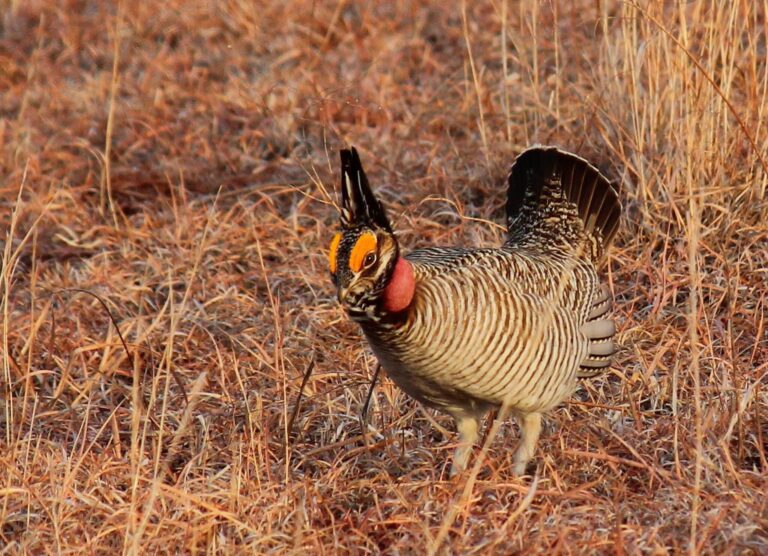
The lesser prairie chicken is known for its distinctive mating dances during the spring, in breeding grounds throughout the plains of its range known as “leks.” The male birds inflate reddish air sacks on the sides of their heads and extend yellow feathers above their eyes, stamping into the sand to attract females.
This process known as “lekking” can be impeded by industrial infrastructure such as fences or oil wells, according to a 2022 report from the Fish and Wildlife Service, as the prairie chickens naturally avoid tall structures where predators may perch.
The report blamed a rapid decline in the prairie chicken’s numbers on heavy growth in agriculture and energy development throughout the bird’s range.
The grouse’s historical range was diminished by about 90%, the report read, and its population across the five-state range sat at just about 32,00 birds from an historic population believed to top 100,000. Those numbers led to Fish and Wildlife’s listing of the lesser prairie chicken as endangered but with the arrival of a new federal administration, the agency reversed course last year.
The shift began after backlash from the oil and gas and agriculture industries, and allegations the listing and recovery efforts could negatively impact local economies and the industries that drive them.
A federal lawsuit was filed in 2023 by the state of Texas and fossil fuel trade group the Permian Basin Petroleum Association. In August 2025, U.S. District Judge David Counts sided with the plaintiffs, issuing a ruling to vacate the lesser prairie chicken’s endangered status.
In its latest decision published last week to the Federal Register, the interior department said delisting was “necessary to comply” with the court, and that no opportunity for the public to submit comments on the matter would be offered.
This followed an August 2025 motion the Fish and Wildlife Service filed in the lawsuit, asking the court to reverse the agency’s own decision to list the species.
Specifically, the agency said its previous leaders falsely separated the species into two “distinct population segments” (DPS), and that a new listing procedure was needed to correctly apply federal law.
“The Service concedes that it improperly applied its DPS Policy in a manner that tainted the substance of the final listing rule,” read the motion. “Given the seriousness of the error identified, the Service will be unable to correct the rule’s defects on remand short of engaging in an entirely new analysis.”
The apparent alignment between the court and the Fish and Wildlife Service followed an executive order issued by President Donald Trump titled “Unleashing American Energy” as he took office in January 2025.
Trump via the order called on federal agencies to limit restrictions on domestic fossil fuel production. This included multiple endangered species listings that occurred under Trump’s predecessor, President Joe Biden.
“President Trump’s removal of the Lesser Prairie-Chicken from the federal Endangered Species Act list is a long-overdue victory for Texas farmers, ranchers, and energy producers,” said Texas Department of Agriculture Commissioner Sid Miller in a Feb. 26 statement. “For years, rural Texans stood shoulder to shoulder with the oil and gas industry to fight back against a weaponized federal bureaucracy masquerading as conservation.”
The decision to delist drew uproar from the environmental community with multiple groups arguing the delisting put industry interests ahead of the environment.
“The Lesser Prairie Chicken is a metaphorical ‘canary in the coal mine’ for New Mexico’s grasslands. They need large tracts of native grasslands to thrive, and their numbers have dwindled dramatically over the past several decades,” said Demis Foster with Conservation Voters New Mexico.
“Research also shows that when it comes to ecosystem resiliency, every species matters.”
Jason Rylander with the Center for Biological Diversity called the decision “shameful,” and said that the Center planned to defend the species’ endangered status in court via an ongoing appeal the organization filed against the Texas court’s ruling in the Fifth Circuit U.S Court of Appeals.
It was the Center, then known as the Biodiversity Legal Foundation, that first petitioned the Fish and Wildlife Service in 1995 for the lesser prairie chicken to be listed as endangered.
It was listed as threatened in 2014, but a subsequent lawsuit filed by oil and gas industry groups in federal court for the Western District of Texas in Midland led to a reversal of that decision. The Center filed again to list the species in 2016, and sued the federal government in 2021, leading to the 2022 listing.
No decision was yet issued on the appeal as of Monday, March 2.
“We’ve been fighting for decades to protect these birds because they’re special and they have a right to exist,” Rylander said. “It’s shameful that the Trump administration sees fit to sacrifice these magnificent birds for oil and gas industry profit.”
Managing Editor Adrian Hedden can be reached at 575-628-5516, or @AdrianHedden on the social media platform X.