Home Blog Page 58

Steve Pearce talks new book at signing in Artesia

0

Adrian Hedden
Artesia Daily Press

Steve Pearce’s memories of warfare unfolded as he drew nearer to Vietnam in the spring of 2016.

He served in the U.S. Air Force from 1970 until 1976, through the final years of the Vietnam War, and recalled how he and other veterans returned home only to be greeted with disregard or even disrespect, never receiving the honor and support accorded those who served in earlier wars.

Forty years later, Pearce was a fixture in New Mexico politics, representing the state’s 2nd Congressional District in the U.S. House of Representatives. He left Congress in 2019, at the end of his seventh two-year term, then served as chair of the New Mexico Republican Party until December 2024.

Last month, President Donald Trump nominated Pearce to serve as director of the federal Bureau of Land Management. If confirmed by the U.S. Senate, Pearce would be in charge of the agency that manages government-owned land, and at the center of the ongoing debate about the oil and gas industry’s use of public land for energy development in New Mexico.

But that’s the future. On March 27, 2016, during a break in the action in Washington, D.C., Pearce left his life in politics to revisit the past, taking off from Las Vegas, Nevada, for what he called a “pilgrimage” around the globe.

His plan was to return to some of the places the war took him and fellow service members, drawing attention to the valor he said was overlooked amid the politics of the 1970s.

He flew alone for 186 flight hours, making 26 fueling stops to cover 26,000 miles in his single-engine private aircraft, a four-seat 1998 Mooney M20M Bravo. The trip ended back in Las Vegas on June 3, 2016.

Pearce’s journey took him back to Southeast Asia where his strongest memories of the war were created, in places such as Chittagong, Bangladesh and U-Tapao, Thailand, which was used as a main transportation hub throughout the war.

He also flew to war-torn regions in India and Oman, reflecting on the courageous service of surviving veterans and those who never made it home.

The trip and Pearce’s thoughts on military sacrifice are key themes of his book, “You Had a Good Home, But You Left…”

The book, released in November by boutique publisher E.P. House, recounts the flight and his reflections along the way.

The Artesia Daily Press caught up with Pearce during a book signing in Artesia to talk about the book and his thoughts on military service.

What inspired you to write this book?

“When I got home from Vietnam, I noticed the kids that were home but never quite made it back. Things had affected them. Then, of course, we had the friends who didn’t come back at all, in coffins and things. That stuff just percolated through the years. I always felt bad that kids that got injured and were forced out of the military.

“I get in Congress, and that’s still weighing on my mind. We had the opportunity to meet several soldiers who were wounded egregiously, amputations. I kept hearing the same question: Does anybody know or care what their freedom cost me? That began to weigh on me. I began to ask myself: How come I wasn’t doing more?”

How do you describe the themes of the book?

“This flight was to honor the veterans who didn’t make it home, and those that made it home without making it home. Home is a really huge piece of this.

“Initially, “You Had a Good Home, but You Left,” was just a comment I made in the book … referring to the value of cadence in our lives. In anything, you don’t need life to get ahead of you, and you start being behind your problems. Cadence has been a big deal to me my entire life.

“It also speaks to the veterans that left good, stable lives to either volunteer or accept induction when they didn’t volunteer.”

What were some of the emotions that came back during the flight?

“I had never thought of pilgrimage in my whole life, but the further along I got, the more I realized I am headed back to the warriors. I began to unpack a lot of things that I folded away and put in the closet and just thought it was all good. Just the loss of valiant soldiers because of political ineptness and military bad decisions. So, I write quite frankly about that.

“I write about the stresses to our marriage. Just, the service in D.C. was very stressful. It was a lot of stress and a lot of missed family time, and this trip was a tremendous stress.”

How did you attempt to right the wrongs of Vietnam while in Congress?

“The first speech I gave on the House floor was I don’t care if we’re in we’re in Iraq, Afghanistan or we’re out. That’s a decision to be made. But if we got soldiers there, God help us if we cut the funding off because they cut our funding off in Vietnam. Put pressure on the administration. That was my job, to be a voice. We documented things that were going wrong at the VA (Department of Veterans Affairs).

“We passed $10 billion for letting people (VA clients) see local doctors instead of having to drive to Albuquerque. Those things really got a lot of attention when I was there, and we became a voice for the military and acting correctly toward our soldiers but also towards our veterans.”

Managing Editor Adrian Hedden can be reached at 575-628-5516, or @AdrianHedden on the social media platform X.


New Mexico’s economic freedom now dead last

0

Paul J. Gessing and Matthew Mitchell

In a study published earlier this year, we highlighted the fact that New Mexico was the only state in the US to have lost economic freedom since 1981. We now know that it is worse than we thought.

People are more economically free when they are allowed to make more of their own economic choices; economists measure this freedom by looking at the degree to which government spending, taxation, and regulation limits choice.

We relied on data from the Fraser Institute’s Economic Freedom of North America index. Over the last two decades, it has become the most cited and most used measure of state-level economic freedom in the US. Like its national-level counterpart, The Economic Freedom of the World, the state index has been used in hundreds of academic studies assessing the effect of economic freedom on a wide variety of measures of economic well-being.

These studies find that states and nations with higher levels of economic freedom tend to prosper. They have higher incomes, faster growth, and less poverty. And prosperity yields a variety of other salutary outcomes including cleaner environments, higher life satisfaction, and more gender equality.

Working within the scope of the rule of law and a system of private property rights, humans tend to voluntarily cooperate together to improve their surroundings and outcomes. Government can play a useful role in enforcing property rights and in ensuring that people are free from fraud and force. But it can also stifle innovation and productivity by consuming wealth and placing too many barriers on workers, consumers, businesses, and entrepreneurs.

The latest edition of the Economic Freedom of North America has just been released. And sadly, New Mexico has lost even more ground relative to the other 49 US states. Now, the Land of Enchantment has fallen behind New York and Hawaii to be dead last in the nation.

This should not surprise anyone who follows New Mexico policy. The state has had a massive oil and gas boom in recent years, creating a gusher of tax revenue. But policymakers have done nearly nothing with that revenue to make the state more appealing to investors, workers, or businesses.

Since the start of 2025, New Mexico’s oil and gas sovereign wealth fund has leapt in value from $58 billion to $66 billion. The general fund budget has risen 71% during Lujan Grisham’s 7 years in office. As a share of statewide personal income, the state’s general consumption expenditures are the highest in the nation. Transfers and subsidies are the 3rd highest. Sales tax revenue is the 3rd highest, and government employment is the 2nd highest. As a share of per capita income, New Mexico’s minimum wage is the 2nd highest in the nation.

Instead of creating and enforcing a level playing field for all New Mexicans, the state’s policymakers have long preferred to lavish privileges on favored firms and industries. Time and again, the state’s film subsidy program, for example, has been found to be a money loser. But they keep throwing good money after bad.

Market pressures have recently forced state policymakers to shift corporate welfare spending from unsustainable boondoggles like Maxeon and Ebon Solar to more economically viable projects like data centers (Project Jupiter in Santa Theresa and Zenith Volts near Roswell).

But whether these projects come to fruition or not, corporate welfare is not an efficient, equitable, or sustainable strategy for long-term economic development.

Instead, policymakers should focus on improving overall economic conditions by increasing economic freedom for all. While it may be unfashionable to say amid massive budget surpluses and revenue growth, the state needs to restrain spending. It should also reduce taxes, ease regulatory burdens, and let the private sector play a larger role in economic development.

The state’s descent to dead last in economic freedom, less free than even New York and California, should be a wake-up call.

Paul Gessing is president of the Rio Grande Foundation in Albuquerque. Matthew Mitchell is a senior fellow in the Center for Human Freedom at the Fraser Institute in Canada. He lives in Northern New Mexico.

Police identify skeletal remains found in Artesia

0

Adrian Hedden
Carlsbad Current-Argus
achedden@currentargus.com

Artesia police identified human bones found in September as belonging to a transient man last seen three years ago when he was released from jail.

Skeletal remains of John W. Littleton, 53, were found Sept. 29 near the train tracks at 300 N. 1st Street in Artesia after a train conductor with Burlington Northern Santa Fe found the remains and called police.

The identification of Littleton was announced by the Artesia Police Department in a Wednesday, Dec. 3, news release. The remains were identified by police based on initial findings by the Office of the Medical Investigator, according to the release. An autopsy was ongoing, the release read, and police were continuing to investigate the cause of Littleton’s death.

The call leading to discovery of the remains came in about 2:50 p.m., police said, when what initially appeared to be a decomposed foot was found along the tracks near a loading dock owned by Artesia Ford Company.

The rest of the body was found beneath the dock after police responded, said Commander Pete Quinones with the Artesia Police Department.

Quinones said the incident, like all death investigations, was being treated as a homicide until evidence is found to the contrary.

Police said Littleton was last seen alive on May 31, 2022, when he was released from the Eddy County Detention Center.

Quinones said Littleton was a known transient in Artesia, as many local businesses called authorities over the past several years to report him locking himself in bathrooms and trespassing on various properties.

“He was well known in our town for being vagrant and causing problems around town,” Quinones said. “He had caused problems with a lot of businesses. I never knew him to be violent. We didn’t consider him a threat.”

Littleton’s most recent arrest was on March 7, 2022, before his release on May 31 of that year, jail records indicate. He did not incur any criminal charges before being discharged from the detention center.

Court records show Littleton’s last criminal charges stemmed from an arrest in April 2019 when he was charged with felony battery against a peace officer, along with misdemeanor criminal trespassing and resisting arrest.

That arrest occurred, police said, after an employee at an Allsup’s store in Carlsbad found Littleton sleeping in a store bathroom. When officers attempted to wake him, he kicked an officer in the leg and threw multiple punches as he was restrained.

A stun gun was used and Littleton was arrested. Police noted he had five previous charges for battery on an officer, according to the criminal complaint.

The felony charge was dismissed in exchange for no-contest pleas on the misdemeanors, records show, and Littleton was sentenced in March 2020 to 13 months and 35 days’ incarceration at the Eddy County Detention Center.

Quinones said police had not had any interaction with Littleton in the years since he was last released from custody, and that Littleton was one of a “handful” of known transients police were frequently called about around town.

“We thought maybe he was in another town. With finding these skeletal remains, obviously that was not the case,” Quinones said.

Managing Editor Adrian Hedden can be reached at 575-628-5516, or @AdrianHedden on the social media platform X.
Victims identified in Alamogordo plane crash

0

Staff Reports

Alamogordo News

New Mexico State Police have identified two victims, 73-year-old Ralph Guernin and 40-year-old Patrick Cheung, in the remains of an aircraft that crashed outside of the Alamogordo White Sands Regional Airport on Nov. 26.

The aircraft was an American Aviation model AA-1A with a Fixed Wing Single-Engine, according to the Federal Aviation Administration Registry. The aircraft was registered to Cheung in Boca Raton, Florida.

A coordinated search effort was conducted with the assistance of the Otero County Sheriff’s Office, Alamogordo Police Department, Otero County Emergency Services, Alamogordo Fire Department, the Lincoln National Forest Service, and New Mexico Search and Rescue and on Nov. 27, 2025, at 10:17 a.m., the aircraft was located. The aircraft was completely burned and Guernin and Cheung were pronounced dead at the scene, according to New Mexico State Police.

Mayor Susan L. Payne took to Facebook to express her condolences, writing: “This is a tragedy. I would ask all of our citizens to please join us in praying for the families.”

Bring home a live Christmas tree from the Lincoln National Forest

0

Staff Reports

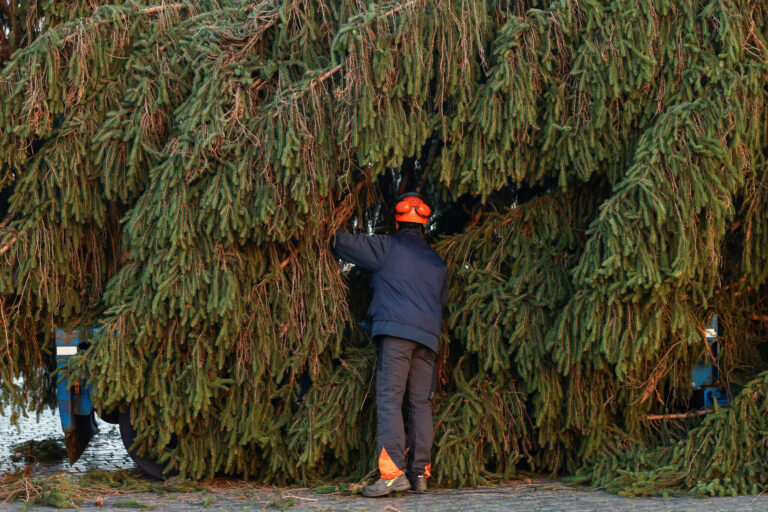
The holidays are near. If you want to have a unique experience, consider visiting the Lincoln Nation Forest to harvest your perfect Christmas tree. The Christmas tree season runs from Thursday, Nov. 13th to Wednesday, Dec. 31st. Permits cost $10 with a $2.50 service fee and allow you to harvest one tree.

Where to cut your tree

* Do not cut on private land, in wilderness areas, within 300 feet of a designated campground or trail, within 100 feet of a paved road or in areas that have been planted with new trees.

* Do not cut in active timber sale areas.

Selecting your tree

* Your tree must not exceed 10 feet in height.

* Take the whole tree. Do not remove the top of the tree; cut down the entire tree.

* If snow is on the ground, remove it from around the stump so you can accurately measure the stump and tree height.

* Please print and display your permit on the dashboard of your vehicle.

Helpful tips

* Before you leave home, be sure to measure the space where you plan to place the tree in your home (height and width), and measure the space in your vehicle where you will be transporting the tree.

* Cell service may be spotty or unavailable. Be sure someone knows where you are and when to expect you back.

* Check the latest weather conditions, forest warnings and road closures before you leave on your trip.

* Dress warmly and take extra dry clothes. Expect winter weather, including cold temperatures, snow and winds.

* Bring plenty of food and water with you as well as an overnight survival kit in case you become stranded.

* Park in areas so that traffic can get by safely, and do not block gates.

* Start your day early. Be sure to find your tree and leave the woods before dark.

* Pets must be on a leash.

The Lincoln National Forest spans 1.1 million acres of southeastern New Mexico, encompassing three majestic mountain ranges: Sacramento, Guadalupe, and Capitan. With elevations ranging from 4,000 to 11,500 feet, the forest boasts diverse ecosystems, from Chihuahuan desert to sub-alpine forest. 

Visitors can enjoy a wide range of outdoor activities, including hiking, picnicking, mountain biking, camping, and dirt bike riding. The forest is also home to Smokey Bear, the iconic symbol of forest fire prevention. 

Permits can be found at https://www.fs.usda.gov/r03/lincoln/permits/lincoln-national-forest-christmas-tree-permits

Artesia gets in Christmas spirit

0

Photos by Mike Smith, Artesia Daily Press

Christmas decorations were up Monday in downtown Artesia as Artesia MainStreet prepares for Light Up Artesia Thursday.

The fun starts at 4 p.m. at the Derrick Floor with the Jingle Bell Jog, followed by the Christmas Tree Lighting at the Derrick Floor and the Electric Light Parade at 6 p.m. Artrageous starts at 7 p.m. at The Ocotillo Performing Arts Center.

Holiday season doesn’t stop trout fishing in New Mexico

0

Information and photos provided by New Mexico Department of Game and Fish

With Thanksgiving behind us and the Christmas-New Year holidays in sight, ’tis the season for trout as anglers report ideal conditions in waters across New Mexico.

In northern New Mexico at Eagle Nest Lake, fishing for rainbow trout was particularly good using Salmon Peach PowerBait.

At Lake Maloya, trout fishing was good using Rainbow PowerBait.

Along the Pecos River, fishing for trout was good using worms.

Fishing for trout was fair to good using lures at Santa Cruz Reservoir.

At the Belen Riverside Drain, fishing for trout was good using salmon eggs.

Fishing for trout was fair to good using Garlic PowerBait at Fenton Lake.

Fishing for trout was particularly good using salmon eggs at the Seven Springs Kids’ Pond.

In Albuquerque at Tingley Beach, fishing for trout was fair to good using Garlic PowerBait.

In southern New Mexico, fishing for catfish at Escondida Lake was good using PowerBait.

At Bonito Lake in Lincoln County, fishing for trout was fair to good using multicolored Kastmasters, worms, and size-12 nymph flies.

This fishing report, provided by the Department of Game and Fish, has been generated from the best information available from area officers and anglers. Conditions encountered after the report is compiled may differ, as stream, lake and weather conditions alter fish and angler activities.

Ski trade organization believes success awaits state ski slopes

0

Mike Smith

Artesia Daily Press

msmith@currentargus.com

The likelihood of a drier, warmer winter has not dampened Christy Germscheid’s hopes for a successful ski season in New Mexico.

“I never go into a season thinking it’s going to be a rough season. We’re going to have a great season,” she said during a telephone interview on Nov. 25.

Germscheid, is the executive director of Ski New Mexico, a nonprofit organization designed to promote skiing and outdoor recreation activities across the state.

Sipapu Ski Resort opened Nov. 21 and before Thanksgiving reported a base depth of 12 inches.

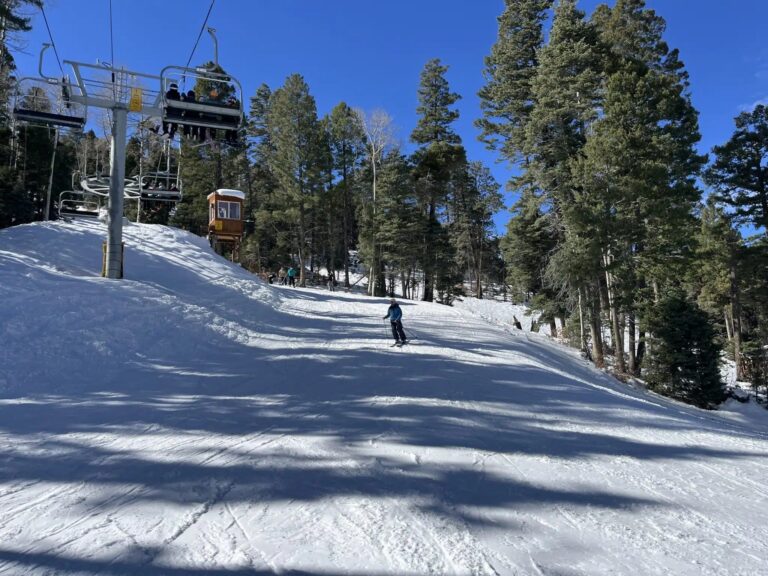
Ski Apache near Ruidoso, Ski Santa Fe, Taos Ski Valley, and Red River Ski Area opened Thanksgiving weekend.

Angel Fire, Pajarito Mountain and Sandia Peak Ski Area are scheduled to open Dec. 12.

The winter weather outlook for December through March, issued Oct. 16 by the National Weather Service in Albuquerque, predicted below normal rain and snow chances for the state along with above normal temperatures.

What Mother Nature does not deliver, Germscheid said, New Mexico’s ski resorts can provide with manufactured snow.

“Resort areas are focused on improvements,” she said, noting that infrastructure at ski areas in northern and southern New Mexico was updated in 2024 and earlier this year.

A snowmaking pipe and a water main were repaired last year at Pajarito Mountain near Los Alamos and work is underway to construct a pipeline from Los Alamos to Pajarito to deliver water via a 250,000-gallon tank, according to the Pajarito Ski website.

“This infrastructure will not only expand early and late season operations but will also increase terrain availability and snow quality throughout the winter,” read a press release posted on the website. “The tank will pump water into Pajarito’s existing reservoir at the top of the mountain.“

“There have been lots of capital improvements across the board,” Germscheid said. “Snowmaking is vital to our industry. It lays a great foundation for us. It augments the natural snow.”

The Ski New Mexico website noted a new ski lift at Angel Fire, 10 new water snow guns at Red River, a rebuilt chairlift and elevator for the beginner’s ski area at Sandia, and a replaced chairlift at Ski Santa Fe.

The website also reported that Taos Ski Valley has improved its ski lift and has arranged for expanded air service to and from the resort.

Germscheid said the goal for Ski New Mexico and personnel at ski resorts is to deliver a great experience for visitors.

“It’s our business,” she said. “The holidays are coming. Snow can be annoying if you don’t get out and play in it. It becomes something you crave,” she said.

Mike Smith can be reached at 575-628-5546 extension-2361.

Western New Mexico community and county awarded Fire Protection Grants

0

El Rito Media News Services

LORDSBURG — Both the city of Lordsburg and Hidalgo County have been awarded New Mexico Fire Protection Grant funding for 2026 projects.

The city of Lordsburg was awarded $347,500 to purchase a new Wildland Brush Truck. This apparatus is a specialized firefighting vehicle designed for rural and wildland areas, characterized by its smaller size, four-wheel drive, and ability to maneuver in rough terrain. It is equipped with a pump, water tank, hoses, and often a foam system, and is ideal for responding to vegetation fires, navigating narrow trails, and providing mobile fire suppression through “pump and roll” capabilities

Hidalgo County was awarded $500,000 to make much needed improvements to the local fire station building, located on DeMoss Street, as well as a $25,000 stipend to help offset call out fees for volunteers.

All fire departments in New Mexico that are certified and funded by the NM State Fire Marshal’s Office are eligible to apply for Fire Protection Grants.

Distance learning must put students ahead of profits

0

Jvanna Hanks

As leaders in Gallup-McKinley County Schools (GMCS), we are committed to ensuring that every student—regardless of geography—has access to a high-quality public education. For many families, that includes the option of online learning. When done right, virtual instruction connects students in rural and tribal communities to teachers and courses that would otherwise be out of reach.

Distance education must be part of New Mexico’s education future, but only if programs meet or exceed state standards, operate transparently, and accept responsibility for results. Unfortunately, our district’s experience with Stride, Inc. (formerly K12)—a national, publicly traded virtual learning company—shows what happens when those principles are ignored and corporate profits take priority over student outcomes.

Our district’s mission is to educate students and provide them with the services they need to succeed. Stride’s mission, as we saw it, was to generate revenue. After repeated internal reviews and data analysis, GMCS identified multiple contract breaches by Stride, including failure to meet special education obligations, poor academic performance, and a lack of timely reporting to the state. Graduation rates plummeted, students became disengaged, and concerns grew about compliance with laws requiring qualified teachers and proper student–teacher ratios.

When we sought remediation, Stride delayed, deflected, and attacked those who called out its failures. In spring 2025, the GMCS Board of Education unanimously voted to terminate the contract based on the evidence. Our obligation is to students—not corporate shareholders. Since then, Stride has retaliated with lawsuits and complaints, diverting public time and resources that should be spent on education.

Our concern, however, goes beyond Gallup-McKinley County. Several other New Mexico districts have recently partnered with Stride, despite a whistleblower complaint from a former company employee alleging violations of state law and misuse of public funds. Even after those claims became public, there has been no apparent investigation by the Public Education Department or the Attorney General’s Office.

That silence raises troubling questions. If Stride’s programs are truly successful, why the secrecy? Why do graduation rates differ so sharply between Stride’s programs and traditional schools? And why has the company resisted transparency at every turn, including in response to public records requests?

Public education depends on public trust. That trust erodes when private vendors can profit from taxpayer dollars without accountability for student outcomes. Transparency is not optional—it’s both a legal and ethical requirement.

This is not an argument against online education itself. Virtual and hybrid models can play a powerful role in expanding opportunity, especially for students in remote areas. But they must be held to the same rigorous standards as any public school.

Every vendor contract should include clear performance goals, lawful student–teacher ratios, and regular public reporting. State agencies must enforce consistent oversight across all districts to prevent companies from hiding behind incomplete data or inconsistent practices. And when a vendor fails to meet its commitments, school districts must act quickly and decisively to protect students.

The lesson from our experience is not that virtual learning should be avoided, but that any program without accountability invites abuse. Private partners can provide valuable technology and expertise, but only within a framework that puts students first and informs the public every step of the way.

Virtual education will continue to grow in New Mexico. Our collective responsibility is to ensure it grows responsibly—with transparency, equity, and a steadfast commitment to student success.

When it comes to the education of New Mexico’s children, distance learning must never mean distance from accountability.

Jvanna Hanks is deputy superintendent of Gallup-McKinley County Schools.