Adrian Hedden
Carlsbad Current-Argus
Beginnings of New Mexico’s atomic history uncovered in Los Alamos
An aging, wooden house in a rural New Mexico town was a flashpoint in New Mexico’s difficult, decades-long entanglement with the nuclear age.
Walking from the front to the back of the 95-year-old home in the center of what is today downtown Los Alamos puts the visitor on top of the footsteps of a man who would revolutionize warfare and be pointed at through history as the alleged “Father of the Atomic Bomb.”
“There’s a feeling. It’s different,” said Allan Saenz, owner of the Sala Event Center in Los Alamos, as he stood on the grounds.
The event center this year hosted the third annual Oppenheimer Festival, kicking off with a guided walking tour through Los Alamos to view several historical landmarks, mostly tied to J. Robert Oppenheimer and his work during the Manhattan Project in developing the world’s first nuclear weapon.
The festival, a two-week series of documentary screenings, expert lectures and musical performances held at the event center, focuses on Oppenheimer’s life and the Manhattan Project’s impact on New Mexico and the world. Local residents and visitors from around the country attend each year to learn about New Mexico’s connection to World War II through the Manhattan Project and the work conducted at Los Alamos, which continues to see nuclear weapons developed today at Los Alamos National Laboratory about 30 miles northwest of Santa Fe.
The festival began Saturday, Aug. 16, starting with the walking tour and featuring a series of movie screenings and lectures about Oppenheimer’s work and the community’s history.
The Oppenheimer House itself is not open to the public, due to structural issues, but was used during filming of the 2023 Oscar-winning Christopher Nolan film named after the scientist. The movie included scenes filmed inside the house, although exterior views of Los Alamos were recreated at Ghost Ranch about 50 miles north of the city.
The film brought renewed interest to the rural town of about 10,000 with a unique past, and Los Alamos Historical Society is pursuing a $5 million renovation project to see the house made accessible to the public.
“Instead of just looking in the windows, you can see what it was like with Oppenheimer carrying that weight on his shoulders, but also making a life here in Los Alamos,” Saenz said.
The house sits at the center of the Manhattan Project National Historical Park, a unit of the National Park Service that winds through town and could serve as a tourism draw to drive the city’s economy, said Kristen Hollis, assistant director of the Los Alamos Historical Society.
She said since the film was released to widespread acclaim, visitation has ballooned to include not just “history buffs” but also moviegoers.
“It’s a really big demographic,” Hollis said of recent visitors to the town. “It impacted our visitation substantially.”
Aside from the Oppenheimer House, the festival tour wound through downtown Los Alamos with stops at a memorial garden where local families planted roses to remember their deceased loved ones, many of whom worked for the Manhattan Project or at the lab, and a “demonstration garden” where biologists continue Oppenheimer’s legacy of experimentation by studying plant life in the unique environment among the arid mountains of northern New Mexico.
Participants also walked through “Bathtub Row,” a street where the homes of top scientists in the Manhattan Project were located, the few in the makeshift town to include amenities such as bathtubs, which most houses in Los Alamos initially lacked as the town was hastily assembled amid the war effort and race to create a nuclear weapon. The homes of Bathtub Row were first built for teachers at the nearby Los Alamos Ranch School, which was closed when the Manhattan Project moved in, and later used to house the projects leaders including Oppenheimer and his wife Kitty.
A tragic figure
J. Robert Oppenheimer, a Harvard-education theoretical physicist, was tasked by the U.S. government in 1942 with leading the Manhattan Project, a secret operation in the country’s race to develop the world’s first atomic bomb amid World War II.
The remote, mountainous, plateau-strewn region in northern New Mexico would become central to the project, and a town would grow out of the work to house Oppenheimer and his family along with several other scientists he assembled to join the effort.
The project continued until 1947, when it was disbanded at the end of the war and after its success led to the nuclear bombs dropped on Hiroshima and Nagasaki on Aug. 6 and 9, respectively, in 1945. The bombs produced an estimated death toll of up to 250,000 Japanese – mostly civilians.
Although the bombing was at the time viewed as a heroic and necessary way to end the war and prevent even more casualties, the tragedy of the deaths haunted Oppenheimer for years and led to his opposition to the next step in the evolution of atomic weapons: the hydrogen bomb with up to 1,000 times more destructive power.
Oppenheimer’s resistance to the fruits of his own legacy would cost him politically, as he was accused of communist sympathies and saw his federal security clearance revoked in 1954. It was restored in 2022 by then-U.S. Energy Secretary Jennifer Granholm, about 55 years after Oppenheimer’s death in 1967.
Today he is remembered as a tragic, yet quintessential historical figure both in America’s scientific progress and the decades of impacts to New Mexico through nuclear proliferation.
It was at the nearby Trinity Site, in the Tularosa Basin bordered by rural towns such as Socorro and Alamogordo, where Oppenheimer conducted his first atomic test in July 1945, less than a month before the bombs were dropped on Japan.
That event still haunts residents to this day, as they suffered through generations of cancer and other health impacts tied to radiation exposure from the blast.
New Mexicans this year were offered reparations from the federal government for such impacts via an expansion of the Radiation Exposure Compensation Act, after decades of debate and failed bills in Congress.
Further south in the Carlsbad area, the nuclear industry continues to grow as the Waste Isolation Pilot Plant about 30 miles east of the city known for the famous Carlsbad Caverns, plans to continue disposing of nuclear waste beneath the same region until 2080.
And private companies are eyeing the region for potential storage of spent nuclear fuel left over from the nation’s nuclear power plants.
But it all started when Oppenheimer and a team of scientists made a life for themselves among the mesas of Los Alamos and made history – albeit a complicated and often heartbreaking entry in the American story.
“After Oppenheimer did what his country asked him to do, he felt like a cursed man,” Hollis said. “He had a crisis of conscience. It’s hard to judge the decisions that were made.”
An ‘inevitability’
To make room for the lab where the weapon was devised, and secure the region around it, an estimated 36 homesteaders were removed in 1942 from the valley that sits below what is now Los Alamos.
A mix of Anglo and Hispanic Americans, the settlers were ordered to leave their land through eminent domain enacted by the U.S. government, making way for Los Alamos National Laboratory, which still operates today.
But they were not forgotten as the historical society, through a partnership with Los Alamos County, saved one of the oldest houses first erected in 1913 and rebuilt by Victor Romero in 1934
The “Romero House” was removed from the original location at the Pajarito Mesa in 1985 and placed at its current site along the sidewalks and bustling roadways of downtown Los Alamos as part of the historical park.
“When they decided this would be the location of the secret laboratory, most of the homesteaders in the valley were hard to find,” said Chris Judson, a volunteer with the historical society offering thoughts and context during the tour. “They got paid eventually for their land, but they didn’t have a choice. They didn’t own their land anymore.”
Stories like that from the start of the Manhattan Project, and the death and destruction caused by its result makes the topic complicated to explain, said Todd Nickols, historical society executive director.
“We’re not glorifying death or a horrible thing that happened during the war,” he said moments before calling for a moment of silence when the tour reached the Oppenheimer House. “We want to give the objective facts. War is horrible.”
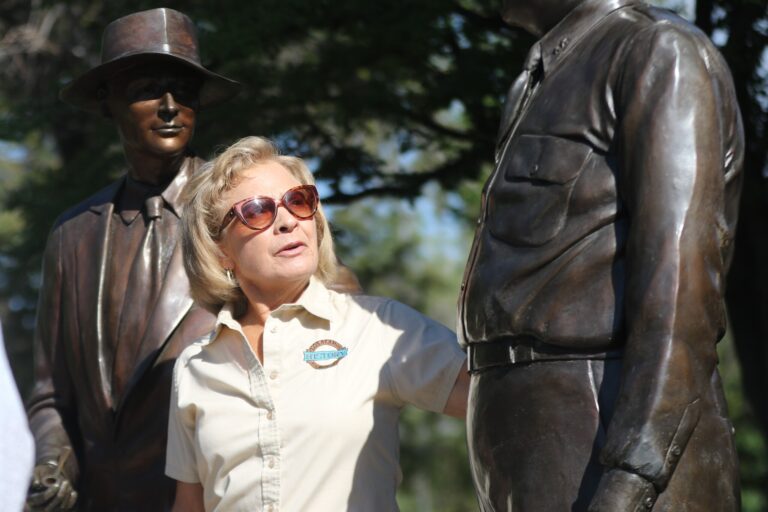
But it was inevitable, said John Charles, during a tour stop at a pair of statues at the entrance to the park, depicting Oppenheimer and U.S. Army Gen. Leslie Groves.
Groves previously led the Army Corps of Engineers in constructing the Pentagon, completed on Sept. 11, 1941.
A year later, he was tasked with overseeing the Manhattan Project and recruited Oppenheimer to assemble and lead the scientists who eventually discovered how to split the atoms necessary to unleash the power of atomic weapons.
To Charles, the work of Groves and Oppenheimer gave the U.S. the edge it needed to outpace World War II enemy Germany and eventual Cold War adversary Russia in developing their own atomic bombs and saved many lives by shortening World War II.
“If we had not dropped the atomic bomb, we would have lost a lot more lives than the atomic bomb took,” Charles said. “The Japanese would have fought to their last woman and child.”
Managing Editor Adrian Hedden can be reached at 575-628-5516, or @AdrianHedden on the social media platform X.