Home Blog Page 124

Mural preparations underway in Artesia

0

Photos by Mike Smith, Artesia Daily Press

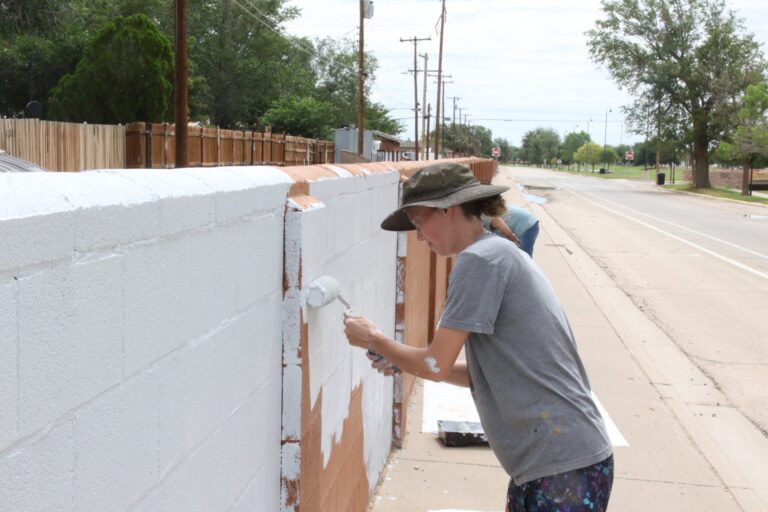
Artesia artist Kirsten Mauritsen and Artesia Clean and Beautiful director Linda Stevens painted and supervised high school students Thursday for a new mural near Eagle Draw.

Mauritsen said a wall was being primed for a community mural.

“(Mauritsen will) draw out an outline and paint by numbers,” she said.

“The public can come out and paint this mural.”

Mauritsen said the mural would highlight the people of Artesia and Eagle Draw.

She said Artesia Clean and Beautiful provided help and the City of Artesia granted permission for the wall along JJ Clark Drive.

Mauritsen said residents were invited to help paint the wall Friday and Saturday.

An Artesia student helps paint a mural near Eagle Draw on Thursday.

Eddy County under flood watch

0

The National Weather Service in Midland issued a flood watch through this evening for Eddy and Lea counties.

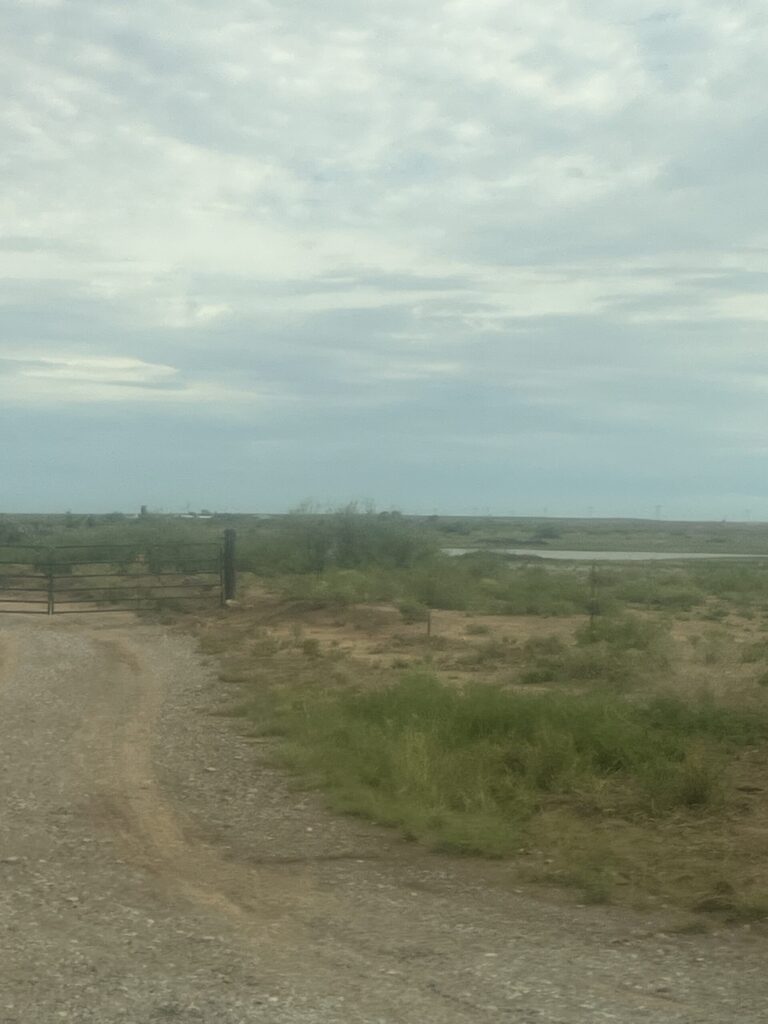
North of Artesia, Hagerman received over six inches of rain in the past three days said Michael Waide of the Hagerman Public Library.

He said the rain started falling around 5 p.m. Monday and Lake Tolliver east of Hagerman was full from showers and thunderstorms.

Seek 1st Sports holds flag football evaluations

0

JT Keith

Artesia Daily Press

jtkeith@elritomedia.com

Seek 1st Sports held its registration and evaluations on Monday and Tuesday, June 23-24, at Jaycee Park.

The league is run by Ty Houghtaling, the lead pastor of First Baptist Church, Artesia. Ben Cox, the church’s student pastor, serves as the league’s director.

The league started as part of Upward Sports, which partners with churches nationwide to sponsor kids in recreational sports leagues.

Seek 1st Sports transformed into its own version of the church and recreational sports program in 2013.

“This is our homegrown, homespun sports program,” Houghtaling said. “It is designed after Artesia’s desire for competition, equality, age-based learning and foundational fundamentals.”

Houghtaling said that Seek 1st Sports has become First Baptist’s ministry.

Its core verse is Matthew 6:33: “But seek ye first the kingdom of God, and his righteousness; and all these things shall be added unto you.”

“This is teaching these kids, first and foremost, about our relationship with God,” Cox said.

The league holds Bible studies every night at practice, and it shares the gospel message with the kids and anyone who would like to accept Jesus Christ as their Lord and Savior.

Houghtaling said the league will wait to see the number of kids that come out before assembling teams.

“We divide teams based on talent level,” Houghtaling said. “And we will wait and see who the coaches are. We try to make them as fair as possible.”

Every team will play six games throughout the season, from July 17 to the last game on August 1.

“We try not to overemphasize sports at this age. We want to stress fundamentals, but most importantly, we want them to seek first the kingdom of God.”

jtkeith can be reached at 575-420-0061, or on X@JTKEITH1.

NMAA executive director talks high school sports

0

JT Keith

Artesia Daily Press

jtkeith@elritomedia.com

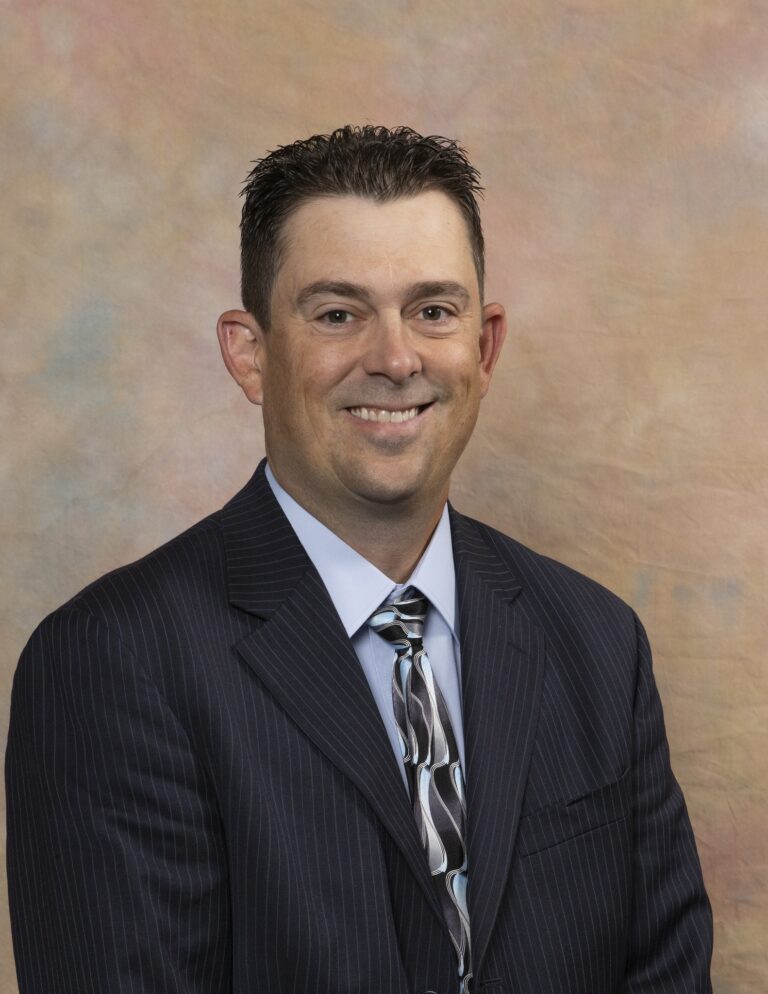
Dusty Young’s ascension to New Mexico Activities Association executive director was 18 years in the making.

Young was a former baseball player for the University of New Mexico and played for the then Florida (now Miami) Marlins organization for three years, but never advanced above Class A.

Young was offered a job by Mario Martinez, then an associate director at the New Mexico Activities Association (NMAA).

In March 2006, Young was hired as the NMAA’s operations manager and worked his way up the corporate ladder. On November 1, 2024, he took over for the retiring Sally Marquez, who had served as executive director since September 2012.

In response to questions from the Artesia Daily Press, Young talked about the changes the NMMA is considering for the upcoming calendar.

What is one of the biggest concerns regarding the NMAA in the upcoming athletic calendar?

We are going to place a heavy emphasis on sportsmanship. We have been hitting it hard since we came out of COVID.

We have been working hard in our office (NMAA) and in schools and districts across the state to change that culture.

Why the perceived harsh punishment for bad sportsmanship?

Adverse incident reports from around the state, especially with severe and egregious acts and conduct, led to significant bylaw changes with a potential 365-day ban for negative behavior or multigame suspensions.

But also the two-strike policies that we implemented; those are two significant policy changes we made at the state and NMAA levels. We are trying to work with our schools to promote and model sportsmanship.

Are there any changes to the transfer eligibility rules?

There is nothing specific to the transfer eligibility rule. We are currently working on conducting a full handbook review of the bylaws, which we have not done in about 15 years.

Have you considered putting in a shot clock for boys’ and girls’ basketball?

The shot clock has been a topic of discussion for several years now, ever since the National Federation of State High School Associations (NFSHSA) allowed states to adopt that.

We have not received a heavy push from our membership to make that change. I know there are a lot of coaches and athletic directors in favor of the concept of a shot clock.

Have you faced NIL yet, and what are your thoughts about it?

It is something that our membership is looking at. NIL is a hot topic nationwide.

Here at the high school level, our bylaws are straightforward. Students can earn money for Name, Image, and Likeness; it just can’t be associated with the school or the New Mexico Activities Association.

What does that mean?

We have amateur status. If a student earns money from a TikTok post because they are an influencer, it is up to them to benefit from their name, image and likeness.

We just can’t cross over into the high school sports space, so if they are trying to do something in their school uniform or at the NMAA state basketball championships–that is where the line is drawn.

If it is on their own, with their name, image and likeness, then that is OK.

Can you provide best practices regarding gender-related concerns involving participation in sports?

For several years, our policy has been that students must participate as the gender listed on their birth certificate.

What is the status of realignment?

That is always a constant with NMAA. That comes up every two years; we are in that year as we speak.

We will vote on the 2026-2028 classification and alignment structure in December.

That means that our staff is already working on it. I have been compiling numbers for our counts for this current school year. Those numbers are used to calculate the average enrollment and place schools in each classification.

We must wait until we get the 40-day count for the next school year before finalizing that three-year average.

Are there any new sports on the horizon?

Nothing new. We have 14 sports and 23 activities that the NMAA sanctions. We want to ensure that we can support our kids.

jtkeith can be reached at 575-420-0061 or X@JTKEITH1.

Village outlines flash flooding preparedness

0

Dave Tomlin for the Ruidoso News

Concerned that video clips of the recent street flooding here are scaring away tourists, village officials put together a media briefing Saturday to spread the word that Ruidoso is open for business and safe for visitors.

“The Midtown shopping area is open,” Mayor Lynn Crawford told two reporters from the Ruidoso News and a couple of big city TV reporters attending via Zoom. “The racetrack is open. The hiking trails are open. There’s just certain areas of the community that are very vulnerable.”

Heavy runoff from monsoon rain over the South Fork burn scar surged down Brady Canyon and across Mechem Drive on Thursday in what looked on a small screen like it could have been a repeat of last summer’s destructive county-wide flooding.

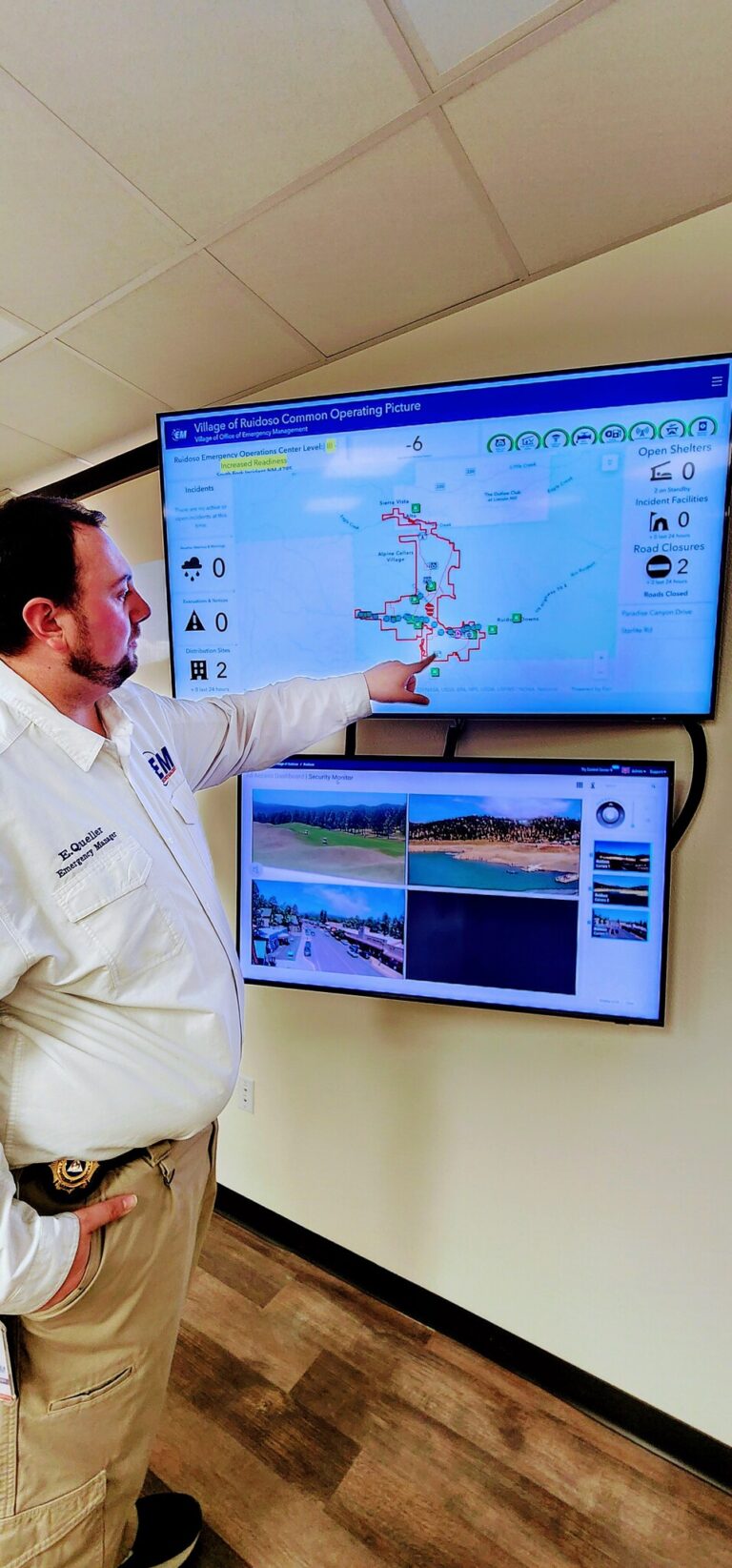
But the appearances were deceiving. Although the water exceeded the capacity of the culverts that carry normal drainage from the canyon under Mechem, traffic was stopped for less than an hour, according to the village’s Emergency Management director Eric Queller.

There was also heavy runoff with some bits of floating debris at the “Y” intersection of Sudderth Drive and Highway 70 at the east end of town, but it didn’t last long either and did no damage. No property damage, anyway.

“We are getting quite a few calls,” the mayor said, “and really it’s just from the footage that you’ve seen on social media of the recent flooding events and also the history that comes back up in people’s Facebook posts showing the devastation that we had over a year ago.”

The mayor said he was hearing that some events and reservations were being cancelled, and a few scheduled guests even wondered if the village would declare an emergency so they might be able to get their deposits back.

As he spoke, Crawford was flanked by Queller, Village Manager Ron Sena, Deputy Manager Michael Martinez, and Ruidoso Fire Chief Cade Hall. They stood behind a podium in a meeting room just a few steps away from the Village’s newly opened Emergency Operations Center.

The facility is where first responders to a future real emergency will be dispatched and coordinated.

Weather forecasts for the coming week include strong possibility of heavy rains. Crawford made it clear that a real emergency is always possible during the monsoon season but emphasized that the village is well equipped to deal with such events.

The remainder of the briefing was devoted to descriptions of the many ways in which visitors can make sure they hear quickly of any safety threats and take steps to steer clear of them.

“The number one way that you can receive alerts is through the callmeruidoso system,” Queller said. “We urge both the primary residents as well as our secondary residents and any of our tourists to sign up for that alert system.

“You can go to callmeruidoso.com to sign up for those alerts,” he said. “The other way is to download the Discover Ruidoso app.” The latter includes a map tool that shows where high water road closings may have occurred.

Sena added that emergency alerts will also be announced through public address speakers installed throughout the Midtown shopping areas, and also by several local radio stations.

“So what we want to assure folks is that we have a plan,” Crawford said, “that there’s no reason to panic, that we are in a very active situation, that we do have people at the positions of flooding and that we do want to be clear that there will be flooding but it will be temporary.

“The roads will be cleaned up and business will be back to usual,” the mayor said, “and when we say flooding it is in select areas of the community.

Dave Tomlin is a freeleance reporter for the Ruidoso News and can be reached at dave.tomlin74@gmail.com

Send us your good news

0

Effective immediately, the Daily Press will be publishing any announcement it considers to be “good news” for free. Examples of “good news” would be engagement announcements, wedding announcements, births, college graduations, business promotions and milestone birthdays.

The Daily Press has also committed to run free classified ad notices for items priced $250 or less.

“We realize that the former ownership made life difficult for our readers to submit good news and we want to change that now,” said Publisher Joshua Byers.

If you have a submission, and photos are welcome, please email them to goodnews@artesianews.com.

What chance did he have?

0

David Grousnick

In the early 1920’s Philo Farnsworth was working on a farm, plowing a straight line on a potato farm. His mind was far away, thinking about the possibility of transmitting moving pictures through the air.

He had no electronic or engineering background, nor was he a scientist. No one in the world of science would have considered him a serious contender in the chase to find the answer to photographic transmission without the aid of wires.

Scientists from all over the world had been struggling to solve this dilemma and although many had been aided by research grants, no one came up with the answer.

So, what chance did Farnsworth, a potato farmer with no education, have?

While plowing, he imagined a different approach. He imagined dividing a screen into long rows just like the field he was plowing, using electricity to create areas of light and darkness at each point along the row. Then stacking the rows on top of each other, he imagined that they could bring to focus a picture. Bingo!

The results were better than anything the world of science had ever conceived. It is the very system used today in a standard television.

What did Farnsworth invent? Television.

It was his vivid imagination coupled with a propensity toward science that has literally changed the world. But unfortunately, he was not credited with the idea since he was only 14 years old.

Two businessmen, George Everson and Les Gorrell took an interest in Farnsworth and invested their life savings in his research. Despite his age, they had faith in him and on September 7, 1927, Farnsworth transmitted history’s first electronic television picture.

Our world changed because Philo Farnsworth kept his hands on the plow and never looked back.

Keeping your hand to the plow is not a part of our usual vocabulary in our time. So, consider Luke 9:51-62.

In Luke 9:62, “Jesus said, ‘No one who puts their hand to the plow and looks back is fit for the kingdom of God.’”

A plowman, simply, was one who used or held the plow; husbandmen and plowmen are used synonymously in the Scriptures. The plowman was a farmer in general.

The scratch plow of biblical times, like a one-legged stool, required full attention to use.

It was lightly built, with the least possible skill or expense, and consisted of two poles, which crossed each other near the ground. The pole nearest an animal or two, was fastened to the yoke.

The other pole had a double purpose. One end was the handle, and the other as the plowshare that broke up the ground and it was pulled along, either by oxen, camels, cows, or heifers. The operator of this instrument is a plowman.

Plowing like this required the full attention by the plowman or the furrows would be crooked, not straight. Being a follower of Christ requires such attention and focus!

A guard in charge of a lighthouse along a dangerous coast was given enough oil for one month and told to keep the light burning every night.

One day a woman asked for oil so that her children could stay warm.

Then a farmer came. His son needed oil for a lamp so he could read.

Another needed some for an engine. The guard saw each as a worthy request and gave some oil to satisfy all. By the end of the month, the tank in the lighthouse was dry.

That night the beacon was dark, and three ships crashed on the rocks. More than one hundred lives were lost. The lighthouse attendant explained what he had done and why. But the prosecutor replied, “You were given only one task: to keep the light burning. Every other thing was secondary. You have no excuse.”

Temptation for Christ followers is a choice between good and evil. But perhaps more insidious than temptation is conflict where one must choose between two good options. The lighthouse keeper in our story found himself in such a conflict situation.

So also, are the would-be disciples in Luke 9:51-62.

Many years ago, a young man went to work at a hardware store. He found all sorts of junk that took up space but did not sell well. This clerk asked the owner to allow him to put it all on one table and sell each item for 10 cents. He did so and had a successful sale.

Later he did the same thing and had another successful sale. The clerk approached the owner and suggested that they open a store specializing in items that cost only a nickel or dime. The owner thought it was a bad idea and refused. The clerk went into business for himself and became very successful with his idea.

His name was F. W. Woolworth.

His old employer later said, ‘I have calculated that every word I used to turn young Woolworth down cost me a million dollars.’

Jesus wants his followers to consider what they are in for, but he does not want them to waste their lives over the matter without ever making up their minds. The all-consuming claim of Jesus is too important!

Matters of the Kingdom of God just will not wait. Obedience is necessary when Jesus calls.

Have a great weekend!

Arizona Policy Runs Circles Around New Mexico

0

Paul Gessing

Recently, a group of business and economic leaders traveled to Phoenix, AZ to get some ideas on why the Phoenix economy is so much stronger than New Mexico’s. Ideas were exchanged and I’m sure a good time was had by all.

But, the trip was a waste of time. You don’t need to travel to see why Phoenix is more economically prosperous than Albuquerque or why Arizona does better than New Mexico. Like most New Mexicans I have indeed been to Phoenix (and other parts of Arizona) many times and seen how the State has grown.

Here are a few of many ways in which Arizona public policies and outcomes make Arizona a fast-growing, successful state that leaves New Mexico in the dust:

Arizona’s top personal income tax rate is 2.5% while New Mexico’s is 5.9%. Allowing people to keep more money means attracting more people. With our oil and gas largesse and $61 billion sovereign wealth fund New Mexico could easily reduce or eliminate our income tax, but that’s not how our politicians think.

Arizona is a “right to work” state. New Mexico remains “forced unionism” for private sector workers. Forcing workers to pay political organizations for the privilege of working is just wrong.

While it DOES have a high sales tax rate 8.38%, Arizona does NOT have a small-business-killing gross receipts tax like New Mexico. Our GRT rates vary, but are not much lower than Arizona’s sales tax.

Arizona has NO state-level prevailing wage law on public construction projects (New Mexico does). This means that roads, bridges, and schools in Arizona are built at market wage rates, not artificially inflated rates.

Arizona’s labor force participation rate is significantly higher than New Mexico’s meaning fewer people on welfare programs and more people paying taxes. New Mexico’s Medicaid population is also the highest in the nation which sucks money from taxpayers and government programs while disincentivizing work.

Business friendly Arizona has 10 companies listed on the Fortune 500 index including Freeport-McMoRan and Carvana (to name two). New Mexico has just thee publicly traded companies headquartered in the State. Our largest such company, PNM, is in talks to be sold.

Arizona’s crime (while high when compared to national levels) is nowhere near as high as New Mexico’s.

Arizona’s K-12 system has a variety of school choice options and outperforms New Mexico’s (which is dead last nationally). Arizona students outperform New Mexico’s while spending 45% less money per student.

A good school system is more than just a nice amenity. Preparing young people for 21st century jobs makes Arizona more attractive to businesses and can keep young people involved in productive behavior rather than crime and drugs.

To top it all off, according to the leading tracker of such information which is called “State Higher Education Finance,” Arizona spends approximately 1/3rd what New Mexico spends (per student) on higher education ($6,571 vs. $18,754). Is there anything that New Mexico policymakers can point to that we are getting for all of that additional money we’re spending?

Of course, many of New Mexico’s big spending projects are funded thanks to the oil and gas industry which dominates our state budget. Arizona has little oil and gas to speak of, but thanks to superior public policies across numerous areas of the economy it is faster-growing economically and in terms of population.

Rather than traveling to Phoenix, our community leaders and more importantly the Gov. and Legislature need to spend some time researching the numerous public policy advantages Arizona holds over New Mexico and embrace them.

Paul Gessing is president of New Mexico’s Rio Grande Foundation. The Rio Grande Foundation is an independent, nonpartisan, tax-exempt research and educational organization dedicated to promoting prosperity for New Mexico based on principles of limited government, economic freedom and individual responsibility

Artesia girls’ basketball to host camp

0

JT Keith

Artesia Daily Press

jtkeith@elrtiomedia.com

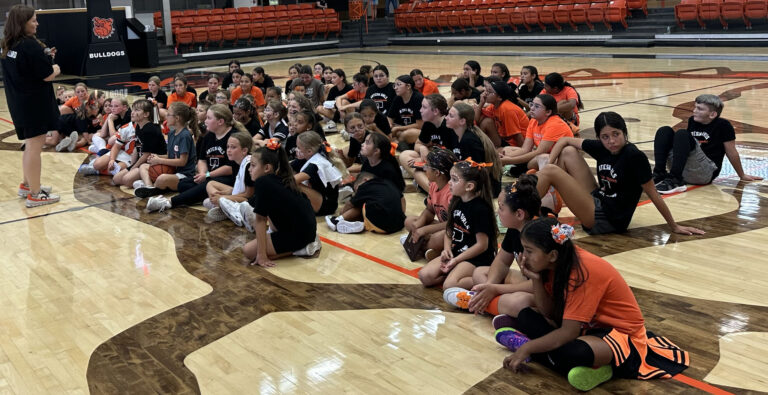
Artesia girls’ basketball coach Candace Pollard will host her second basketball camp for girls from Wednesday to Friday, June 25-27.

The camp will have two sessions, with the kindergarten through fifth graders participating from 10 a.m. to noon and the sixth through ninth graders from 1-4 p.m.

“We are looking forward to camp,” Pollard said. “I want to have as many one-on-ones with kids at the camp as possible. It is going to be a good time.”

Pollard made the playoffs in her first year as head coach, going 10-17 overall before losing to the eventual 2025 Nusenda Credit Union Girls Basketball State Class 4 champion Gallup.

“June is our basketball month,” Pollard said. “We’ve been going every morning, Monday through Thursday, from 8 a.m. to noon. We have little girls come in, and we are doing fundamental work, just getting the ball in the kids’ hands.”

Team camps in June

The Artesia girls’ basketball team has played in other team camps in June. On weekends, they have traveled to Lubbock Christian, San Angelo, Las Cruces and Oklahoma team amps.

The first one the Lady ’Dogs played in was the Lubbock Christian Team Camp. Pollard said the camp was great for her team because many girls had not played basketball since March.

“That camp was great for our girls,” Pollard said. “They go off and play spring sports. This camp is a good jump-start for us.”

Las Cruces Team Camp

The Lady ’Dogs went to a team camp in Las Cruces on June 6-8 and played against teams such as Organ Mountains, Alamogordo, Tularosa and Mayfield.

Pollard said she was happy with the competition and how the Lady ’Dogs played.

San Angelo Team Camp

Artesia also played at the San Angelo Team Camp at Angelo State University in Texas. The Lady ’Dogs played Texas teams such as Brownwood and Randall.

Pollard said her team went into overtime in some of the games they played, also making it to the bracket play-in games.

“That was huge for us,” Pollard said. “Texas basketball is different than New Mexico basketball. It is a little bit faster and a little bit more up-tempo. It was good for our girls to get out there and compete.”

Pollard said that she and the assistant coaches are seeing a shift in the little things–that the players are picking up on the changes the coaches have implemented.

Oklahoma Team Camp

For its last camp, the team attended the Oklahoma Team Camp on June 20-21. She compared the caliber of basketball in Oklahoma to that of Texas.

“June is not just basketball month for Artesia,” Pollard said. “Everybody (teams) is out there trying to get better. If you are here, you are fundamentally getting better, creating those memories and building relationships with the teammates you will play with this season.”

jtkeith can be reached at 575-420-0061, or on X@JTKEITH1.

The great land rush of 2025

0


Sherry Robinson

All She Wrote

We now know which public lands in New Mexico that Congressional Republicans might sell, and it’s quite a list — 61 properties in 20 counties. Authors of the budget reconciliation bill have been secretive, but Sen. Martin Heinrich recently extracted some specifics.

Heinrich, a Democrat who is the ranking member of the Senate Energy and Natural Resources Committee, released the list on June 18, saying the bill mandates the unprecedented sale of two to three million acres.

We’ve been having this public lands debate for years. Sometimes discussion swings to the left, sometimes to the right, but it’s never resolved.

In 2012 Utah’s governor demanded that 20 million acres of federal land be transferred to his state. A few other western states (but not New Mexico) looked into it. The argument was that states could better manage these lands than federal agencies.

The reality? States have nowhere near the personnel and funding to take this on and would have to sell or lease some land to finance management of what remained. In 2014 Heinrich, then the state’s junior senator, predicted that states would sell the best, most desirable lands and “taxpayers would be saddled with the costs of overseeing the rest.” And the public would find more locked gates and the end of access to prized hunting, fishing and hiking areas.

Others observed that state ownership could backfire, as states raised fees for grazing and recreation and jacked up royalties for mining and energy development.

However, Paul Gessing, of the conservative Rio Grande Foundation, countered that in the previous two years the federal government, with only a signature by President Obama, had placed more than 783,000 acres of New Mexico land in two monuments – the Rio Grande del Norte and Organ Mountain.

President Trump during his first term tried to shrink some national monuments, including those two, provoking an outcry in Las Cruces and northern New Mexico.

“After many protests and photos of Interior Secretary Ryan Zinke on horseback, what happened is: Not much,” I wrote in 2017. “The blowback was hotter than Zinke and the administration anticipated; public comments, overwhelmingly in support, topped 2.3 million.”

In 2022, during the Hermit’s Peak-Calf Canyon fire, the right-wing ALEC (American Legislative Exchange Council) renewed the push for state ownership, arguing in the Albuquerque Journal that federal land managers had been poor stewards, and millions of acres were at high risk for wildfire. A northern New Mexico landowner wrote in response that the Virginia-based group should butt out of New Mexico land policy.

The poor-stewardship argument is an old one. A representative of Trout Unlimited has argued that the same people demanding state ownership have for years cut funding to land agencies, making it impossible for them to do necessary preventive maintenance.

In 2022, the governor joined a Biden administration initiative to conserve 30% of lands and waters by 2030. But 15 counties hollered “land grab” and passed resolutions in opposition. Never fear. The so-called 30×30 initiative morphed into a committee embedded in state bureaucracy and likely won’t be heard from again.

Now we’re looking at the sale of public lands.

In the House, our own Rep. Gabe Vasquez joined with former Interior Secretary and now Republican Rep. Ryan Zinke of Montana to found the Bipartisan Public Lands Caucus. They removed language from the bill that would have placed a half million acres on the block.

The Senate version, however, would unload up to 3.3 million acres of public lands; an amendment adds a whopping 258 million acres in the next five years, according to outdoor journalist Wes Siler. And the process sounds something like the Oklahoma land rush of 1889 with no hearings, no debate, no public input.

In New Mexico, about 6.5 million acres of U.S. Forest Service land and 7.8 million acres of BLM land could be eligible for sale. This doesn’t include national parks, monuments, historic sites, wildlife refuges or fish hatcheries, according to Source New Mexico.

How about grazing land? Nobody knows, and the bill’s authors aren’t saying.

If this bill is so good for us, why can’t its sponsors roll it out of the garage and let us kick the tires? What we don’t know is as scary as what we do know. It amounts to a big experiment.

So I have a modest proposal. Utah wants to sell federal land within its borders. Why not let them? They can be a pilot project for federal land sales, and we can see how it works out.

Sherry Robinson is a longtime New Mexico reporter and editor. She has worked in Grants, Gallup, the Albuquerque Journal, New Mexico Business Weekly and Albuquerque Tribune. She is the author of four books. Her columns won first place in 2024 from New Mexico Press Women.