Adrian Hedden
Carlsbad Current-Argus
achedden@currentargus.com
A U.S. Supreme Court decision could pave the way for a private company to store spent nuclear fuel rods from power plants across the country in the Permian Basin.
In a 6-3 decision on Wednesday, June 18, the Supreme Court ruled against the State of Texas and oil company Fasken Oil and Ranch, which sought to block a license issued by the Nuclear Regulatory Commission to Interim Storage Partners – a nuclear technology company that sought to build and operate the facility in Andrews, Texas.
The Nuclear Regulatory Commission granted the Texas site a license in 2021 along with another in 2023 for Holtec International to build a similar facility near the Eddy-Lea county line in New Mexico.
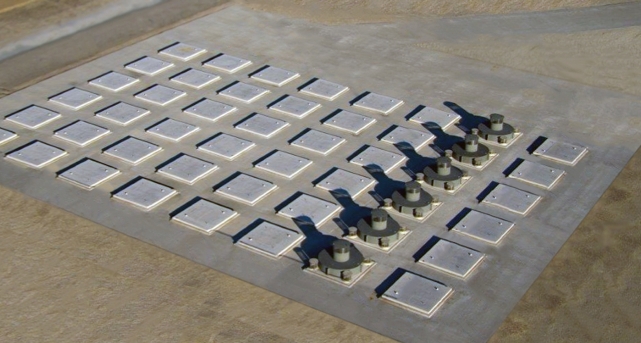
Under 40-year licenses, which could be renewed, both facilities would gather spent nuclear fuel rods via rail from power plants throughout the U.S. and store them in 40-foot casks on the surface. In total, Holtec’s site could store more than 100,000 metric tons of the material, while the Interim Storage Partners facility would contain about 40,000 metric tons.
The state of Texas and Fasken filed an appeal challenging the Interim Storage license and the state of New Mexico appealed the Holtec license. The licenses were vacated in separate decisions in 2023 by the U.S. Fifth Circuit Court of Appeals.
The court said the licenses were invalid under a provision of the federal Atomic Energy Act that specifies spent nuclear fuel can only be moved to a permanent, deep geological repository owned by the federal government.
In vacating the licenses, the appeals court contended the Nuclear Regulatory Commission lacked the authority to approve offsite spent fuel storage by private companies.
Those rulings were appealed last year to the U.S. Supreme Court in separate fillings by the Nuclear Regulatory Commission and the companies. The appeals were consolidated, meaning any ruling on the Texas case would also apply to the New Mexico proposal. The U.S. Supreme Court’s June 18 ruling overturned the appellate court’s 2023 decisions vacating the licenses.
Supreme Court sidesteps authority question
Justices Brett Kavanaugh, John Roberts, Sonia Sotomayor, Elena Kagan, Amy Coney Barrett and Ketanji Brown Jackson concurred in the court’s written decision that Fasken Oil and Ranch and the state of Texas lacked grounds to challenge the licenses as they were not legal parties to the initial process.
The court’s written decision expressly did not give an opinion on the commission’s authority to issue the licenses under federal law.
“We disagree with each of Texas’s and Fasken’s arguments. They were not parties to the Commission’s licensing proceeding and therefore cannot obtain judicial review of the Commission’s licensing decision,” read the opinion.
Justices Neil Gorsuch, Clarence Thomas and Samuel Alito dissented. In the dissenting opinion given by Gorsuch, the justices argued the Nuclear Regulatory Commission illegally granted the license in the first place, contending that federal law only allows storage of nuclear waste – such as the fuel rods – at the reactor site or federally-owned facility.
The dissenting justices also argued that Texas and Fasken were present and participated during the public comment period and hearings throughout the licensing process, asserting that the court’s opinion was based on a legal technicality rather than federal law and the safety of the American people.
“Radioactive waste poses risks to the State, its citizens, its lands, air, and waters, and it poses dangers as well to a neighbor and its employees,” read the dissenting opinion. “Maybe the agency’s internal rules governing who can participate in its hearing are highly restrictive. Maybe those rules are themselves unlawful.”
Risk or reward?
Jack Volpato, who chairs the Carlsbad Mayor’s Nuclear Task Force, said the decision could mean an economic boon for the local economy.
The plan to store spent nuclear fuel was supported by local leaders in Carlsbad, Hobbs, and Eddy and Lea counties. The entities formed a consortium known as the Eddy-Lea Energy Alliance which provided the land and recruited Holtec to build the facility.
At the helm of the task force, Volpato worked to continue supporting the Holtec project, along with operations at the nearby Waste Isolation Pilot Plant – a repository for nuclear waste produced at federal facilities around the country. The facility is about 30 miles east of Carlsbad.
Volpato said Holtec could join WIPP in providing a stable, continual nuclear industry in southeast New Mexico, insulating the region from dramatic market shifts in the oil and gas industry – the region’s main economic driver.
“These are high-paying, stable jobs and they diversify our economy,” Volpato said of the region’s growing nuclear sector. “If one of the extractive industries goes down, this can prop us up.”
He also said that if the Holtec project comes to fruition, it could attract future development in spent nuclear fuel processing, research and manufacturing.
“It really puts us first in line (for reprocessing), if we have spent nuclear fuel right here,” Volpato said. “There’s a lot of good things that could come from interim storage. It also puts pressure on the (Department of Energy) to find a permanent repository.”
But New Mexico’s environmental community charged that the economic benefit for one part of the state was not worth the risk nuclear storage posed to all of New Mexico.
For this reason, the project was also opposed by New Mexico Gov. Michelle Lujan Grisham, and a bill was passed by the state’s Legislature in 2023 to block any permits from being issued by New Mexico agencies that would allow such a site to operate.
In reaction to the Supreme Court ruling, national group Beyond Nuclear – which represented the Sierra Club’s chapters in New Mexico and Texas in filing comments to oppose the project – said it planned to pursue a new challenge to the licenses.
Beyond Nuclear attorney Diane Curran said future litigation would reveal the storage facilities were illegal under federal law.
“We look forward to resuming our litigation in the D.C. Circuit, where we will demonstrate that the law unequivocally prohibits Holtec’s private storage of federally owned spent fuel,” she said.
Managing Editor Adrian Hedden can be reached at 575-628-5516, or @AdrianHedden on the social media platform X.