Home Blog Page 129

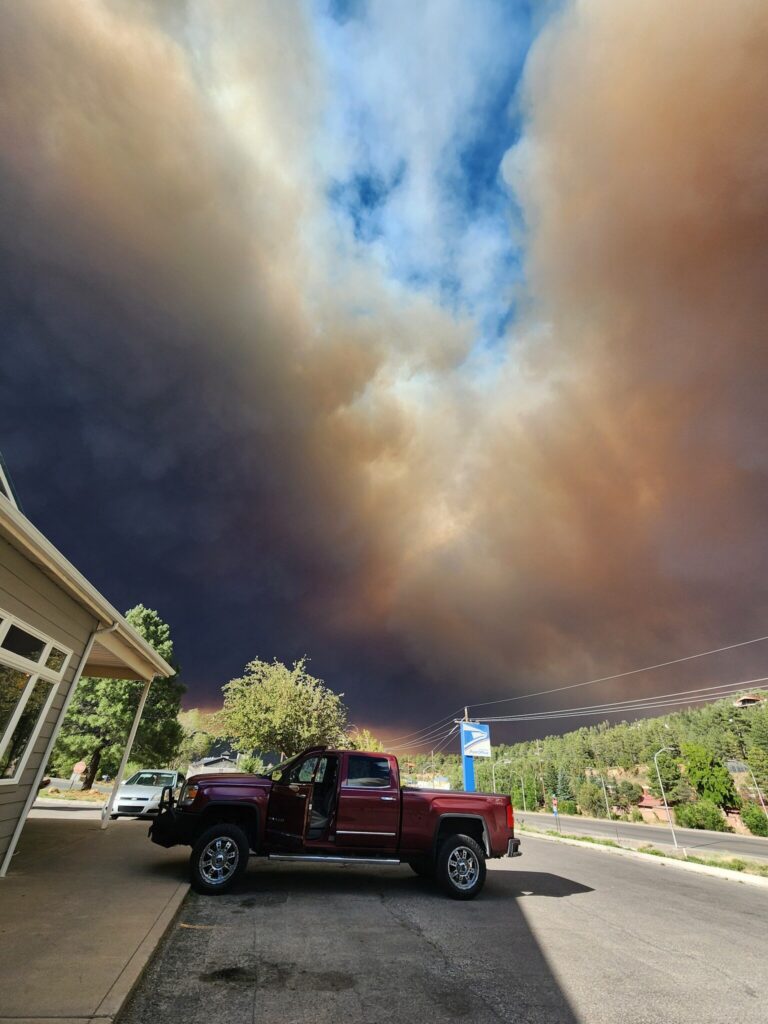
Ruidoso rises from the ashes

0

By Dave Tomlin
For the Ruidoso News

Strength, courage, resilience and generosity emerged in wake of fire one year ago

Everybody who was here a year ago has a story about what they did when they realized the South Fork Fire was out of control and coming our way. Here’s mine.

It was late morning on Monday, June 17, and I was in the front yard of my cabin in Ponderosa Heights, looking west across Brady Canyon to the ridges behind it, where a thick plume of gray smoke was rising.

Helicopters were dropping red fire retardant, but the plume kept getting bigger. The wind was blowing strong, straight into my face. It smelled like burning trees.

I pulled my phone from my pocket and texted my wife at work that I was going to hitch our camper to my Tacoma.

“Come home now,” I wrote. “We need to get out of here.”

Less than half an hour later, around noon, as we were scrambling into the truck with our daughter, go-bags and dogs, I suddenly remembered we had new neighbors a few doors away who might not realize what was happening.

I told my daughter to run to their door and tell them the fire was getting too close and we were leaving. Sure enough, they had no idea of the danger.

They thanked her, packed up and hit the road not long after we did. We went south to Alamogordo on Highway 70 before smoke from the Salt Fire closed the road. Our neighbors drove just a few miles north and checked into the Swiss Chalet Inn.

Their stay was a short one.

Tragedy strikes

From its point of origin in the Upper Canyon a couple of miles inside Mescalero tribal land, the titanic wall of flame and smoke swept northeast through the northern edge of Ponderosa Heights, destroying two dozen homes just a few hundred yards from my cabin.

Then it wiped the Cedar Creek and Alpine Village subdivisions off the map before jumping Highway 48 onto upper Gavilan Canyon Road and lapping at the edges of Alto.

The Swiss Chalet Inn, built in 1962, stood directly in the fire’s broad path as it leaped the highway. The motel was reduced to cinders and rubble. Only its sky blue roadside pylon sign was spared and still marks the empty site.

Rescue workers found the body of Patrick Pearson lying not far away. Pearson, 60, a popular Ruidoso country musician, father of three and grandfather of seven who often played guitar at Quarters in Midtown, was living at the Chalet. He was recovering from surgery on a broken leg. As the news spread, social media blew up with heartfelt tributes, photos and grief.

My neighbors realized when they saw the outpouring of sorrow online that they had spoken with Pearson outside the Chalet as they made their second hasty evacuation of the day. He told them somebody was coming for him. The fire was moving so fast, it seems tragically possible that if Pearson’s ride was arriving from the north, it couldn’t reach him after Highway 48 was closed.

Pearson’s was one of two known deaths in the fire. The other victim was discovered across the highway and down a steep hill from the Chalet inside a vehicle parked on Ranier Road, burned beyond recognition. To this day, authorities haven’t said who it was or even if they ever found this out themselves.

Most of the 8,000 permanent residents of Ruidoso, along with however many visitors were here, swarmed east toward Roswell, 75 miles away on the only highway left open out of town. At the same time, an influx of responders was just beginning.

“Fourteen states responded and multiple state and federal agencies,” said Kerry Gladden, who handles public relations for the Village of Ruidoso. “At the height of the disaster, there were 2,000-plus responders on-scene, including firefighters, swift water rescue teams, National Guard, and local, state and federal resources.”

The danger and destruction lasted for weeks. As the fires were contained, the National Weather Service counted more than 40 flash floods from monsoon rains that hit the burn scars and turned our lazy cross-county streams into raging cataracts.

In the 12 months since, inbound and outbound migrations of large mobile workforces have defined each stage of the rescue, recovery and cleanup, and then the rebuilding processes that are ongoing and will be with us for years to come.

In countless ways, it has been and continues to be a remarkable comeback. Yet if a comeback is a return to where you were before tragedy struck, what is underway here is really something else entirely.

The version of Ruidoso slowly taking shape before our eyes — Mayor Lynn Crawford calls it Ruidoso 2.0 — is a place that will look, feel and behave differently after what it’s been through, and yet will still somehow be the Ruidoso that we and our visitors have always loved.

“We want a place that people, their kids that are born here, raised here, can get educated here through ENMU,” Crawford said. “The look and feel is clean and energetic and homey.

“How do you throw all that in there,” he asked as he struggled to describe his own vision of the Ruidoso to come. “Family businesses, eclectic shops, artisans, breweries and things that are fun in life but that are built for the long term. And a strong economy, diversified.”

Comeback in the works

“Diversified” is a freighted word among those who monitor the business vitality of Lincoln County and the neighboring Mescalero tribal homeland.

It’s shorthand for a regional economy that doesn’t depend almost entirely on visitor traffic generated by the Ruidoso Downs racetrack in the summer and Ski Apache in the winter.

It’s not a new idea. Ten years ago, Jim Miller helped organize and lead a series of high-level study and focus group meetings on economic development at the Inn of the Mountain Gods. Miller was the founding president of ENMU-Ruidoso and later became a business and management consultant.

The “Stronger Economies Together” conferences produced a thick report and a list of recommended “Strategies for Building New Economic Opportunities.”

Among them was the creation of more opportunities for outdoor recreation and exploration of cultural and historic sites. It proposed more systematic marketing to state and national groups that love the outdoors and might bring their members here to hike, bike, compete and play, then to eat, drink, shop and spend the night.

The report also urged “expansion or recruitment of 20 new non-tourism corporations or light industries to the region.”

In 2015 when the meetings ended, Miller took his three-ring binder of talking points and infographics home, put it on a shelf and watched it gather dust. But lately, it’s been coming to life all around him.

Miller sees the current expansion of the Region 9 Education Cooperative and the likely revival of commercial logging in Mescalero to process lumber from forest thinning projects as examples of the non-tourism business expansion the area needs.

The fires and floods have been a wake-up call. The racetrack had to move its 2024 season to Albuquerque. Then a paltry winter snowfall crushed all hope of a busy ski season that might have made up at least some of the lost summer millions in tourism earnings.

Participants in Miller’s 2015 breakout sessions thought they were looking for a way to better fill the quiet “shoulder seasons” between racing and skiing. But after a taste of two “peak” seasons not much richer than “off-peak,” there’s a real sense of urgency around the “Ruidoso 2.0” brainstorming that has resumed in earnest.

The village has hired a full-time staffer to go after off-road racing competitions, disc golf tournaments and other such events.

Miller isn’t the kind of guy to say, “I told you so.” But he might murmur a quiet “better late than never.” With a caveat: To keep visitor traffic strong, “the appearance of recovery is as important as recovery itself,” he says.

Road to recovery

It’s safe to assume that visitors who know what happened here last summer are willing to make allowances for absent landmarks, street closures, convoys of silt-laden dump trucks, heavy earth moving equipment on flatbed haulers, flood mitigation barriers and piles of woody waste from tree thinning.

And of course, there’s the dead-zone slash of scorched earth and naked tree trunks that now mars Ruidoso’s trademark view of Sierra Blanca, rising from what used to be unblemished forest green expanses of ponderosa pine.

For anyone whose most recent view of Ruidoso was before last June 17, these industrial-scale signs of a disaster’s aftermath are bound to be startling. But if “the appearance of recovery” is important, this really is what recovery looks like. It is not pretty, nor is it cheap.

Mayor Crawford estimates that damage to Village infrastructure alone — roads, bridges, culverts, water and sewage systems — will eventually cost at least $500 million to put to rights, and the work is less than 15% done so far. It may go on for five more years.

Most of the money is expected to come from FEMA, the Federal Emergency Management Agency, but it doesn’t come fast or easy.

Crawford explained that you have to go around with FEMA staff looking at whatever is broken. You have to figure out what it will take to fix it. You have to commission engineering studies to plan the solutions. You have to find state money or a grant to pay for the studies. When the studies are done, you have to get FEMA to agree in writing to reimburse the cost of doing the work.

Then and only then can you sign the work orders to do the projects, but only if you have gotten your hands on state or other grant or loan funds to pay the contractors. FEMA will only pay you or your lender back for work that has already been done and paid for, and only if it has approved the work in advance.

Oh, and you have to locate the contractors. Crawford said good ones are hard to find these days.

Crawford said some municipalities that signed post-disaster work orders too soon have found themselves on the hook for work after FEMA failed to reimburse them.

“We’ve run across communities all over this country that they’re still trying to pay off that debt,” he said. “It’s almost bankrupted some communities.”

Another cause for worry has emerged this year about dependence on FEMA. There has been open hostility in the new administration to federal involvement in disaster relief, along with threats to the agency’s very existence.

“It is a concern,” said Lincoln County Commission Chair Mark Fischer. But he said President Donald Trump visited disaster scenes in North Carolina and California even before the election. Fischer said he’s “cautiously optimistic” that federal support for relief work and the many grants in the pipeline will remain solid.

“I like to think it’s not just politically motivated,” Fischer said.

Crawford seemed less sure.

“At the end of the day, disaster response shouldn’t be partisan,” he said. “The fires and floodwaters didn’t check voter registrations before destroying homes and businesses in our community.”

‘Astonishing’ outpouring of aid

The loss of homes has been devastating on many levels. Fischer puts the total at approximately 1,350, perhaps 900 of those from the fire and the rest from floods. Kerry Gladden confirmed that 15 of the burned or flooded houses belonged to Village employees.

Some lost their homes while fighting to save the homes of others. Four were firefighters, including the chief, Joe Kasuboski. The Village police chief, L.T. Chavez, also lost his home. Both have since retired.

At the Ruidoso Municipal School District, 20 teachers and staff members were burned or flooded out of their homes.

Hundreds of evacuees returned to find themselves homeless and required immediate help with food and shelter while they figured out how to reorganize and relocate their lives.

More than any other family, Riker and Cindi Davis found themselves totally immersed in the chaos created by the mountain of urgent needs. Riker is chair of the Community Foundation of Lincoln County. Cindi is chair of the foundation’s Shelter Fund Committee.

Together, they led a fundraising campaign that collected more than $3.5 million and quickly distributed all of it in the form of instant cash grants to pay for immediate aid to well over 1,000 families who had been suddenly left with nothing.

“Money came in from all over the country,” Riker said. “We just need to harness that energy going forward.”

“It was truly astonishing the love that poured in,” said Cindi Davis. “I don’t see us raising that kind of money again, though we’ll probably need it.”

Most of the recipients were unaware that the Davis family had troubles of its own after the fires were out. Riker and Cindi’s main house survived, but they lost other structures, and their children were not so lucky. One lost a home in Cedar Creek. The home of another burned on upper Gavilan Canyon Road.

“We’ve got four insurance claims going among the four of us,” Cindi said.

For homeowners who chose to stay here and rebuild, insurance claims have been only one of the dozens of frustrations they’re facing, including but not limited to clearing away debris, obtaining new insurance and applying for building permits.

Nowhere have these tasks seemed more numerous or difficult than along the banks of the Rio Ruidoso. Post-fire flash floods have permanently changed and expanded the shape of the floodway and surrounding floodplain, forcing changes in building codes and insurance eligibility and leaving owners uncertain whether they can — or should — rebuild.

The confusion is even greater in the formerly shaded and coveted but now flood-ravaged enclave of Fern Trail near Midtown, where some officials would like to see damaged cabins and houses permanently removed and replaced with a public greenway and river walk.

A voluntary property buyout program has been discussed but seems to have stalled over some property owners’ reluctance to trust assessments of the “fair market value” they might be offered.

Another stumbling block is that federal funds would pay for only 75% of the cost of the buyout, and local government sponsors of the program must come up with the rest of the money.

“There’s a lot of interest,” said County Commissioner Fischer. “A lot of private property owners are still wanting to do that. The problem the county has is getting the 25% match.”

Yet even with all the complications, new homes are starting to pop up in burned-out neighborhoods. Three or four are taking shape in Ponderosa Heights. Two of them are even painted. Cindi Davis said one of her neighbors in Cedar Creek had broken ground by last September.

“I was so excited,” she said. “It was like, ‘OK, we’re coming back, don’t mess with us.’ You know, after the fire you wondered how many residents would move away. To see the determination, it’s fabulous.”

Even in Alpine Village, formerly a wooded dreamland of rolling hills and upscale homes but now a scorched and deserted moonscape, there are signs it won’t be that way forever or even for very long.

Tom Austin, a local real estate broker who knows property and knows the community, swallowed his misgivings and bought 4 acres where the previous owner’s house had burned down.

“I bought and planted 20 aspen trees,” he said. “Now I’m fighting off the elk and fighting off the horses. I love the spot. I love the area. I wouldn’t mind living there for the rest of my life. We don’t really know what the future’s going to hold. Everybody’s scared up there. We’re just hoping this all works out.”

Restoration and mitigation

Anybody living within the vast tracts of Lincoln County who has been burned or flooded at least once in the past century and says they aren’t scared isn’t paying attention.

The Bad Hoss Map Co. published a large-format topographical map last year titled “A Geographic History of Wildland Fires” in Ruidoso from 1911 through 2024. It lists 15 events and displays the overlaid scars in pastel colors. It’s pretty, from a distance.

“Burn scar” is a harsh phrase, but it doesn’t do justice to the reality. A scar marks the healed location of past trauma. But the charred regions left behind by the South Fork and Salt fires are open wounds. They still hurt. They still threaten the healthy zones around them. They still need care.

The good news is that they’re getting quite a lot of it. You can see some if you stand next to the Swiss Chalet sign north of town and turn in a slow circle. The hills are cleared of all debris except for long tree trunks laid horizontally on the slopes.

“We know that we’re going to have more flooding over the burn scars,” said Commissioner Fischer. “To try to reduce the rate and amount of flow of water, you’ve got to do those things. So reseeding, mulching and then taking out most of the material that was partially burned was important.

“And then establishing these horizontal runs of a few logs that you see to try to reduce that water flow perhaps reduces the impact of flooding and sediment.”

The federal Natural Resources Conservation Service does this kind of restorative work. Fischer doesn’t know what the agency work cost north of town, but he said the county has earmarked $50 million in federal aid for such defensive measures. Forest thinning projects and flood mitigation are underway in Mescalero as well.

Mitigation work is also visible along the Rio Ruidoso, especially near the intersection of Mechem and Sudderth where converging torrents smashed the Adobe Plaza beyond repair and drove giant boulders and debris into Fern Trail. Concrete Jersey barriers are lined up next to the scraped and flattened site to keep future floodwaters in their channel, now deepened by extensive silt removal.

Downstream near the racetrack and on tribal land to the south, huge catch basins are being laid out to keep water from overwhelming the clusters of mobile homes and the track itself, which were inundated last summer.

So we and our property are safer and getting more so as work proceeds. Has enough been done so far to get us through the summer just ahead?

I asked Rick Baugh, general manager of Ruidoso Downs, who has as much on the line as anyone and more than most as the monsoon season begins. He raised his hands and then his eyebrows. His mouth opened, but no words came out.

Ruidoso’s resilience

Memorial Day weekend brought two significant wildfires to Lincoln County, one of them at historic Ft. Stanton and the other in Flume Canyon. From my yard in Ponderosa Heights, the Flume plume looked too much like South Fork’s did a year ago. But RFD crews and air drops snuffed it out quickly.

In spite of the harms and fears of the past year, our communities have a lot to be thankful for and much to celebrate during this anniversary week.

Considering the scale and speed of the disasters, the loss of life could have been enormous. Good preparedness and decisive action prevented that. Eric Queller, village emergency management director, won a state award for his work before, during and after the days of crisis.

There was no local announcement. I stumbled across Queller’s honor by accident when I went online to find out how to spell his name for an article last year. Queller didn’t like talking about it; in his zero-tolerance view of emergency response, even one death would have been one too many. On the plus side, no firefighters or water rescue specialists were seriously hurt here.

Civic and government leaders could have taken bows for other achievements if the moment had ever made it seem appropriate. The water system stumbled but never fell. Zia crews kept natural gas lines from adding fuel to the fires. Commissioner Fischer improvised a recovery task force whose weekly meetings helped local, state and federal authorities coordinate efforts across interlocking jurisdictions.

The expected economic collapse of the regional economy never quite happened. Crawford said gross receipts tax, the most visible metric of business activity, staggered but then recovered.

Doomsday predictions of failures of Midtown retail and hospitality businesses didn’t materialize either. “There were some closures,” said Riker Davis, “but not to the numbers we thought might be impacted.”

Some business owners did leave, but new entrepreneurs arrived to replace them and serve visitor crowds that seem back to predisaster levels.

Much of this good news was driven by the hundreds of laborers who moved in, some with families in tow, for long-term recovery and repair work all over the county. Ongoing large-scale commercial projects like the Kinetic broadband network and the wind farms up north around Corona also helped.

The population of Lincoln County has been slowly declining for most of the past decade. The Ruidoso Municipal School District feared the fires and floods would lead to steeper losses and a sharp drop in school enrollment. That would have had a serious budget impact, since the state funding formula is based on classroom head counts. But it didn’t happen. Enrollment stayed flat.

Most gratifying of all, though, were the strength, courage, resilience and generosity that emerged from within and around the community in its hour of need. Tattoo artist Logan Fleharty became the poster boy for “Ruidoso Strong.” He grew internet famous for feeding evacuees’ pets and checking on property. My family learned from one of his video posts that our cabin was still standing.

There were cash donations to aid funds in astonishing amounts. There was volunteer help in abundance from church and nonprofit teams from near and far who passed out food, water and clothing, helped those in need with paperwork of all kinds and arranged temporary housing.

Merchants went far beyond the call of duty, too. Evacuees gridlocked on the road to Roswell told of handouts of water and food from the Allsup’s plaza east of Hondo, where they had to spend the night in their cars.

Chris Woodul of Sierra Blanca Pharmacy did many hours of behind-the-scenes paperwork and phone calls to fill prescriptions for locals and visitors whose medications and medical records were lost.

“One of the biggest things I learned is we’ve got a lot of people who love Ruidoso,” said Riker Davis. “We’ve got so much more in common than differences. I’m very optimistic for the future of this community.”
Artesia dads talk Father’s Day and parenting

0

Marshall Mecham
Artesia Daily Press

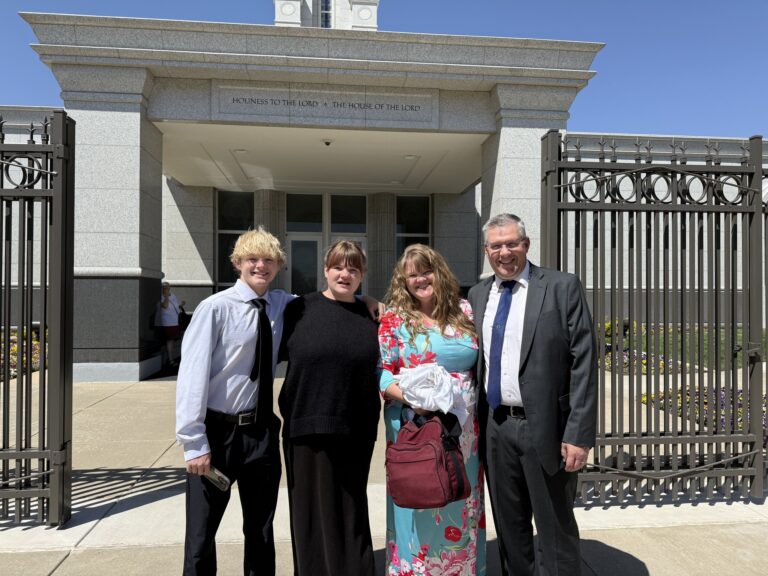
Lars Nielson, a father of four, said teaching his kids to make the right decisions at a young age is both enjoyable and a priority.

Balancing social life, work and taking care of his children is not easy, Nielson said. Like anyone else, he said, he has his own way of balancing it all.

“My favorite part about being a father is being able to teach and lead young souls,” Nielson said. “I think the most enjoyable part, honestly, is watching them grow into themselves, into who they are, and into who I think and know they can be.”

Nielson said the key to being a successful dad is balance. He prioritized spending time with his son and three daughters, often over his career in the oilfield.

This approach is what helped Nielson raise Sam, 16; Olivia, 19; Kearsty, 21; and Madelyn, 23.

“Different times in your life call for differentiation in balance,” Nielson said. “When I was younger, it was definitely wanting to have a job where I could be with them more when they were younger.”

Despite all the fun parts of being a father, challenges are bound to arise and working through them is part of the process, he said. One of those was maintaining his relationship with his wife, Ginger.

“I think a lot of it is not just balance around work and life and social and fun and all that stuff but also being able to maintain your relationship with your spouse,” Nielson said. “As long as you try to keep those balances, and you both work together and try and be understanding of one another’s needs as you grow together, and as you watch your kids grow, then it can be a challenge, but it can also be successfully accomplished.”

This year, Father’s Day falls on Sunday, June 15, the latest in more than 100 years of honoring dads annually across the U.S.

It was first thought of in 1909 by Sonora Smart Dodd, a woman from Spokane, Washington. After listening to a Mother’s Day sermon, Dodd was inspired to create a holiday to honor fathers as well. Dodd looked up to her father, William Jackson Smart, a Civil War veteran who raised her and her siblings after their mother’s death.

The first celebration of Father’s Day took place June 19, 1910, in Spokane. At this point, however, it had not gained national recognition. Mother’s Day was already a popular holiday, and individuals did not think having a day to celebrate fathers was needed, according to History.com.

In 1966, President Lyndon B. Johnson issued the first presidential proclamation honoring fathers, designating the third Sunday in June as Father’s Day. President Richard Nixon signed a law to declare Father’s Day a national holiday on April 24, 1972.

For Joseph Cdebaca of Artesia, being a dad means challenging himself to serve as a role model for his kids.

“I always got to make sure that I’m doing everything right, so I can set a good example,” he said.

Follow reporting intern Marshall Mecham on Twitter @nmstateMBBnews.

Eddy County Shooting Range opens

0

Artesia Chamber of Commerce

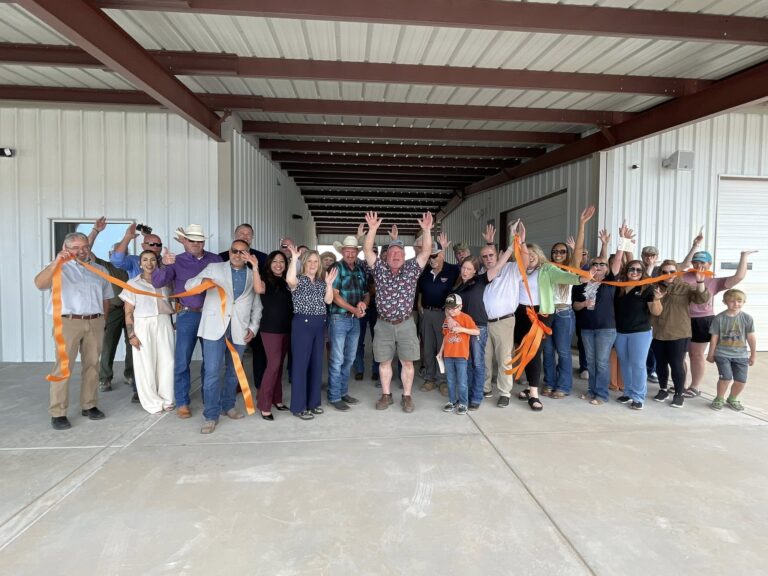
We were so honored to be part of the Eddy County Shooting Range Association’s ribbon cutting Tuesday for the expansion of this awesome facility! They have been around for many years but recently received some wonderful improvements (indoor plumbing being just one) This is a great place to hone your skills in any category of marksmanship. Get in contact with Creek Side Clays to learn more about all they have to offer.

P.S. We are proud to report your favorite chamber ladies were 10/10 on busted clays

Crawford has confidence in Jingle Wood

Ruidoso Downs Race Track

Jingle Wood’s four-length victory in trials for the $350,000 Mountain Top Futurity on May 30 was an eye-opener for racing fans at Ruidoso Downs, including trainer Clint Crawford. The gelding’s race time of 17.608 seconds at 350-yards was fastest that day.

“He finally got focused and put it all together,” Crawford said about the gelding that will race again Sunday in the Mountain Top final. Jingle Wood is the 2-1 morning line favorite with jockey Jacob Enriquez riding as the eight horse in the 10th race.

Crawford started training Jingle Wood at his ranch in Shawnee, Okla. over the winter. That’s when he first noticed the horse’s talent.

“He was out-working a lot of horses with famous bloodlines,” Crawford said. “Then we started him at Sunland Park in the spring where he ran second in the West Texas consolation. He ran a little green but still finished second with tons of speed toward the end. I think we’ve got a 440 [yard]-horse.”

On June 10, Crawford stood Jingle Wood in the starting gates at Ruidoso Downs to practice leaving at the sound of a bell.

“He stood super,” Crawford said. “You can tell he’s very mature and focused on what he’s doing and I’m really excited about this horse’s future.”

Jingle Wood is owned by Chris and Melody Lykins and Pat Guthrie, who purchased Jingle Wood at the Ruidoso Downs New Mexico-bred Yearling Sale last fall for $77,000.

First post time on Sunday is 1 p.m.

Rodriguez to lead wound care

0

Staff reports

Adriana Rodriguez, FNP-BC, has taken on the role of leading Artesia General Hospital’s Wound Care and Hyperbaric Medicine Center. With her background in family practice and emergency medicine, Rodriguez is committed to providing compassionate and comprehensive care to patients with chronic and non-healing wounds in Artesia and surrounding communities.

Rodriguez emphasized the importance of personalized care in wound management.

“I am passionate about serving our community and look forward to this new opportunity to make a positive impact.,” she said. “Each patient is unique, and their treatment plan should reflect that individuality.”

Under Rodriguez’s leadership, the center continues to offer state-of-the-art treatments, including Hyperbaric Oxygen Therapy (HBOT). HBOT is a non-invasive therapy that delivers 100% oxygen in a pressurized environment to promote healing, fight infection, and restore damaged tissue. It is particularly effective for patients with diabetic foot ulcers, radiation injuries, non-healing surgical wounds, and severe infections that have not responded to conventional treatments, Rodriguez said.

Rodriguez leads a dedicated team of specialists in providing advanced, compassionate care to patients with chronic and non-healing wounds. The team’s collaborative approach ensures that each patient receives the highest quality of care tailored to their specific needs.

Rodriguez is a native of Artesia and is fluent in Spanish, allowing her to connect with a broader range of patients in the community. She said she is passionate about bringing advanced wound care services to the area, ensuring that patients have access to the best possible treatments without the need to travel long distances.

Patients interested in HBOT or other wound care services can schedule an evaluation through the Wound Care & Hyperbaric Medicine Center by calling 575-736-8235. Most insurance plans cover HBOT for approved conditions, and AGH’s wound care specialists work with referring physicians to develop personalized treatment plans.

For more information about Hyperbaric Medicine and Wound Care Services at Artesia General Hospital, visit artesiageneral.com/centers-of-care/wound-care.

Trinity Sunday

0

David Grousnick

A preacher proudly boasted that he doesn’t preach doctrinal sermons. They are boring he asserts and people do not understand or relate to them. Further, he claimed, I am a preacher and not a theologian. I get down do the practical issues and simply preach Christ crucified.

In my opinion, his thinking is faulty at several points.

First, he is wrong when he says that he is not a theologian. The fact is that everyone to a certain extent is a theologian. Theology is nothing more than what you think about God. Well, shouts one person, I don’t believe In God. That then is your theology.

I would also take issue with him when he claims that he does not preach theology but gets down to practical issues. In my thinking there is no difference in good theology and good practice. Good, solid theology gets down to the very core of our existence.

Finally, I would disagree with him when he says that we should only preach Christ crucified. I know that is what the Apostle Paul said but this preacher doesn’t mean what Paul meant.

He is saying that he only preaches about the cross and saving the sinner. I submit to you that the cross is not central in Paul’s theology; rather, it is Christ.

It has always puzzled me why some ministers preach the message of salvation to people who have been sitting in the pews all their life when they need so much more of Christ’s teaching on life’s other issues.

There are many strings on a guitar. To make beautiful music all of them must be played and not just one. That is why in our church we honor the lectionary and the seasons of the church year.

That insures a witness to the whole Gospel of Jesus Christ.

How can one go through the season of Advent and not touch upon the doctrine of the incarnation. How can one go through Lent without touching upon the doctrine of the resurrection? Likewise, how can we embark upon the season of Pentecost, as we did last Sunday, without mentioning the doctrine of the Trinity?

This Sunday is Trinity Sunday. This is a day that has been celebrated in the church since the 10th century. It is on this occasion that ministers around the world address themselves to the subject of the triune God.

Let me begin by saying that the doctrine of the Trinity does not attempt to explain God. It only explains to us, in a very elemental way, what God has revealed to us about himself so far.

To describe the tip of the iceberg above the water is not to describe the entire iceberg. So, we affirm the Trinity, not as an explanation of God, but simply as a way of describing what we know about Him.

The idea of the Trinity is not emphatically stated as a doctrine in the scriptures. Yet, by implication, it is stated many times.

The early Christians soon discovered that they simply could not speak of God without speaking of the three ways in which he had revealed himself to them. This does not mean that there are three Gods. It means that there is one God who has shown himself in three ways: Father, Son, and Holy Spirit.

Once, me and three other drivers, all arrived at a Four Way Stop intersection at virtually the same moment. Too many drivers seem unaware of the rule at Four Way Stops, that drivers take turns in a clockwise fashion or according to whoever got to the intersection first. In this case, the four of us arrived simultaneously and so there was no logical starting point for even a clockwise rotation.

What happened instead is that each of us was making hand gestures to encourage someone to go first. After being momentarily stuck with no one moving, the next thing you knew, all four of us crept forward a bit at the same moment!

We all stopped and again we all encouraged each other to go first. After lots of silly grins and even laughter among us four strangers, eventually we managed to get someone to go first. It was the opposite of what often characterizes road rage – we were terminally considerate!

But it was hilarious and wonderful at the same time.

I think that something of that kind of respectful joy must characterize the interior life of God. There is something wonderful about a shared love and a shared enthusiasm one person for the other that is so intense, it results in a never-ending dance of affirmation and celebration.

This Trinity Sunday scripture from John 16:12-15 is brief. Yet packed into this short section is the animating energy and enthusiasm and effervescence that exists at the bright center of the universe: that holy community is God in three persons, blessed Trinity!

I pray you a wonderful weekend and an energizing worship experience!

Earl Grey cookies flavored with tea and zest

0

By Wheeler Cowperthwaite

Ever have one of those moments where something new fills you with a sense of awe?

I had that when a friend brought over a fresh baked batch of Earl Grey cookies, which have become all the rage once they were popularized in the New York Times in a recipe from Yossy Arefi.

The concept, whether it’s these sugar cookies or shortbread cookies, or baked into a cake, is to use tea leaves to infuse flavor into the baked good.

Forget my Thai grilled pork or the German potato salad or any of the other innumerable dishes brought — these cookies were the star of the show.

Once you try them, and their flavor, it’s like a whole door opens to a world of tea-infused cookies, presumably each with their own flavor profile.

The cookies are easy to bake and don’t take very long. At their heart, they’re sugar cookies with a few extra steps and a little extra flavoring.

They use baking powder and baking soda as a leavener, and man, do they rise into picture-perfect half-rounds. The tea and orange zest give them just a hint of color.

In all, they’re very easy to make. The only complicated step is preparing the tea leaves: you melt the butter and steep the leaves in it. If you have loose tea leaves, that’s the easiest way. Otherwise, remove the contents of three tea bags.

The major change to the recipe here is to double the amount of orange zest used, which really comes through. The original calls for ½ a teaspoon of orange zest, so go to a full teaspoon.

Take it from me, and my friend, these cookies are worth trying and then adding to your baking rotation. From there, the world of tea is the limit.

Perhaps on the second or third time baking them, consider adding some spices like nutmeg, cardamom, allspice or ginger.

Earl Grey tea sugar cookies
Ingredients

1 1/3 cups granulated sugar

2 sticks unsalted butter

1 tablespoon Earl Grey tea leaves, finely ground, about 3 tea bags

½ cup brown sugar

¾ teaspoon kosher salt (Diamond brand)

1 teaspoon finely grated orange zest

1 large egg

2 teaspoons vanilla extract

2 ½ cups all-purpose flour

½ teaspoon baking powder

Directions

1. Preheat oven to 350 degrees and line two pans with parchment paper. Put ½ a cup of granulated sugar into a shallow dish, to be used later to roll the cookie balls in.

2. Add the tea leaves and butter to a small saucepan over medium heat, melt the butter until it begins to “sizzle around the edges.” Take off of the heat and let it sit for 5 minutes.

3. In a large bowl, mix the tea butter, brown sugar, salt, orange zest and remaining granulated sugar until “grainy and separated.” Then add the egg and vanilla and mix until smooth.

4. In a medium bowl, combine the flour, baking soda and baking powder, then add to the large bowl with the sugar and butter mixture. Mix until combined.

5. Create balls of dough the size of 2 tablespoons, roll in the granulated sugar in the shallow dish, place on the baking sheet 2 inches apart.

6. Bake the cookies until light golden and cracks form on the top, an estimated 16 to 19 minutes. Midway through, rotate the two sheet pans from top to bottom and front to back.

Recipe adapted from the New York Times.

Artesia boutique offers affordability for customers

0

Mike Smith

Artesia Daily Press

msmith@currentargus.com

Long before Alexis Archunde opened her new clothing and jewelry store in Artesia, “affordable” was a key word in her approach to business.

“I wanted everyone to be able to afford my shop,” said Archunde, 35, whose Limitless Unique Boutique opened March 25 at 315 W. Washington Ave. “I’m a frugal mom.”

The store is new but Archunde’s appreciation for affordability dates back at least to 2020 when she was selling online for a company called Paparazzi Accessories, and a single mom thanked her for selling $5 jewelry.

“She said, ‘Thank you for offering something affordable,’ Alexis recalled. “I remember crying. There is a need for affordability.”

A 2007 graduate of Artesia High School, Alexis attended New Mexico Junior College in Hobbs but moved on without earning a degree.

She returned to Artesia, where she and future husband Christopher had their first child in 2013.

“We agreed I would be a stay-at-home mom,” she said. “Sitting still and not working was an adjustment.”

Later, in search of extra income, Alexis undertook a multi-level marketing venture selling jewelry and scented wax bars and warmers. After that, she signed on with Paparazzi Accessories.

“I loved it, it was fun,” Archunde said.

Her encounter with a single mom who appreciated affordable jewelry prompted Archunde to create an online boutique featuring clothing and jewelry, which in turn planted the seed for a brick-and-mortar store.

“I started small with my group. It grew to 1,700 members. I remember when I had 60,” she said. “I got community support from Artesia. Artesia is one of the best places to have a small business.”

In November 2024 she found what she decided was the perfect location for her store when she drove past an office park that had a vacant corner suite.

“I envisioned my shop here,” she said. “It needed a lot of cosmetic work.”

She drove to the Sherwin-Williams store, bought a can of paint, and Limitless Unique Boutique was on its way.

“It took me about four months to renovate and I was doing it myself,” Archunde said.

Besides painting, she pulled up the old carpet and added new patio rugs.

“What it looks like today is what I envisioned. If you have a dream, you can accomplish it with hard work,” Archunde said.

She said the shop offers merchandise ranging in price from $2 to $25, including clothing, jewelry, and custom-made hats that are made right in the store.

“You can design your own hat and walk out with it,” Archunde said.

Limitless Unique Boutique is open from 11 a.m. until 6 p.m. Monday, Tuesday, Thursday and Friday. The store is closed Wednesdays for family time, Archunde said.

“Saturdays are on a ‘when available’ schedule right now because of summer,” she said. “But I post in my (Limitless Unique Boutique) group on Facebook a heads-up when I’m there. When I am, it’s 9 a.m. to noon.”

Husband Christopher, who works as branch manager for Q2 Artificial Lift Services in Carlsbad, provided support as she accomplished her dream, Alexis said.

The couple has two children, 11-year-old Zayden and 4-year-old Luka.

Luke Burns, spokesman for the city of Artesia, said Archunde’s store is a welcome addition to the city’s retail scene, reflecting a “can-do” business culture.

“It’s exciting to see people turn their passion into a small business and to see how it adds to our community in the process,” Burns said.

Mike Smith can be followed on X @mikesmithartesianm.

Being a Good Father

0

Rick Smith

In honor of Fathers Day I want to share with you some thoughts about being a good father from the Bible.  Let’s read Ephesians 6:4 and use it as our lead scripture.  “And, ye fathers, provoke not your children to wrath: but bring them up in the nurture and admonition of the Lord.”  I believe that the first half of this verse is a warning against overly stern discipline – discipline that is mean, excessive, and absent of love.  That only produces anger and rebellion in the heart of the child instead of loving submission and obedience.  So, looking at the second half of Ephesians 6:4, we will use it to guide us to be good fathers.  “…but bring them up in the nurture and admonition of the Lord.”

First, fathers need to know their children.  We are told, “Train up a child in the way he should go: and when he is old, he will not depart from it (Proverbs 22:6).”.  Many take this as a promise, but it is a proverb that tends to be true.  How do we train a child in the way he should go?  Every child is different, but they all are sinners.  “The rod and reproof give wisdom: but a child left to himself bringeth his mother to shame (Proverbs 29:15).”. You may ask the question, What is God’s plan for this child?  Then begin praying for you child: for their salvation, for their obedience to God and His will for their life, etc.  Spend time with them, loving them, and getting to know that unique person that God has given you for a time to raise them in the nurture and admonition of the Lord.

Secondly, you need to teach, or instruct, your children.  Dad, you need to teach you children and not leave it up to your wife to do.  It is you, the father, who God has commanded to teach your children.  “And thou shalt teach them diligently unto thy children, and shalt talk of them when thou sittest in thine house, and when thou walkest by the way, and when thou liest down, and when thou risest up (Deuteronomy 6:7).”. You are to impart the information needed to know and follow the Lord. They need to know that they are sinners.  They need to know that God’s law condemns them, through repentance and faith in the Lord Jesus Christ they can have their sins forgiven.  This is the most important thing in life, because it prepares them for life both here and for hereafter.  “…bring them up in the nurture and admonition of the Lord.”

It is also important to train your children well.  It’s not enough to teach them – to instruct them in the information that they need, but you must also train them.  Dad, family life is the boot camp for life.   They need to know the scripture, but they need to be trained to apply it to their own life.  They can be taught the Lord’s Prayer, but not know how to pray.  Training takes what they are taught and shows them how to use it.  It takes that which was instructed and moves it from the brain to the heart.  It is a molding of character – Christian character.  In reality, Dad, it is discipleship.  You are to be the one, along with your wife, that trains and disciples your children in the Christian faith.  Ideally, it should be you that brings your children to faith in our Lord Jesus Christ.  It should be said of your children as was said of Timothy, “And that from a child thou hast known the holy scriptures, which are able to make thee wise unto salvation through faith which is in Christ Jesus (2 Timothy 3:15).”

Finally, they need you to be a good example of what a good father and a godly man is supposed to be.  They need to see and experience your life, your faith, and your obedience.  You are to be to them like Abraham.  God said of Abraham, “For I know him, that he will command his children and his household after him, and they shall keep the way of the LORD, to do justice and judgment; that the LORD may bring upon Abraham that which he hath spoken of him (Genesis 18:19).”  That is talking about passing the faith on from one generation to another.  But that cannot happen if you, first, are not a Christian.  It is your responsibility to pass on the faith that you have.  So if you are not a Christian, repent and believe in the Lord Jesus Christ and be saved.   Secondly, you must take the lead in the spiritual upbringing of your children so that they may be saved.  And then, as long as they are under your roof, you must be the one to guide, instruct, and train them in the faith.

God bless each and every father on this day that we honor them.   Happy Fathers Day!

If you have any questions, we invite you to visit with us this Sunday.   Worship at 10:50 A.M.  We are located at 711 West Washington Ave.  Check our sermon videos on Youtube @ricksmith2541.  Send comments and prayer requests to prayerlinecmbc@gmail.com.

Lucero guilty of 1st degree murder

0

Adrian Hedden
Carlsbad Current-Argus
achedden@currentargus.com

Sentenced to life in prison

Acadio Lucero gazed stoically toward the 12 jurors who found him guilty of first-degree murder on Friday, June 6, for shooting a man during a 2023 argument outside the Artesia Police Department.

Minutes later, he was sentenced to life in prison – the mandatory sentence for the charge under New Mexico law. Lucero will be eligible for parole in 30 years.

The verdict followed a four-day trial held at Fifth Judicial District Court in Carlsbad.

Lucero, 24, was accused of shooting Mark Rommel, 42, on Oct. 12, 2023 in the parking lot of the Artesia Public Safety Complex, which houses the city police and fire departments. The facility also serves as a location for “custody exchanges” when estranged couples pick up their children from one another.

Such an exchange brought Lucero and Rommel, along with Jahnika Guajardo, the mother of Rommel’s infant child who Lucero was dating, to the parking lot where the shooting took place.

Police said Lucero retrieved a handgun from his truck, firing at Rommel 12 times and hitting him three times including a fatal shot to the head.

Rommel’s mother Linda Dobbins read a statement to Lucero ahead of sentencing, describing the “ripple effect” her son’s death had on her family. She said she was at the scene of the shooting, and watched her son die.

Dobbins was called to testify in the trial and contended Rommel made no physical threat to Lucero to justify the shooting.

“He wanted nothing more than to live a good life. It was a dream that was stolen when Acadio took his life,” Dobbins said. “I witnessed my son’s murder. I don’t sleep, and when I do I have nightmares.”

Rommel’s younger brother James Dobbins also gave a statement before Lucero was sentenced, calling Lucero a “coward” and “evil.”

“You took away my brother that day,” James Dobbins said. “I know what it was like to be around my brother. I know he was scary. But you chose to gun him down instead of fighting him.”

Before issuing the sentence, Finger said the incident that claimed Rommel’s life was “very unfortunate” and “should not have happened.”

A ‘show of force’

During closing arguments ahead of the jury’s two-hour deliberation, prosecutor Ariane Gonzales recapped the events leading to Rommel’s death, describing how the two men met in the parking lot, and how they moved through the area during the argument and shooting.

She said the conflict began at a nearby medical center where Rommel brought the child, who was suffering from COVID-19 symptoms. Gonzales said Lucero was not present at the medical center but was called by Guajardo, who was with Rommel at the center at some point during an argument that arose between the parents.

Gonzales said Lucero gathered his firearm and ammunition and drove first to the medical center and then to the public safety complex after a police officer recommended the arguing parties meet there for a “safe drop-off” of the child.

These acts by the defendant, Gonzales said, were proof of Lucero’s intent to kill Rommel.

“By the defendant’s own words, they were there as a ‘show of force,’” Gonzales said. “You get the idea of the tone the defendant wanted to create at this custody exchange.”

The prosecutor continued to narrate how Lucero allegedly shot and killed an unarmed Rommel and was witnessed in the act by Artesia police Sgt. Christopher Gallegos, who shot and injured Lucero during the incident. She said that while curse words were exchanged between the two men, the altercation did not get physical until Lucero opened fire.

“There are no actions that were seen by anyone that was there, or any evidence that was presented, that there was a gun on Mark Rommel or a knife. He (Lucero) never saw a weapon,” Gonzales said.

Defense attorney Raymond Conley countered that Lucero’s police interviews were consistent in that his client’s version of events indicated Rommel was threatening Lucero with physical violence, justifying the shooting.

Conley questioned the detectives’ tactics throughout the investigation as they told Lucero during interrogation that police had video evidence and multiple witnesses indicating the incident conflicted with the defendant’s statements.

No such evidence was presented at trial, argued Conley, who said police repeatedly lied to his client during the investigation. Conley said Lucero maintained that Rommel was much closer than the prosecution presented, physically threatening the defendant.

The defense attorney also questioned Sgt. Gallegos’ testimony that Lucero and Rommel were 20 feet apart when Lucero started shooting. Conley said that while Gallegos’ training as a police officer kicked in, adrenaline may have clouded the officer’s judgment as to the distance between the men.

“The issue is distance and position,” Conley said. “It’s reasonable to ask if Gallegos was as focused as he thought he was or saw what he thought he saw. What he (Lucero) is saying is the truth.”

Managing Editor Adrian Hedden can be reached at 575-628-5516, or @AdrianHedden on the social media platform X.