Alex Ross
El Rito Media
aross@elritomedia.com
Bills on crime, healthcare and roads pass Senate
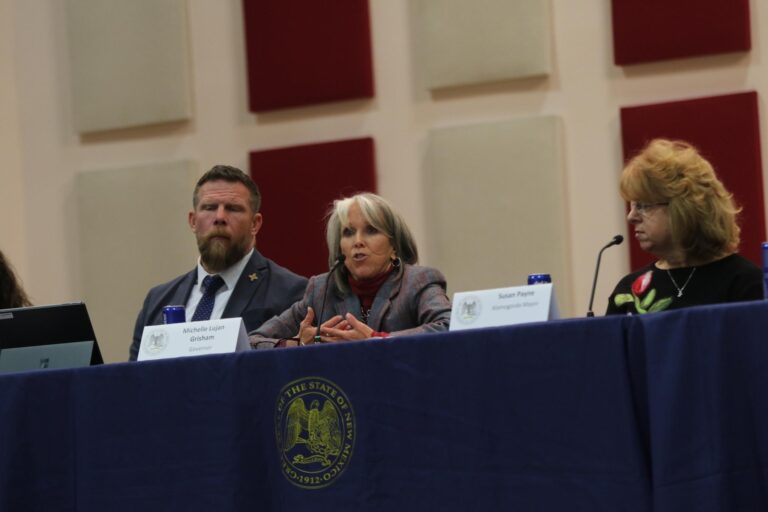
Three of Gov. Michelle Lujan Grisham’s priority bills to up road funding, address healthcare shortages and expand mental health moved closer to becoming law.
Less than a week into the 30-day legislative session and with broad bipartisan support, three bills on those subjects passed the New Mexico Senate on Friday, Jan. 23, marking a victory for the governor’s last session in office.
Lujan Grisham, a Democrat whose second term expires on Dec. 31, 2026, is unable to seek reelection this year due to term limits.
In a press release issued Friday, the governor called passage of the bills “an early win” and urged the New Mexico House of Representatives to act on them “without delay.” If the bills pass the House, Lujan Grisham will have until March 11 to sign or veto them. Any legislation not acted upon by that date will be pocket vetoed and not become law.
Senate Bill 1: Interstate Medical Licensure Compact
A bill aimed at providing out-of-state physicians with a more expedited pathway to practice in New Mexico passed the Senate 40 to 0, a day after it had cleared the Senate Judiciary Committee without opposition.
SB 1 authorizes New Mexico to join the Interstate Medical Licensure Compact, a legal agreement between 42 states, the District of Columbia and the territory of Guam that provides an expedited path for qualified physicians in one state to get licensed in other states that are also members of the compact.
Neighboring states to New Mexico such as Arizona, Colorado and Texas were already members of the compact.
During the 2025 legislative session, legislation for New Mexico to join was introduced as House Bill 243. It, and a series of other compacts, cleared the House of Representatives unanimously but did not make it to the Senate floor.
Amid a groundswell of political support for the compacts, last year Senate Majority Floor Leader Peter Wirth (D-27) of Santa Fe announced the formation of a bipartisan working group to deal with issues related to the compacts.
In all, 11 different compacts on professions ranging from dentists to EMT workers to social workers have been introduced this session in addition to SB 1 and were still under consideration by lawmakers.
Senate Bill 2: Transportation bonding
Efforts to upgrade New Mexico’s roads and highways could soon get a boost in funding, after senators voted 31 to 9 to pass Senate Bill 2.
The bill allows the State Transportation Commission to authorize an additional $1.5 billion in bonding for state road and bridge projects over multiple years, as long as no more than $1.124 billion in road projects are not already bonded out.
The bonding process allows the state to borrow funds against vehicle registration fees and taxes paid to the state for road projects
SB 2 also raises registration fees by 25%, and the weight-distance tax on commercial vehicles by 35%, which is charged based on the weight of a commercial vehicle and the distance it travels each year. The bill also imposes new vehicle surcharge fees on electric and hybrid plug-in vehicles.
The fee for electric vehicles proposed in SB 2 would start at $70 in the calendar year 2027, rise to $80 in 2028 and settle at $90 in 2029. For hybrid plug-in vehicles, the fee would start at $35 in 2027, increase to $40 in 2028 and settle at $45 in 2029.
An analysis of SB 2 estimates that the new taxes and fees would bring in revenue of $69.9 million in fiscal year 2027 and $76.4 million by fiscal year 2030.
Senate Bill 3: Involuntary commitment
Another bill pushed by the governor to reform requirements to determine a person incompetent to stand trial, and provide treatment for such defendants, also passed the Senate with bipartisan support, 37-3.
Sens. Linda Lopez (D-11) of Albuquerque, Harold Pope (D-23) of Albuquerque and Shannon Pinto (D-3) of Tohatchi opposed the bill.
SB 3 amends the state’s criminal competency statute’s definitions of harm to self or harm to others, so that more people with serious mental health issues and who are believed to be dangerous can receive court-mandated treatment.
Current New Mexico law defines “danger to self” as being when “it is more likely than not” that a person will take their life or inflict serious bodily harm to themselves “by violent or self-destructive means.”
SB 3 revises the definition so that a person a court finds is unable to make decisions about their own mental healthcare, potentially resulting in death or physical harm can also be held by a court.
Requirements for a “harm to others” finding was also revised so that recent past behavior can enter into the court’s assessment if it is determined the defendant “has inflicted or attempted to inflict serious bodily harm on another or has acted in such a way as to create a substantial risk of serious bodily harm to another,” read the bill.
In a press release, the governor’s office stated that the new definitions will allow people to receive assisted outpatient treatment earlier instead of after their conditions have deteriorated, or after multiple hospitalizations and incarcerations.
Legislative reporter Alex Ross can be followed on X at alexrosstweets.com