Adrian Hedden
Carlsbad Current-Argus
achedden@currentargus.com
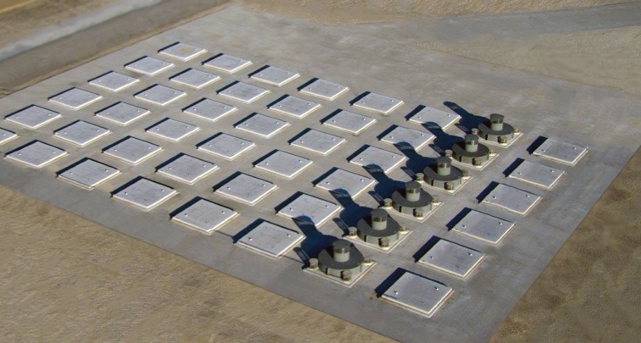
Grave concerns for the viability of a project to store nuclear fuel at a site near Carlsbad were shared by the company proposing to do so in a letter to local officials in southeast New Mexico.
Company officials wrote in the letter that the project “was impossible” amid strong opposition from state lawmakers and current agreements in place with local leaders, though suggesting later that such issues could be renegotiated to move the facility forward.
Holtec International appeared ready to build the facility which would hold up to 100,000 metric tons of the refuse after a June U.S. Supreme Court verdict reinstated a federal license to build and operate the site.
But in a July 28 letter to the Eddy-Lea Energy Alliance, which was presented to the group at its Aug. 11 meeting, the company said the project was blocked by New Mexico state law.
That’s because of Senate Bill 53, passed by state lawmakers in 2023 to bar any state agency from issuing permits Holtec would need to operate the site, and the overall “political climate” in New Mexico, read the letter.
Holtec was issued a federal license to build and operate the site known as a Consolidated Interim Storage Facility (CISF) by the Nuclear Regulatory Commission (NRC) in May 2023, an approval that was vacated by the Fifth Circuit Court of Appeals last year.
The matter, along with a similar license and ruling to vacate the license for a site to store the fuel in Andrews, Texas, by Interim Storage Partners, went before the U.S. Supreme Court this year with justices ruling those opposed and who initially appealed the license to the site had no legal standing to enter the licensing process in the first place.
That left Holtec and its supporters claiming victory and expecting the project to move forward, after more than a decade of negotiations between the company and Alliance, public hearings and debate.
But the progress could be stalled, as Holtec’s recent letter to the Alliance sought to terminate its revenue sharing agreement with the consortium. The agreement would give ELEA a third of the project’s revenue once the facility was operational in exchange for use of the land needed.
“Unfortunately, the passage of state legislation that effectively prohibits the construction of the CISF, combined with the continued public opposition expressed by New Mexico’s current administration, has made the project impossible in the near future,” read the letter signed by William F. Gill, Holtec vice president and senior counsel.
Gill went on to explain that the project’s success hinged on support expressed by former Gov. Susanna Martinez, a Republican – support that was reversed by Martinez’ successor and current Gov. Michelle Lujan Grisham.
Lujan Grisham, her Cabinet, lawmakers and New Mexico’s entire five-person congressional delegation – all Democrats – remained opposed to the proposal and the project in Texas throughout the licensing process due to risks they purported it could pose to the oil and gas and agriculture industries in rural southeast New Mexico.
“Faced with the obdurate opposition of the state government to establishing the consolidated interim storage facility in the state, we find ourselves with no alternative but to respectfully terminate the revenue sharing agreement effective immediately,” the letter read.
Waste project still viable?
Despite those words, Holtec spokesman Patrick O’Brien said in a statement the company still believed the project was doable, pending further negotiations with the Alliance to potentially alter the agreements and allay concerns expressed in the letter.
“With the NRC license in place, our HI-STORE consolidated storage project in New Mexico, partnered with Eddy-Lea Energy Alliance, remains a viable part of that solution,” read the statement emailed to the Current-Argus on Aug. 14. “The two parties, with a nearly decade long relationship, have discussed options available moving forward on both the revenue sharing and land purchase aspects under the current agreement, and will continue to do so.”
Alliance Chair John Heaton agreed it’s not over.
He said the Alliance and Holtec continued to negotiate how to get around the state legislation effectively blocking the project, and that Holtec cannot “unilaterally” terminate the agreement.
“The letter they sent us has no basis in fact as far as what they (Holtec) plan to do,” Heaton said. “This says they want to withdraw from the agreement, and there is no provision in that agreement that they can do that unilaterally.”
Aside from those plans, and concerns over opposition in New Mexico, Holtec also explained in the letter that it planned to take part in the U.S. Department of Energy’s “expressions of interest” program which would see the company going out to other communities to find support for other federal waste storage facilities.
Holtec’s agreement with the Alliance, Heaton said, is “essentially a non-compete” agreement, meaning the company is not allowed to promote or take part in competitive projects in conjoining states.
Heaton said that means Holtec cannot pursue projects in Colorado or Texas, places the federal government, he said, was targeting for such facilities. The company and local leaders remained in discussion on how to address these contractual concerns, Heaton said.
“I think we can get to some agreement,” he said.
Critic says project doesn’t ‘make any sense’
However, Don Hancock with the Southwest Research and Information Center in Albuquerque, a frequent critic of nuclear development in New Mexico, said Holtec’s letter was “unsurprising” as he said the project was doomed from the start.
He also said it is not economically sound as he argued Holtec does not have any customers – utility companies in possession of the spent fuel that are currently storing it onsite at the reactors.
About “90%” of spent nuclear fuel is already stored in the eastern half of the U.S., Hancock argued, and efforts to move it out west were “bad and nonviable.”
“It is confirming what has been suspected for a while,” Hancock said. “NRC licensing is necessary, but not sufficient. They have no customers. Who’s going to be pay for the transportation?”
As for the Supreme Court ruling that supported Holtec and the Texas facility, Hancock said the idea that it made the projects inevitable was “not realistic.”
He questioned if leaders in Carlsbad and the surrounding communities would ever receive a return on their investment in the project, which entailed granting Holtec access to the 1,000 acres of land for the site, along with promoting and supporting the project over the years.
“You can’t do it in New Mexico,” he said. “The thing I hope the local people in Carlsbad would say is that they invested the money to buy this site. What are local people actually getting out of it? That’s too bad that they pursued projects that don’t make any sense.”
Managing Editor Adrian Hedden can be reached at 575-628-5516, or @AdrianHedden on the social media platform X.