Home Blog Page 36

Wagner seeks District 4 slot on Artesia City Council

0

Mike Smith
Artesia Daily Press
msmith@currentargus.com

Editor’s note: The Artesia Daily Press has submitted questionnaires to each candidate for Artesia City Council and mayor running in this year’s municipal elections on March 3. The paper is publishing each of the responses in the order they are received.

Charles Morgan Wagner II is a 36-year-old Artesia native and resident who is running for the Artesia City Council seat currently occupied by Dickie Townley, who decided not to seek another term. Wagner is facing former councilor Terry Hill in the March election.

What made you decide to run for this office?

“I decided to run because Artesia is home for my family, and I care deeply about its future. I want to be a voice on City Council that listens to residents, asks good questions and helps make thoughtful decisions for our city.”

What is your day-one priority if elected?

“My priority would be to gain a clear understanding of current projects and challenges, and most importantly to hear directly from residents in District 4. Building relationships with city staff, first responders and fellow councilors will be critical so that I can be effective, informed and ready to contribute.”

What do you see as the biggest needs for City Council, and what can you do as a councilor to meet those needs?

“One of our biggest needs is staying focused on core city responsibilities which I believe are public safety, infrastructure and reliable services while also being mindful of the city’s budget.”

How would like you to see the City of Artesia spend tax revenue for city services?

“I believe tax revenues should be spent responsibly and prioritized toward essential services that benefit the entire community. I also think it’s important to budget carefully and ensure taxpayers understand how their money is being spent.”

What can the City Council do to improve municipal services such as road maintenance for Artesia residents, especially those living in rural areas of the city?

“I believe the City Council should take a proactive approach by prioritizing repairs based on need and ensuring that less populated or less traveled roads are not overlooked. This requires listening to residents and coordinating closely with city staff, which will help improve consistency and service delivery.”

Mike Smith can be reached at 575-628-5546 extension-2361.

Swim team wins invitational on Senior Day

0

JT Keith
Artesia Daily Press
jtkeith@elritomedia.com

The Artesia Bulldogs boys swim team won the Artesia Swim Invitational on Jan. 31. The girls team placed second at the event, which was held at the Artesia Aquatics Center.

“It was really exciting,” Artesia swim coach Andrea Ciro said. “We have five seniors graduating who have been a part of our team for the last five years. Two of them are my sons (Alec and Aidan).”

Ciro said it was a bittersweet day for her because it was one of the last meets for her sons. The team set some state-qualifying times during the meet.

Ciro said the team was close to breaking some school records and looks forward to breaking those in the following weeks.

Ciro said she is happy with her team, and even though they are young, they have improved as the season has gone along, getting faster and faster.

Ciro said that coaching her twin sons, Alec and Aidan, has been great and that she is saddened that this is her last year coaching them in high school.

“Coaching them has been great,” Ciro said. “Both of them have been motivated to lead their team. They know this is their last year, and they want to leave a strong culture and tradition for those coming up next.”

Ciro said one of her favorite memories of coaching her sons is from last year, when one of the relay teams qualified for state by hundreds of a second.

“Aidan had a great season last year,” Ciro said. “He broke a lot of team records last year. During their relays, they almost beat Albuquerque Academy (at state), which is a tremendous feat for Artesia. They (Alec and Aidan) were really pumped at that meet.”

The team will host the district tournament on Saturday, Feb. 7, at 11 a.m.

JT Keith can be reached at 575-420-0061, or X @JTKEITH1.

Governor signs bills on vehicle registration hikes, medical compacts, and immigrant detention

0

By Alex Ross
El Rito Media
aross@elritomedia.com

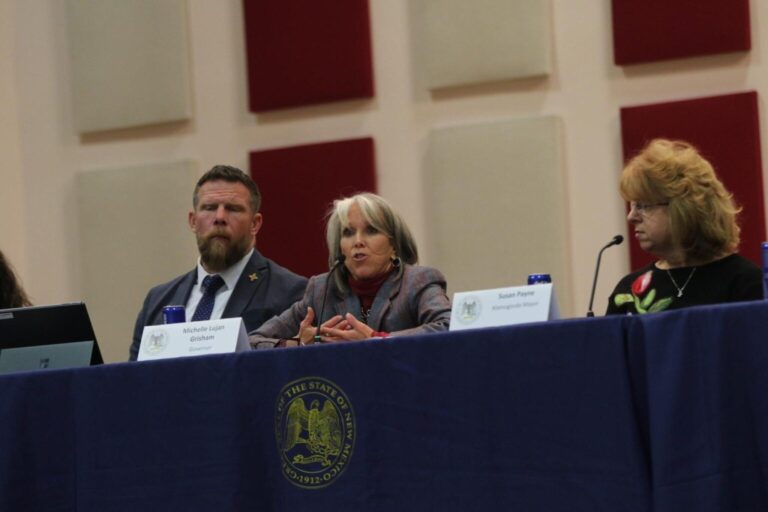
New Mexico motorists and truckers will pay higher fees and taxes on their vehicles under a law signed Thursday by Gov. Michelle Lujan Grisham.

Lujan Grisham signed the legislation, Senate Bill 2, at the state Capitol in Santa Fe along with two bills designed to lure more physicians and social workers to New Mexico and another to prohibit local governments in the state from entering into agreements with the federal government to detain individuals accused of violating immigration laws.

The four bills were among the governor’s top priorities for the 30-day legislative session that began Jan. 20.

“Halfway through the session, we’re showing what’s possible when we focus on getting things done for New Mexicans,” she said in a news release issued after the signing ceremony/news conference at the Roundhouse.

Vehicle registration fees and road funding

In addition to raising vehicle registration fees by 25% and the weight distribution tax on commercial vehicles by 35%, SB 2 increases the amount of money the state can borrow for state road and bridge projects by $1.5 billion. The bill passed the House of Representatives by a vote of 44-23. The Senate vote for passage was 31-9.

According to the New Mexico Motor Vehicle Department, registration fees vary depending on a vehicle’s age and weight. For a passenger vehicle, the fee for a one-year registration currently ranges from $27 to $65 and a two-year registration costs between $54 and $124. Registration fees for trucks range from $38 to $207 for a one-year registration and from $76.00 to $414 for a two-year registration.

The increases in registration fees and the weight distribution tax, which is based on a vehicle’s weight and miles driven on Mexico roads, are scheduled to take effect July 1.

The bill also imposes a new surcharge on electric vehicles and hybrid plug-ins. Fees for electric vehicles will start at $70 in 2027 and rise to $90 in 2029. Owners of hybrid plug-ins will pay $35 in 2027 with that fee increasing to $45 in 2029. Those new taxes become effective Jan. 1, 2027.

An analysis of SB 2 by the New Mexico Taxation and Revenue Department found that in fiscal year 2027, which begins July 1, the new fees will bring the state an additional $69.9 million for road and highway maintenance and construction.

New Mexico Transportation Secretary Ricky Serna told legislators in November that the higher fees were necessary due to rising construction costs and an expected decrease in revenue coming into the road fund over the next 25 years.

Lujan Grisham said the legislation will help address the state’s deteriorating roads. A report released in January by the National Transportation Research Group, known as TRIP, found that New Mexico has $7.5 billion in projects that need funding.

Medical compacts

The two bills aimed at the shortage of medical practitioners in the state, Senate Bill 1 and House Bill 50, both passed the House and Senate without opposition.

SB 1 enables New Mexico to join the Interstate Medical Licensure Compact, which provides 43 other states, the District of Columbia and the territory of Guam with a common path to licensing qualified physicians across state lines.

An analysis of SB 1 by the New Mexico Medical Board projects that the state will experience a 10% to 15% increase in physician license applications after joining the compact.

HB 50 enables New Mexico to join the Social Work Licensure Interstate Compact, which allows social workers to practice in multiple states.

Although 31 states participate in the compact, an analysis of HB 50 by the New Mexico Regulation and Licensing Department found that no multistate licenses are currently being issued. However, the analysis found those licenses could start being issued as soon as this year if the compact’s “administrative infrastructure” is in place.

Lawmakers and the governor have rallied around the compacts as a way to deal with the state’s shortage of health care workers.

Immigrant detention

The bill dealing with immigration detention centers – HB 9, also known as the Immigrant Safety Act – passed the House and Senate on mostly party-line votes. It advanced out of the House 40-29, with Democratic Reps. Martha Garcia of Albuquerque, D. Wonda Johnson of Rehoboth and Patricia Lundstrom of Gallup voting against it. In the Senate, George Muñoz of Gallup was the only Democrat who opposed the measure.

The bill prohibits local governments from contracting with federal authorities to detain individuals on civil immigration violations. It also bans law enforcement in New Mexico from performing certain immigration enforcement functions.

In New Mexico, facilities in three counties are party to such detention agreements: the Otero County Processing Center in Chaparral; the Cibola County Detention Center in Milan; and the Torrance County Detention Facility in Estancia.

Under the agreements, the counties receive federal payments for housing detainees and use the money to contract with private companies to operate the facilities.

Last year, the New Mexico Advisory Committee to the U.S. Commission on Civil Rights voted 7-2 to endorse a report recommending an end to county-level agreements with federal agencies for immigrant detention, citing concerns about conditions at the facilities.

Officials from those areas opposed HB 9 out of concern it could lead the companies that manage the facilities to leave those communities, costing them jobs and local tax revenue.

RB Nichols, attorney for Otero County Processing Center, told the Legislature’s Courts, Corrections and Justice Committee the center is responsible for 284 jobs.

Legislative reporter Alex Ross can be followed on X @alexrosstweets.

CULINARY CONFIDENTIAL: Grilled Shrimp Tamales with Pine-Nut Coleslaw

0

Bruce Lesman

Serves 4 to 6 people.

Grilled Shrimp – Preparation

In a bowl combine 1½ pounds of peeled shrimp with 2 tbsp olive oil, smoked paprika, cumin, chili powder, garlic powder, lime zest, salt and pepper.

Toss well and let marinate 15 minutes.

Grill shrimp over medium‑high heat 2–3 minutes per side until lightly charred and just cooked.

Cool slightly, then chop into bite‑size pieces.

Toss with 2 tbsp lime juice and ¼ cup chopped cilantro. Set aside.

Grilled Shrimp Filling Ingredients

1½ lbs large shrimp

2 tbsp olive oil

1 tsp smoked paprika

1 tsp ground cumin

½ tsp chili powder

1 tsp garlic powder

Zest of 1 lime

1 tsp salt

½ tsp black pepper

2 tbsp fresh lime juice

¼ cup chopped cilantro

Tamale Masa:

3 cups masa harina

2½ cups warm chicken or vegetable broth

1 tsp baking powder

1 tsp salt

½ cup unsalted butter or lard, softened

½ cup sour cream

Pine‑Nut Coleslaw

3 cups shredded green cabbage

1 cup shredded purple cabbage

½ cup julienned carrots

⅓ cup toasted pine nuts

Dressing:

½ cup mayonnaise

2 tbsp apple cider vinegar

1 tbsp honey

1 tsp Dijon mustard

½ tsp salt

¼ tsp white pepper

Bruce Lesman is the creator of Culinary Confidential. He previously served as Food & Beverage Director for Cunard and Seabourn Cruise Lines, Lead Culinary Consultant for Royal Caribbean Cruise Lines, and Vice President of Canyon Ranch Wellness Resorts.

Side hustles look profitable for Artesia friends

0

Mike Smith
Artesia Daily Press
msmith@currentargus.com

Meagan McClure learned a valuable skill from her grandmother 27 years ago that became a hobby and now is a part-time business.

Jessica Mendoza combined her maiden name and a nickname with her love of baking and she, too, found herself with a profitable sideline.

And so it happened that on a cold, foggy Saturday, the two friends sat side by side at the Artesia Aquatic Center selling homemade wares during the Artesia High School Invitational swimming tournament.

Artesia native McClure, 32, offered crocheted pot and pan holders while decade-long pal Mendoza, 35, a Hagerman High School graduate who now resides in Artesia, marketed her fresh-baked delicacies under her very own brand – “Sugar Rose by J.”

“My grandma taught me when I was about five, and I’ve crocheted off and on since then,” said McClure, a licensed massage therapist and instructor at Southeast New Mexico School in Artesia. “I tried knitting but I couldn’t get it right, so I stuck with crochet.”

In addition to pot and pan holders, she also crochets beanies and blankets.

“If I was just working on pot and pan holders, I could probably do about seven a week. Because I do all of my crocheting in my free time,” she said.

McClure has been selling her creations at the seasonal Oil Patch Market in downtown Artesia as well as community events such as the Jan. 31 swim meet.

She also takes online orders through social media.

McClure said large national retail chains such as Walmart and Target offer convenience for those looking for clothes or other household items, “but when something is homemade it has more meaning and feeling in it.

“I personally think that handmade things are better quality. My mother always sewed her own clothes. My grandma made all kinds of things for her home. And it is a lost art but making a comeback.”

McClure and Mendoza met a decade ago at the International House of Pancakes (IHOP) in Artesia.

“She had worked there as a waitress and me and my family would go to IHOP every week after church,” McClure said. “So we started talking and realized that we had a lot of things in common.”

A native of New York’s Hudson Valley whose family also lived in West Virginia before settling in Hagerman in 1996, Mendoza moved to Artesia with her husband Adam four years ago.

And she didn’t have far to go to set up her Sugar Rose by J sale at the Artesia Aquatic Center – she works full time at the center as a customer service representative.

Nor did she have far to go to find a name for her business.

“My maiden name is Rose, and my in-laws call me J,” she said.

The Sugar Rose by J menu features chocolate chip and blueberry white chocolate chip cookies plus banana bread and jalapeno bread.

Like McClure, Jessica sells her specialties at the Oil Patch Markets, community events and by special order.

“It usually takes me a couple of days to get everything ready, but I love it,” she said.

While her baking sideline can be time consuming, Mendoza said, she encourages others to turn their hobbies into businesses.

“My advice would be to have fun with it and don’t let yourself get burnt out,” she said.

Mendoza said people can contact her on Facebook through “Sugar Rose by J.”

Mike Smith can be reached at 575-628-5546 extension-2361.

Nathan Ryno believes in service for community

0

Mike Smith
Artesia Daily Press
msmith@currentargus.com

Editor’s note: The Artesia Daily Press has submitted questionnaires to each candidate for Artesia City Council and mayor running in this year’s municipal elections on March 3. The paper is publishing each of the responses in the order they are received.

Leadership and service are not new for Artesia District 2 City Council candidate Nathan Ryno.

The 50-year-old Denver native served in the U.S. Army for 22 years and is a special education teacher and assistant girls’ soccer coach in the Artesia Public Schools.

He and Joseph W. Wright are running to replace incumbent George Mullen who decided not to seek another term.

What made you decide to run for this office?

“I have several reasons for running for Artesia City Council. If I had to pinpoint a couple, one is for my girls. My beautiful wife and daughters are everything to me. My wife and I are resource foster parents. We have seen what happens to families and more to the point children when not enough people are involved in the community and their families. My family motivates me to do more for the community. Which leads to a second reason. I see a lot of people in my district and in Artesia that need help. They need a voice they can count on to support them. I want to be that voice.”

What is your day-one priority if elected?

“I want to thoroughly review Artesia’s budget and really see where we are spending taxpayer money. This will lead to working on some of the areas I want to address while on the council. For instance, a review of available funding for a revamp of the baseball and softball fields at JC Park and more services for our animal control and shelter department.”

What do you see as the biggest needs for City Council, and what can you do as a councilor to meet those needs?

“I believe the City Council and Mayor have done a great job in Artesia. Everything has room for improvement and growth, though. I believe communication with Artesia residents before decisions are made can be improved. I believe we can do this with proven leadership and new points of view on the council. I want to step into the council with an open mind, a fresh perspective on what we can do moving forward and be that communication with my district and community.”

How would you like to see the City of Artesia spend tax revenue for city services?

“After conversations with Artesia residents, neighborhood safety and crime reduction are high on the list. Speed deterrents such as flashing stop signs and speed bumps in neighborhoods are wanted. Upgrading the baseball and softball fields at JC Park is a request I’ve received often. Adding affordable veterinary services and spay and neuter programs to our animal control department has been requested. People are also excited to see work being done on the movie theater. I would also support this endeavor. These are just some of the requested areas for spending tax dollars.”

What can the City Council do to improve municipal services, such as road maintenance for Artesia residents, especially those living in rural areas of the city?

“First thing we need to do is ask and listen to the residents in the rural areas, perhaps with a town hall for discussions or an online/mailed survey. Many people I have spoken with feel their voices aren’t heard. We need to analyze our budget and include rural areas as a greater priority than they have been. If elected to the council, I would promote communication with community meetings to give residents a chance to share ideas and keep them informed of city plans and decisions. As leaders of the city, we cannot assume what the people want, we must ask and act.”

Mike Smith can be reached at 575-628-5546 extension-2361.

Letter to the Editor shows support for Todd and Wright

0

Our city has been blessed to have Mr. Raye Miller and Mr. Jon Henry at the helm of Artesia these past few years, but now it’s time to welcome new leadership with a different set of skills. This year the City of Artesia has a unique opportunity to vote for two men who exemplify the meaning of Service. Terry Todd and Joseph “Woody” Wright are running for Mayor and City Council. 

As a 25 year veteran of the United States Border Patrol, with 15 years spent serving at the Federal Law Enforcement Training Center (FLETC)/Border Patrol Academy in Artesia, I have first hand knowledge of the accomplishments, skills, and abilities of these men. They have both led a life of service not only to our State of New Mexico but to our country by overseeing the training of thousands of students who also answered the call to service. They both have managed multi-million dollar budgets that ensured safe, effective and efficient training that included numerous contract negotiations. Those contracts included construction, housing, infrastructure, security, and many other areas that ensured FLETC ran successfully. 

Additionally, both Mr. Todd and Mr. Wright have strong grasp of Master Planning that focuses on short, mid, and long term goals. They have both demonstrated the ability to develop and execute effective plans that led to decades of success at FLETC.

On may occasions Mr. Todd and Mr. Wright were faced with critical situations. Some were weather related, some were budget related due to government shut downs, and some were sadly related to medical incidents involving staff and students. During each of these incidents, both Mr. Todd and Mr. Wright responded in a professional and caring manner and ensured that all policies and procedures were followed, but more importantly, they made sure that the safety and well being of all involved were top of mind. 

I believe that Terry Todd and Woody Wright have the extraordinary backgrounds necessary to manage our City of Champions. We need forward looking, fiscally responsible, and law and order-minded leadership. I encourage all of the citizens of Artesia to make their vote count to ensure we have a safe and prosperous future. 

Sincerely, 

Jennie Anderson Marquez

Assistant Chief Patrol Agent (Retired)

Feds to lease 30K acres in New Mexico for oil and gas

0

Adrian Hedden
Artesia Daily Press
achedden@currentargus.com

Oil and gas companies could lease another 30,000 acres of public land in New Mexico this spring.

The Bureau of Land Management said it was planning to lease the lands in an auction planned for May 2026.

The bureau completed its environmental analysis of the lands proposed for lease, and opened a public comment period on Wednesday, Jan. 21, for input on the analysis until Feb. 20.

This followed a “scoping period” in December 2025, where comments could be submitted after the proposed parcels were released.

Here’s what to know about the sale, and how to comment.

How to submit public comments

Public comments can be submitted online at the bureau’s website, https://eplanning.blm.gov/Project-Home/?id=543adaf8-a7f2-f011-8407-001dd80db62a, after clicking the “Participate Now” link.

The environmental analysis can be accessed under the “Documents” section of the page.

Where is the land?

About 94% of the lands offered in the lease sale – 31,525 out of the total 33,530 acres – were in southeast New Mexico’s Permian Basin region spread out between Eddy and Lea counties.

Thirty-five parcels are in Eddy County on 14,289 acres – about 42% of the total lands offered in the sale. Another 24 parcels were offered in Lea County on 16,015 acres, or 47% of the sale.

The sale also includes three parcels on 360 acres in Quay County, and a single, 320-acre parcel in Roosevelt County, along New Mexico’s eastern border with Texas.

In the northwest corner of New Mexico, 11 parcels were offered on 2,168 acres spread among Sandoval, Rio Arriba and San Juan counties.

The lone Texas parcel was on 156 acres in McMullen County.

Analysis finds ‘no significant impact’

Up to 142 oil and gas wells could be drilled on the lands nominated for leases, read the environmental analysis published by the Bureau of Land Management.

In its analysis, the bureau argued the area where the leases were proposed was designated by the federal government for oil and gas production, and that such operations are common nearby.

Most impacts to air quality from oil and gas drilling on the lands would be “short-term,” the report read, and peak within the first 60-90 of operations as the well is completed.

“Emissions are anticipated to decline during operations and maintenance as the need for earth-moving and heavy equipment decreases,” read the report. “Ongoing operations of well sites would be subject to state and federal permitting requirements, which ensure compliance with air quality emission standards.”

The agency reported water use would also peak during this time as the well is drilled using hydraulic fracturing, or fracking, when water and chemicals are pumped underground to break up shale rock to extract fossil fuels.

But the report did warn there was “uncertainty” as to when underground aquifers would be recharged after water is used for drilling, meaning any impact to local groundwater supplies could be “long-term.”

What are the terms of the leases?

Federal oil and gas leases are for 10 years or as long as oil or gas is produced.

Leasing is the first step to production on federal public land, granting a company access to the acreage.

Operators are still required to gain various approvals from the bureau to install the necessary infrastructure and to commence drilling via an application to permit drilling, known as an “APD.”

Once operations begin, the leaseholder must pay a royalty rate to the federal government, taken as a percentage of the proceeds from oil and gas production, which is reported annually based on the volume extracted and current market pricing at the time of the report.

Revenues from federally-leased lands for oil and gas development are split with the host state.

The Bureau of Land Management currently charges a 12.5% royalty rate, after it was decreased from 16.67% with the July 4, 2025, signing by President Donald Trump of a sweeping spending bill known to supporters as the “One Big Beautiful Bill.”

The 16.67% rate was enacted by former President Joe Biden, increasing from the previous 12.5% royalty.

Supporters of the lower rate said it would aid the oil and gas industry’s growth.

“The recent adjustment to federal royalty rates helps maintain New Mexico’s competitiveness in attracting investment,” said Missi Currier, president of the New Mexico Oil and Gas Association, a trade group that lobbies for industry interests. “It’s important to note that taxpayers benefit most when production occurs.”

But a Jan. 22 report from national government watchdog group Taxpayers for Common Sense said the lower rate would cost New Mexicans tens of millions of dollars.

The group’s report pointed to 17,889 acres in New Mexico leased after July 2025, when the lower rate went into effect, bringing in about $154.4 million. If the higher rate had been maintained, the group reported, another $84.3 million would have gone to the government.

And New Mexico oil and gas production grew heavily in 2023 and 2024, the report read, undeterred by the higher rate charged in those years.

“New Mexico continues to demonstrate that competitive leasing occurs where resource potential justifies investment, not where terms are tilted to favor operators,” read the report.

Managing Editor Adrian Hedden can be reached at 575-628-5516, or @AdrianHedden on the social media platform X.

Artesia bowlers complete regular season undefeated

0

Ken Clayton
Special to the Artesia Daily Press

The Artesia High School bowling team traveled to Starlight Lanes to pursue one of its goals: an undefeated regular season in the New Mexico High School Bowling Association. To add an additional incentive to the day, Artesia’s two Advanced division teams were looking to complete the season by sweeping first and second place in the state’s top division for the entire season.

Artesia No. 1 took no chances early, with Jace Miles leading the way with an opening 232-pin game, followed by teammates Ayden Gomez (222), Payton DeMerritt (220), Brenden Depew (181) and Ayden Dean (173) for a team total of 1,028.

“I have always told them that if they are having a rough game, don’t worry about it,” said Artesia coach Ken Clayton. “Someone else on this team will pick you up. A couple of tough games still improved the team average to 205 a man.”

Game two saw no need to pick anyone up as Gomez led with his 247, followed by DeMerritt with 225, Depew and Miles adding a pair of 223s and Dean with 189 to see the team roll a strong 1,107 game, averaging 222 a man. With a two-game total of 2,135, Artesia’s No. 1 team had a 206-pin tournament lead moving to the Baker game section of the day.

Seven Baker games later, including a nice 247 game and a 1,406 total, Artesia’s No. 1 team advanced, finishing the day and the season undefeated.

With Gomez’s 469 two-game total at Starlight Lanes, the senior finished the regular season with an all-time state high average record of 225 per game.

“Coach (Laura) Weddige and I are really proud of these guys and the effort they have shown all season,” Clayton said. “There have been some amazing high school bowlers in New Mexico the past 19 years, so for Ayden to break the highest regarded record is pretty special.”

Artesia No. 2, as always, was determined to win the tournament. The team also focused on maintaining its undefeated streak in the 1-2 advanced division season.

“It’s great that our children know our history,” Clayton said. “When they accomplish something unprecedented, they rise to the occasion and achieve it.”

Junior Chase Collins led Artesia No. 2 with games of 231-212 for a 443 series. Brent McIntire followed with 211-190-401, Damian Lopez with 213, Jurijah Gonzales with 189 and Talyn Pacheco with 168. A tournament-high 259 Baker game and a solid 1,341 set allowed Artesia No. 2 to secure the runner-up spot and ensure no other school in the state defeated either of the Artesia Advanced teams.

The Novice Division saw Artesia No. 6 with a big 150-pin victory, and Artesia No. 5 finished in third place in the 12-team division. Adam Longoria led Artesia No. 6 with a 243 game and 435 series. Colton Sandmann added a 188, Phoebe Green a 168, JC Apodaca a 158 and Katherine Lewis a 164 to round out the Artesia No. 6 victory. Artesia No. 5 was paced by Garyn Usherwood and Destiny Powell, each with 190 games.

The Intermediate Division had 12 teams compete at Starlight, with Artesia No. 4 taking the runner-up trophy. Ale Bahena, with 200-162, led Artesia No. 2, followed by Zeke Sanchez (209-151), Edwin Villarreal (190-171), Justin Rodriguez (179-167) and Peyton Troost (147).

Other leading scores for the Bulldogs were Jack Erbacher (172), Ashlyn McIntire (171), Diego Molina (164), Drake Thurman (161), Mia Duran (150), Sophie Kitchen (145), Exaviar Corza (141), Daniel Alcocer (138), Kylie Mendoza (137) and Jade Marquez (130).

“Our 35 bowlers had a tremendous season. The improvement of our new bowlers from the start of practice until today is amazing,” Clayton said. “Our returning bowlers’ ending averages for this season are 318 pins a game higher than their averages were last season. That is hard work and wanting to be the best.”

The Artesia Bulldog bowlers will compete in the NMHSBA State Championships at Silva Lanes in Albuquerque on Feb. 7.

New Mexico Senate passes immigrant detention bill

0

Alex Ross
El Rito Media
aross@elritomedia.com

The New Mexico Senate passed a bill Tuesday, Feb. 3, that would prohibit local governments in the state from entering into immigrant detention agreements with the federal government.

House Bill 9 was approved on a 24-15 vote as just one Democrat, Sen. George Muñoz of Gallup, sided with the 14 Republicans who voted in opposition. Rio Rancho Republican Sens. Jay Block and Craig Brandt, and Sen. Martin Hickey (D-20) of Albuquerque were absent and did not cast a vote.

Senators debated the bill after the House passed it Jan. 30 by a vote of 40-29.

Democratic Gov. Michelle Lujan Grisham will sign the bill, according to her communications director Michael Coleman.

HB 9, also known as the Immigrant Safety Act, will prohibit local governments from entering into agreements with the federal government to detain people charged with civil immigration violations, including being in the country without legal status or overstaying a visa.

Under these agreements, counties enter into and manage contracts to house immigrant detainees, for which they receive federal payments. The counties then subcontract with private contractors who are paid to operate the facilities.

Three such detention facilities currently operate in New Mexico: the Cibola County Detention Center in Milan; the Otero County Processing Center in Chaparral; and the Torrance County Detention Facility in Estancia. HB 9 would require those counties to end their involvement in immigration detention.

The legislation also prohibits local law enforcement personnel from being deputized by federal authorities to carry out some immigration enforcement duties.

Tuesday’s action by the Senate came after years of debate over similar proposals. During the 2025 legislative session, an immigrant detention ban cleared the House but died in the Senate.

Democratic Rep. Melanie Stansbury supported the bill over concerns about conditions at the facilities, as did immigrant advocacy groups.

But many lawmakers, including some who represent communities that host the facilities, opposed the bill, citing public safety issues and concerns that if HB9 became law the detention centers would close and lead to a loss of local jobs and tax revenue.

It is unknown if CoreCivic, the Tennessee-based company that manages the Cibola and Torrance County facilities and owns the buildings that house them, would remain in those communities without the agreements.

Rebecca Sheff, an attorney for the ACLU of New Mexico, told the House Judiciary Committee during its debate on the bill that the legislation would not prohibit the federal government from detaining immigrants in the state but only prevent local governments from being involved in the process.

Legislative reporter Alex Ross can be followed on X @alexrosstweets.